The Raconteur · Kalyani Kalakriti Foundation
The Open Studio
Original works by young artists from our open call. 463 works by 96 artists.
Before you turn the page
Every week, art students and young artists from across India send their work to The Raconteur. Our panel chooses a few for the magazine. Many more deserve to be seen.
This is where they live. Every work in this book came to us through our open call, and every artist asked us to show it. Some of these names will be in the magazine soon. You saw them here first.
Prices are set by the artists and shared on request. Tap Ask for the price under any work, or message us on WhatsApp. Our team calls you within a working day, checks everything with the artist and handles the payment, packing and delivery.
In this book
The artists
From the open call
Sneha ks
My practice explores a form of womanhood that emerges through a girl’s conscious emotional growth ,shaped by restriction,isolation,and moments The feminine form in my work is not symbolic but experiential, functioning as a continuous presence that bears witness to lived reality. These figures reflect the inner world of an ordinary girl who observes, endures, and absorbs her surroundings. Childhood appears as a fragile, liminal state suspended between inner and outer…


Sneha ks
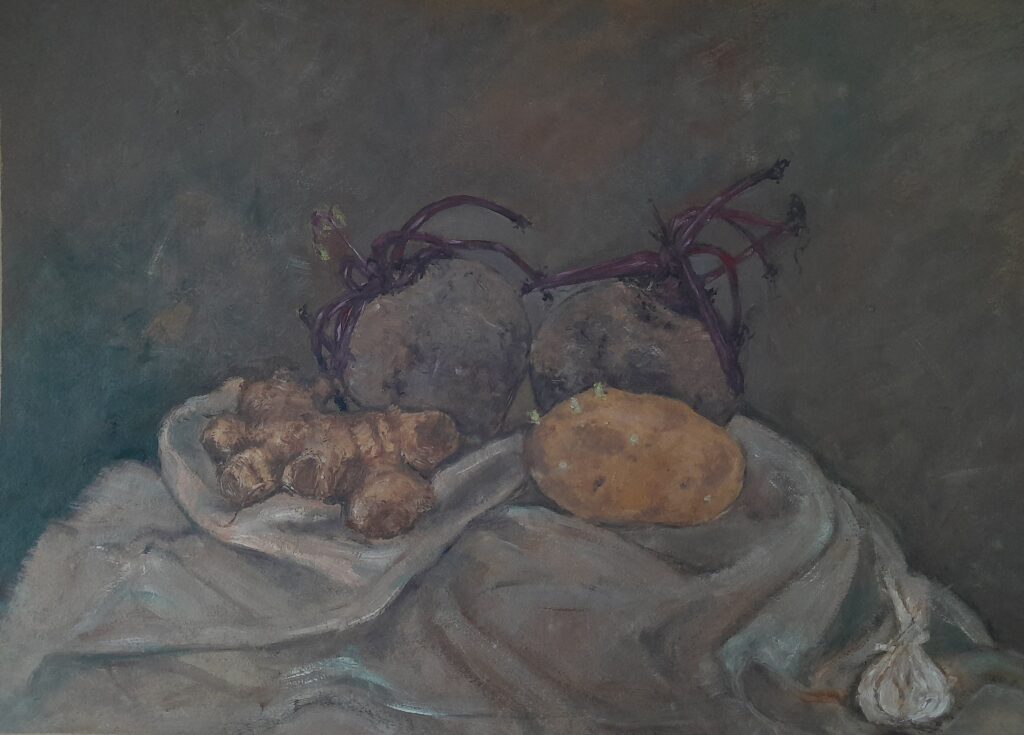
UNTITLED
A potato begins to sprout while no one is watching
Two beetroots hold up their thin purple veins like wires.
The ginger sits knuckled and pale, still smelling of soil.
A potato pushes out green eyes on its own slow clock.
The cloth sags under them, grey as washing left too long.
At the edge a single garlic bulb catches the last light.
Nothing here is cooked yet. The kitchen waits.
Sneha K S comes from Changaramkulam in Malappuram. Sneha studies at the Sarojini Naidu School of Arts and Communication at the University of Hyderabad. This watercolour from 2025 is a still life of kitchen things: two beetroots with purple stems, a knot of ginger, a potato with small sprouts and one bulb of garlic. They rest on a folded white cloth against a dark background. Sneha's work looks at home and domestic space. Here plain objects become silent witnesses to a quiet moment.
Watercolour on paper · 23INCH × 22 INCH × 2 cm · 2025
Theme Silent objects of home
RC-5822
Sneha ks
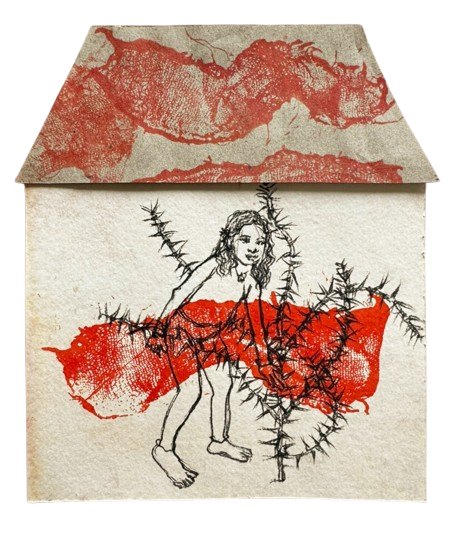
Where the skin ends, The land Begins
She bends inside a paper house where the thorns grow too
A roof of red, pressed into grey paper like the print of a palm.
Below it a girl bends, her bare feet set on nothing.
The thorns do not hold her. They grow through her.
Red spreads across her waist the way a stain spreads on cloth.
The paper is soft at the edges.
The house is small enough to hold in two hands.
In this work by Sneha K S, the paper takes the shape of a small house. Red marks with a grainy texture spread across the roof. Below, in fine black line, a barefoot girl bends forward. Thorny stems wrap around her and a wide band of red crosses her body. Sneha is from Changaramkulam in Malappuram. She studies at the Sarojini Naidu School of Arts and Communication, University of Hyderabad. Her work looks at girlhood shaped by home, memory and domestic space.
Mixed media on paper · 16 × 14 × 2 cm · 2026
Theme Girlhood and home
RC-5823
From the open call
Tarun Butta
My work initiates a longer inquiry in to moments where human identity destabilises in the presence of non human intelligence and decaying structures .My visual emphasis is on the absolving bounds of formal and conceptual paradigms. The visuality of the semiotics becomes an exchange of dialogue between me, the space, the method and the encounters that eventuate. As the monopolised agency of the artist disperses, I wish to peel away,…


Tarun Butta
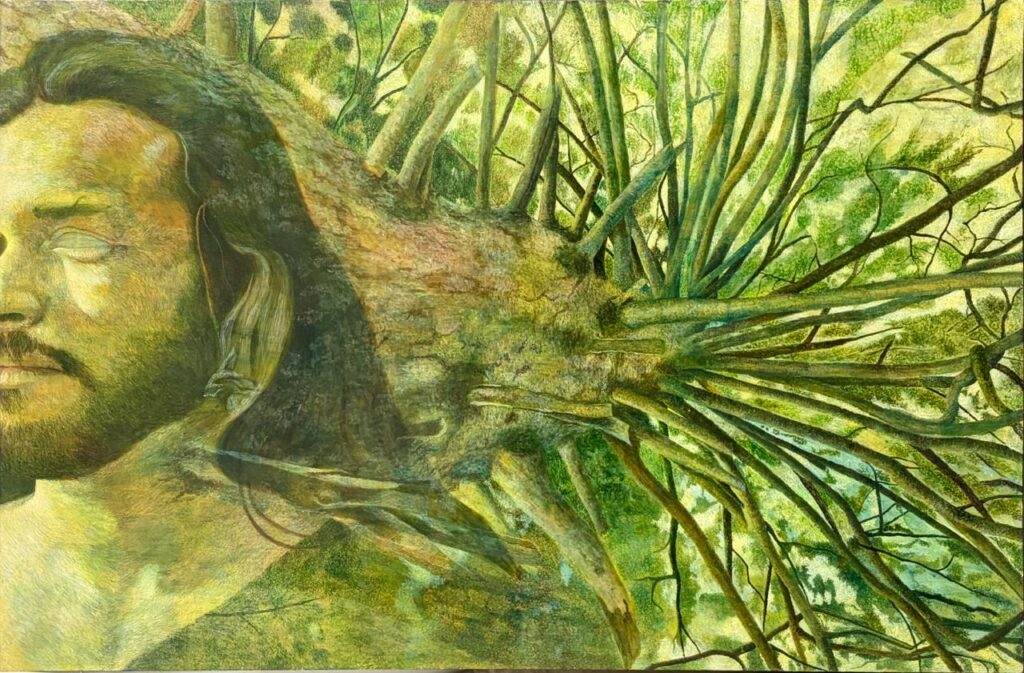
Untitled
His hair turns to bark and the forest takes over
Green light falls through thin skins of paint.
A face rests at the edge, eyes closed like seeds.
His hair darkens and thickens into bark.
The trunk splits into a hundred pale arms.
Leaves hum yellow behind them, close to gold.
You can see the forest through his cheek.
Nothing here is finished growing.
Tarun Butta paints a man's face and a tree as one body. The face sits at the left edge with the eyes closed. His long dark hair flows to the right and becomes a rough trunk. Branches spread out across a field of green and yellow leaves. Butta works in egg tempera on a gessoed panel 122 × 183 cm. He builds the picture from thin layers. The forest shows through the skin. He is drawn to the place "where silence takes on volume."
Egg tempera on gessoed panel · 122 × 183 cm · 2025
Theme Self becoming tree
RC-3955
Tarun Butta
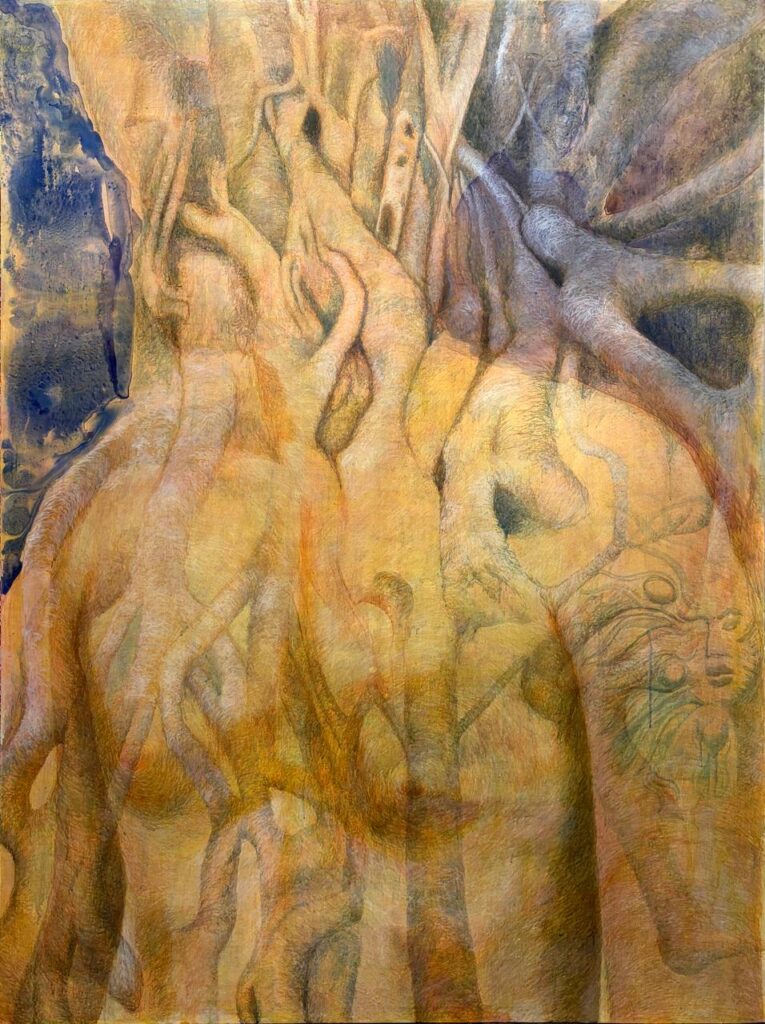
Feel Like a Tree
Roots that might be limbs, limbs that might be roots
Ochre light runs down the trunks like warm skin.
A root bends at the elbow. A branch opens like a hand.
In the left corner indigo pools like rain in old stone.
Thin strokes lie over each other, fine as hair on bark.
Low on the right a face rests in the grain, half there.
You lean in and the wood leans back.
Tarun Butta trained at Kala Bhavana, Visva Bharati University and is based in Gurgaon. Feel Like a Tree is a large acrylic painting on canvas, 183 × 152 cm. Pale trunks and roots twist up the canvas. Some of them turn into bodies and a quiet face. Butta builds the image in thin layers of paint and fine strokes so that one form shows through another. Butta writes that trees and ruins are "not metaphors but interlocutors". Here the tree is someone to meet.
Acrylic on canvas · 183 × 152 cm · 2026
Theme Body becoming tree
RC-3956
From the open call
Mrunmayee Chaitanya Alandkar
Art, for me, is a way of giving shape to thoughts and emotions that are sometimes difficult to put into words. I enjoy observing small details, experimenting with forms and colours and turning an idea in my mind into something tangible. My work moves between pencil, acrylics, poster colours,mixed media and digital art, with each medium allowing me to express a different side of my imagination. The process is not…


Mrunmayee Chaitanya Alandkar
Escape from Reality
A golden figure falls from a red flower into the dark
A rose of red paint turns slowly in a green wind.
From its pale centre a blue river spills down the painting.
A small gold body falls with the water, arms first.
Around it the purple night is made of strokes like feathers.
Below, the dark pulls in a slow circle.
The figure does not look afraid. It looks light.
Mrunmayee Chaitanya Alandkar is from MIT ADT University in Pune. Escape from Reality is a tall acrylic painting, 75 cm high and 30 cm wide. Short curved strokes cover every part of it. A red flower opens at the top. A blue stream falls from the flower. A small golden figure dives head first into a dark circle below. Alandkar also works in pencil, poster colours, mixed media and digital art. For her, art gives shape to thoughts and emotions that are "sometimes difficult to put into words".
Acrylic · 75 × 30 × 0.3 cm · 2019
Theme Escape and letting go
RC-4184

Mrunmayee Chaitanya Alandkar
Samay Raina Caricature
His time may be bad. His grin says otherwise
A cone of cream light cuts the maroon dark.
He leans over his folded arms at the edge of a wooden table.
Red and black checks run square after square down his sleeves.
The silver microphone waits, its grille full of tiny holes.
His eyes slide sideways, as if he heard the joke first.
Above him the letters jump, red and loose, like a laugh half said.
Mrunmayee Chaitanya Alandkar makes this caricature of Samay Raina as a digital work. She studies at MIT ADT University in Pune. The head is drawn big, as caricature asks. A wide grin fills the face. A cone of cream light falls onto a dark red wall. Hand-lettered words in Hindi float above him. They play on his name, since ‘samay’ means time. Alandkar moves between pencil, acrylics, poster colours, mixed media and digital art. Here she works on screen.
Digital art · 42 × 29.7 cm · 2026
Theme Time and laughter
RC-4185

Mrunmayee Chaitanya Alandkar
Suvarna mrug phad painting
The deer is walking calmly into the oldest trap
Red, then black, then yellow: three borders hold the forest in.
The tree is a dark cloud of small inked flowers.
Under it, a blue skirt blooms with red suns.
A blue cloud curls once and stays curled.
The deer is the colour of turmeric, lifting one hoof.
No one has stood up yet.
Mrunmayee Chaitanya Alandkar paints a scene from the Ramayana in the style of phad, a tradition of painted storytelling. A golden deer steps across green ground. Under a dark tree, a man with a bow and a woman in a blue skirt sit close together. Every shape has a firm black outline. Alandkar fills each one with flat colour in gouache poster paints. She moves between pencil, acrylics, poster colours, mixed media and digital work. Her college is MIT ADT University in Pune.
Gouache poster paints on paper · 29.7 × 21 cm · 2024
Theme Temptation in the forest
RC-4186
From the open call
Nandita Basak
I am interested in the enormously complex and powerful world of human behaviour. I observe how people engage with items, how they choose objects to represent themselves. An individual’s clothing choices impacts oneself and determines other people’s behaviour towards them. My personal experience of these matters as a woman sharpens my focus of recognizing surveillance mechanisms and social judgement. Therefore, my works have words of interrogation in them. I take…



Nandita Basak
Overthinking
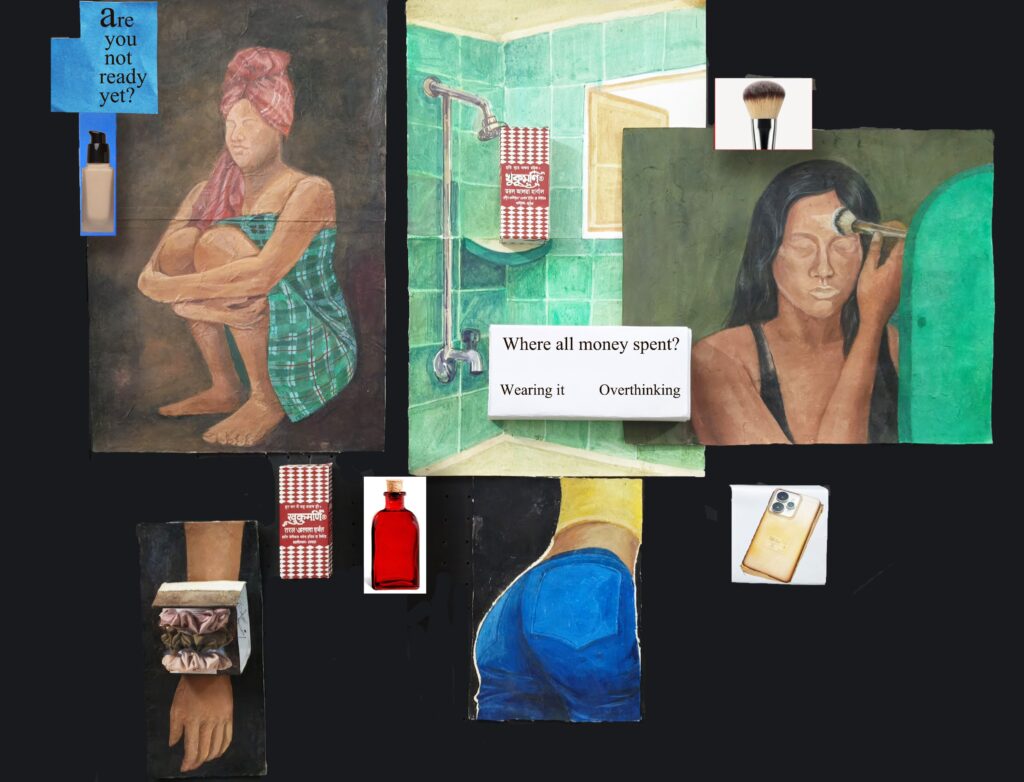
Are you not ready yet? A question every mirror seems to ask
Green tiles wait, cold and wet, for someone still in the shower.
A red towel holds her hair. Her arms hold the rest of her.
The brush moves over a face with closed eyes.
A gold phone shines like a small sun on a black wall.
Blue denim, pink scrunchies, a bottle the colour of skin.
Somewhere a voice asks again if she is ready.
Nandita Basak studies how people choose objects to show who they are. In Overthinking, Basak paints in gouache on Nepali handmade paper. A woman sits wrapped in towels, hugging her knees. Another brushes powder onto her face with her eyes closed. Painted scenes of a green bathroom, a wrist and blue jeans sit beside printed pictures of a foundation bottle, a brush and a gold phone. Words on paper ask questions, which Basak calls "words of interrogation". Her college is Sarojini Naidu School of Arts and Communication in Delhi.
Gouache on Nepali handmade paper with digital prints on paper and a paper box · 91.44 × 121.92 × 8 cm · 2026
Theme Women, objects and judgement
RC-4188

Nandita Basak
“Your destination”
On the metro, every outfit is read before a word is spoken
A woman covers her face with yellow hands.
A black mask hides another face beside her.
Orange trousers, a blue jacket, a head painted out in shadow.
Gold earrings hang on a dark board like small suns.
A phone says you are here, then your destination.
Clear plastic holds it all, pinned at the corners,
so the wall shows through every life.
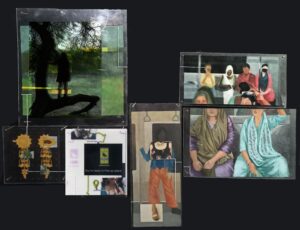
Nandita Basak watches how people dress and how others judge them for it. In this work she paints women on a metro train in gouache. Beside them she places digital prints of her own photographs. Every sheet of paper is pasted onto clear acrylic. Thin white lines join the panels like a route on a phone map. Basak takes her references from daily life and social media. She is a student at the Sarojini Naidu School of Arts and Communication and is based in Delhi.
Gouache and digital prints of self photograph on paper pasted on acrylic sheet · 121 × 121 × 3 cm · 2026
Theme Clothing, surveillance and judgement
RC-4189

Nandita Basak
Feeling relax?
A shopping menu that sorts bodies like stock on a shelf
A yellow mat, a phone held low, a face left empty.
Beside her, someone sleeps in blue shorts with a head on a blue pillow.
The menu on the left keeps asking where we belong: Men, Women, Accessories.
A blue checked cloth hangs over two sandals with no feet inside.
Two pink covers wait in a paper box.
A sheet mask looks out through three dark holes.
Rest here is a room where everyone can see.
Nandita Basak paints in gouache on Nepali handmade paper. In Feeling relax? she places these paintings beside digital prints and a small paper box. Words from a shopping website run down the left side: Men, Women, Top wear, Accessories. At the centre a woman sits on a yellow mat with her phone. Her face has no features. A figure in blue shorts lies beside her. Basak takes her pictures from daily life and from social media. The work is 60.96 × 91.44 × 8 cm.
Gouache on Nepali handmade paper, digital printout on paper and paper box · 60.96 × 91.44 × 8 cm · 2026
Theme Clothing and social judgement
RC-4190

Nandita Basak
Wardrobe
A wardrobe laid out like evidence, joined by thin white lines
Gold silk and mustard cotton wait on black, empty of shoulders.
On the rail, orange, green and rose hang in a quiet line.
Five girls lean into one mirror. A flower, a mask and green glass take their faces.
Yellow slides to red in five flat squares.
White lines run from blouse to body to colour, like a form someone is filling.
Under plastic and screws, every choice is kept.
Nandita Basak watches how clothes change the way people treat us. In Wardrobe she sets eight panels behind clear acrylic sheets held with screws. She paints some in gouache. Others are digital prints of her own photographs. Thin white liner joins them like a chart. Blouses, a clothes rack and a row of small clothing icons surround a group selfie with hidden faces. Basak works with "surveillance mechanisms and social judgement" in mind. She is from the Sarojini Naidu School of Arts and Communication in Delhi.
Gouache and digital prints of self photograph pasted in acrylic sheet and white liner · 121 × 121 × 3 cm · 2025
Theme Clothing and social judgement
RC-4191
Nandita Basak
Between glances
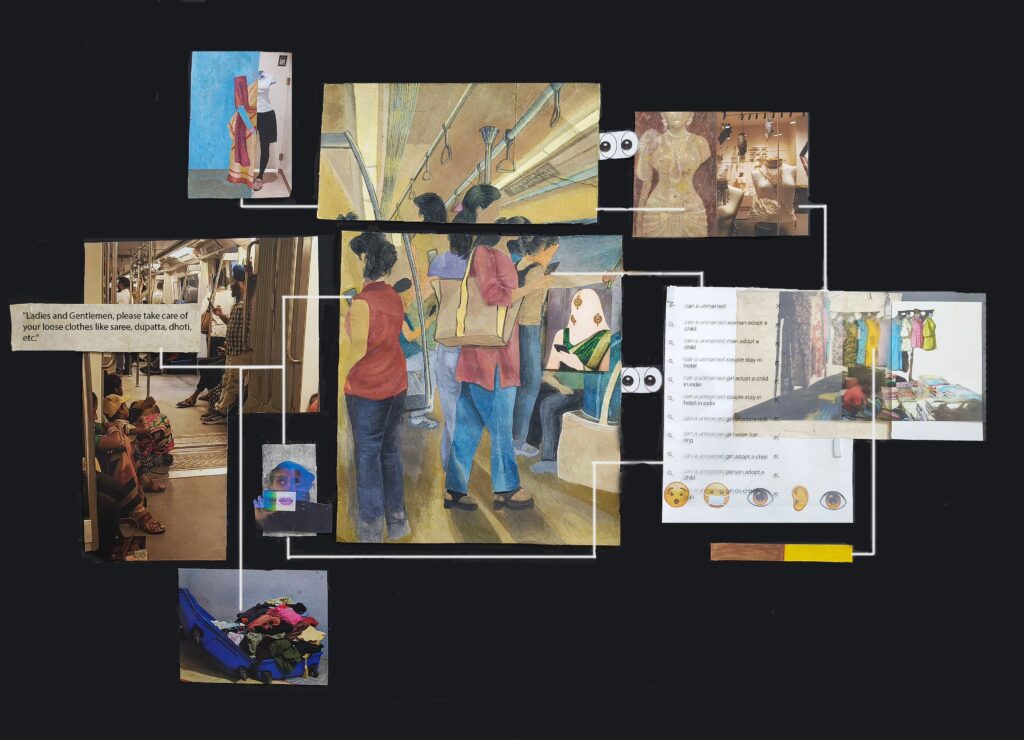
A train asks women to mind their dupattas. Everyone else watches
Mustard light pools on the metro floor.
A red shirt turns away. Blue jeans hold their ground.
Googly eyes peep out from the black between the pictures.
A suitcase spills its clothes like a long argument.
Thin white lines run from face to face, shop to screen.
Someone is always looking. Here we look back.
Nandita Basak paints a crowded metro coach in gouache. Women stand close and hold the poles. Around this scene she pastes digital prints of her own photographs on acrylic sheet: shop mannequins, a suitcase full of clothes and a train announcement about loose sarees and dupattas. A screen lists searches that begin with "can a unmarried". White lines join every piece like a map. Basak is from the Sarojini Naidu School of Arts and Communication in Delhi. The work asks how clothes shape the way people watch a woman.
Gouache and digital prints of self photograph pasted on acrylic sheet with white line · 121 × 121 × 3 cm · 2026
Theme Clothes and public gaze
RC-4192

Nandita Basak
Title- “Chronicles of Absence
A face kept hidden while the screen keeps asking who she is
Gold hangs from an ear on a field of black.
Lips, a nose, two closed eyes, each in its own small moon.
She lifts a phone where her eyes should be.
Again she hides behind a cloth the colour of sand.
Rows of numbered doors, a few left open.
A blue hoodie keeps the shape of someone gone.
The screen asks if she is the same person. Not sure.
Nandita Basak builds Chronicles of Absence from many small parts on a black ground. Six round gouache paintings on Nepali handmade paper show a nose, a hand, lips, an ear, a head and closed eyes. Most wear gold jewellery. Around them sit digital prints of her own photographs. In most of them her face is hidden. Lockers, a blue hoodie and a screen asking "Same or different person?" complete the work. Basak is from the Sarojini Naidu School of Arts and Communication.
Gouache on Nepali handmade paper and digital prints of self photographs · 121 × 121 × 3 cm · 2026
Theme Surveillance and shifting identity
RC-4193

Nandita Basak
Inorganic organs
A face with no eyes still feels every eye on it
Lipsticks stand in a row like soldiers waiting to be chosen.
On the shelves, plaster heads smile the same small smile.
A face has no eyes, only pearls and paper popcorn at the ears.
An ear under cloudy plastic asks, Am I audible?
The hibiscus is the reddest thing here. Even it is painted.
Pins hold everything still, like specimens on a black wall.
In Inorganic organs, Nandita Basak lays out the body as a set of parts. Eyes, lips, a nose, an ear and a tongue sit in clear plastic sleeves held by pins. She paints them in gouache on Nepali handmade paper. Beside them are digital prints of her photographs. Thin white lines join each piece like a diagram. Text such as "Last seen at 3:00 am" reads like a message on a phone. Basak takes words like these from daily life and social media. She uses them to question who watches a woman's body.
Gouache on Nepali handmade paper and digital prints of self photograph · 121 × 121 × 3 cm · 2025
Theme Surveillance of the body
RC-4194
Nandita Basak
Selfie
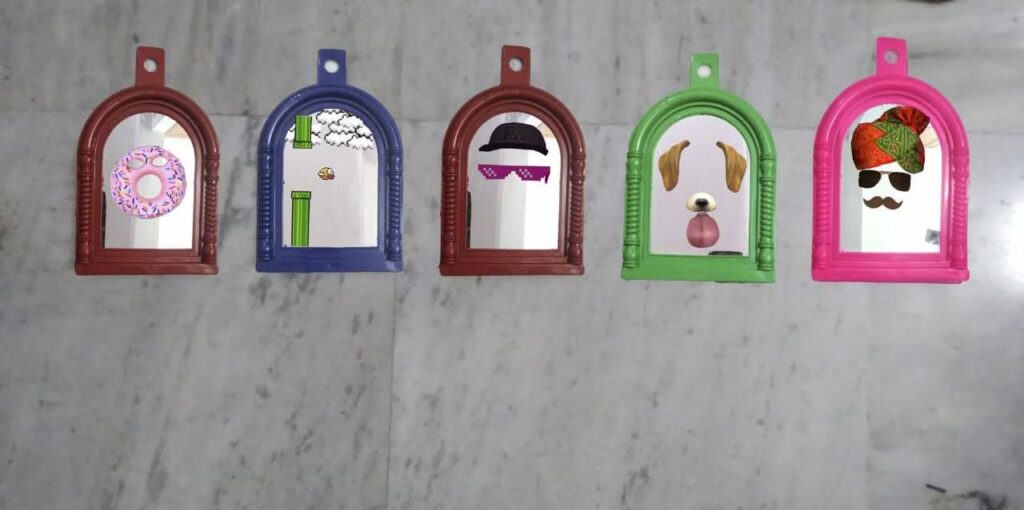
Lean in and the mirror decides who you are
Five plastic arches lie on grey marble: maroon, blue, maroon, green, pink.
Each one holds a small square of pale ceiling light.
A pink doughnut floats where a face should be.
A dog's tongue hangs over nobody.
A turban and a moustache wait for someone to wear them.
Lean in and you are already dressed.
Nandita Basak, of the Sarojini Naidu School of Arts and Communication in Delhi, makes Selfie (2024) from five everyday plastic mirrors. On each glass she pastes a digital printout: a doughnut, a game bird between green pipes, a hat with dark glasses, dog ears and a tongue, a turban with a moustache. They look like the filters people add to photos on their phones. Basak watches how people choose objects to show who they are. Here the viewer's own face fills the gap.
Collage: digital printout pasted on mirror · 33 × 175 × 2 cm · 2024
Theme Identity and digital masks
RC-4195
From the open call
Meghna Naiker
Meghna, recently completed my Master’s in Visual Art at Dr. B. R. Ambedkar University, Delhi. I hold a Bachelor's degree in Painting from the College of Art, Delhi. My artistic practice spans across multiple mediums and disciplines — including photography, videography, documentation, and glitch art. My journey began with an exploration of patterns in nature — forms, rhythms, and repetitions that exist organically. Over time, this inquiry led me to…


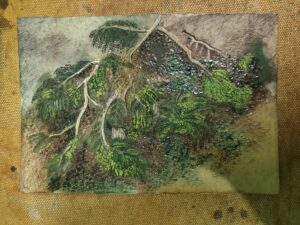


Meghna Naiker
Camouflage
New leaves learning to hide in the colour of city dust
Tea-brown wash settles like dust on a Delhi road.
Roots hang from the branches in thin dark threads.
Ink lines scratch the bark until it looks worn by many hands.
At the edge of the shade a red leaf opens.
Pale green blades lean into the light.
Everything new slowly takes the colour of the street.
Meghna Naiker makes Camouflage in 2023, after a bachelor's degree in Painting at the College of Art, Delhi. At this time Naiker is looking closely at foliage. The work studies how plants compose themselves and how they exist in the city. Brown washes cover the surface like dust. Roots hang from thick branches. At the bottom, red and green leaves push forward. Naiker sees each new leaf merging into the city dust. The work also speaks of passing time.
Mixed media · 2023
Theme Nature in the city
RC-3689

Meghna Naiker
Part of previous series
Something old and slow grows across the paper
A dark crust spreads across wet grey paper.
Its plates curl at the edge like old leaves.
Thin gold cracks run between them.
Underneath, a rust-coloured skin is full of tiny black stitches.
A few white flecks catch the light.
Below, a cold green pool holds the weight of it all.
Meghna Naiker made this work in 2023. It belongs to an earlier series. Her practice began with "patterns in nature". Here a dark form grows across grey paper. It looks like bark or lichen. Small black marks fill its brown underside. Pale lines crack across its top. A blue-green wash sits below it like a shadow. Naiker studied Painting at the College of Art in Delhi. She now holds a Master's in Visual Art from Dr. B. R. Ambedkar University Delhi.
Mixed media on paper · 2023
Theme Patterns in nature
RC-3690

Meghna Naiker
Same series
The same small leaf, painted again until it becomes a forest
Branches the colour of old bone push through the green.
Leaves fall in small yellow strokes, one after another.
The dark ground rises in lumps and holds the light like wet stone.
At the edges the surface thins to grey mist and brown dust.
Look long enough and the repeat begins to breathe.
Meghna Naiker makes this mixed media work in 2023. Pale branches cross a thick, rough surface. Small leaves hang along them in many shades of green. Some dark patches shine as if they are wet. At the edges the colour fades to grey and brown. Naiker studied painting at the College of Art, Delhi. She then completed a Master's in Visual Art at Dr. B. R. Ambedkar University Delhi. Her practice begins with patterns in nature. Here one leaf shape repeats again and again.
Mixed media · 2023
Theme Patterns in nature
RC-3691

Meghna Naiker
Cycad
An old trunk bends low while new leaves still curl upward
A trunk lies down like a sleeping animal, black and thick with scales.
At one end the leaves rise, sharp as broom straw.
Two young fronds still curl, small fists not yet open.
Thin lines rush across the white paper like slanting rain.
Every mark is a scratch that holds ink.
The plant is heavy and old, but it keeps reaching up.
Meghna Naiker holds a Bachelor's degree in Painting from the College of Art, Delhi. She has recently completed a Master's in Visual Art at Dr. B. R. Ambedkar University Delhi. Her practice starts with patterns in nature. In Cycad, dense black lines build a heavy trunk that leans across the sheet. Spiky leaves burst from its top. Slanting strokes fill the air around it. Pencil notes below read "Drypoint" and "1/3". Naiker now looks at the patterns that people make and how they shape us.
Printmaking on paper · 2025
Theme Patterns in nature
RC-3692

Meghna Naiker
Untitled
Moss, bark and rust, drawn one small mark at a time
Rust bleeds through green like an old wall after rain.
Thousands of small dots sit on the dark like seeds or lichen.
Ochre lines curl and drip, the way roots search for water.
In the centre a pale shape opens, cream and red, almost a face, almost a stone.
Look longer and the marks begin to move.
Each one is small. Together they hold you in place.
Meghna Naiker studied Painting at the College of Art, Delhi and Visual Art at Dr. B. R. Ambedkar University Delhi. Her practice starts with patterns in nature: forms, rhythms and repeated shapes that grow on their own. In this untitled mixed media work from 2025, tiny dots gather like moss. Wavy lines in ochre and rust run like bark across a dark green ground. Naiker also looks at patterns in society. She asks how the systems we follow show us a way and limit what we see.
Mixed media · 2025
Theme Patterns that bind us
RC-3693
From the open call
Ajay
I am Ajay Kushwaha, a resident of Delhi. I was born in Etah district of Uttar Pradesh and brought up in Delhi. I have done my Bachelors in Painting from College of Art Delhi and currently pursuing my Masters from College of Art Chandigarh. The goal of my artistic journey is to show the reflection of nature to humans. Through my art, I aim to depict the complex and symbiotic…



Ajay
Aakarshan
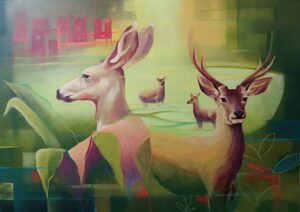
Two deer turn their heads as thin lines cross the green
A green like pond water fills the air behind them.
The doe turns toward him. He turns toward her.
His antlers rise like bare branches into the light.
Pink leaves lean in from the right, heavy and close.
Thin blue lines run over fur and leaf alike,
as if the picture was once broken and joined again.
Still the two of them stand, listening.
Ajay Kushwaha grew up in Delhi. He studied painting at the College of Art in Delhi and now studies for his Masters at the College of Art in Chandigarh. Since childhood he has loved spending time with animals, birds and the sky. In Aakarshan he paints a doe and a stag in oil. They stand close in a soft green light beside tall pink leaves. Thin raised lines run across the whole surface. Kushwaha wants his paintings to show people the changes taking place in nature.
Oil · 2026
Theme Changes in nature
RC-3741

Ajay
Family
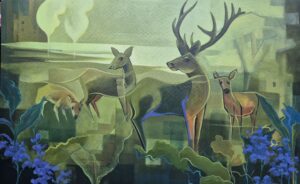
A stag holds your gaze while the city glows pink behind
Green light pours in like water through a leaf.
A stag stands still and holds my eyes.
Beside him a pale deer listens with ears like two open hands.
Far back, two small shapes wait in the grass.
Pink walls float at the edge of the field, soft as a memory of the city.
Thin blue lines run through it all, like a path no one has walked yet.
Ajay Kushwaha lives in Delhi. Kushwaha studies for a Masters at the College of Art in Chandigarh after a Bachelors in Painting from the College of Art in Delhi. The painting is in acrylic. In Family a stag looks straight at us. A pale deer with tall ears turns away. Two smaller deer stand in the green field behind them. Pink shapes like buildings glow at the top. For Kushwaha "nature is the only thing that takes you away from the hustle and bustle of the society."
Acrylic · 2026
Theme A family in nature
RC-3742
Ajay
Revenge
A painter from Delhi on what humans take from nature
Acrylic dries fast, the way a season turns.
A bird remembers a tree that is no longer there.
The sky over the city is grey above the traffic.
Something we took is coming back to ask for it.
It does not shout. It waits at the edge of the colour.
We stand in front of it and feel the ground under our feet.
Ajay Kushwaha makes Revenge in acrylic in 2026. Kushwaha grows up in Delhi and spends his childhood with the sky, animals and birds. For him, nature is the place that takes you away from "the hustle and bustle of the society." His paintings start from nature, animals, birds, landscapes and flowers. He tries to weave a story into each one. He wants to show people the changes taking place in nature. He trains as a painter at College of Art Delhi and now at College of Art Chandigarh.
Acrylic · 2026
Theme Humans and the natural world
RC-3743
Ajay
Untitled
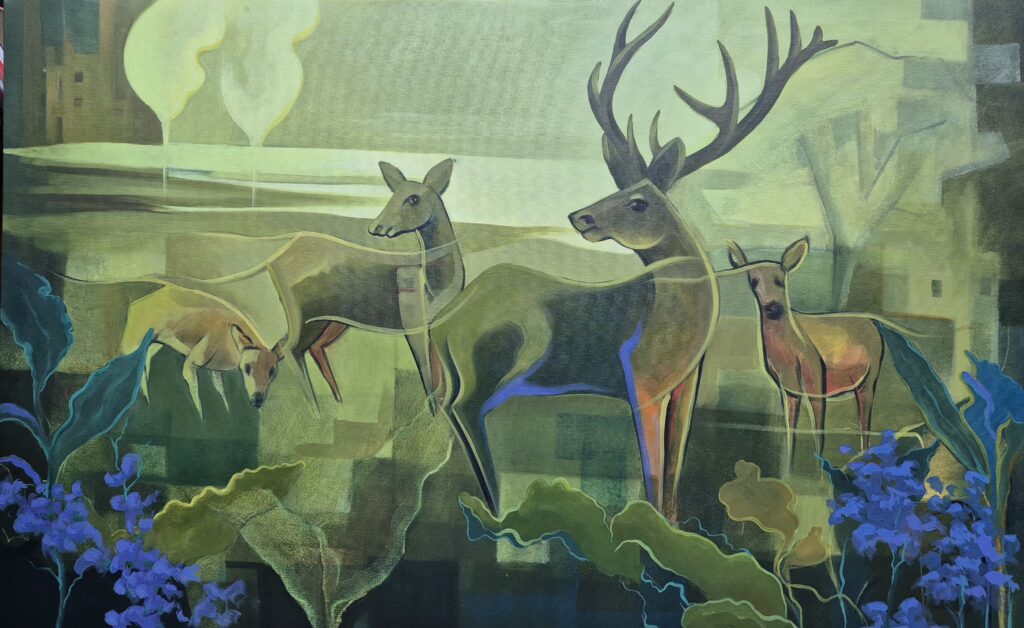
The city is behind them. The deer have not left.
A stag lifts its antlers into a sky the colour of pond water.
Three deer stand close, their bodies thin as tracing paper.
You can see the field through them.
Violet flowers crowd the lower corners, small and dense.
Behind, pale squares of buildings wait in the haze.
No one moves. The herd listens to something we cannot hear.
Ajay Kushwaha was born in Etah district of Uttar Pradesh and grew up in Delhi. As a child he spent his time with the sky, animals and birds. He studied painting at College of Art Delhi and now studies for his Masters at College of Art Chandigarh. In this acrylic painting a stag and three deer stand in a green field. Their bodies are thin and see-through, so one shows through the next. Faint buildings rise behind them. Here the animals and the city share one space.
Acrylic · 2026
Theme Animals beside the city
RC-3744
Ajay
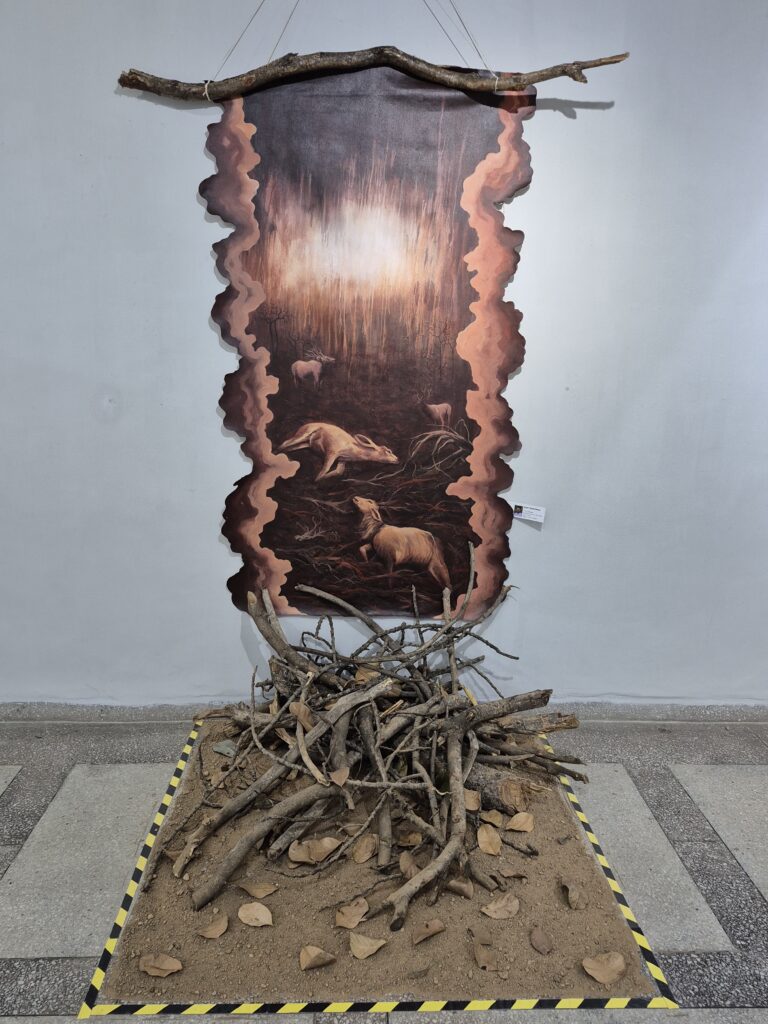
Ksharan
Dry sticks wait on the floor below a fading forest
Brown upon brown, the trees go thin as smoke.
A white light opens in the canopy and gives no warmth.
The hare runs flat to the earth. The deer only watches.
The edges of the picture ripple like heat over a road.
Below, the forest has already arrived: sticks, soil, leaves curled like old paper.
A yellow and black line tells us not to step closer.
Ajay Kushwaha paints a forest in shades of brown. A deer stands among thin trees. A hare runs low across the ground and another animal looks back. A white light burns at the top. The painted cloth, with soft wavy edges, hangs from a real branch. Below it lies a pile of dry sticks on a bed of soil and fallen leaves. Kushwaha studies for his Masters at the College of Art Chandigarh. He wants his paintings to show how nature is changing.
Acrylic, with branches, soil and dry leaves · 2026
Theme Nature slowly wearing away
RC-3737
Ajay
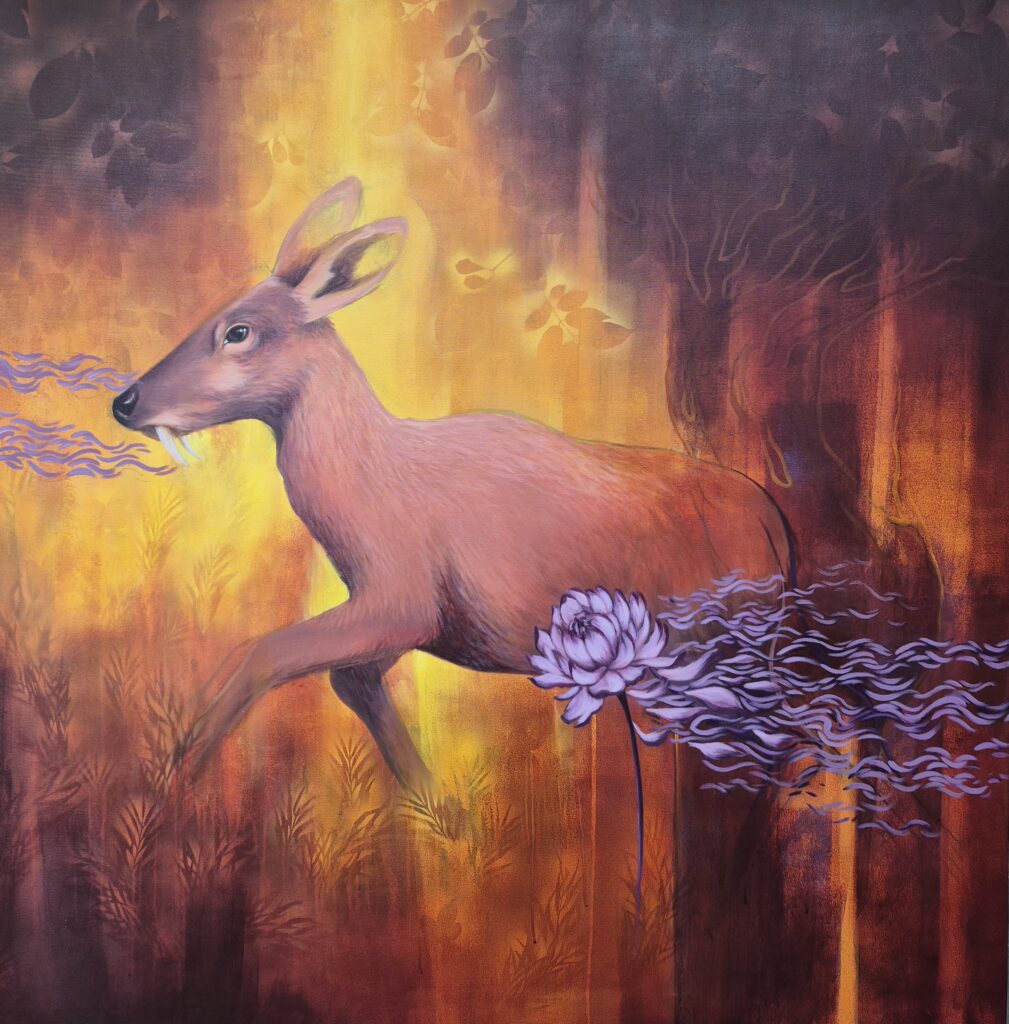
Musk deer
A deer with fangs steps through the golden dark
Amber light pours down between dark trunks.
The deer lifts one foreleg and does not look back.
Two white tusks rest against its lip.
Its breath leaves in violet threads.
Behind it a flower opens the colour of a bruise.
Paint runs down like late rain on bark.
Ajay Kushwaha paints a musk deer in acrylic, mid-stride through a forest of amber light. Its small tusks show at the mouth. Purple waves trail from its breath and from behind its body where a pale flower opens. Kushwaha grew up in Delhi and studied painting at the College of Art there. He now studies for his Masters in Chandigarh. Animals, birds and flowers fill his work. He says nature "is the only thing that takes you away from the hustle and bustle of the society."
Acrylic · 2026
Theme Nature and its changes
RC-3738

Ajay
Maa ki karuna
She holds a fawn while the sky behind her burns
Green hands cup a fawn no bigger than a loaf of bread.
Her skin is bark. Her veins are roots that run down into the ground.
Behind her the sky turns orange and red and the light breaks into honeycomb.
Her dark hair streams out into the heat.
She does not look at the burning.
She looks at the small spotted life she keeps.
Ajay Kushwaha makes this square painting in acrylic on canvas in 2025. It measures 91.4 × 91.4 cm. Kushwaha comes from Etah district in Uttar Pradesh and grows up in Delhi. He now studies for his Masters at College of Art Chandigarh. A woman sits with a small fawn in her cupped hands. Her skin is green with pale lines like roots. Below the waist her body becomes a green mound. Roots run across it. The title means a mother's compassion.
Acrylic on canvas · 2025
Theme Nature as a mother
RC-3739

Ajay
Barrier for whom
Three deer look back at us through a screen of grass
Green strokes fall across the deer like rain that forgot to stop.
Three faces wait with ears open wide as leaves.
Pink trunks bend behind them like veins in a hand.
The light is the yellow of an early field.
One deer looks away. Two look at me.
I cannot tell which side of the grass I stand on.
Ajay Kushwaha uses acrylic to paint three deer in a green forest. Two look straight out at the viewer. The third turns its head to one side. Long strokes of green cross the picture like grass or a thin fence. Behind them stand trees with pink and purple trunks. Kushwaha lives in Delhi and studies for his Masters at College of Art Chandigarh. His paintings often show animals and the changes in nature. The title asks a simple question. Who is the barrier for?
Acrylic · 2026
Theme Nature and its barriers
RC-3740
From the open call
Prasuna Akundi
My relationship with cotton began in my childhood. My mother made cotton wicks for pooja, and sometimes I helped her. I also observed women around me and how they continued working through different struggles. Those memories stayed with me. In my current work, I am trying to understand how changing emotions and inner strength can be expressed through material. I chose raw cotton because it is soft and delicate but…


Prasuna Akundi
Untitled
Raw cotton holds love, anger and pain in red
A long sheet of cotton falls from the ceiling and lies down on the floor.
Light passes through its open web like light through a net.
Its shadow climbs the grey wall behind it.
Red letters run down the centre, one under another.
Small red marks spread to the edges like dye in water.
Something soft is holding its own weight.
Prasuna Akundi of JNAFAU in Hyderabad makes this tall hanging from raw cotton pulp and cotton threads. Akundi's bond with cotton began in childhood. Akundi's mother made cotton wicks for pooja and Akundi sometimes helped. Here the cotton keeps its natural white. Red marks carry love, anger, pain and strength. The material is hard to control. It can tear, bend or change shape as it dries. Akundi lets these changes become part of the work. The piece continues the project Flow of Change.
Raw cotton pulp and cotton threads · 225 × 46 × 1 cm · 2025
Theme Emotion and inner strength
RC-3815
From the open call
Mohit
I was trying to look at an ordinary subject from a different perspective and understand what it can tell us about people, culture, and everyday life. I often begin with photography because it allows me to observe small details that can easily be overlooked. Instead of simply recording what I see, I try to think about why a particular place, object, gesture, or moment feels meaningful and what memories or…


Mohit
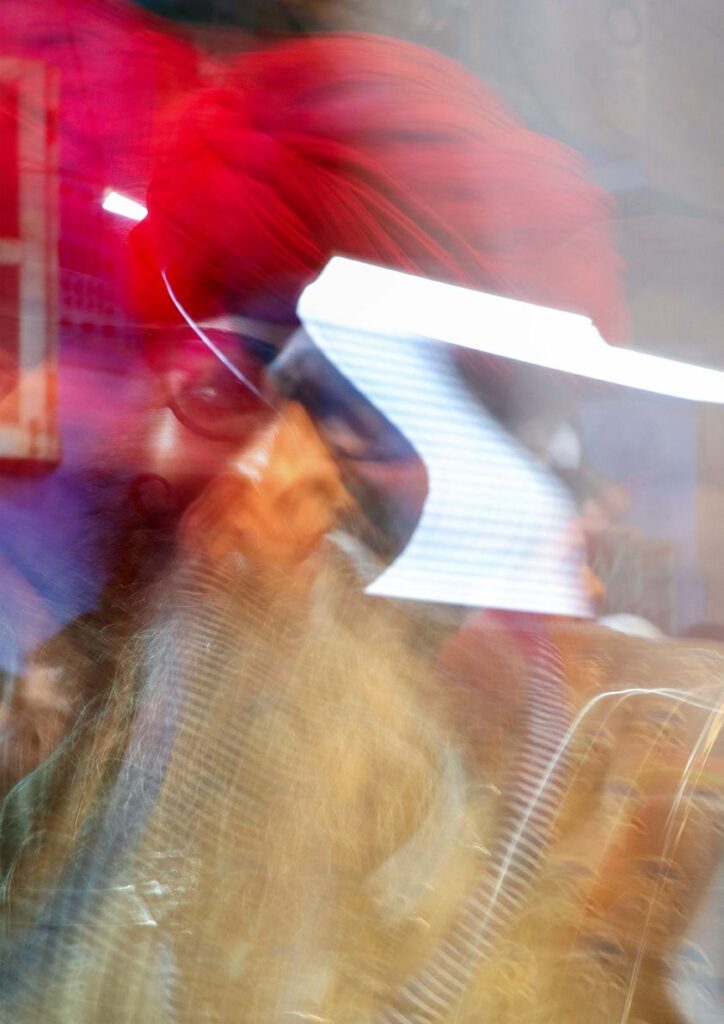
Limelight
The light moves faster than the man it falls on
Red cloth fills the top of the frame, warm as a stove.
The glasses catch a little pink from the sign behind.
A white bar of light lies across the face, striped like a shutter.
The beard loosens into straw and smoke and gold.
Nothing stays still long enough to be named.
Yet he is here, looking out through the glare.
Limelight is a 2023 photograph by Mohit of Amity University, Haryana. It measures 16.5 × 11.7 cm. A man in a red turban and glasses seems to move in the frame. His white beard blurs into gold. A curve of white light cuts across his face. Mohit comes to photography from painting. He looks at colour, texture and layers as a painter does. He wants an image that stays true to life but is more than a record. He observes, selects and reworks until it feels honest.
Photography · 16.5 × 11.7 cm · 2023
Theme Seeing the everyday anew
RC-582
Mohit
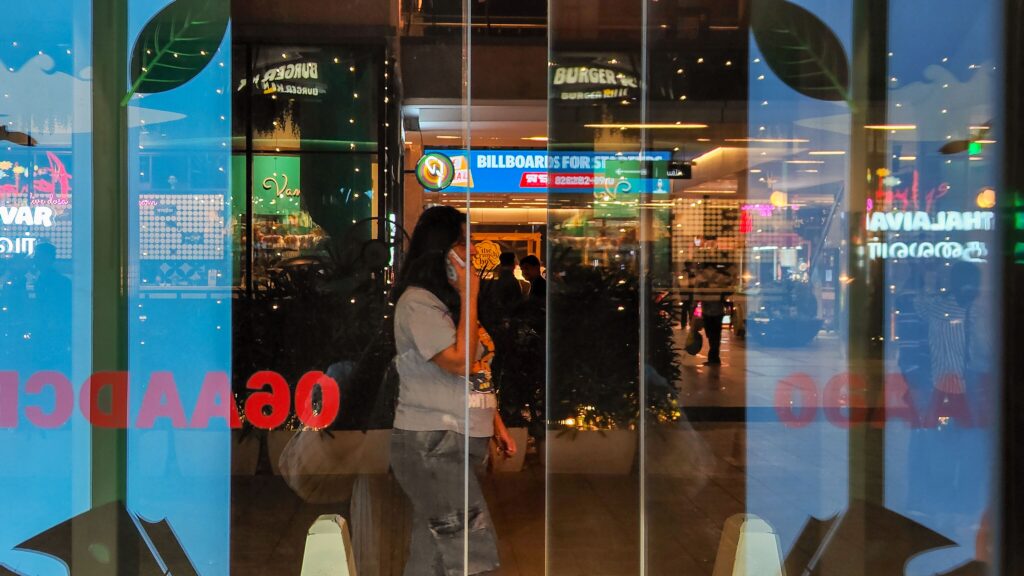
Glowing Season
A phone call passes through glass, leaves and borrowed light
Blue glass holds two painted leaves like a shopfront in a pond.
A woman in grey walks inside it, phone to her ear, mask on.
Tiny lights hang in the dark plants behind her.
Red letters run backwards across the glass.
Burger signs repeat in the shine above.
The mall goes on behind the door, warm and half there.
Glowing Season is a photograph from 2025 by Mohit, who studies at Amity University, Haryana. Mohit often starts with a camera because it catches small details that are easy to miss. A background in painting guides the eye. Colour, texture, layers and space all matter in the frame. The hard part is balance. Mohit does not want a plain record of a place. But the image must also stay close to real life. So Mohit watches, selects and reworks the pictures until they feel honest.
Photography · 32 × 56.89 cm · 2025
Theme Everyday life through glass
RC-580
Mohit
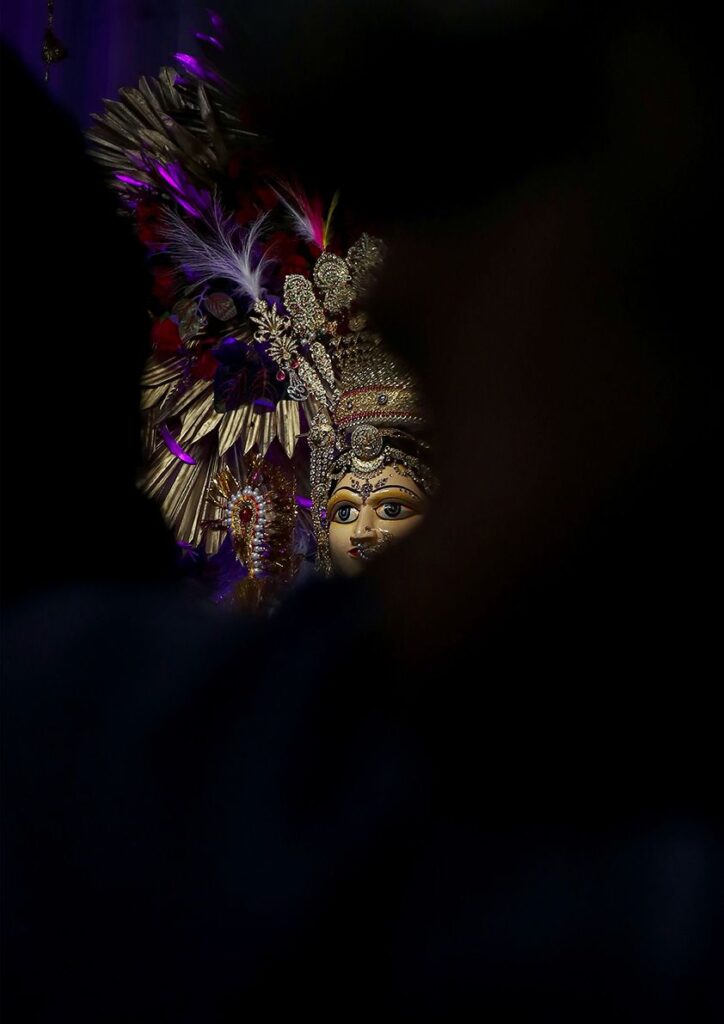
The Gavar
Through a gap in the crowd, a painted face looks back
Most of the picture is night, soft and close, like a shoulder in front of you.
Then a gap opens.
Gold leaves fan out behind a painted face.
Purple feathers, a white plume, a string of pearls.
The eyes are wide and lined in black. They do not look away.
You stand at the back of the crowd and still she finds you.
Mohit is a young artist from Amity University, Haryana, in Gurugram. A background in painting guides the way Mohit uses the camera. Colour, texture, layers and space all matter in the frame. In this 2023 photograph, dark shapes fill almost everything. Through one small opening, a decorated idol looks out in gold and purple. Mohit wants a true record of a moment that also holds more than we first see. Mohit spends time observing, selecting and reworking images until they feel honest.
Photograph · 16.5 × 11.7 cm · 2023
Theme Looking through the crowd
RC-581
Mohit
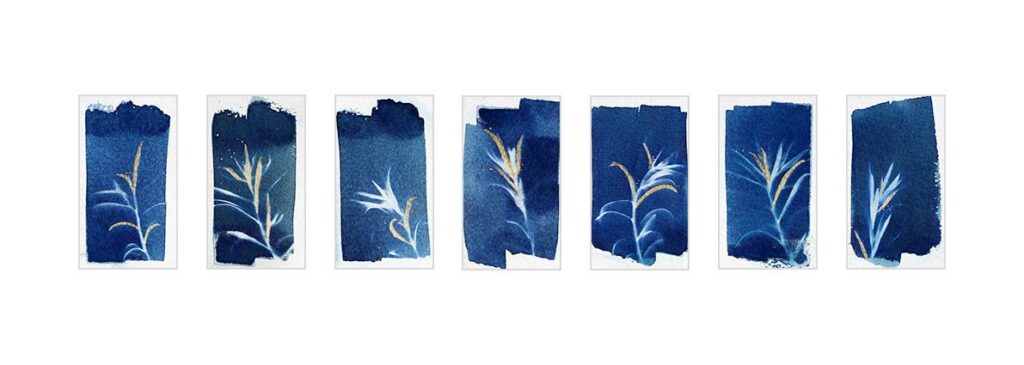
Untitled
Seven blue panels, seven pale stems, each one leaning a new way
Blue laid down with a wide brush, edges torn like the end of a wet day.
A stem rises in each one, pale as breath on a window.
The leaves lean left, then right, then open like fingers.
Someone has touched them with gold, only here and there.
Seven times the same sun, seven slightly different mornings.
White paper waits at the borders.
Seven small panels sit in a row. Each one holds the pale shape of a leafy stem on deep blue. Small marks of gold touch some leaves. Mohit, from Amity University, Haryana, makes the work in 2023. Mohit often starts with photography because it shows small details that are easy to miss. A background in painting is clear in the brushed edges and layers of colour. The aim is a picture that keeps its link to reality without becoming "only a straightforward record".
Cyanotype and mixed media · 9.5 × 15.35 cm · 2023
Theme The overlooked everyday
RC-578

Mohit
Intertwine
A face woven back together, one paper square at a time
A face goes under the white and comes back up.
One eye, a red dot, the corner of a mouth.
Purple petals slip between the squares like a second weather.
Small ink lotuses float where the skin should be.
At the edge the paper runs on, unfinished, toward the light.
Below, the strips hang loose and a hand rests at the chest, still holding.
In Intertwine, Mohit cuts a portrait photograph into thin strips. The strips are woven with plain white paper, like threads on a loom. The face now sits in a grid of small squares, part seen and part hidden. Tiny lotus flowers are drawn in some white squares. Mohit often begins with photography. A background in painting shapes the way Mohit looks at colour, texture and layers. The aim is a balance between a true record and a personal reading.
Collage, woven photography · 16.5 × 11.6 cm · 2022
Theme Memory and identity
RC-579

Mohit
Her Inner World
She speaks, pauses and bends low inside a gold ring
A woman sits on a cool floor and lifts her hand to speak.
Behind her, the same woman waits in blue, soft as breath on glass.
A gold ring floats above her head, thin as a bangle.
She smiles. She leans forward. She laughs toward the floor.
The edges of the blue fray like dried paint on white paper.
Three small rooms hold one person. The blue keeps what the light let go.
Her Inner World is a row of three prints made in 2023. In each, a black and white photograph shows a woman sitting cross-legged on a floor. Behind her, a brushed patch of cyanotype blue holds a faint, larger image of the same woman. A thin gold circle rings her head. Mohit, from Amity University in Haryana, starts with photography. A background in painting guides how colour, texture and space are layered. Each image is reworked until it holds both the real moment and a personal reading of it.
Cyanotype print with photomontage · 8.5 × 24.8 cm · 2023
Theme Memory and everyday presence
RC-576

Mohit
Doh Taarfa Kahaani
Three moments of one laugh, each with its own blue ghost
Blue spreads like water left to dry on rough paper.
A person sits on a cool floor, one hand lifted mid-sentence.
Behind, the same body fades into the blue, half remembered.
A gold ring floats there, drawn in one slow turn of the wrist.
The hand comes down. The face opens into a laugh.
In the last frame the floor takes the weight of a palm.
Mohit sets three moments side by side. In each panel a black-and-white photograph of a seated figure lies over a blue cyanotype print of the same scene. The blue layer shows the figure again, pale and faint, with brushed edges. A thin gold ring circles the head. Mohit begins with photography and brings a painter's eye for colour, texture and layers. Mohit reworks the images to balance a true record with a personal reading of an ordinary moment.
Cyanotype print and mixed media · 10.6 × 30.7 cm · 2023
Theme Memory and everyday gesture
RC-577
From the open call
Adarsh Mishra
I work with ordinary spaces, the kind that exist in the background of everyday life, neither noticed nor remembered. Within these spaces, human figures appear, not as subjects but as quiet inhabitants. They are present, yet absorbed elsewhere in a state that has no clear name, somewhere between the world outside and something much further within. Over time, the boundary between the figure and its surroundings has grown less defined.…



Adarsh Mishra
Neighbours in Silence
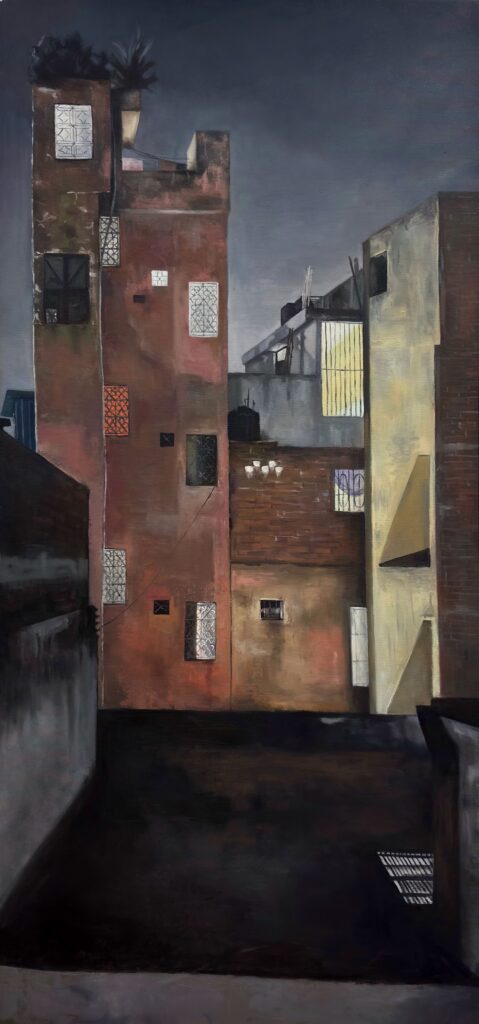
Every window has a grille. Nobody looks out
Rose brick turns grey as the light leaves.
Every window wears a grille, white lace made of iron.
One pane holds the last yellow of the day.
On the roof a plant leans toward nothing.
Below, the ground is a dark floor no one crosses.
A shadow of bars lies there and waits.
The walls stand close, like neighbours who stopped talking long ago.
Adarsh Mishra paints ordinary spaces that sit in the background of daily life. Mishra is from the College of Art in New Delhi. In this oil painting from 2025, the backs of city buildings crowd together under a dark grey sky. No person appears. Metal grilles cover the windows. A water tank and potted plants stand on the roofs. The painting is tall and narrow at 152.4 × 71.12 cm. Mishra hopes that "whoever is looking might find something of their own there too."
Oil · 152.4 × 71.12 cm · 2025
Theme Silence between buildings
RC-435
Adarsh Mishra
Within the Landscape
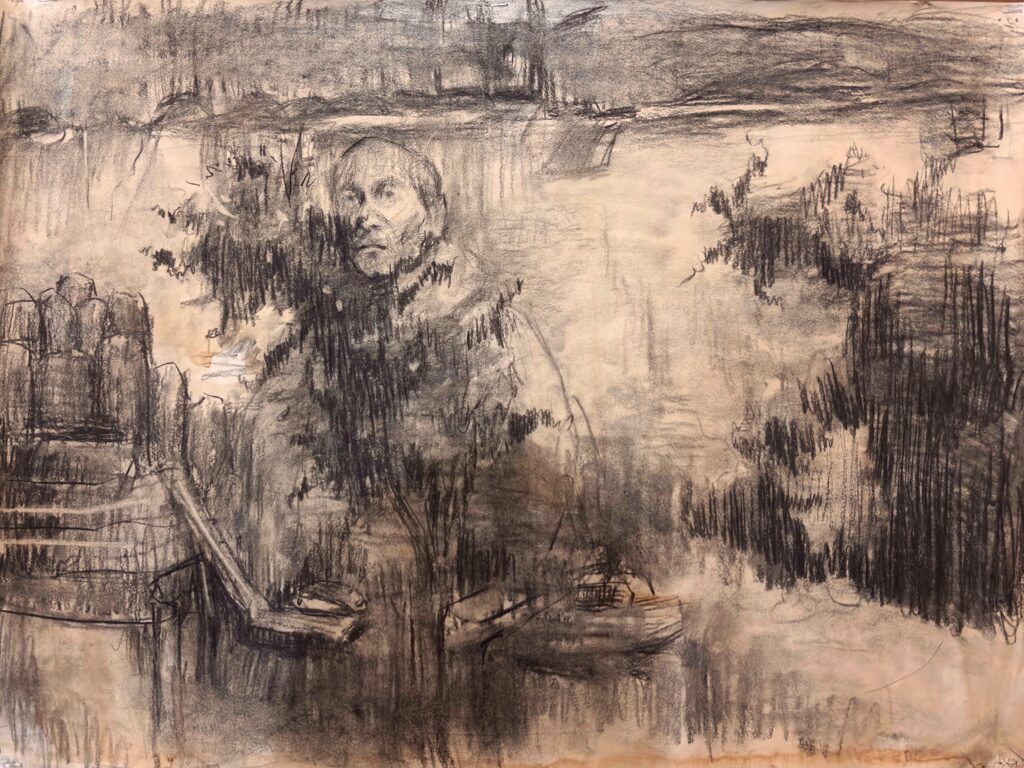
A face rises out of the dark grass and does not look away
Coffee-brown paper, the colour of an old letter.
A face floats above a body made of grass.
Black strokes fall like rain that never lands.
At the bottom, water has left its brown tide mark.
Somewhere a boat waits with no one in it.
The eyes stay open, looking past us at something we cannot name.
Adarsh Mishra comes from the College of Art in New Delhi. Mishra draws ordinary places and the quiet people in them. Here a face looks out from a field of dark strokes. The body below it almost disappears into grass and water. The work is charcoal and water media on coffee-toned paper. Washes soften the black and leave brown marks along the lower edge. Mishra says the line between figure and surroundings "has grown less defined." The drawing measures 59.44 × 84 cm.
Charcoal and water media on coffee-toned paper · 59.44 × 84 cm · 2026
Theme Figure merging with place
RC-436
Adarsh Mishra
Untitled-I
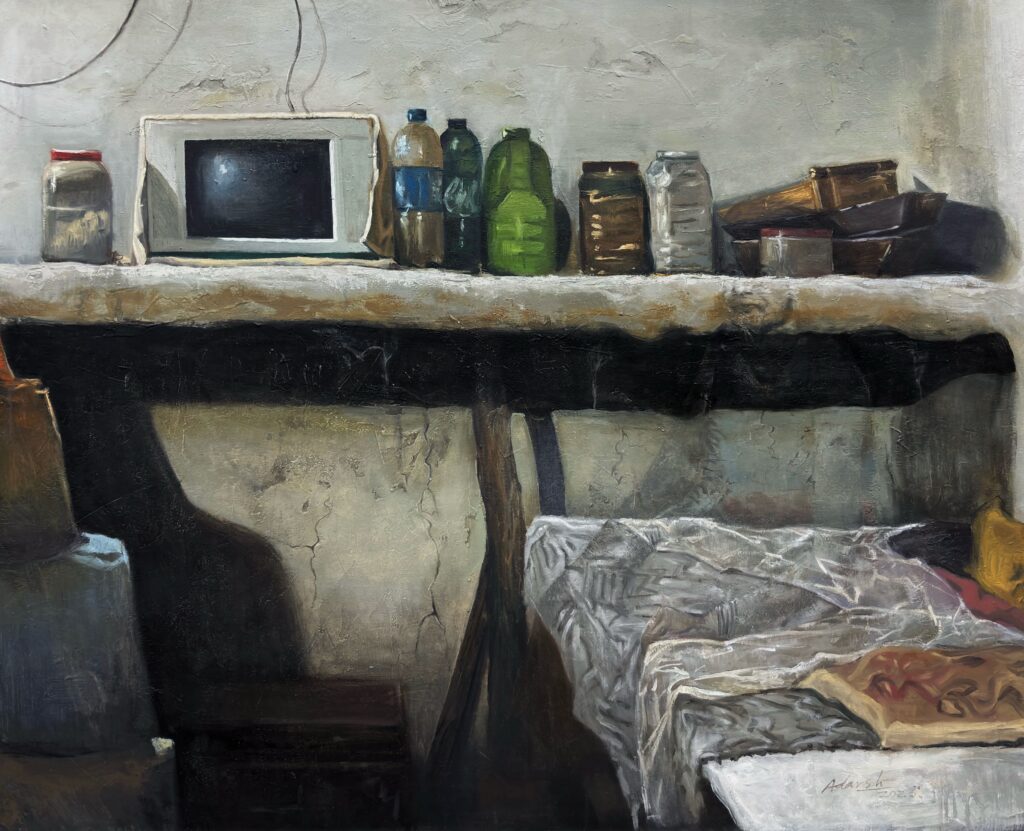
Plastic on the bed, wires on the wall, nobody home
Chalk-white plaster, cracked in thin grey lines.
A red lid, a green bottle, a blue label holding the light.
The small white box watches with its dark glass eye.
Under the shelf the shadow is deep as a well.
Clear plastic creases over the bed, keeping the dust for later.
Someone has gone. The wires still hang, waiting.
Adarsh Mishra paints the corners of a home that nobody looks at twice. Here a rough plaster shelf holds jars, plastic bottles, stacked trays and a small white machine with a dark glass front. Below it, clear plastic covers a bed. A dark shadow on the wall looks almost like a person. Mishra works in oil and acrylic on a textured ground made by hand on the canvas. The cracks and lumps of the wall rise out of that surface. Mishra calls such spaces "neither noticed nor remembered."
Oil and acrylic on handmade texture ground on canvas · 91.44 × 106.68 cm · 2026
Theme Memory in ordinary rooms
RC-431
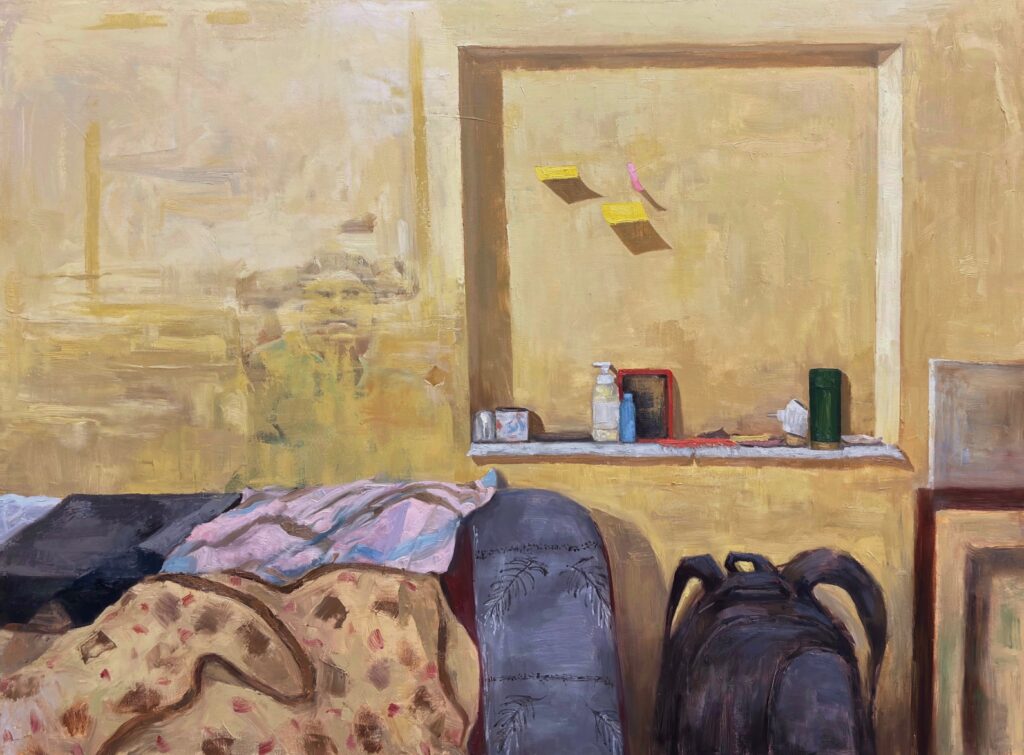
Adarsh Mishra
Everyday silence
A face sinks into the wall above an unmade bed
Yellow wall, the colour of old turmeric on a steel plate.
Three paper squares hold their small shadows.
A bottle, a flask, a red frame wait on the ledge.
The blanket keeps the shape of someone's sleep.
The bag is packed or never unpacked.
In the plaster a face rises and goes under like a swimmer.
In Everyday silence, Adarsh Mishra paints a lived-in room in oil. A blanket lies heaped on a bed. A black backpack leans on the wall. On a white shelf sit a pump bottle, a green flask and a small red frame. Paper notes cling to the yellow plaster. To the left a face fades into the wall. Mishra paints people as "quiet inhabitants" of ordinary spaces. Over time, the edge between figure and place has grown "less defined".
Oil · 91.44 × 121.92 cm · 2026
Theme Absence that feels present
RC-432

Adarsh Mishra
Still here
Someone lies here so long the room begins to keep them
Red cloth flecked with turmeric yellow, heaped against a pale wall.
A bamboo panel tied shut with a white cord.
A blue sheet sags in the corner where the light gets in.
Under the quilt a shape, thin as a stain, the colour of the floor.
The walls are marked where shoulders have leaned for years.
Nothing moves. Something stays.
Adarsh Mishra paints the corner of a small room in oil on board. A red quilt with yellow marks covers a shape that lies against the wall. A bamboo panel, a blue sheet and stained walls close in around it. Look longer and a figure appears under the quilt. It is thin as a shadow and almost part of the cloth and the floor. Mishra is from the College of Art in New Delhi. In Mishra's paintings, people and the places they live in slowly merge.
Oil on board · 60.96 × 76.2 cm · 2026
Theme What a room holds
RC-433
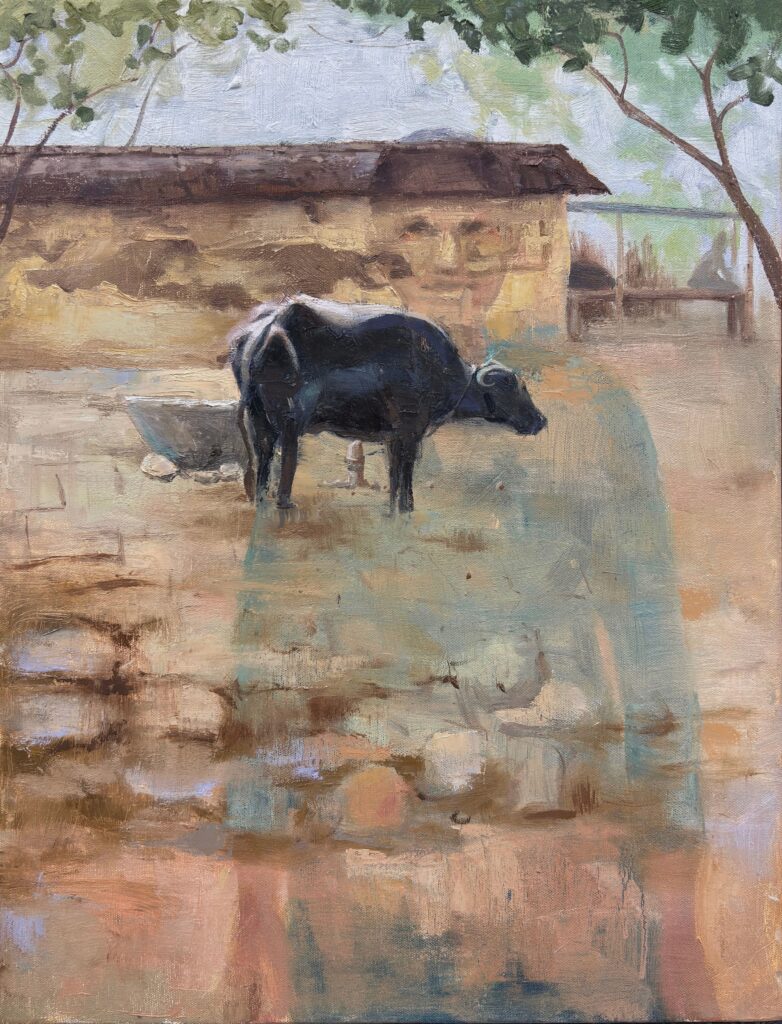
Adarsh Mishra
She
She is in the wall and the water, not quite there
A buffalo waits in the wet yard, black as a cooking pot.
The mud wall holds a face it has kept for years.
Rain left the ground the colour of tea and brick.
A green-blue shape stands in the puddles, light as breath.
No one turns to look at her.
She stays anyway.
Adarsh Mishra paints a black buffalo in a muddy village yard. A mud house with a brown roof stands behind it. Look closely and a face appears in the wall. A pale blue-green figure spreads across the wet ground in front. It is as thin as water. Mishra is from the College of Art in New Delhi. Mishra's work looks at ordinary places where people and their surroundings slowly merge. The title She points to a woman who has become part of the yard itself.
Oil · 60.96 × 45.72 cm · 2026
Theme Presence in ordinary places
RC-434
From the open call
Pooja Nannaware
My painting is a representation of peace, purity, and the beauty of Indian culture. I have created a composition featuring a peaceful white cow resting on a large pink lotus flower, surrounded by smaller flowers, leaves, and a traditional decorative border. The cow is an important symbol in Indian culture, often connected with kindness, purity, and respect for nature. The lotus represents beauty, spiritual growth, and peace, which are the…



Pooja Nannaware
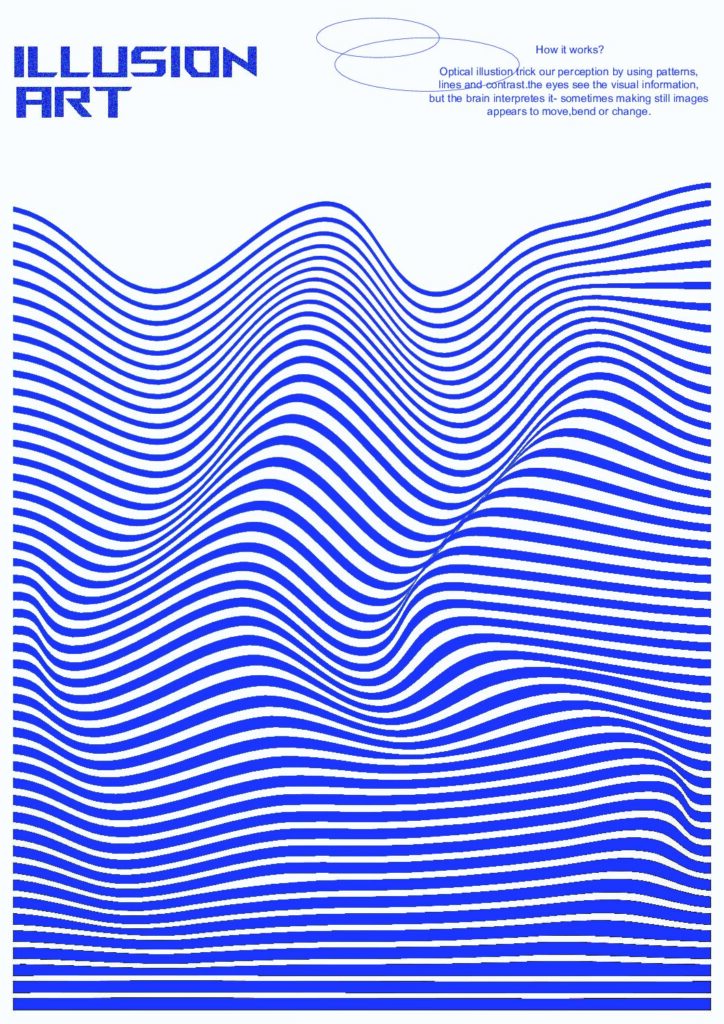
Illusion
Nothing on this page moves. Your eyes will not believe it
Blue lines lie across white paper like threads on a loom.
In the middle they lift into a hill. Then they drop into a valley.
Look long enough and the page seems to breathe.
Near the bottom the lines grow heavy and lie still.
The paper never moves. Only the eye does.
Pooja Nannaware makes Illusion as a digital work in 2026. Nannaware studies at MGM in Aurangabad. The work measures 21 × 29.7 cm. Many blue lines run across a pale page. Near the top they rise and fall like hills. Lower down they grow thick and flat. The words "Illusion Art" stand in square letters at the top left. A short note at the top right explains how such pictures trick the eye.
Digital artwork · 21 × 29.7 cm · 2026
Theme Optical illusion and perception
RC-470

Pooja Nannaware
Whispers of sea
The whole coast fits in the palm of a hand
Two dark fronds lean in from somewhere we cannot see.
Below them the sea is the blue of a school notebook.
Clouds rest on the horizon like folded cotton.
On the left the rocks keep still and warm.
On the right a wave lifts its white edge
and stops there, held in paint,
never reaching the sand.
Whispers of sea is an acrylic painting by Pooja Nannaware from 2024. Her college is MGM in Aurangabad. The painting is very small. It measures 6 × 6 cm. A blue sea fills the middle. Soft white clouds float above it. Brown rocks sit low on the left. On the right a wave breaks into white foam. Two dark palm leaves hang down from the top edge. Nannaware paints the foam with short light strokes so the water seems to move.
Acrylic on canvas · 6 × 6 cm · 2024
Theme Calm at the coast
RC-468
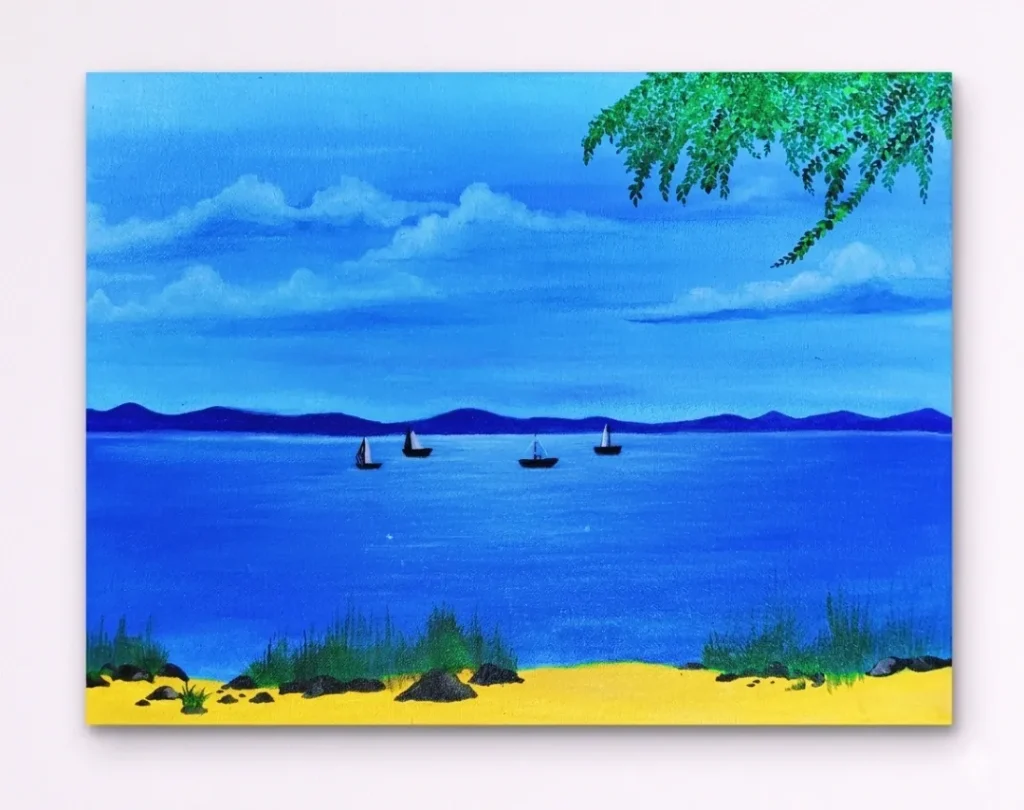
Pooja Nannaware
A Breath of blue
Four small sails rest where the blue water meets the hills
Yellow sand, warm as a plate left in the sun.
Dark stones sit in it like sleeping animals.
The water is one long sheet of blue.
Four white sails wait near the purple hills.
Leaves lean in from the corner and do not move.
Everything here is holding its breath.
Pooja Nannaware paints a quiet shore in acrylic. The work is from 2024 and measures 12 × 16 cm. Nannaware studies at MGM in Aurangabad. A strip of yellow sand runs along the bottom with dark stones and tufts of grass. Beyond it, deep blue water stretches to a low line of purple hills. Four little sailing boats rest near the centre. Soft white clouds drift across the sky. Green leaves hang down from the top right corner, from a tree just out of view.
Acrylic · 12 × 16 cm · 2024
Theme Stillness by the sea
RC-469

Pooja Nannaware
Chhatrapati
Thousands of fine ink lines build one steady gaze
Black ink on a pale sheet. No colour, only line.
The turban winds round and round like a road up a hill.
A feather lifts. A string of beads hangs still.
Thousands of small strokes make the shade under his eye.
His beard is a field of short dark grass.
He looks past us to something far away.
Pooja Nannaware makes Chhatrapati in 2025. She studies at MGM in Aurangabad. The work is an ink drawing on a sheet of 21 × 29.7 cm. It shows a man in a high wrapped turban with a feather and a tassel of beads. Three lines and a crescent mark his forehead. Fine hatched lines build the folds of cloth, the curls of his beard and the shadow on his cheek. Strings of beads fall across his chest. He looks to the side, calm and watchful.
Ink drawing · 21 × 29.7 cm · 2025
Theme Portrait of a ruler
RC-471
From the open call
Sayan Mondal
My work explores the theme of hard work and struggle as essential paths toward success and destiny. Through my paintings, I express the idea that nothing meaningful can be achieved without persistence, effort, and endurance. Every goal demands sacrifice, and every success carries the weight of unseen struggles. A recurring symbol in my work is the ant, which represents discipline, unity, and tireless labor. Ants may seem small and insignificant,…



Sayan Mondal
THE SILENT STRUGGLE OF HARD WORK
Follow the stitches down his body. They end in ants
A man the colour of evening sky falls back on cream cushions.
One arm hangs down until his knuckles almost touch the floor.
A red cloth slides off him like a slow spill.
A row of stitches runs from his shoulder to its hem.
At the end of the thread, ants climb out and walk away.
The warm light stays on the sofa. Nobody comes.
This large oil painting by Sayan Mondal, of the College of Art in New Delhi, dates from 2025. It measures 121.92 × 91.44 cm. A blue man lies across a cream sofa with his head thrown back. A dotted line runs down his body and along his red cloth to the floor. There it becomes a line of ants. Ants return again and again in Mondal's work. They stand for “the quiet, continuous work that often goes unnoticed”.
Oil · 121.92 × 91.44 cm · 2025
Theme Unseen labour and endurance
RC-3769
Sayan Mondal
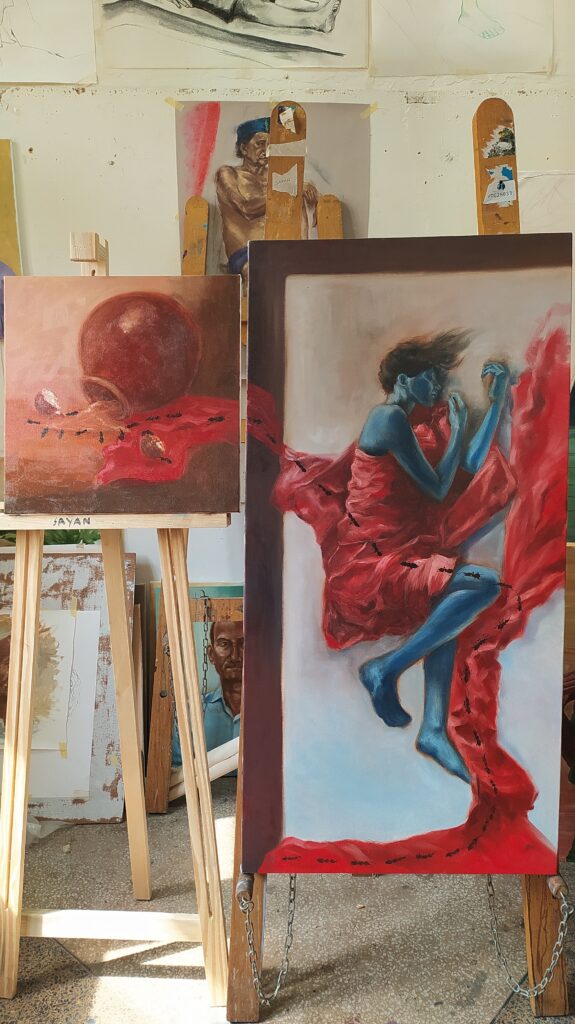
STUCK IN A POINT
Even in sleep, the ants keep walking
Blue skin on a white sheet, the colour of cold water.
The red cloth will not stay still. It pours down to the floor.
She holds her hands close to her face, like someone waiting.
Her hair lifts as if a window is open.
The ants walk one behind another along every fold.
They do not stop to look at her.
In this tall painting from 2025, a blue figure lies curled on a pale ground. A red cloth wraps the body and spills past the edge of the canvas. A thin line of ants marches along its folds. For Sayan Mondal, the ant stands for discipline, unity and hard work. These small creatures are easy to miss. So is the quiet daily effort that Mondal believes sits behind every success. The work is painted in oil and measures 121.92 × 60.96 cm. Mondal comes from the College of Art, New Delhi.
Oil paint · 121.92 × 60.96 cm · 2025
Theme Effort and endurance
RC-3770

Sayan Mondal
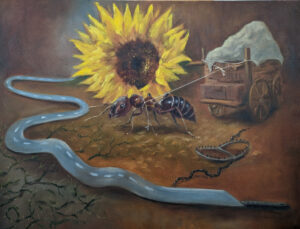
JOURNEY TO THE LIFE
One ant, one thread and a cart far heavier than itself
Brown earth cracks under six thin legs.
The sunflower burns yellow and does not look at the small one in front of it.
A real thread pulls tight from jaw to cart.
The road is grey and soft, a snake with painted lines and a blade for a tail.
Thorns creep in from the left. A trap lies open on the right.
The ant keeps walking.
An ant pulls a wooden cart across dry brown ground. A large sunflower glows behind it. Sayan Mondal of the College of Art in New Delhi paints in oil. Real thread runs from the ant to the cart and ties down its white cover. A grey road winds past like a snake. It ends in a toothed metal blade. Thorns spread on one side. A trap and chain wait on the other. For Mondal the ant stands for work that few people see.
Oil and real thread · 76.2 × 101.6 cm · 2025
Theme Hard work and endurance
RC-3771

Sayan Mondal
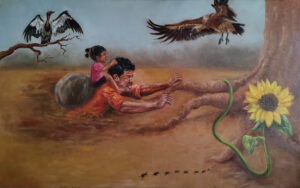
STRUGGLE
A man crawls through the dust while the vultures wait
Dust the colour of rust fills the whole field.
An orange shirt pushes into it, elbows deep, a stone pressing on his spine.
The girl on his shoulders cries into the haze and holds on to his hair.
One vulture spreads its wings on a dead branch. The other drops lower.
At the edge, a sunflower turns its face away from them all.
Below, small ants keep walking in a line.
Sayan Mondal paints in New Delhi. In Struggle, an oil painting from 2026, a man crawls through brown earth. A heavy grey stone rests on his back. A small girl rides on his shoulders. He reaches for the roots of a large tree, where a yellow sunflower grows. Two vultures wait above him. Along the bottom, a line of ants walks towards the tree. Ants appear again and again in Mondal's work. For him they stand for discipline, unity and "tireless labor." The painting measures 91.44 × 121.92 cm.
Oil · 91.44 × 121.92 cm · 2026
Theme Hard work and endurance
RC-3772
From the open call
Nitesh Kushwaha
I am Nitesh Kumar Kushwaha, a sculptor and performance artist whose practice centers on the themes of identity, ecology and healing and human rights. A postgraduate from Jamia Millia Islamia, my work emerges from the intricate interplay between human existence and the environment, reflecting both personal narratives and collective experiences. In my art, I engage with diverse materials such as real and synthetic hair, found objects, and thematic elements chosen…


Nitesh Kushwaha
Golden shower
Five falls of gold hair, each one longer than the last
Five dark red shelves on a white wall.
From each one, gold hangs straight down like hair just washed.
The smallest is a thin tail. The largest is a curtain.
Spotlights press down from the ceiling.
Grey shadows lean across the wall beside the strands.
Nothing moves, yet it all looks like falling.
I want to part it with my fingers.
Nitesh Kushwaha is a sculptor and performance artist. He is a postgraduate of Jamia Millia Islamia and is based in Greater Noida. In Golden shower he works with hair, canvas and threads. Five pieces hang in a row on a white wall. Each has a dark red top. Long golden strands fall from it towards the floor. The pieces grow larger from left to right. For Kushwaha, hair is "a powerful metaphor for identity". Here it hangs loose and heavy. Its shadows stretch across the wall.
Hair, canvas and threads · 10 × 365 × 300 cm · 2023
Theme Hair and identity
RC-3699

Nitesh Kushwaha
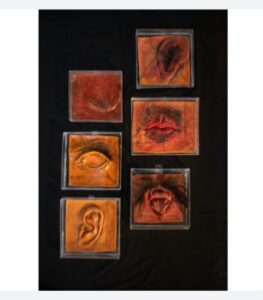
Growth of desire
An ear, an eye, a tongue: skin that grows its own hair
Six squares of skin, the colour of turmeric and rust.
An ear listens from inside its clear box.
Thin dark lashes rest above an eye that cannot close.
Red lips wait in a field of stubble.
A tongue pushes out through a thicket of hair.
On the black cloth they hang like things kept, not shown.
Growth of desire is made of six small panels of latex and hair. Each panel sits in a clear box and holds one part of a face. There is an ear, an eye, red lips and an open mouth with its tongue out. One panel shows only a soft curve. Dark hair grows from some of them as lashes or as a rough beard. Nitesh Kushwaha is a sculptor and performance artist in Greater Noida. He is a postgraduate of Jamia Millia Islamia. Hair is at the centre of his current work.
Latex and hair · 121 × 46 × 1.27 cm · 2023
Theme Hair, body and desire
RC-3700
From the open call
Arthik
My creative process is about my life experiences. I try to rewind my past life(childhood), how I used to live and Surrounding nature. For me, the only medium to visualize these images, experience, ideas and observation is through Art, like painting and sculpture. I try to experiment with different medium to convey the idea or image from mind to canvas. Different medium takes an image to different aesthetics and meaning,…


Arthik
Home
One open door, one sleeping cat, a forest full of fireflies
The door is open and the light inside is the colour of ripe mango.
A white cat lies across the step like a folded cloth.
The roof keeps its red even in the dark.
All around, the trees hold small green lamps.
Fireflies prick the night with yellow pins.
No one is calling you in.
The house waits anyway.
Arthik studies at the Sarojini Naidu School of Arts and Communication. The artist has lived away from home for nearly four years. Home grows out of that distance. It is a small painting, 13 × 25 cm, in poster colour and watercolour. A house with a red roof stands alone in a dark forest at night. Yellow lights float between the trees. A white cat sleeps at the open door. Arthik paints from memory and goes back to childhood, pets and the nature around the house.
Poster colour and watercolour · 13 × 25 cm · 2025
Theme Memory of home
RC-2225
From the open call
Vidushi Singh
While making these paintings, I was mainly trying to explore different ideas through colour, composition, shapes and details. I didn’t have everything planned before I started. Sometimes I had a clear idea in my mind, but once I started painting, I changed things depending on how they looked on the canvas. I wanted the paintings to feel natural and personal rather than just copying a reference exactly. I mainly used…



Vidushi Singh
Weight of silence
A face that cannot hold its shape any longer
Grey dust holds a face that is coming apart.
The eyes close as if the light is too much.
Cheeks slide like wax near a lamp.
The open mouth says nothing. Only the teeth show.
Black runs from the chin and does not stop.
Around it the paper stays pale and quiet.
Vidushi Singh draws this face in charcoal and pencil on a small sheet of paper, 29.7 × 21 cm. The eyes are shut. The mouth is open and the teeth show. The skin seems to melt and fold. Thick dark lines drip down from the chin. Singh uses shadow, distortion and flowing forms to show emotion. The work dates from 2025. Singh studies at Deen Dayal Upadhyay College, Delhi University. Her city is Kanpur.
Charcoal and pencil on paper · 29.7 × 21 cm · 2025
Theme Emotion held in silence
RC-571

Vidushi Singh
Sacred bloom
A white elephant walks under a night sky full of lotuses
Night pools inside the arch, deep as a well.
Pink lotuses rise on thin green stems and open above a slow white elephant.
Its cloth hangs heavy with red, yellow and green, the tassels still.
Black dots fall across its skin like seeds.
Around it a red wall blooms with white flowers.
At the top and bottom, small figures hold hands and dance along the edge of the page.
Vidushi Singh paints Sacred Bloom in acrylic on a sketchbook page. Markers add the finer detail. She works in layers. First come basic shapes and colours. Then she adds shadows, highlights and small touches. Big brushes cover large areas and thin ones handle small parts. Singh does not plan everything before she starts. She changes things as the painting grows and swaps colours when another combination looks better. A student at Deen Dayal Upadhyaya College, Delhi University, she is also learning when to stop.
Acrylic and marker on paper · 29.7 × 21 cm · 2025
Theme Elephant among lotuses
RC-572

Vidushi Singh
The Last pour
One twist of red, caught before it reaches the bottom
A navy bottle leans in from the left edge, heavy as a sleeping arm.
Red ribbons out of its mouth and folds over itself.
Inside the glass the wine breaks into pink curls and white sparks.
The wall behind is the grey of rain on slate.
The table below is a strip of bright sea green.
Everything waits for the stream to end.
In this small gouache from 2023, a dark bottle tips its last red stream into a glass. Vidushi Singh builds the picture in layers. First come the basic shapes and colours. Then come shadows, highlights and details. Thin white lines catch the light on the glass and the bottle. Singh does not plan everything at the start. Colours change as the painting grows. Knowing when to stop is hard. Singh is from Kanpur. Singh's college is Deen Dayal Upadhyay College, Delhi University.
Gouache on paper · 19 × 21 cm · 2023
Theme Light caught in glass
RC-573
Vidushi Singh
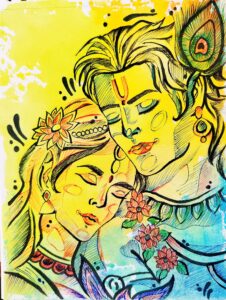
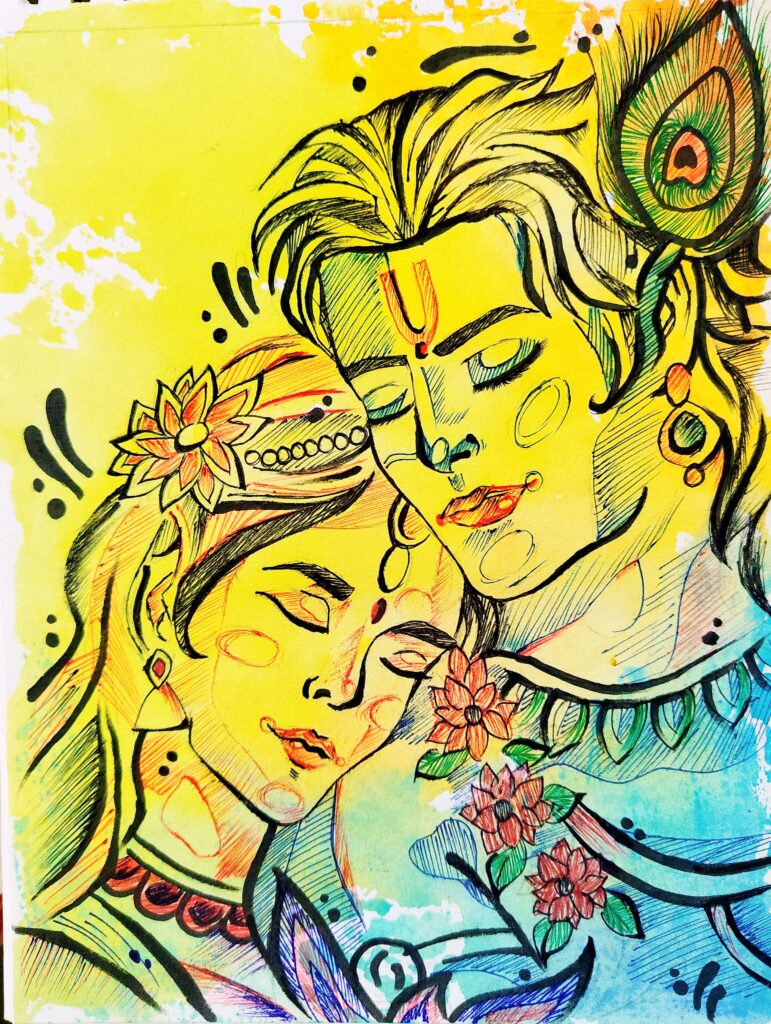
Divine embrace
Eyes closed, cheek to cheek, in a wash of yellow
Two faces lean together, eyes closed.
The yellow is the light of late morning, soaked into paper.
Blue pools under his chin like water in a cupped hand.
Red pen lines run across her cheek, thin as thread.
A peacock feather keeps watch from the corner.
Small white patches show where the paint did not go.
No one speaks. The ink holds them still.
Vidushi Singh makes Divine embrace in 2024 on a small sheet of paper, 23 × 16.4 cm. Watercolour washes cover the page. Yellow fills the top and blue and green gather at the lower right. Black ink lines and colour pen marks sit over the washes. Singh is based in Kanpur and studies at Deen Dayal Upadhyay College, Delhi University. She does not plan everything before she starts. She changes things as the picture grows. She wants her work to feel natural and personal.
Watercolour and colour pens on paper · 23 × 16.4 cm · 2024
Theme Love and quiet closeness
RC-574
Vidushi Singh
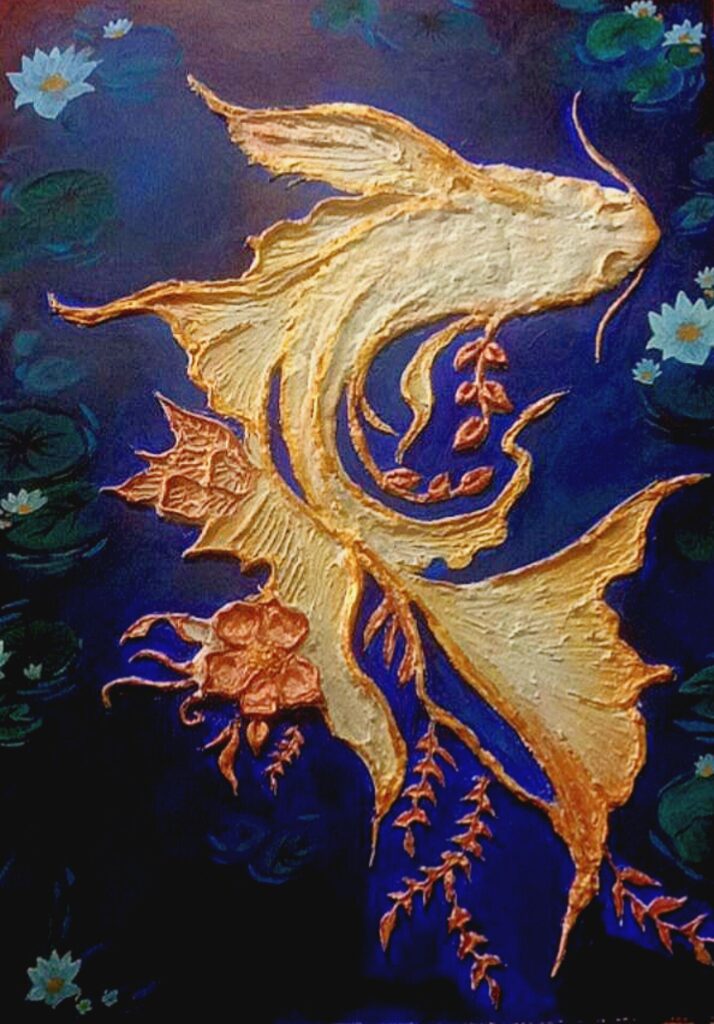
Whispers of the pond
A golden fish lifts off the board, its fins thick as cream
Night water, blue going purple at the edges.
A fish of pale gold turns, its fins ridged like wet sand.
You could trace its curve with one finger and feel every ridge.
Copper flowers drift from its belly like seeds let go.
At the corners, white lilies keep their small yellow lamps lit.
The pond says nothing. The fish listens anyway.
Vidushi Singh lives in Kanpur and studies at Deen Dayal Upadhyay College, Delhi University. In Whispers of the pond, made in 2024, a golden fish stands out from the board in thick ceramic texture. Behind it, the water is painted in deep blue acrylic, with green lily pads and white water lilies. Singh does not plan everything before she starts. She builds her work in layers and often changes colours as she goes. When she makes a mistake, she works around it or paints over it.
Ceramic texture art on MDF board with acrylic background · 72.5 × 42.6 × 1.2 cm · 2024
Theme Life in still water
RC-575
From the open call
Priyanka Nandan
My name is Priyanka Nandan, and I am a passionate artist who believes that art is not simply about colours, brushes, and canvases; it is a beautiful way of expressing emotions, ideas, experiences, and imagination. For me, art has always been a meaningful part of my life. My journey with painting began in childhood, and over the years, my interest gradually developed into a deep passion and a serious commitment…
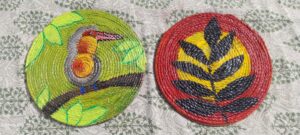


Priyanka Nandan
Round Art
A bird and a black leaf, painted onto spirals of cord
Cord turns and turns until it becomes a field.
A bird the colour of a ripe mango waits on a dark branch.
Its pink beak points at a leaf just out of reach.
Next to it a black stem climbs through a yellow sun.
Red holds everything in, like the border of a sari.
Paint sits in the grooves and catches the light in small bright ridges.
Round Art is a pair of painted discs by Priyanka Nandan from Ghaziabad. Her college is Banasthali Vidyapith. Each disc is built from cord wound in a tight spiral. Nandan paints over the coils in acrylic. On one disc a bird with an orange body sits on a dark branch among green leaves. On the other a black leafy stem rises against a yellow sun on red. Her main fields are folk art, abstract art and landscape. The work dates from 2026.
Acrylic on coiled cord · 10 cm · 2026
Theme Nature in a circle
RC-664

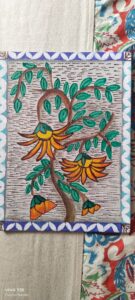
Priyanka Nandan
Blooming flowers
Two flowers open wide while two still hang closed
A brown branch leans like someone listening.
Orange petals spill down in soft points, warm as a lamp at dusk.
Two buds hang low and keep their colour folded.
Behind them, small dark strokes run like grain in old wood.
A blue border of white scallops holds it all in.
Even the leaves seem to turn.
Priyanka Nandan paints a single tree that bends across the board. Its brown branches carry green leaves. Each leaf is outlined in a darker line. Four flowers hang from the branches in orange and yellow. Two are open wide and two are still closed. Behind them, rows of short dark strokes fill the grey ground. A border of white scallops on blue and turquoise frames the scene. Nandan works from Ghaziabad. Folk art is one of the forms she works in most.
Paint on canvas board · 2026
Theme A tree in bloom
RC-666

Priyanka Nandan
Green forest
A kitchen table slowly turning into a forest
Every bottle holds a different green.
Leaves climb out of the tall one, as if it forgot it was glass.
On the wall, quiet faces watch with square chins and open eyes.
The table tilts in olive and moss.
Thin yellow lines catch a little light.
And in all this green sits one red apple, the only thing not trying to be a forest.
In Green forest, Priyanka Nandan paints a table of bottles, a jug and a small box in many shades of green. One red apple sits in front. Behind them the wall fills with faces drawn in a few simple lines. Nandan works mainly in folk art, abstract art and landscape. This painting draws on all three. Flat blocks of acrylic colour sit inside dark outlines. She comes from Ghaziabad. Her college is Banasthali Vidyapith. The work is from 2026.
Acrylic · 3 × 4 cm · 2026
Theme Still life as forest
RC-661

Priyanka Nandan
Morning raga
A harmonium at dawn and even the animals stop to listen
Orange cloth falls in folds under a yellow scarf.
Her fingers rest on white keys and the brown box breathes.
The white animal lifts its face toward the sound.
A pink bird hangs in the blue with open wings.
Small orange fruit wait on thin dark branches.
The floor runs in lines of yellow and cream like a woven mat.
In Morning raga, a woman in an orange sari sits on a patterned floor and plays a harmonium. A white animal turns its head toward the sound. A pink bird flies above her. Two fruit trees curve in from the sides under a blue sky. Priyanka Nandan paints the scene in flat acrylic colour inside a turquoise border of white loops. Nandan is based in Ghaziabad. Her college is Banasthali Vidyapith. She works mainly in folk art, abstract art and landscape. This painting is from 2026.
Acrylic · 3 × 4 cm · 2026
Theme Music and nature
RC-662

Priyanka Nandan
Boho art
A plant rises from rings of sun on coiled cord
Rope turns and turns until it becomes a field.
Orange heat sits in every ridge.
Green leaves stand up like hands, each one outlined in chalk white.
Below them a small sun is buried, ringed and ticking with white marks.
Brown earth moves in slow waves.
You could run a finger along the colour and feel it climb.
Priyanka Nandan paints on a round surface of coiled cord. In Boho art, a plant with pointed green leaves grows from a circle of yellow and red rings. Brown waves run across the bottom. White lines trace every edge. The cord gives each colour a ridged feel. Nandan, of Banasthali Vidyapith, is based in Ghaziabad. She works mainly in folk art, abstract art and landscape. Her confidence grew in Class 10, when she won first place in an art contest.
Acrylic · 12 cm · 2026
Theme Plant, sun and earth
RC-663
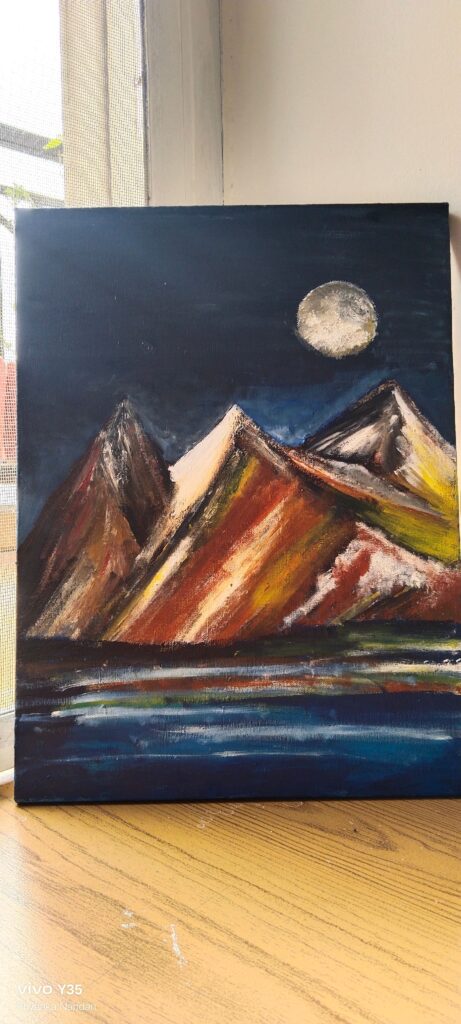
Priyanka Nandan
Mountain on range
Three warm peaks hold their own fire under a cold moon
A moon like a worn coin sits in the navy.
The peaks answer it in rust and ochre, as if the sun forgot to leave.
White paint drags along each ridge where the light lands.
Below, the lake breaks into long strokes of green and red.
You can see the weave of the canvas through the dark.
The mountains are warm. The night is not.
Priyanka Nandan paints three peaks under a full moon. The sky is a deep navy. The mountains are rust red, ochre and yellow, with white light on their sides. Below them, long flat strokes of blue, green and white suggest still water. Nandan studies at Banasthali Vidyapith and is from Ghaziabad. She works mostly in folk art, abstract art and landscape. In this acrylic painting from 2026 the landscape leans towards the abstract: the rocks become bands of colour.
Acrylic on canvas · 4 cm · 2026
Theme Mountains under moonlight
RC-665

Priyanka Nandan
Blue mist
Everything in this room is blue except the fruit and fire
Blue folds over blue like cloth hung in a cold room.
The lamp leans on its twisted stem and gives no warm light.
Only the candles hold a little yellow.
A green pear sits heavy as a sleeping animal.
Grapes break loose and roll across a pale square.
On the wall the square faces keep still and watch.
Blue Mist is a still life painted mostly in blue. A lamp, a round glass bottle and a striped pear stand on a table cut into flat squares. Green grapes and loose green dots lie on a pale patch of cloth. Two candles burn with small yellow flames. Line-drawn faces watch from the wall. Priyanka Nandan paints it in acrylic. She is based in Ghaziabad and her college is Banasthali Vidyapith. Nandan says "every new project gives me an opportunity to learn something new and improve myself as an artist."
Acrylic · 3 × 4 cm · 2026
Theme Still life in blue
RC-667

Priyanka Nandan
Brown Hue
A quiet room where even the walls keep watching
A clock sits on a stack of closed books and keeps its own time.
The kiwis are the only green in the room, cut open to show their seeds.
Every shape wears a dark line, as if someone traced the house to keep it safe.
Faces in the wall watch in white chalk lines.
Brown, rose and the pink of old brick.
The tablecloth runs toward me in warm squares.
Brown Hue is a still life in acrylic from 2026 by Priyanka Nandan of Ghaziabad. Her college is Banasthali Vidhyapith. Nandan works mainly in folk art, abstract art and landscape. In this painting she brings folk faces and abstract blocks into one room. A vase, a jug, a clock, a pile of books and a bowl of kiwi fruit sit on a cloth of coloured squares. Every shape has a dark outline. Faces drawn in thin white lines look out from the wall behind.
Acrylic · 3 × 4 cm · 2026
Theme Folk forms in still life
RC-668
From the open call
Rudraksh Pandit
My Painting'' The Metaphor '' is Made by Oil On Canvas . My Painting Tells Just as a cat closes its eyes while drinking milk, foolishly believing no one can see it, we often try to conceal our past misdeeds under the illusion that they remain hidden. However, true reality is never blind. The shadowed face in the background represents the silent, inescapable presence of truth. While we may attempt…


Rudraksh Pandit
The Metaphor
She hides her eyes. The face on the wall does not
Brown walls fold into a corner like a box half shut.
A strip of red sits tight across her eyes. She smiles anyway.
The cat's pink tongue touches the milk. Its pale blue eyes stay open.
Her fingers rest on the cold rim of the glass.
Up on the wall a face hangs in shadow, patient as old wood.
Nothing in this room is as hidden as it thinks.
Rudraksh Pandit studies at the Government Fine Art College in Indore. The Metaphor is oil on canvas, 60 × 60 cm. The idea starts with a cat. It shuts its eyes while it drinks milk and thinks no one can see it. Pandit sets this in a dim brown room. A woman with a red cloth over her eyes kneels by a glass bowl of milk. A cat drinks from it. On the wall a shadowed face looks down at them. For Pandit this face is truth, always watching.
Oil on canvas · 60 × 60 cm · 2026
Theme Hidden deeds and truth
RC-2249
From the open call
Pritesh Bhowmick
My practice is rooted in personal memory and lived trauma, particularly the enduring mark of sexual harassment. Rather than withdrawing or escaping, I chose to engage with these experiences critically, allowing them to shape my artistic inquiry. This has led me to a sustained exploration of identity, its fractures, its negotiations, and its layered complexities. Central to this exploration is the question of queer identity. My work seeks to articulate…



Pritesh Bhowmick
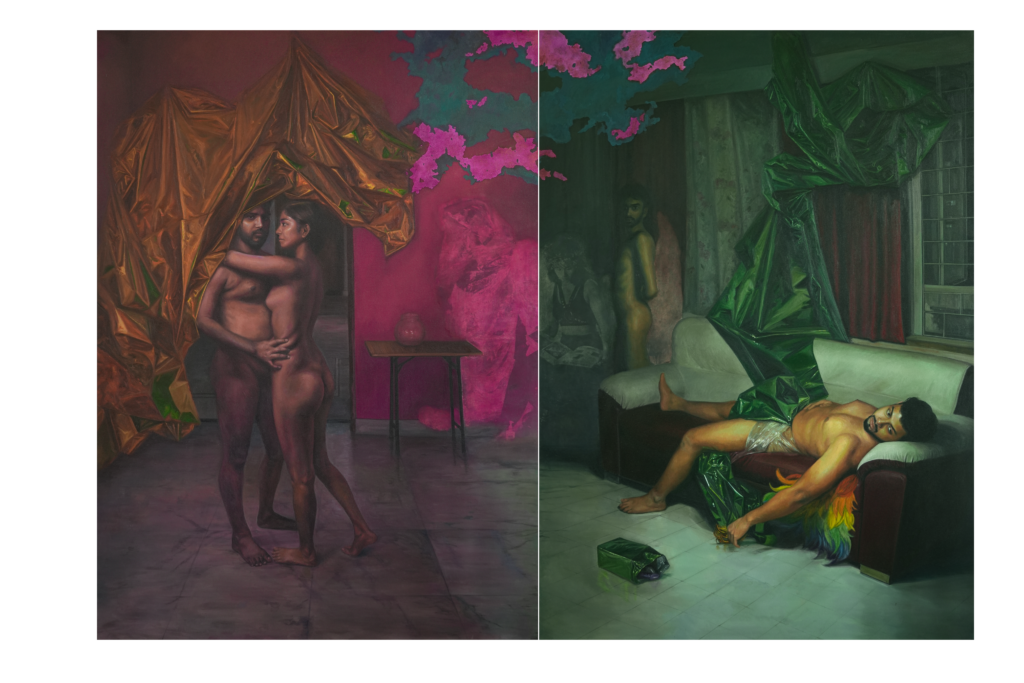
Sokoli Haraye Jay
Foil for armour and feathers for a flag
Copper foil hangs over two bodies like a roof that will not hold.
Pink spreads across the wall and climbs into the next room.
There the light turns green and cold.
A man lies back on a white sofa with one foot in the air.
A tail of rainbow feathers slips toward the tiles.
A small green bag waits on the floor.
Behind him a winged figure stands and watches.
Pritesh Bhowmick paints this work in oil across two large panels. Together they measure 228.6 × 335.2 cm. Bhowmick is from Nabadwip and trained at Sir JJ School of Art. His practice begins with personal memory and the lasting mark of sexual harassment. He uses loud props and extravagant accessories as signs of queer identity. They act as shields and as statements of difference. He builds his pictures by adding layers and peeling surfaces away. His figures move between real life and allegory.
Oil · 228.6 × 335.2 cm · 2026
Theme Queer identity and memory
RC-3720

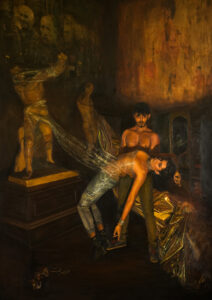
Pritesh Bhowmick
Chai jare barebare
Wrapped in plastic, a body falls back into gold
Cling film pulls from a statue's fist to a soft waist.
A body bends back until its fingers almost touch the floor.
Bangles at the wrist. Grey jeans gone silver in the wrap.
Gold foil spills like water that forgot to fall.
Old faces float in the dark above, half rubbed away.
One man stands behind. He holds on and looks straight at us.
Pritesh Bhowmick paints this large canvas in oil and adds images by transfer. It is 259 × 198 cm. Bhowmick comes from Nabadwip. Bhowmick's college is Sir JJ School of Art. The work grows from personal memory and from the lasting mark of sexual harassment. Clear plastic film wraps a classical statue and a young person who falls back into a man's arms. Bhowmick builds in layers, adding surfaces and peeling them away. A body is shown and hidden at the same time.
Oil and image transfer on canvas · 259 × 198 cm · 2025
Theme Queer identity and concealment
RC-3721

Pritesh Bhowmick
Who am I ?
Bodies in hiding, heads swallowed by purple, gold burning behind them
Grey like old silver, then white plaster spreading as if a wall is giving way.
A body leans back while its head pours out sideways into purple.
Behind it, a coil of gold turns like a small warm sun.
Two more figures fold and kneel, faces lost in the same soft weight.
Teal stains rise at the edges like water through stone.
Under the cover, the skin stays warm and brown.
Who am I? is painted on two wooden panels placed side by side. Pritesh Bhowmick works with natural pigment and plaster. The surface grows in layers. Some layers are peeled away and new ones are added on top. Pale plaster patches now break up the dark grey ground. Three figures lie, crouch and bend. Their heads disappear into long purple shapes. Gold leaf shines behind two of them. For Bhowmick, gold points to queer style. It works as a shield and as a sign of being different.
Mixed media: natural pigment and plaster on wood · 60.9 × 121.9 cm · 2025
Theme Queer identity and concealment
RC-3722

Pritesh Bhowmick
Beneath the coating, a becoming
Under the peeling yellow, two bodies rest in grey smoke
Mustard plaster cracks open like old wall paint in the rain.
Beneath it, a grey haze keeps two bodies close.
Brown legs rise straight into the dark. A pink cloth catches the light.
A blue chest rests, slow with breath.
White edges show where the skin of the wall was pulled away.
Something is still coming through.
Pritesh Bhowmick, of the Sir JJ School of Art, paints on a wooden panel shaped like the letter L. He builds the surface in layers of plaster and acrylic. Then he peels parts away. Here a yellow coat breaks open. Under it, grey smoke holds two bodies lying close together. One lifts brown legs into the dark. Bhowmick's work begins in memory and in the lasting mark of sexual harassment. It asks how queer identity is shown, hidden and changed.
Mixed media: acrylic and plaster on wood · 76.2 × 71 cm · 2026
Theme Queer identity and becoming
RC-3723

Pritesh Bhowmick
Untitled
Two bodies kneel back to back behind a peeling wall
Purple dries on plaster like paint on an old door.
The cream edges crack and curl away from the wood.
In the grey middle, two people kneel with their backs almost touching.
One wears red. One wears blue.
Their faces go soft as breath on glass.
The wall comes apart around them
and they wait inside the dust, close and quiet.
Pritesh Bhowmick paints two kneeling figures back to back. They sit in a grey haze on wood. Their heads fade into the smoke. Around them, thick plaster rises in broken patches of cream and purple. The edges chip like an old wall. Bhowmick calls the process "layering and unveiling." Surfaces are added and then peeled away. The figures stay half hidden behind the plaster. The work asks how identity is shown and how it is hidden. Bhowmick comes from Nabadwip and studied at Sir JJ School of Art.
Mixed media: acrylic and plaster on wood · 60.9 × 50.8 cm · 2026
Theme Hidden and revealed identity
RC-3724
From the open call
Harshini kishan
Harshini Kishan is a visual artist whose practice spans painting, textiles, and mixed media. Rooted in the interplay of spirituality, tradition, and contemporary expression, her work transforms fabrics, threads, and unconventional surfaces into vessels of cultural memory. By layering materiality into compositions that blur the boundaries between painting, installation, and textile art, she situates her practice at the intersection of physical presence and symbolic meaning. Her process is intuitive and…

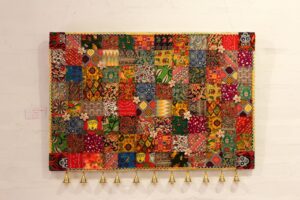
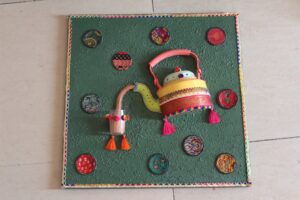
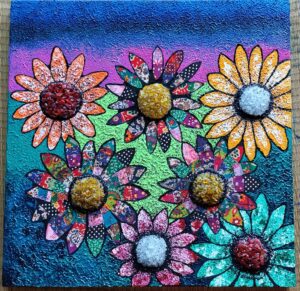

Harshini kishan
Mumbai logo
A city spelled out in printed cloth and gold trim
Red dots crowd the cloth like a market at noon.
A blue swirl turns inside the U and does not stop.
Gold trim runs round each letter, a thin bright fence.
Paisley, flowers, tiny earrings on red: every letter wears its best.
Along the bottom, tassels wait to swing.
The wall behind is plain grey stone. The name is not.
Harshini Kishan spells out her city in cloth. Six raised letters stand on a long panel. Each letter wears a different printed fabric: big flowers, blue swirls, pink paisley, small earrings on red. Gold trim edges every letter. Behind them sit strips of dotted red, deep blue and striped cloth. A bright fringe runs along the top. Red and green tassels hang below. Kishan works without a fixed plan. Her path into art runs through science and years as an Air India flight attendant.
Mixed media · 2025
Theme City and textile memory
RC-2551

Harshini kishan
Bells of Heritage
Every square a different cloth, every bell waiting for wind
Red and saffron squares sit shoulder to shoulder, like saris folded on a shop shelf.
Elephants walk across one patch. A yellow face with lowered eyes rests in another.
Small white shells open into flowers between the seams.
A gold edge keeps everything in its place.
Below, eleven brass bells wait for a door to open and a little wind to come in.
Harshini Kishan builds Bells of Heritage from squares of printed cloth. Each square carries a different pattern. There are dots, zigzags, leaves, elephants and painted faces. A gold border holds the grid together. A row of brass bells hangs from the lower edge. Kishan works without a fixed plan. She lets each piece find its own direction as it grows. Small flaws are part of the work. Her path to art began in science and passed through a time as an Air India flight attendant. She now works full time in Mumbai.
Textile · 2025
Theme Cultural memory in cloth
RC-2552
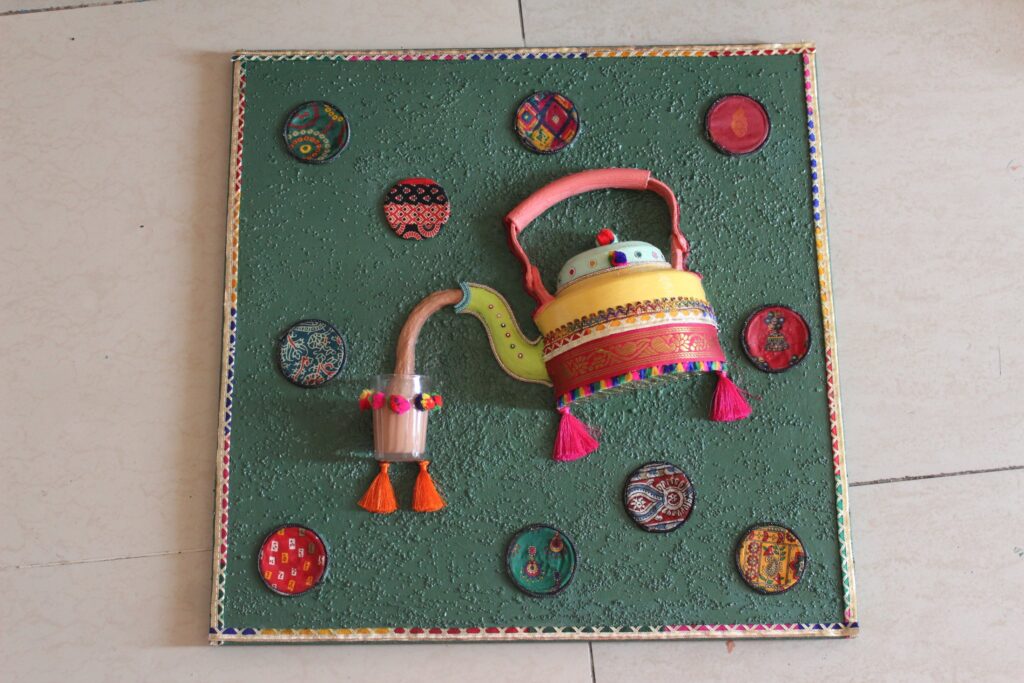
Harshini kishan
cutting chai
A kettle that never stops pouring, stitched from brocade and tassels
A green wall, rough as a pavement after rain.
The kettle wears a gold border and pink tassels like earrings.
Its spout bends and the tea comes down in one thick pink rope.
The glass waits, half full, with orange tassels for feet.
Around it, small rounds of old cloth sit like saucers on a table.
Nobody is here yet. The tea is still hot.
In Cutting Chai, Harshini Kishan turns a small daily habit into a raised picture. A kettle dressed in gold brocade, braid and pink tassels stands out from a rough green board. A pink stream pours from its spout into a small glass of tea. Circles of printed and embroidered cloth sit around it like coasters. Kishan begins without a fixed plan. She lets texture and form show her the way. Before art, her path took her through science and work as an Air India flight attendant.
Mixed media · 2026
Theme The daily ritual of tea
RC-2553
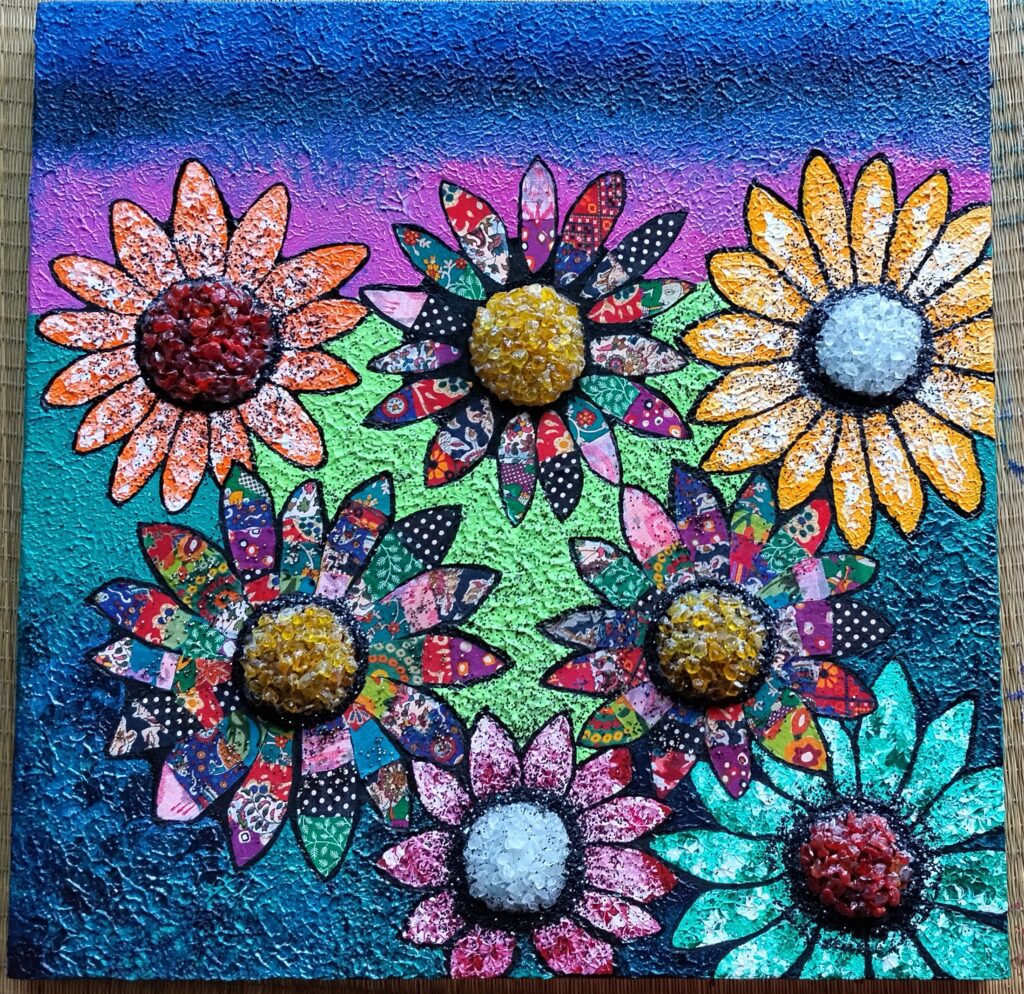
Harshini kishan
blooming flowers
Seven flowers with hearts you want to touch
A sky slides from night blue into pink, rough as plaster after rain.
Seven flowers stand shoulder to shoulder under it.
Some wear old prints, dots and paisley, pieced like a quilt.
Others are paint flecked with black, like pepper on orange.
Their hearts are heaped with amber and frost, small stones you want to touch.
The whole field glitters slowly, the way a crowd does in the sun.
Harshini Kishan is an artist based in Mumbai. She came to art after a start in science and years as an Air India flight attendant. Her practice moves between painting, textiles and mixed media. In this work from 2025 seven large flowers fill the square. Some petals are pieced together from small patterned scraps. Others are painted over a rough, raised surface. The centres are heaps of small glassy pieces in amber, white and red. Kishan starts without a fixed plan and lets each piece find its own direction.
Mixed media · 2025
Theme Flowers and layered texture
RC-2554
From the open call
Narender
"नमस्ते, मैं गुरुग्राम से नरेंद्र हूँ। मैं कई तरह के कलात्मक कामों में सक्रिय रूप से आगे बढ़ रहा हूँ। मैं पेंटिंग, मूर्तिकला, आर्ट इंस्टॉलेशन, फ़ोटोग्राफ़ी और परफ़ॉर्मेंस आर्ट जैसे कई माध्यमों में काम करता हूँ। अपनी कला के ज़रिए, मैं खुद को और उन लोगों को दिखाता हूँ जिनके अनुभव मेरे जैसे ही हैं। मेरे काम का मुख्य विषय बालों का झड़ना, उससे जुड़ी चुनौतियाँ और उनके समाधान हैं।…


Narender
Marriege of bald men
A whole wedding party and not one hair between them
Every head is bare and round: orange, lemon, ash and pink.
The drums are out. The legs fly up.
Turquoise dots hold each elbow and knee like pins in a doll.
The ground burns orange, curled like hot wire.
Above, the night is brown and full of small loops.
On a white horse one rider sits still in saffron.
No one here is hiding anything.
Narender lives and works in Gurugram. He paints, makes sculpture and installations, takes photographs and performs. One subject runs through all of it: hair loss. He looks at what it does to him and to people like him. He also asks how they can find their confidence again. In this acrylic painting from 2025 the subject becomes a wedding. The canvas is long and narrow, 30.48 × 137.16 cm. It holds a crowd of dancers, drummers and horses and every head in it is bald.
Acrylic on canvas · 30.48 × 137.16 cm · 2025
Theme Hair loss and confidence
RC-3792

Narender
The fracture
Five figures spun from curls and held by thin blue ribbons
Five figures rise like spun wool, curl upon white curl.
Thin blue ribbons wind around them, as if to keep each strand in place.
Their faces are calm: a nose, a soft wave of lips.
At the edges, orange and pale green animals fall and twist in the dark.
A green border holds it all, like a hand around a room.
Nothing here is bare yet.
Narender is from Gurugram. He paints but also makes sculpture, installations, photographs and performance. His subject is hair loss and how it touches him and people like him. In The fracture, five tall figures stand in a row. Their bodies are built from hundreds of small white curls in acrylic on canvas. Blue ribbons wind around each one. At the edges, orange and pale green animals tumble across a dark ground. The canvas measures 121.92 × 182.88 cm.
Acrylic on canvas · 121.92 × 182.88 cm · 2026
Theme Hair loss and confidence
RC-3793

Narender
Mundit avtaar
No hair and no hiding at the centre of this dance
Bare heads shine like river stones in gold light.
Blue and black bodies bend, kneel and turn over.
An animal head grins. Another shows its teeth.
In the middle a man stands still and lifts two white flowers.
Pale roses rest at his feet on the dark ground.
No one here is hiding.
Narender lives and works in Gurugram. He paints, makes sculpture and installations, takes photographs and performs. One subject runs through all of it: hair loss. He makes work about himself and about people who share the same experience. In Mundit avtaar every head is bare. A tall figure stands at the centre and holds up two white flowers. Other figures turn, kneel and hang upside down around him. The work asks how people can find their confidence again.
Acrylic on canvas · 91.44 × 182.88 cm · 2026
Theme Hair loss and confidence
RC-3794

Narender
Stupid tringle
Three bare heads under a net of pale triangles
Orange burns like a stove left on.
Three dark figures stand in it, shoulder to shoulder.
Blue pastel runs down their bodies like water down a window.
Their heads are smooth. One looks out with two round eyes.
Thin lines cross from edge to edge and make triangles nobody asked for.
Still the feet are wide. Still they stand.
Narender works in Gurugram. He paints, makes sculpture and installations, takes photographs and performs. Hair loss is the main subject of his work. He shows how it affects him and people like him and how they can find their confidence again. In this 2026 painting three tall figures stand side by side. Flat acrylic gives the dark bodies and the orange ground. Soft blue oil pastel runs over them in strands and thin straight lines. The lines make triangles across the canvas.
Acrylic and oil pastel on canvas · 91.44 × 60.96 cm · 2026
Theme Hair loss and confidence
RC-3795

Narender
War of mentality and hair
Small bodies wrestle across the dark heart of a tree
A slab of wood opens like a cloud with torn edges.
In its dark centre, pale bodies grapple and fall.
Yellow beasts lower their heads and pull on thin lines.
Gold discs hang in the air like small suns.
A crack runs through the middle of the fight.
The bark holds it all, quiet and brown.
Narender paints in oil straight onto a slab of wood. The slab keeps its natural edge and its dark bark rim. Cracks run through the grain. On the darker heart of the wood small figures in white, orange and blue twist and struggle. Yellow animals crowd among them. Small gold discs float between them. The work measures 76.2 × 91.44 cm. Narender comes from Gurugram. He works in painting, sculpture, installation, photography and performance. His main subject is hair loss and how it affects a person's confidence.
Oil on wood · 76.2 × 91.44 cm · 2026
Theme Hair loss and confidence
RC-3796
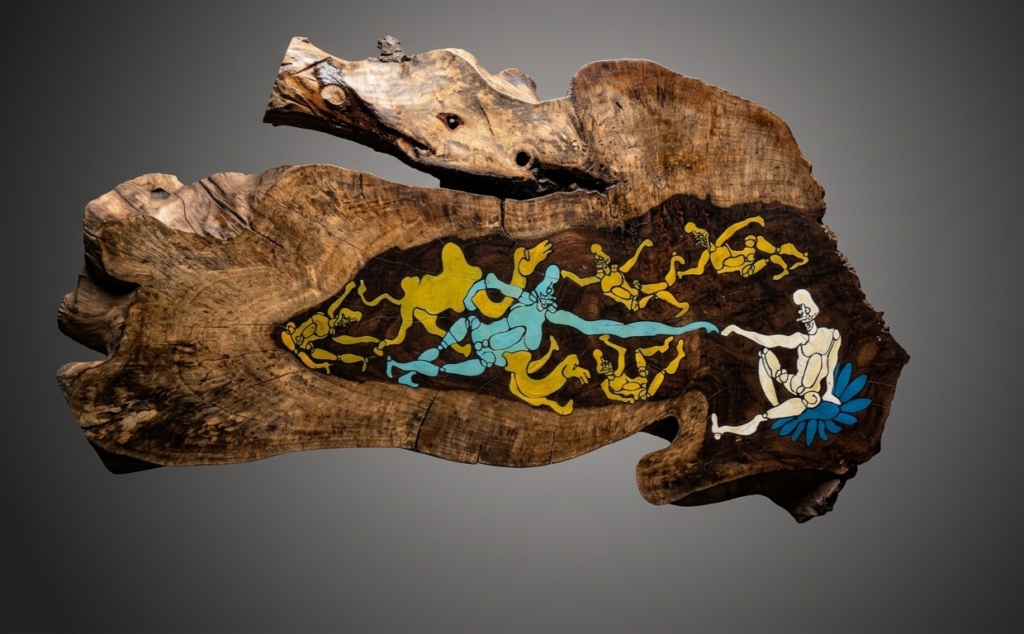
Narender
We have to meet,but never
Two hands reach across the dark wood and stop short
The tree keeps its bark at the edges, rough as a knuckle.
Inside, the wood goes dark as tea left too long.
Small yellow bodies fall through the grain like seeds shaken loose.
A blue arm stretches across the whole width of the dark.
A pale hand lifts from a blue flower to answer it.
Between the two fingers lies a strip of bare wood.
The gap is the width of one breath.
Narender is from Gurugram. He paints this work in oil on a slab of wood that keeps its rough outer edge. The centre is stained dark. On it, figures that look like jointed wooden dolls move across the grain. Small yellow figures tumble. A turquoise figure stretches one long arm towards a pale figure seated on a blue flower. Their hands reach out but do not touch. Narender works in painting, sculpture, installation, photography and performance. His work is mostly about hair loss and how people find their confidence again.
Oil on wood · 30.48 × 60.96 cm · 2026
Theme Reaching without touching
RC-3797
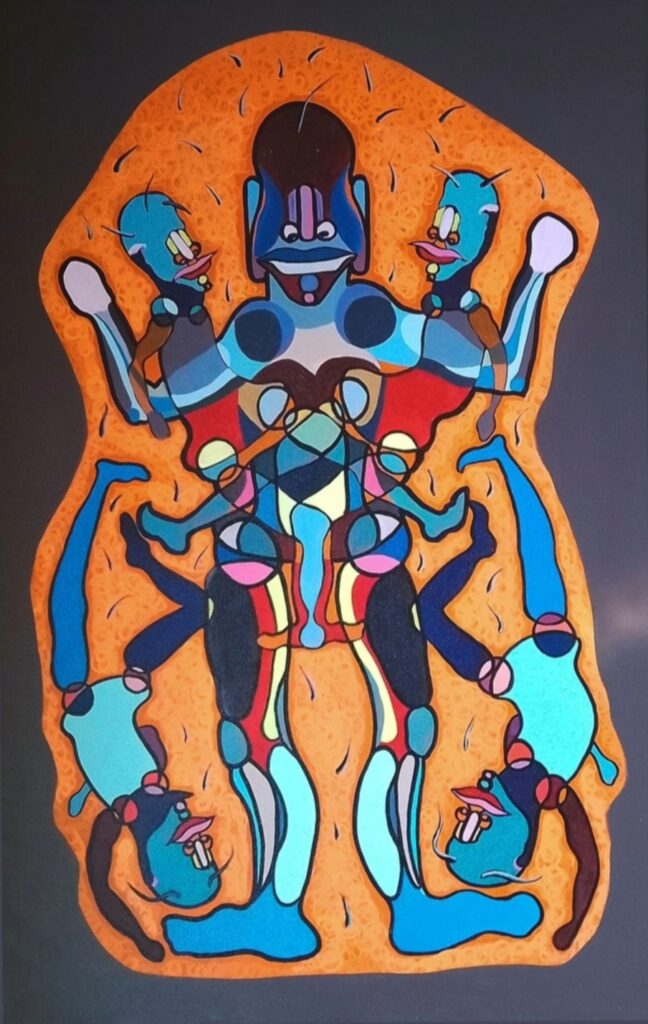
Narender
Swinging in the bed
The pillow keeps count every morning
An orange bed, warm as a pressed sheet.
A blue man lifts his arms and opens his mouth wide.
Small blue friends hang from him, upside down, swinging.
Across the orange, thin dark hairs lie where they fell.
Grey all around, the bed floats like an island.
No one sweeps the hairs away.
He keeps swinging anyway.
Narender comes from Gurugram. He paints and also makes sculpture, installations, photographs and performance art. His main subject is hair loss and how it affects him and people like him. In this acrylic painting on canvas from 2025, a blue figure stands on an orange shape with his arms raised. Four smaller blue figures cling near his arms and legs. Each body is cut into flat blocks of colour inside black lines. Thin dark hairs lie across the orange ground.
Acrylic on canvas · 91.44 × 60.96 cm · 2025
Theme Hair loss and confidence
RC-3798

Narender
Ignoring the loop
A ribbed metal pipe ties itself in a knot it cannot leave
Blue the colour of old paint on a gate.
A pipe ribbed like a throat, bent until it meets itself.
Black crust breaks open over the ridges.
Flecks of gold sit where a hand pressed down.
The loop holds tight on its dark plinth.
One end looks away, as if the knot were not there.
Narender bends a ribbed aluminium pipe into two loops that cross and lock together. He coats parts of the pipe in hard silicone. The blue and black surface is rough and broken in places. Small gold-coloured patches catch the light. In other places the bare ridges of the pipe show through. Narender lives in Gurugram. He works in painting, sculpture, installation, photography and performance. His work turns again and again to hair loss. He asks how people who live with it can find their confidence again.
Aluminium pipe and hard silicone · 60.96 × 91.44 cm · 2026
Theme Hair loss and confidence
RC-3799
From the open call
Nishkala Polamarasetty
The first and last paintings which are 1 and 8 are my new series of paintings and everything in between are my old ones soo the first and last one are mainly based on how There is a profound, unspoken dialogue that exists between humanity and the non-human world, a connection that forms the very bedrock of this artist's creative work and personal philosophy. For as long as they can…


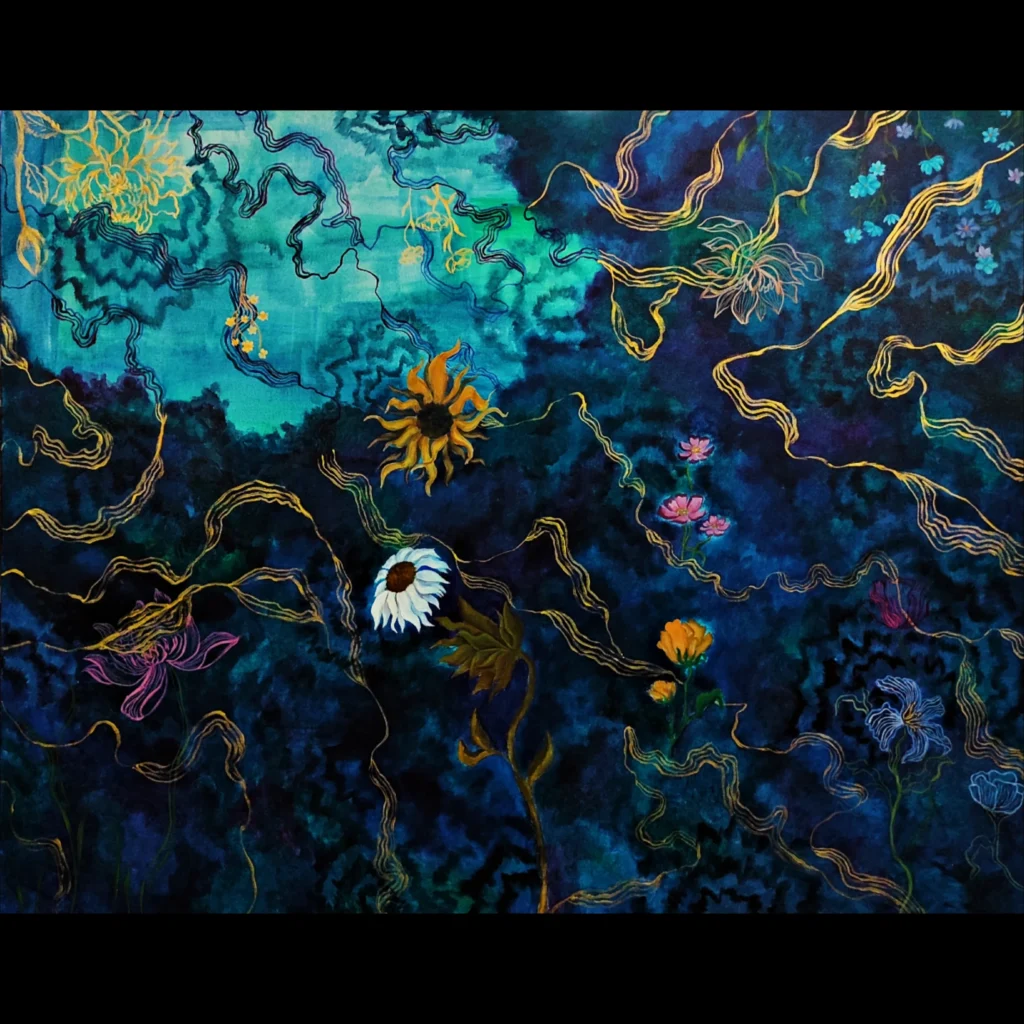
Nishkala Polamarasetty
Galaxy of flowers
Flowers drift through a night sky stitched with gold
Blue on blue, then deeper blue, the colour of water at midnight.
A thread of gold comes loose and wanders where it likes.
A sunflower turns, looking for a sun it cannot find.
The daisy lifts its white face like a small moon.
Some flowers are only outlines, pink and pale, half remembered.
Nothing here grows down into soil. Everything floats.
Galaxy of flowers by Nishkala Polamarasetty is from 2025. It is painted in acrylic on a large canvas, 121.92 × 152.4 × 5 cm. Deep blues and sea greens fill the surface like a sky at night. Gold lines wave across it like loose ribbons. Between them float a sunflower, a white daisy, small pink flowers and blooms drawn only in outline. Polamarasetty is based in Visakhapatnam and is connected with Andhra University. The artist says nature teaches without words.
Acrylic on canvas · 121.92 × 152.4 × 5 cm · 2025
Theme Living with nature
RC-605

Nishkala Polamarasetty
Evolution
A galaxy turns quietly inside every cell
Blue moves like water around white stones.
Each stone is a net of tiny rooms.
In one room, a red spiral turns slowly.
In another, yellow light gathers at the edge.
Small orange seeds wait in dark rings.
The near and the far wear the same skin.
Nishkala Polamarasetty paints Evolution in acrylic on Canson paper. Round shapes float in a deep blue ground. Many of them hold a fine net of small cells, like plant tissue seen under a lens. Inside some, red and yellow spirals turn like far galaxies. Short curved brush marks flow around the shapes like water around stones. Polamarasetty comes from Andhra University in Visakhapatnam. For Polamarasetty, nature teaches without words: patience from trees and surrender from rivers.
Acrylic on Canson paper · 56 × 71 cm · 2025
Theme Nature, cells and cosmos
RC-606

Nishkala Polamarasetty
Who am I?
Every face on this sheet gives a different answer
A yellow mouth laughs wide enough to fill the dark corner.
Beside it a blue cheek holds three small tears.
One mask is mint on one side and rust on the other.
The grey face with white eyes says nothing at all.
Two women lean into one outline, orange and blue, warm and cold.
Black lines run around everything like a fence that cannot decide who is inside.
Nishkala Polamarasetty paints Who am I? in acrylic on Canson paper. Polamarasetty studies at Andhra University in Visakhapatnam. The work dates from 2025 and measures 56 × 71 cm. Many faces crowd the sheet. Some look like masks. One face is half blue and half yellow. A grey face stares out with round white eyes. Two women at the right share one outline, one orange and one blue. Thick black lines hold every shape. A red heart, a paintbrush and a peacock feather sit among the faces.
Acrylic on Canson paper · 56 × 71 cm · 2025
Theme Many faces of the self
RC-607

Nishkala Polamarasetty
Fickle as a monkey
A chimpanzee in a red tie bets the house
Black air. Paper slips fall like late leaves.
A red tie lies flat down a white shirt.
The cards rest loose in a furred hand that has done this before.
A blue roof and a red car wait on green felt like small toys.
One square on the table says DEAD in thick black letters.
Around it all, pink spirals turn and turn.
Nishkala Polamarasetty paints a chimpanzee in a dark grey suit and a red tie. The animal sits at a green gaming table with cards held close in one hand. Paper slips fall through the black air around it. On the table lie stacks of chips, a small blue-roofed house and a red car. One box on the felt reads "DEAD". A border of pink and purple spirals frames the scene. Polamarasetty works in gouache on Canson paper. The painting measures 71 × 56 cm and dates from 2025.
Gouache on Canson paper · 71 × 56 cm · 2025
Theme Chance and the fickle mind
RC-608

Nishkala Polamarasetty
Tales of padmanabhaswamy
Something older moves across the face of the temple
Gold climbs the tower step by step, a crowd of small carved people.
Then grey water slides over it like smoke that has learned to coil.
A face looks out from the top with its crown of spikes.
Two wheels turn slowly in the stone.
The sky is stained like old paper left near a lamp.
Below, one small door waits with its steps, open.
Nishkala Polamarasetty paints a temple tower in warm gold and ochre. Rows of small carved figures climb its tiers. Over the tower lies a second drawing in grey wash and black line. Coiling forms and two wheels rise around a tall central shape with a fierce face at the top. At the bottom a small doorway opens between two pillars. Polamarasetty works in watercolour on a sheet of 71 × 56 cm. Faint pencil lines still show under the paint. Polamarasetty studies at Andhra University in Visakhapatnam.
Watercolour on watercolour paper · 71 × 56 cm · 2025
Theme Stories held in stone
RC-609

Nishkala Polamarasetty
Greed for power
His crown blazes gold while his red robe rots away
Gold spikes fan out behind his head like a sun that has stopped giving warmth.
The face is grey stone. A small red mark sits on the brow.
His hands rest on the throne but do not let go.
The red cloth is eaten with dark holes, wider near his feet.
Around him the blue and green night keeps moving.
He does not see it. He only sees the chair.
Greed for power is a 2025 work by Nishkala Polamarasetty of Andhra University in Visakhapatnam. It is made in oil pastels and measures 71 × 56 cm. A crowned king sits on a gold throne. Gold spikes rise behind his head like rays. His red robe is full of dark holes, as if something eats it from inside. Much of Polamarasetty's work looks at lessons from old Hindu writings such as the Ramayana and the Mahabharata. The aim is not belief. It is the lesson inside the story.
Oil pastels · 71 × 56 cm · 2025
Theme Power and decay
RC-610
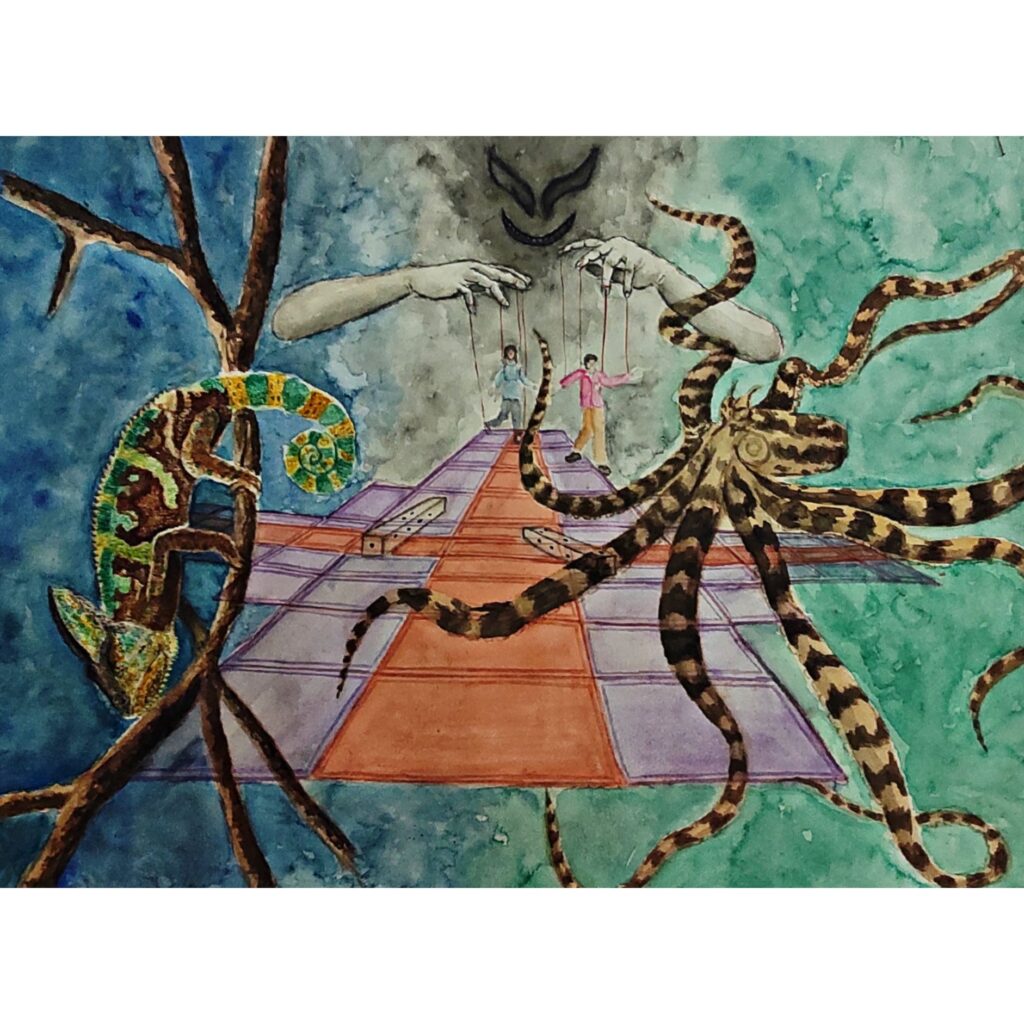
Nishkala Polamarasetty
Bad company
Someone above them is holding the strings
Grey cloud pools above a road of orange tiles.
Two hands lean out of it. The strings are thin as thread.
The small figures lift one foot each and wait.
A chameleon holds on to a dry branch, its green tail curled tight.
The octopus spreads its brown bands across the sea-green water.
Nobody on the road looks up.
In Bad company, Nishkala Polamarasetty paints a road of orange and purple tiles that runs into grey cloud. Two small figures walk on it. Pale hands above them hold their strings. A chameleon grips a bare branch on the left. A striped octopus reaches across the right. Made in 2025, the work is watercolour on Canson paper. The artist's college is Andhra University in Visakhapatnam. Polamarasetty paints in two series. One sees trees, rivers and insects as teachers. The other looks for lessons in the Ramayana and the Mahabharata.
Watercolour on Canson paper · 56 × 71 cm · 2025
Theme Influence and control
RC-611
From the open call
Hemlata Kantilal Patil
I am a printmaking artist from Nashik. I make prints about what I see and feel around me.My work is printmaking on paper, mostly around nature and human connection. I make it to understand my own feelings better - how we grow, hold on, and let go.I make them because these ordinary things hold a lot of memory for me and I don't want them to be forgotten.


Hemlata Kantilal Patil
Self2
Two quiet people, one thorny seed and the feelings between them
Green gathers at the bottom like a pond after rain.
At the top it thins to the yellow of a ripe lime.
A seed stands in the middle, its edge all thorns.
One small person carries roots inside the head.
Another keeps a stone of light in the chest.
Leaves drift past them and do not land.
Hemlata Kantilal Patil is a printmaking artist from Nashik. In Self2 the ink sits on the paper in one rough, rounded shape. Green deepens towards the bottom and turns yellow at the top. Fine white lines show through it. Two figures face each other across a large spiked seed. One has threads running from the head down the body. The other holds a seed in the chest. Patil makes prints to understand her own feelings about how we grow, hold on and let go.
Printmaking, ink on paper · 2026
Theme Growing and letting go
RC-2638

Hemlata Kantilal Patil
Dwandwa 2
A hollow tree holds a yellow heart inside its trunk
A tree opens its chest and shows a yellow room.
White lines turn inside it like a thumbprint, like water around a stone.
Brown seeds bristle on their stems and wait on square stools.
Two green ones stand closer and cooler, almost listening.
The bark is printed in tiny crosses, a net that holds the dark.
Everything hangs from one body and nothing falls.
Hemlata Kantilal Patil is a printmaker from Nashik. She studies at K.K. Wagh College of Visual Art. Patil makes prints about nature and human connection. In this print a wide tree spreads its bare branches across the paper. Its trunk opens in the centre. Inside, fine white lines curl around a glow of yellow edged in green. Spiky forms hang from the branches on thin stems. Each one rests on a heavy block. The brown and green ink looks like bark. In pencil below the image Patil marks the print 1/4.
Printmaking: ink on paper · 11 × 10 cm · 2026
Theme Holding on and letting go
RC-2639
From the open call
Durga
Art is not only a way for me to express creativity but also a way to share emotions and personal experiences. As an artist, I spent a long time searching for my true artistic voice and often felt lost, lonely, and uncertain. My perspective changed when I spent time with my grandmother in the mountains. There, I discovered that solitude can be a source of strength, peace, and self-understanding. My…

Durga
A peaceful farewell
One small fire, a quiet river and a hill that keeps watch
The hill holds every green and the rust of dry leaves.
Grey stones lie at its foot like sleeping animals.
The river is the colour of old glass and does not hurry.
On the pale bank a few people stand close together.
One small orange flame is the brightest thing here.
Beyond them the mountains turn to mist and let go.
A dark hill full of trees rises over grey rocks and a green river. On a pale bank a small group of people gathers around an orange fire. Mist hides the far mountains. Durga, of Jamia Millia Islamia in Delhi, paints this scene in oil on a wide canvas. The artist's grandmother lives independently in the mountains and is the main inspiration for the work. Durga mixes observation and imagination. The brushwork sits between realism and impressionism.
Oil on canvas · 60 × 91 cm · 2026
Theme Solitude and farewell
RC-445

Durga
Strength in solitude
A bare tree, a snowy peak and nobody else for miles
Night is the colour of ink left too long in the bottle.
A bare tree holds out its arms, brown as an old walking stick.
Behind it the peak wears its snow like a grey shawl.
No leaves. No birds. No lamp in any window.
The mist sits low in the valley and waits.
The old trunk stands in the cold and does not fall.
Durga is an artist from Jamia Millia Islamia in Delhi. For a long time Durga felt lost and lonely and unsure of an artistic voice. Time with a grandmother who lives independently in the mountains changes that. "My grandmother is the main inspiration behind my work," Durga says. Here a bare tree reaches across a deep blue night. A snowy peak rises through the mist behind it. Painted in acrylic and oil at 76.2 × 101.6 cm, the work sits between realism and impressionism.
Mixed media: acrylic and oil · 76.2 × 101.6 cm · 2026
Theme Solitude and resilience
RC-446

Durga
Morning Light at Sarangkot
Snow catches the first light while the valley still sleeps
Brown paper, the colour of tea left to cool.
White pencil scratches snow onto the far ridge.
The sharp peak on the right stands alone and does not mind.
Below it charcoal gathers like smoke in the low ground.
A few thin trees wait for the sun to reach them.
The quiet here is not empty. It is full of morning.
Durga is an artist from Jamia Millia Islamia in Delhi. In this drawing a line of snowy peaks rises above dark slopes and trees. Charcoal builds the shadows on brown paper. Fine white strokes pick out the snow where the light falls. Durga mixes looking with imagining and works between realism and impressionism. The mountains come from time spent with a grandmother who lives independently in the hills. There the artist learns that being alone can bring calm and strength.
Charcoal and pencil on paper · 48.26 × 81.28 cm · 2026
Theme Solitude as strength
RC-447
From the open call
Rashmeet Kaur
My practice explores dreams, identity, emotions, and the subconscious through painting and sculpture. I am drawn to the feelings and stories that are often difficult to express in words. I work with different materials, textures, and forms to turn these thoughts into something tangible. My process involves experimentation, observation, and allowing the material to guide the work. I want my art to create a sense of curiosity and invite people…


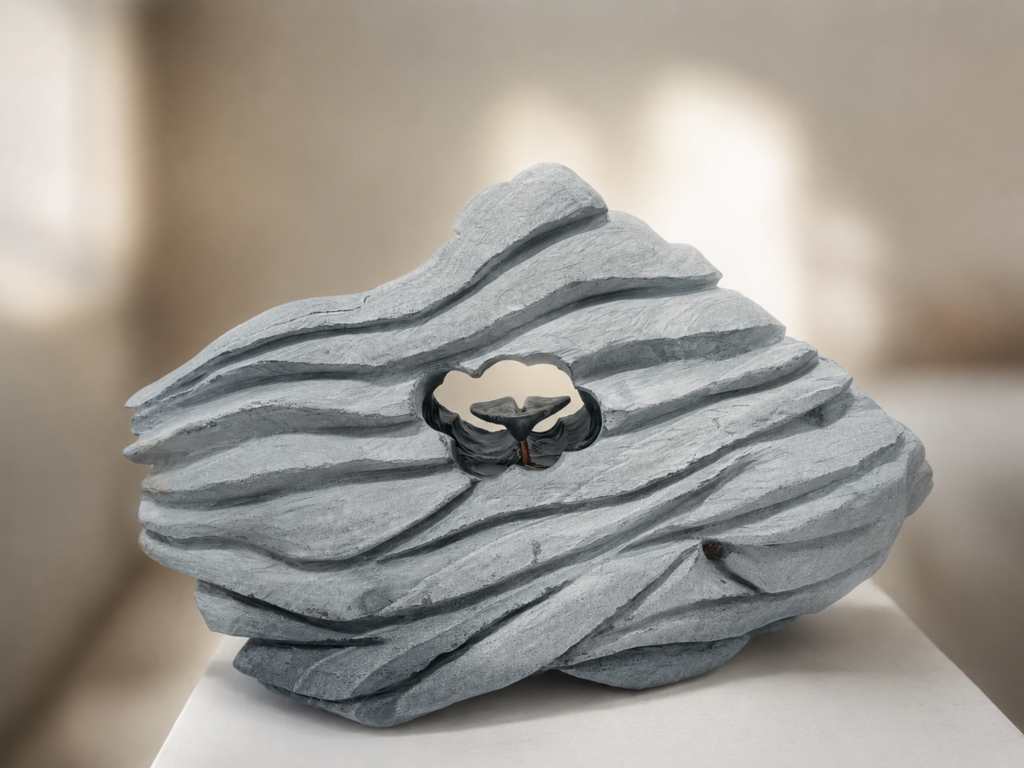
Rashmeet Kaur
Paper Dreams In The Sky
A cloud cut clean through solid stone
Grey stone combed by a slow wind that never blew.
Ridge after ridge like sky folded into a drawer.
In the middle a window shaped like a cloud.
Through it pale light from the far wall.
A small dark shape opens like a wing on a thread of rust.
The heaviest thing in the room holds something with no weight.
This grey stone sculpture by Rashmeet Kaur is from 2026. It measures 35 × 42 × 20 cm. Long ridges run across the stone like wind over sand or clouds in a sky. Near the centre is an opening in the shape of a cloud. Inside it a small dark form rises on a thin stem. Kaur works in painting and sculpture. She is drawn to dreams and feelings that are hard to put into words. She lets the material guide her. She wants each viewer to find their own meaning.
Stone · 35 × 42 × 20 cm · 2026
Theme Dreams held in stone
RC-3505
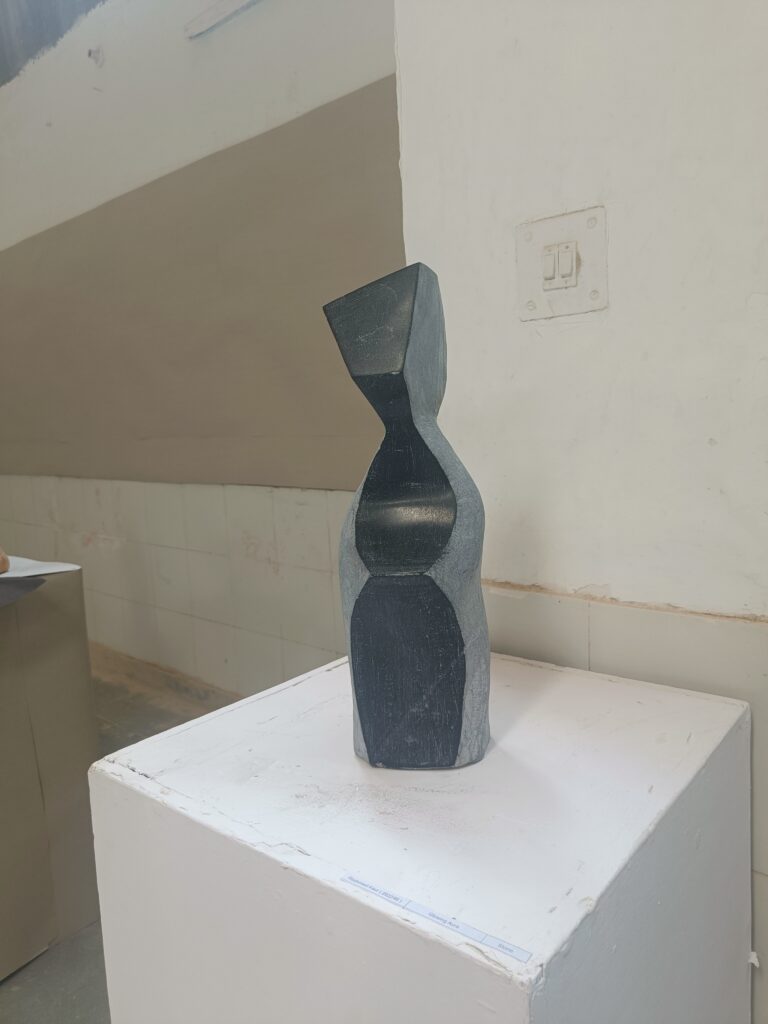
Rashmeet Kaur
Abstract muse
Rough grey stone, polished black, holding its breath
Grey stone, rubbed until a dark face wakes inside it.
A narrow waist, as if the block took a breath and held it.
The top tilts away, a flat plane catching the afternoon.
Rough skin on one side, polished night on the other.
On a chipped white plinth beside a light switch, it waits to be named.
Abstract Muse is a stone sculpture by Rashmeet Kaur from the Government College of Arts. It dates from 2025 and stands 50 cm tall. The form rises and pinches in like a waist. Then it opens into a slanted, flat top. Some faces are polished dark and smooth. Others stay grey and rough. Kaur works with dreams, feelings and the subconscious. She lets the material guide the work. She does not fix one meaning. She wants each viewer to find their own.
Stone · 50 × 18 × 15 cm · 2025
Theme Feeling given form
RC-3507
From the open call
Shruti
I always start with a rough idea, layout, base sketch for whatever artwork I'm about to do. I work mainly with oil pastels and oil paints. Whenever I see texture I love to replicate the same using thick impasto strokes. So it all starts with my sketches and layouts and then I experiment with different media and just love to go with the flow. These are the small cut out…



Shruti
Contemplating
A purple glow burns under every blue in this quiet room
Blue settles on the walls like an evening that came too early.
A bowed head. Hair falls over the eyes.
Under the skin a purple keeps burning.
One shoulder catches the light from the left and holds it.
On the table a striped shape waits in red and white, the only warm word in the room.
The cloth at the edge remembers pink.
Nobody speaks. The thought is not finished yet.
A figure sits in a quiet room with eyes turned down. Shruti paints the scene in blues and violets. Light comes from the left. It falls across one shoulder and the side of the face. Shruti always begins with a purple underpainting. Parts of it stay uncovered so that it glows through the top layers. Each painting starts as a rough sketch and layout. Here the brushstrokes stay loose and easy to see on the wall, the skin and the striped cloth.
Oil on canvas · 76.2 × 91.44 × 3.5 cm · 2026
Theme Solitude and quiet thought
RC-272
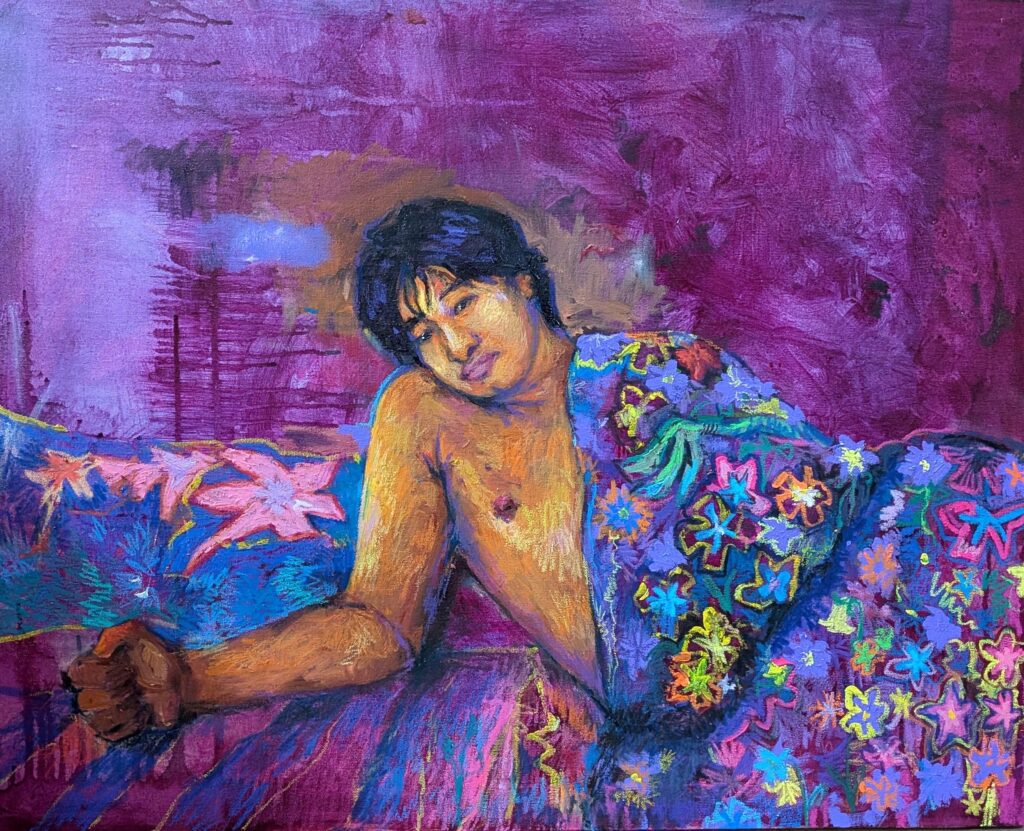
Shruti
valley of emotions
A tired gaze under a cloth of bright drawn flowers
Magenta runs down the wall like late rain.
He rests his cheek near his own shoulder and waits.
One fist holds on to the edge of the bed.
Stars of pink and lime and blue crowd the cloth around him.
Under it all the purple keeps burning through.
It is the colour of a room just after the lamp goes out.
Shruti trained at the College of Art in New Delhi. She begins each work with a rough sketch and a layout. Then she lets the materials lead her. Here a young man lies back against a cushion. His head tilts and his eyes meet ours. Under everything is a purple underpainting. She leaves it showing on purpose so the picture glows. She lays down oil pastel first for colour and texture. Sometimes she melts it with a lighter so it blends. Thick strokes of oil paint follow.
Oil paint, oil pastels and acrylics on canvas · 60.96 × 76.2 × 3 cm · 20263
Theme Rest and feeling
RC-273

Shruti
Rosy
A doll keeps watch over a cupboard full of folded days
The cupboard doors open like two yellow curtains.
Jeans hang blue and tired from thin hangers.
Shelves hold folded reds and greens, pressed flat by years of use.
A doll in a red dress sits at the edge, her yellow hair bright in the dark.
Below her the clothes slide into a soft heap.
Purple glows through every gap, like the last light in a room at dusk.
Shruti paints an open cupboard in Rosy. Folded clothes fill the shelves. Jeans hang from hangers at the top. A doll in a red dress sits on a ledge near the bottom with a heap of cloth below her. Shruti always begins with a rough idea and a base sketch. She then lays down a purple underpainting. She leaves parts of it showing on purpose so that the colours glow. Here that purple shows in the shadows between the shelves. The canvas is tall and narrow.
Acrylic on canvas · 152.4 × 60.96 × 0.1 cm · 2025
Theme Memory in a cupboard
RC-275

Shruti
self portrait
A face that glows from a purple layer hidden underneath
Purple lies under everything, like dusk under skin.
A blue cheek turns away from a yellow fire.
The mouth is one orange stroke, still warm.
Thick pastel rises off the paper in ridges you could touch.
Green stems lean in from the dark edges.
The eyes keep their black and say nothing.
Shruti is from the College of Art in New Delhi. This small self portrait is one of the pieces she makes before she starts a big canvas. She always begins with a purple underpainting. She leaves parts of it bare so that it glows through. Over it she lays oil pastel in thick strokes to build texture. At times she melts the pastel with a lighter so the colours blend. She pairs complementary colours: yellow against purple, orange against blue.
Oil pastel on paper · 14.8 × 21 × 0.1 cm · 2026
Theme The self in colour
RC-276

Shruti
Nostalgia
On the floor below a doll, a child stares straight back
Purple sits under everything, under the grey floor and the brown knees.
A doll folds over the drawer, its legs hanging, its pink dress gone pale.
On the blue wall someone has drawn a sad face, a small figure, a question.
The bedspread keeps its white flowers.
A red thread holds the wrist.
The child grips a stick and waits for us to speak first.
A child sits on a grey floor and looks straight out of the painting. Behind are a pink bedspread, a doll folded over wooden drawers and small drawings on a blue wall. Shruti begins every work with a rough sketch and layout. Then comes a purple underpainting. Parts of it stay uncovered so the colour glows through. Here it shows in the shadows of the floor and the skin. Shruti studies at the College of Art in New Delhi.
Oil on canvas · 76.2 × 101.6 × 3 cm · 2025
Theme Childhood and memory
RC-274
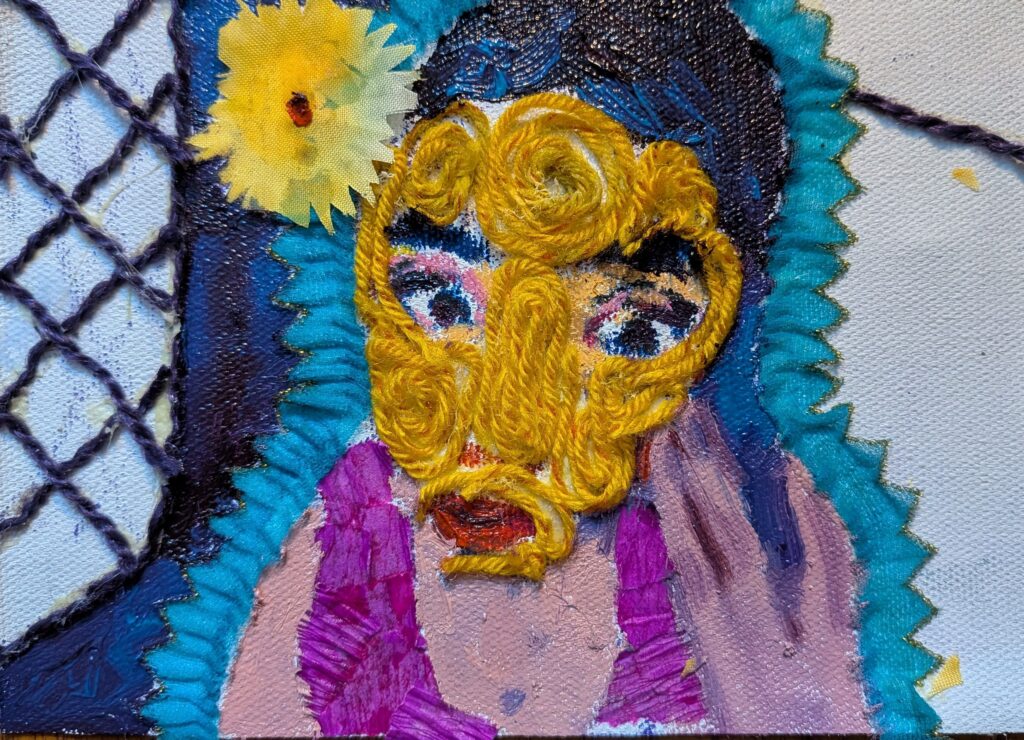
Shruti
Besan ka pack
A face pack drying, held forever in coils of yellow wool
Yellow wool curls over the cheeks like wet gram flour drying.
Two dark eyes look out through the gaps.
A red mouth waits under one last loop.
Hands press the face, pink going to violet.
Turquoise lace stands up around her like a frill of small waves.
A paper flower sits in her hair and holds the light.
In Besan ka pack, a face looks out from under a gram flour face pack. Shruti, of the College of Art in New Delhi, makes the pack from coils of yellow wool laid over oil paint. Turquoise lace frames the head. Her work always begins with a rough sketch and a layout. Then she tries different media and goes with the flow. She starts with a purple underpainting. She leaves parts of it showing so that it glows.
Mixed media: wool, lace, paper and oil on canvas · 14.8 × 21 × 0.1 cm · 2026
Theme A home beauty ritual
RC-277
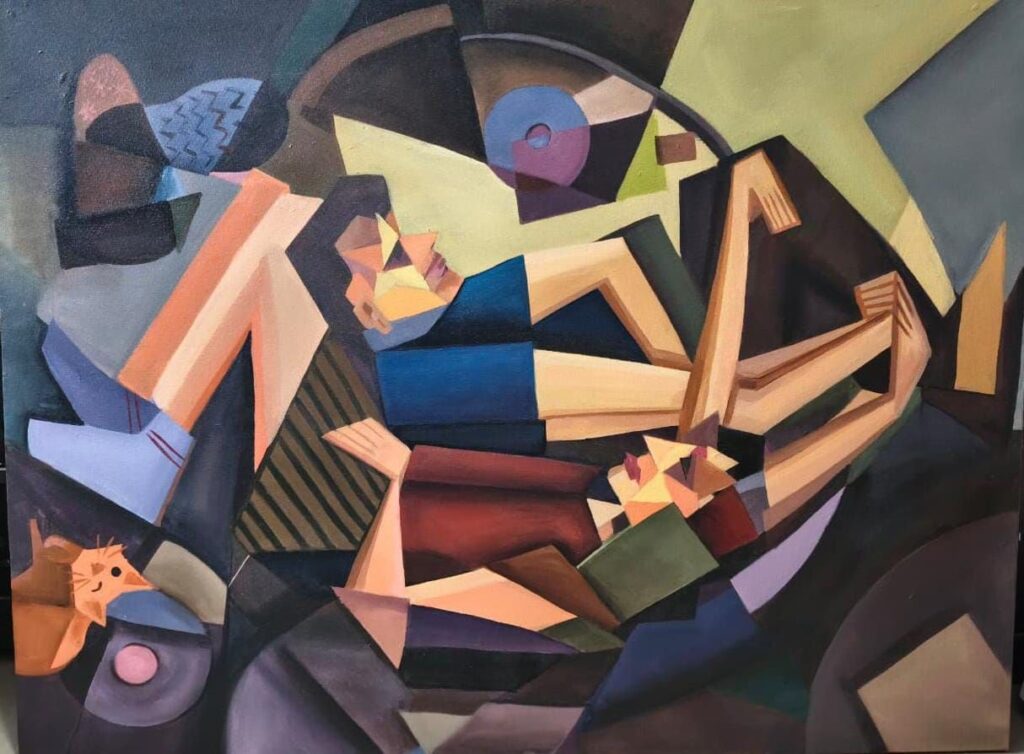
Shruti
spooning
Knees, elbows and a smiling cat share one small space
Elbows meet knees and nobody minds.
Blue shorts, a red shirt, skin cut into warm wedges.
The cat in the corner keeps one eye on the music.
Records turn without a sound.
Green light leans in from above.
Under everything a quiet purple hums and holds them close.
In spooning, Shruti breaks two resting figures into sharp planes of colour. One figure in blue shorts lies along the top. A smaller figure in red curls up below. Their arms and knees fold together. A striped cloth, two round discs like records and an orange cat fill the edges. Shruti comes from the College of Art in New Delhi. She begins each work with a rough sketch and a layout. She always starts with a purple underpainting. She leaves parts of it showing so that the colour glows.
Acrylic on canvas · 72.6 × 101.6 × 3 cm · 20253
Theme Closeness and rest
RC-278
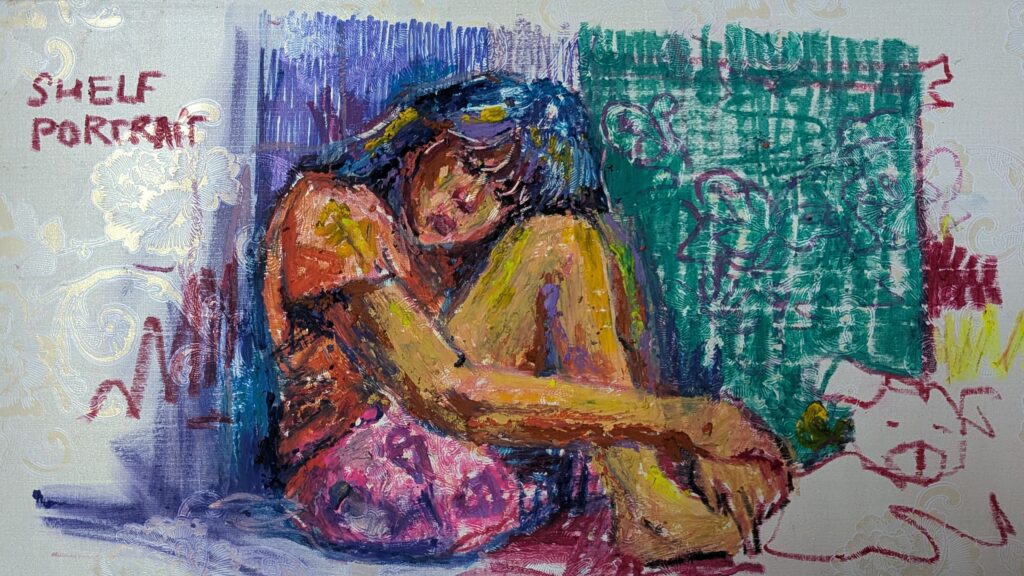
Shruti
shelf portrait
Knees drawn up, eyes closed, a body glowing over purple
A woman folds into herself. Knees up. Eyes shut.
Her arms are orange bark. Her hair is night with a few yellow sparks.
Purple strokes stand behind her like rain on a wall.
A green square hums at her shoulder, full of red flowers drawn fast.
Under it all lie pale printed roses and thin gold vines.
She rests on a pink cloth and does not look up.
Shruti is from the College of Art in New Delhi. Every work begins with a rough idea, a layout and a base sketch. Here the medium is oil pastel on a small PVC panel. The pastel goes on thick so the strokes build texture. Shruti often melts pastel with a lighter to help the colours blend. Each work starts with a purple underpainting. Shruti leaves parts of it showing on purpose because it makes the picture glow. You can see it in the purple strokes behind the folded figure.
Oil pastel on PVC panel · 21 × 29.7 × 0.2 cm · 2026
Theme Rest and turning inward
RC-279
From the open call
Krishna Ganapati
My practice explores how landscapes are changed through human interventions, and how land slowly becomes a commodity through extraction, construction, and different kinds of development. I come from Mavinkurva, near Honnavar, where I grew up around agricultural land, coconut plantations, laterite soil, the sea, and the backwaters. So I have seen how these landscapes are changing around me. In my current project, LAYER BY LAYER, I am looking at the…
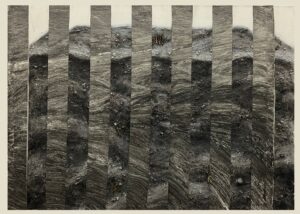


Krishna Ganapati
Rescaping
The ground, opened strip by strip, shows what was taken
A grey field cut into standing boards.
The pale sky shows only in thin gaps at the top.
Charcoal and ash sit thick, with grit you could lift with a fingernail.
Between them, scraped lines bend like wind over cut grass.
Small twists of gold rest in the dark soil like rusted wire.
On every second strip the earth lies open.
Krishna Ganapati grew up in Mavinkurva, near Honnavar, among farmland, coconut plantations, laterite soil, the sea and the backwaters. Ganapati has watched that land change. In Rescaping the large canvas is divided into tall strips. Some strips hold dark, gritty layers, like the side of a dug pit. Others carry scraped, swirling lines. Charcoal, ash, jute and glue build up the surface. The aim is not to picture a landscape. It is to show what has been removed, added, changed or left behind.
Charcoal, ash, jute, emulsion and synthetic glue on canvas · 152.5 × 213 cm · 2026
Theme Land changed by people
RC-418
Krishna Ganapati
Crated
A sheet of ash, scratched back until the paper shows through
Grey ash, thick as a road after rain.
Someone has dragged a nail through it again and again.
Thin white lines show where the pale paper waits underneath.
Two empty slots wait for hands to lift it.
The other edge is cut into teeth.
It looks like the side of a box left out too long.
What was carried in it is gone.
Krishna Ganapati grew up in Mavinkurva near Honnavar. It is a place of coconut plantations, laterite soil, the sea and backwaters. Ganapati has watched that land change. In Crated, ash and synthetic glue cover a sheet of Canson paper. Long scratches cut through the grey crust and show pale paper underneath. The sheet is cut into a hard shape. Two narrow slots sit near one edge. Square notches bite into the other. Ganapati studies at the SN School of Arts and Communication, University of Hyderabad.
Ash and synthetic glue on Canson paper · 30 × 23 cm · 2026
Theme Marks on changing land
RC-419

Krishna Ganapati
Six realms of plastic
Who turns the wheel that cuts the land?
A saw blade stands on a three-legged stool.
Six windows of grey and white, cut like slices from one round loaf.
A turtle. A cactus. A box printed all over with a brand.
The teeth of the wheel are the dark red of wet earth.
The handle waits for any hand.
String pulls the canvas tight to bamboo, as if the land itself is tied down.
Krishna Ganapati grew up in Mavinkurva, near Honnavar, among farmland, coconut plantations, laterite soil, the sea and the backwaters. Ganapati has watched that land change. Here a saw blade sits on a crank above a small three-legged stool. Its six parts hold six scenes. A cactus stands in fenced desert. A turtle swims near the shore. A stepped mound rises from the sand. Kaavi powder, gouache, charcoal, glue and emulsion build the surface on canvas. Ganapati studies at the SN School of Arts and Communication, University of Hyderabad.
Kaavi powder, gouache, charcoal, synthetic glue and emulsion on canvas · 162 × 124 cm · 2025
Theme Land as commodity
RC-421
Krishna Ganapati
Shan-mukha (the one with six face)
Five windows show the land. The sixth is painted shut
The first square is black enamel, shining like a road after rain.
Then the red comes, curling like ink dropped in water.
A pale blue band holds each horizon still.
Charcoal finds a hill, a ring cut deep into the ground, a boat under small flags.
A saw blade circles three round tools.
Six faces of one land, each watching what is taken.
Krishna Ganapati grew up in Mavinkurva, near Honnavar, among coconut plantations, laterite soil, the sea and the backwaters. Ganapati has watched that land change. Shan-mukha means the one with six faces. Here, six square panels sit in a grid. Red and white swirls of Chinese ink fill five of them. Four are cut into shapes like a saw blade and a drop. Over the ink, charcoal draws a hill, a ring dug into the ground, a boat and a long machine. The first panel is only black enamel.
Charcoal, Chinese ink and enamel on Canson paper · 38 × 56 cm · 2025
Theme Land changed by people
RC-422

Krishna Ganapati
Unboxing
Cardboard boxes, cut and scraped until they look like stone
Brown card, the colour of dry laterite.
Long grooves run down it like rain has found the same path for years.
At the edges the layers open, thin as pages.
Sun falls flat and warm on one side.
A white sheet hangs behind, a tiled floor below.
Something that once held things now stands alone, upright and still.
Unboxing is a tall column made from carton boxes and synthetic glue. It stands 182 cm high. Its sides are cut and scraped into deep grooves. The layers of card show at the edges like bands of rock in a cliff. Krishna Ganapati comes from Mavinkurva, near Honnavar, a place of laterite soil, coconut plantations and backwaters. Ganapati's work looks at how people change the land through extraction, construction and development. Here packing material becomes something that seems dug from the earth.
Carton box and synthetic glue · 182 × 90 × 90 cm · 2026
Theme Land changed by people
RC-417
From the open call
Harish Sharma
My name is Harish Sharma, and I am currently pursuing my Master of Fine Arts in Painting from Jamia Millia Islamia, having completed my Bachelor of Fine Arts from the College of Art in Delhi. Being a visual artist, my work doesn't just come from sitting in a studio and mixing colors—it comes from walking down the streets, observing everyday life, and looking closely at the people who keep this…


Harish Sharma
The Residue
What stays on the wire after the people have gone
Brown dark as old tea, lit here and there with rust and gold.
Line after line of wire runs across, each knot a small closed fist.
White cloth hangs from the barbs, thin as a shirt worn too long.
One rag has slipped low and holds on by a corner.
Behind the wire a brown shape waits, folded like a bag no one came back for.
The light keeps returning to the cloth.
Harish Sharma paints torn white cloth caught on rows of barbed wire. The rags hang like things left behind after people have crossed. Sharma is studying for a Master of Fine Arts in Painting at Jamia Millia Islamia. His family comes from a village in Bihar. His father went to Delhi first to find work. Later the family built their own home in Haryana. Sharma works in acrylic. He lays a dark brown ground with patches of amber light. Each barb of wire is painted clearly.
Acrylic on canvas · 60.96 × 76.2 × 2.54 cm · 2026
Theme Migration and lost identity
RC-302

Harish Sharma
Human Acclimatized
One wing dark, one pale, both learning a new sky
Rust spreads across the canvas like heat over a dry field.
Someone has scratched circles into it again and again, the way a hand traces a name.
A black wing rises, its tips already warm with brown.
Below it a grey wing drifts, catching orange at its edges.
There is no bird. Only the wings, still holding the shape of flight.
They are taking on the colour of the air they move through.
Harish Sharma paints the lives of people who move to big cities for work. He knows this life from home. His father left Bihar for Delhi to find work. The family followed. Later they built their own house in Haryana. In this acrylic painting two wings float on a rough orange ground. One is black. One is pale grey. Sharma uses them to show a migrant changing to fit a new place. He is studying for a Master of Fine Arts in Painting at Jamia Millia Islamia.
Acrylic on canvas · 60.96 × 76.2 × 2.54 cm · 2026
Theme Migration and adaptation
RC-304

Harish Sharma
Outdoor study
A white figure sits in the shade beside a heap of sand
Sand piled high, the colour of warm bread.
A white figure sits and thinks, his chin on his fist.
Leaf shadows move across the road like slow water.
The brick wall holds the heat of the afternoon.
A small stone head waits by the tree, broken pieces at its feet.
Nobody comes. The gate stays shut.
Harish Sharma paints a quiet corner in strong daylight. A heap of pale sand rests by the kerb. A white sculpted figure sits on a chair with its head in its hand. A small bust and broken stone pieces lie near a tree. Behind them stand a red brick wall and a closed iron gate. Sharma is studying for a Master of Fine Arts in Painting at Jamia Millia Islamia. He says his work comes from walking the streets and looking closely at everyday life.
Acrylic · 76.2 × 101.6 × 2.4 cm · 2025
Theme Stillness in the street
RC-305

Harish Sharma
In Transit
Cut the bus open and a young man looks back
Grey all around, like a wall at dusk.
A white sheet, creased and torn at the edges, holds a bus the colour of marigolds.
Someone has cut the bus open.
Inside it is dark and warm and full of shoulders.
One young man in a white shirt holds on and turns his face toward us.
The rest of the bus hangs below him, upside down, still moving.
In Transit is an acrylic painting from 2023 by Harish Sharma. An orange city bus covers a white sheet that looks crumpled and torn. A cut runs across the middle. Through it we see a young man in a white shirt among other passengers. Sharma studies for a Master of Fine Arts in Painting at Jamia Millia Islamia. His family moved from a village in Bihar to Delhi. Later they built their own home in Haryana. When Sharma sees people standing in packed buses, he thinks of his father.
Acrylic · 52 × 59 × 2.5 cm · 2023
Theme Migrant life in the city
RC-306

Harish Sharma
Two Different Worlds
A fish far from water tries to hide inside the news
The paper is grey with small print and one red stripe.
It folds around the fish like a borrowed shirt.
The scales are dull silver, dry where the water should be.
One amber eye stays open and looks away from us.
Around it the dark ground breaks into old gold, like light under a door.
The fish is still. It is trying very hard to be small.
Harish Sharma paints a fish that has left the water. Its grey body lies on a dark brown ground. A sheet of newspaper wraps around it like a coat. The fish stands for a migrant who hides from a city full of papers. Sharma's family comes from a village in Bihar. His father went to Delhi first to find work. Later the family built a home in Haryana. Sharma studies painting at Jamia Millia Islamia. In acrylic he paints each fold and printed column of the paper.
Acrylic on canvas · 106.68 × 137.16 × 5.08 cm · 2026
Theme Migration and city life
RC-299
Harish Sharma
Perch
Real feathers gather around one small flame far from home
Pale sticks curve like the ribs of a wing that lost its bird.
Real feathers lie against the paint, brown and black and speckled.
A white breast bends down toward a glass lamp.
One small flame stands still in the dusk.
The sun is a soft orange circle in the corner.
Everyone here has come a long way to sit near this light.
Harish Sharma paints people who leave home to find work. His family came from a village in Bihar. His father went to Delhi first. Later the family built a home in Haryana. In Perch, Sharma paints a frame of pale bones shaped like a wing. He sets real feathers on the canvas over acrylic paint. The feathers gather above a small oil lamp. Sharma sees them as travellers from many places. They take warmth from one flame before they fly on.
Acrylic and real feathers on canvas · 101.6 × 76.2 × 2.54 cm · 2026
Theme Migration and shared hope
RC-300
Harish Sharma
Interrupted flight
Every bird is tied by the same white thread
A red wall, scraped and rubbed like dry earth.
White thread runs down from somewhere above the frame.
One dark bird hangs on its back with its wings still open.
Below, the others lie in a soft black pile, blue at the edges.
A small bird is still falling.
Near the top, a thin green twig is all that is left of a tree.
Harish Sharma paints this work in acrylic on canvas. A large dark bird hangs on its back near the top. White threads wrap its body and run up out of the frame. Below, black and blue birds lie in a heap, tied in the same thread. One small bird still falls. The red ground is brushed loosely. Sharma's family comes from a village in Bihar. His father went to Delhi first to find work. Sharma is studying for a Master of Fine Arts in Painting at Jamia Millia Islamia.
Acrylic on canvas · 101.6 × 26.2 × 3.1 cm · 2026
Theme Migration and displacement
RC-301
Harish Sharma
Diaspora,
A calf from home rests on a saw above the city
Pale blue sky, the colour of a morning far from the village.
A saw blade, dark as river water, holds a man and a calf.
He looks away from them, chin on his folded arms.
A litchi splits open, pink and wet, falling slowly.
A hoopoe drops with its striped crest down.
Below, the towers lean as if the ground has tilted.
Nobody here knows the calf's name.
Harish Sharma paints himself resting his arms on a huge handsaw. The saw floats above tall city buildings. It stands for the carpentry tools of his ancestors. Around him are memories of rural Bihar: peeled litchis, a sparrow, a hoopoe and a calf the family loved. His family's roots are in Bihar. His father moved to Delhi first to find work. Today the family lives in a home they built in Haryana. Sharma is studying for a Master of Fine Arts in Painting at Jamia Millia Islamia.
Acrylic on canvas · 91.44 × 152 × 3.81 cm · 2025
Theme Migration and home
RC-303
From the open call
Priyotosh Ghosh
My work comes from my experience of growing up in Basahari, a farming community in Birbhum, West Bengal. I have always been closely connected to agricultural land and rural life, so for me, the land is not just a place. It carries memories of people, farming, seasonal changes, labour and knowledge that is passed from one generation to another. I mainly work with painting and mixed media, using materials that…



Priyotosh Ghosh
Memory Embedded in Farming Land
A field remembered in ash, jute and thumbprints
Grey dust the colour of a field after burning.
The weave of a jute sack pressed into it, again and again.
In one corner an old stamp paper. Below it, inked thumbs in rows.
Names written by hand, then fading into ash.
A dark tool shape hangs near the far edge.
The canvas has the outline of a plot no one has measured.
Priyotosh Ghosh comes from Basahari, a farming community in Birbhum, West Bengal. The materials in this work come from farm life. Ghosh uses ash from straw, rice husk and cow dung. Jute leaves the print of its weave on a shaped canvas. Ghosh does not fully control how the ash spreads. Those changes stay in the work. Faint handwriting and rows of thumbprints sit inside the grey, like old land papers slowly turning back into soil.
Straw ash, rice husk ash, cow-dung ash and jute impressions on shaped canvas · 152.4 × 223.52 cm · 2026
Theme Land, labour and memory
RC-412
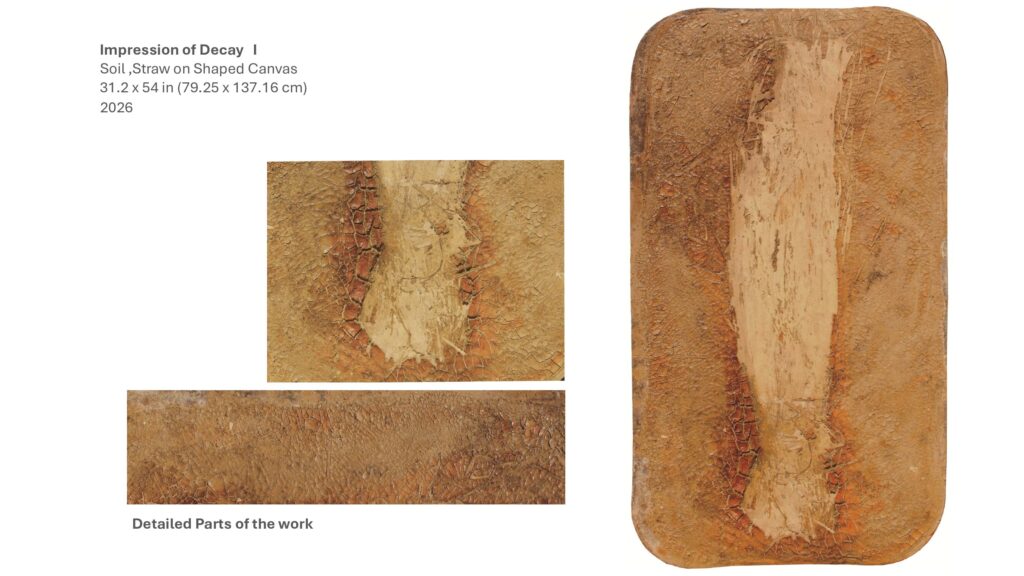
Priyotosh Ghosh
Impression of Decay I
He let the soil crack and kept every line
A field in the last week before rain.
The earth splits into small brown tiles with rust at every edge.
Down the middle runs a pale path, scraped thin as old straw.
It could be a footprint. It could be a sheaf laid down.
The corners are soft, like a tray of drying mud.
Nothing here is still. The cracks are still opening.
Priyotosh Ghosh comes from Basahari, a farming community in Birbhum, West Bengal. He works with materials he finds around him. Here he uses soil and straw on a tall shaped canvas with rounded corners. He does not try to fully control the soil. As it dries, it cracks into small plates of brown and rust. A pale band runs down the centre, scratched like dry straw. For Ghosh, the land holds memories of farming, labour and changing seasons. He lets each crack become part of the work.
Mixed media: soil and straw on shaped canvas · 137.16 × 79.25 cm · 2026
Theme Memory held in soil
RC-414
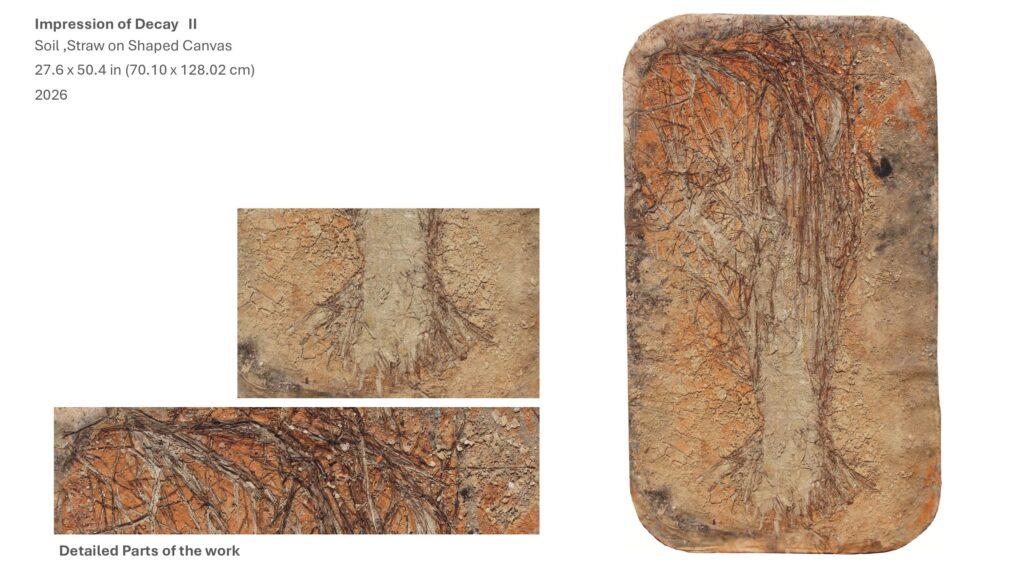
Priyotosh Ghosh
Impression of Decay II
A tree of straw rises from soil left free to crack
Orange earth, the colour of a field after the harvest fire.
Pale soil runs up the middle like a path worn by feet.
Straw splits at the top into thin dry branches.
At the bottom it spreads out and holds on.
Everywhere the ground has opened into small cracks.
A dark stain sits in one corner, quiet as an old burn.
Priyotosh Ghosh comes from Basahari, a farming community in Birbhum, West Bengal. He studies at Biswa Bangla Biswabidyalay in Bolpur. In this work he lays soil and straw on a shaped canvas with rounded corners. The straw outlines a tall pale trunk. Its strands branch at the top and spread like roots at the base. Ghosh does not try to control the soil. It cracks as it dries and the cracks stay in the work. For him these materials hold the memory of farm land.
Soil and straw on shaped canvas · 128.02 × 70.1 cm · 2026
Theme Land, memory and decay
RC-415

Priyotosh Ghosh
Impression of Decay III
Soil and straw, left to crack and change as they will
Orange earth, cracked fine like the skin of a dry field.
A sheaf of pale straw sweeps across it, heavy with clay.
Dark threads run loose from its edges like roots looking for water.
At the corners the ground turns white and thin.
The frame is rounded like a winnowing tray.
Nothing here stands still. It is all slowly drying, slowly letting go.
Priyotosh Ghosh comes from Basahari, a farming community in Birbhum in West Bengal. Ghosh studies at Biswa Bangla Biswabidyalay in Bolpur. In this work, soil and straw sit on a shaped canvas with rounded corners. Ghosh does not try to control the material. The soil cracks as it dries. The straw slowly decays. These changes become part of the work. For Ghosh, farm land holds memories of people, labour, seasons and knowledge passed from one generation to the next.
Soil and straw on shaped canvas · 97.54 × 124.97 cm · 2026
Theme Land, memory and decay
RC-416
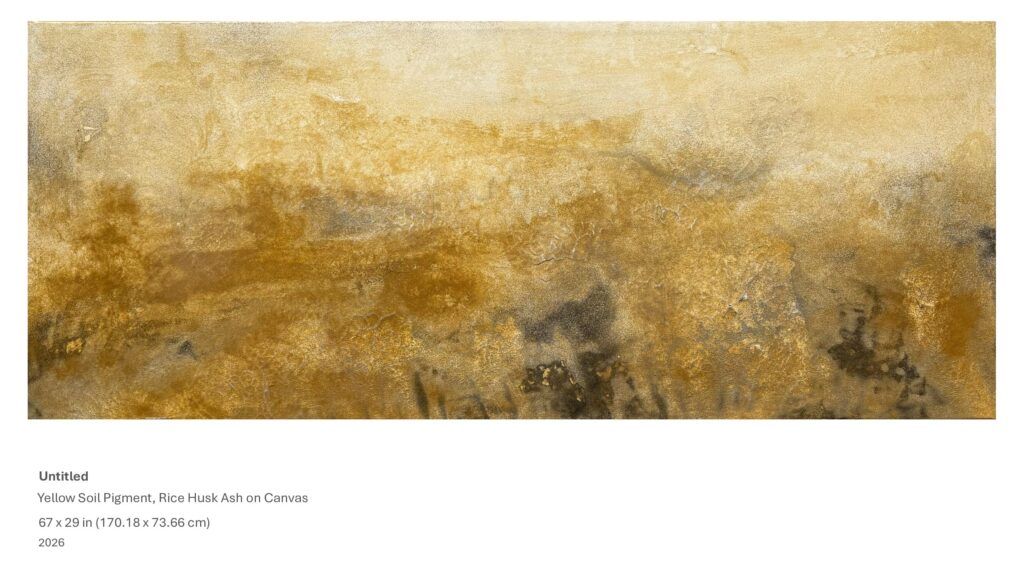
Priyotosh Ghosh
Untitled
A field painted with the field itself
Yellow soil, pressed flat and left to dry.
At the top it is pale, like dust in afternoon light.
Lower down the ochre thickens and turns to rust.
Small cracks open where the earth pulled tight.
Ash settles at the bottom edge in dark clumps.
It is what is left after the husk has burned.
Priyotosh Ghosh comes from Basahari, a farming community in Birbhum, West Bengal. Ghosh works with materials found around that land. Here, yellow soil pigment and rice husk ash sit on canvas. Ghosh does not try to control them. Soil cracks. Ash spreads. These changes stay in the work. Fine cracks run through the pale upper half. Near the bottom edge, dark patches of ash gather in low marks. Ghosh studies at Biswa Bangla Biswabidyalay in Bolpur.
Yellow soil pigment and rice husk ash on canvas · 30.48 × 35.56 cm · 2026
Theme Land and memory
RC-413
From the open call
Bhaskar Thakur
I wanted to explain why I soft-focus everything in my work, not just as a visual trick, but as a deliberate way to push back against a world that demands everything be totally clear-cut and locked into rigid boxes. My work draws from memory, fantasy, queer desire, and ordinary life. Obscurity is my political stance—a refusal of fixed appearances and binary truths. Much of my practice handles intimacies and desires…


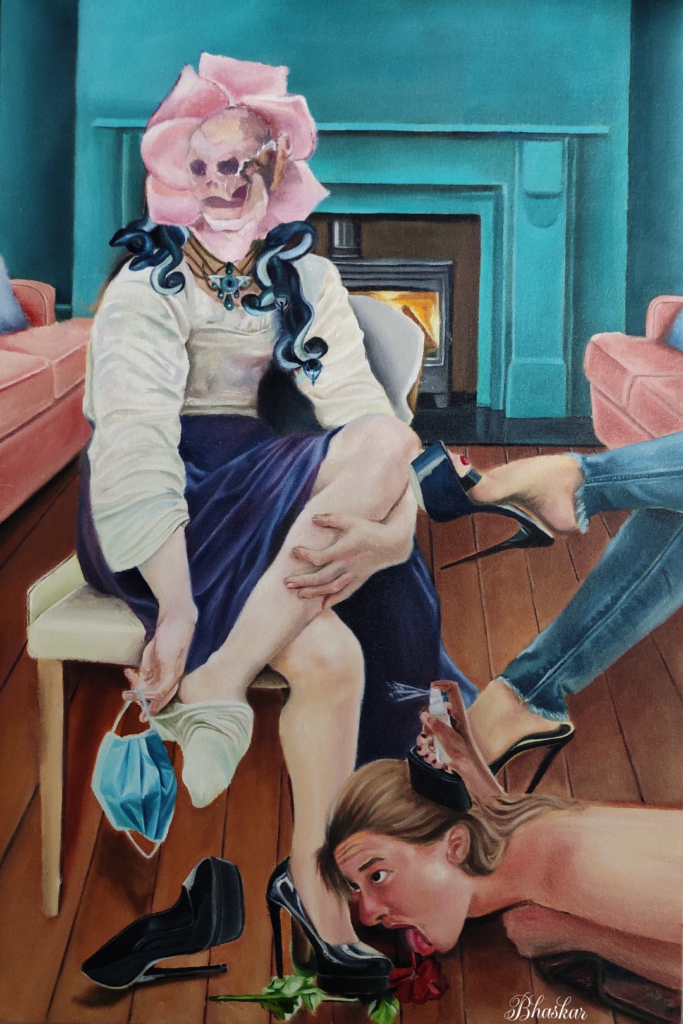
Bhaskar Thakur
Dead and wild
A rose for a face, a skull inside the petals
Teal walls hold the heat of a small stove.
A pink rose opens where a face should be and a skull looks out from the petals.
A blue mask hangs from one hand like a thing finished with.
One black heel stays on. The other lies on the floorboards.
On the wood a red rose waits under a pointed shoe.
The room is warm and nothing in it is still.
Dead and wild is an oil painting on canvas from 2021. It measures 91 × 71 cm. Bhaskar Thakur is based in Ludhiana. His college is Kala Bhavana in Santiniketan, West Bengal. In a teal room with a lit stove, a figure sits with a pink rose for a head. A skull looks out from the petals. Thakur sees obscurity as a political stance. Here the hidden face carries that idea. Shoes, a mask and a fallen rose suggest desire without spelling it out.
Oil on canvas · 91 × 71 cm · 2021
Theme Queer desire and concealment
RC-271

Bhaskar Thakur
Buried Under the Kink
A sunflower hides a face in a room that refuses focus
A sunflower sits where a face should be.
White cloth spills down the canvas like poured milk, cut into small squares.
Polka-dot socks, a pink cup, a green shoe with red laces.
Every body is close and every body is hidden.
The floor is blue tile, teal tile, pink grid.
Look harder and the squares only grow larger.
Someone is resting here who does not want to be named.
Bhaskar Thakur is from Ludhiana. Thakur's college is Kala Bhavana in Santiniketan, West Bengal. In this oil painting from 2025, the whole scene breaks into small squares, like a picture seen too close on a screen. Bodies lie across a tiled floor. A sunflower hides one face. Thakur blurs things on purpose and calls obscurity a "political stance". The work comes from real conversations and trust with other queer people. These moments are never shown directly. They are only suggested.
Oil on canvas · 101 × 76 cm · 2025
Theme Queer intimacy without exposure
RC-264
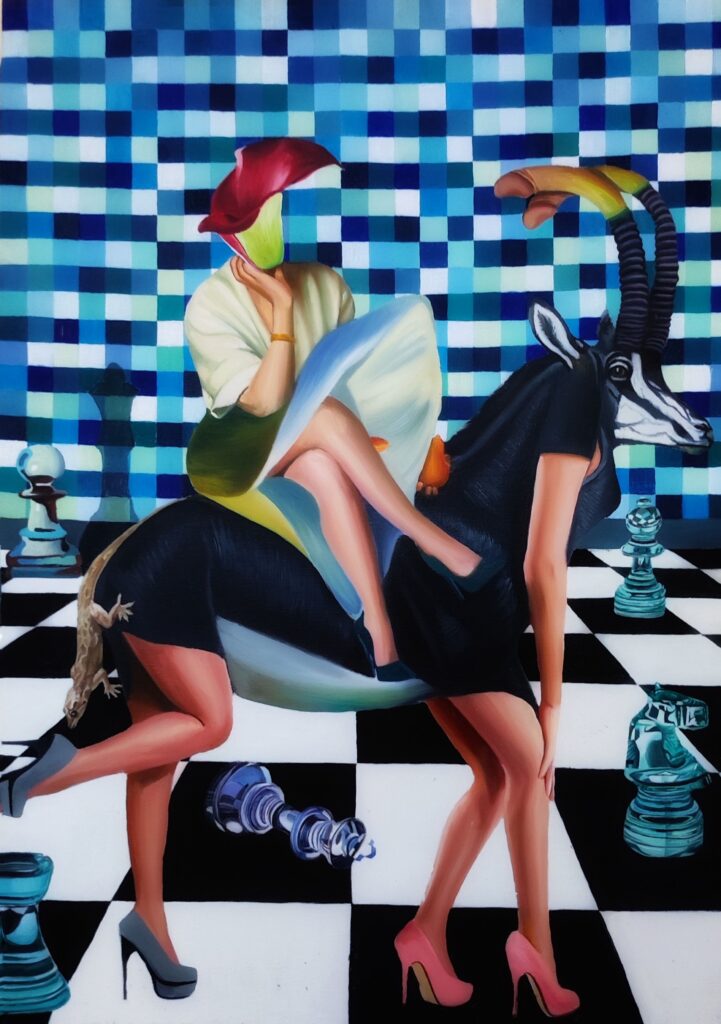
Bhaskar Thakur
Imposter
A lily for a face, high heels for hooves
Blue squares climb the wall like a screen that will not settle.
A red lily hides a face behind one cool green throat.
The antelope looks away, horns ringed and heavy, legs in pink heels.
Glass pawns stand clear as water on the checked floor.
One piece has already fallen.
A small lizard holds on and waits.
Imposter is a 2023 oil painting on canvas by Bhaskar Thakur of Kala Bhavana in Santiniketan, West Bengal. Thakur is based in Ludhiana. A figure with a red lily for a face sits on a strange creature. It has an antelope's head and a woman's legs in high heels. Glass chess pieces stand on a black and white floor and one has fallen. Thakur draws on memory, fantasy and queer desire. These are never shown directly. Symbols and suggestion let identity be sensed without being exposed.
Oil on canvas · 91 × 61 cm · 2023
Theme Queer desire and disguise
RC-265
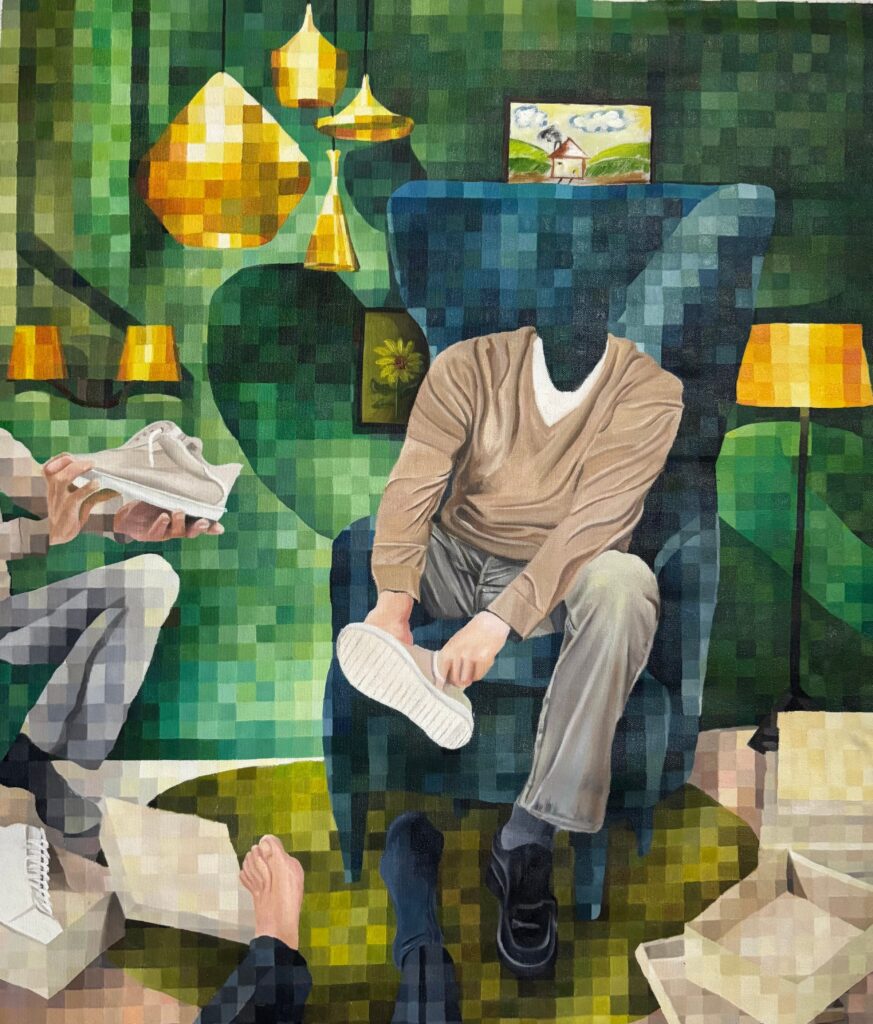
Bhaskar Thakur
Lost
Every shoe is clear. The face is not
Green squares climb the walls like tiles in a pool.
Four yellow lamps hang warm and low.
A man in a soft beige jumper leans to fit a white sneaker.
Where his face should be there is only the dark blue of the chair.
A bare foot waits at the edge of the rug.
Open boxes. Hands holding a second pair.
The room keeps its secret in small coloured blocks.
Lost is an oil painting on canvas from 2025 by Bhaskar Thakur of Kala Bhavana in Santiniketan, West Bengal. A man sits in a blue armchair and fits a white shoe to his foot. Hands at the left hold another shoe. Open boxes lie on the floor. Thakur paints the clothes, hands and shoes with care. He breaks the room and the man's face into small squares of colour. For Thakur, this blur is a political stance. It lets queer intimacy appear without forced exposure.
Oil on canvas · 71 × 61 cm · 2025
Theme Visibility and erasure
RC-266

Bhaskar Thakur
6/12
A sunflower takes the wheel of a very large shoe
A sky made of small blue tiles, like a screen that has not finished loading.
The road runs straight to one striped balloon.
Someone in a pink shirt drives a shoe the size of a car.
Where a face should be, only yellow petals.
Under the shoe, a red patch of warm ground.
Everything far away is soft. Only the ride is clear.
Bhaskar Thakur paints 6/12 in oil on canvas in 2025. The sky, the fields and the road break into small squares of colour. Only a few things stay sharp: a giant green and cream shoe, a striped hot air balloon and a figure at a steering wheel. A sunflower covers the driver's face. The blur is a choice, so that feeling can be sensed without being forced into the open. Thakur's art school is Kala Bhavana in Santiniketan, West Bengal. Thakur is based in Ludhiana.
Oil on canvas · 61 × 46 cm · 2025
Theme Desire held out of focus
RC-267
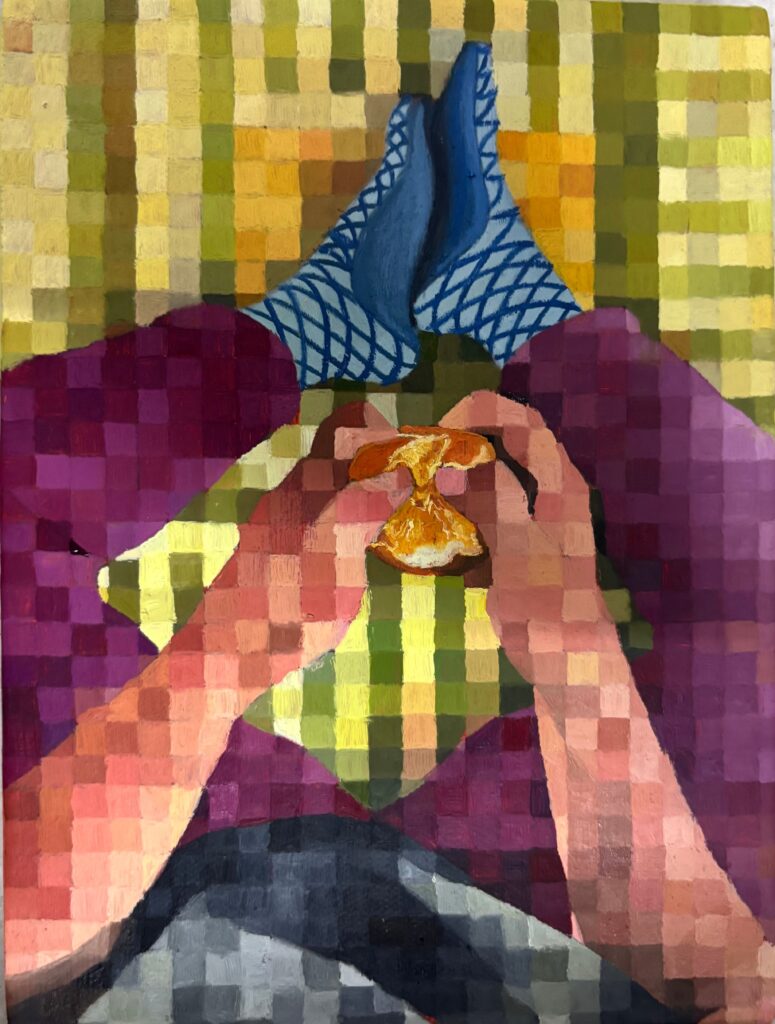
Bhaskar Thakur
The Orange
A piece of orange held up where a face should be
Yellow and green squares stack like tiles in an afternoon room.
Two blue feet press together, caught in a net of lines.
Plum shapes fold over everything, warm and heavy.
Pink hands lift a curl of orange to the eye.
The pith shines white, a small private sun.
Look closer and the squares only multiply.
Someone is here, kept soft, kept safe.
In The Orange, Bhaskar Thakur paints a close, private moment in oil on a small canvas. The whole picture is built from small squares of colour, like a photograph blurred on a screen. Two feet in blue net stockings rise at the top. Two hands lift a piece of orange over a face. Thakur's work draws on talks and trust with other queer people. The squares keep the scene soft so no one is forced into view.
Oil on canvas · 20 × 15 cm · 2026
Theme Queer intimacy and concealment
RC-268
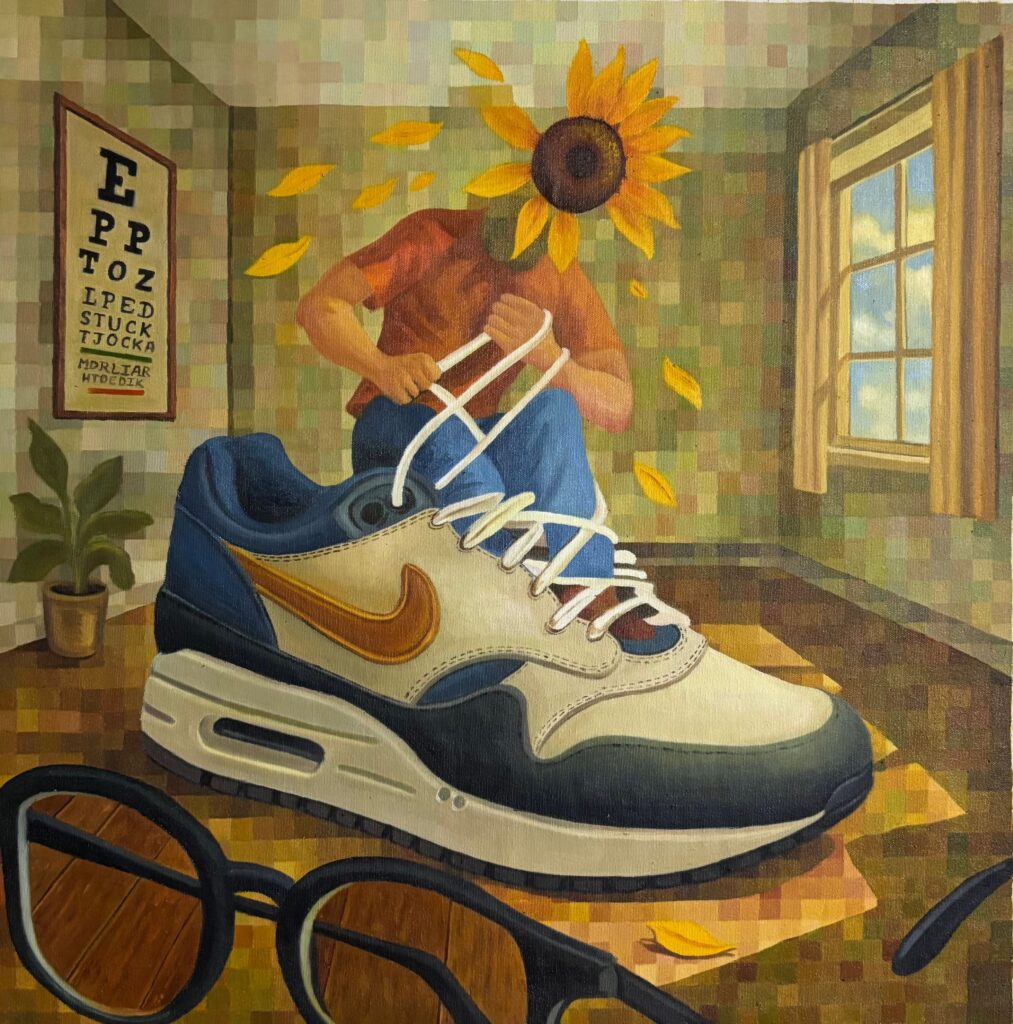
Bhaskar Thakur
HE Loves me
A sunflower head, a giant shoe and a room going soft
Yellow petals drop through a room made of small green squares.
A figure with a sunflower face pulls white laces tight.
The shoe is almost as big as he is.
On the wall the letters shrink and smudge.
A pair of glasses waits on the floor, empty of eyes.
Outside, clouds sit still in a blue window.
One petal says he loves me. The next one falls without a word.
Bhaskar Thakur, of Kala Bhavana in Santiniketan, makes this oil painting in 2025. A figure with a sunflower for a head laces a huge shoe. The room breaks into small soft squares of colour. Thakur blurs his work on purpose. For him haze is a political choice. It refuses fixed looks and simple truths. His paintings grow from memory, fantasy, queer desire and ordinary life. He shows private feelings through symbols, not open display.
Oil on canvas · 61 × 61 cm · 2025
Theme Half-seen queer desire
RC-269
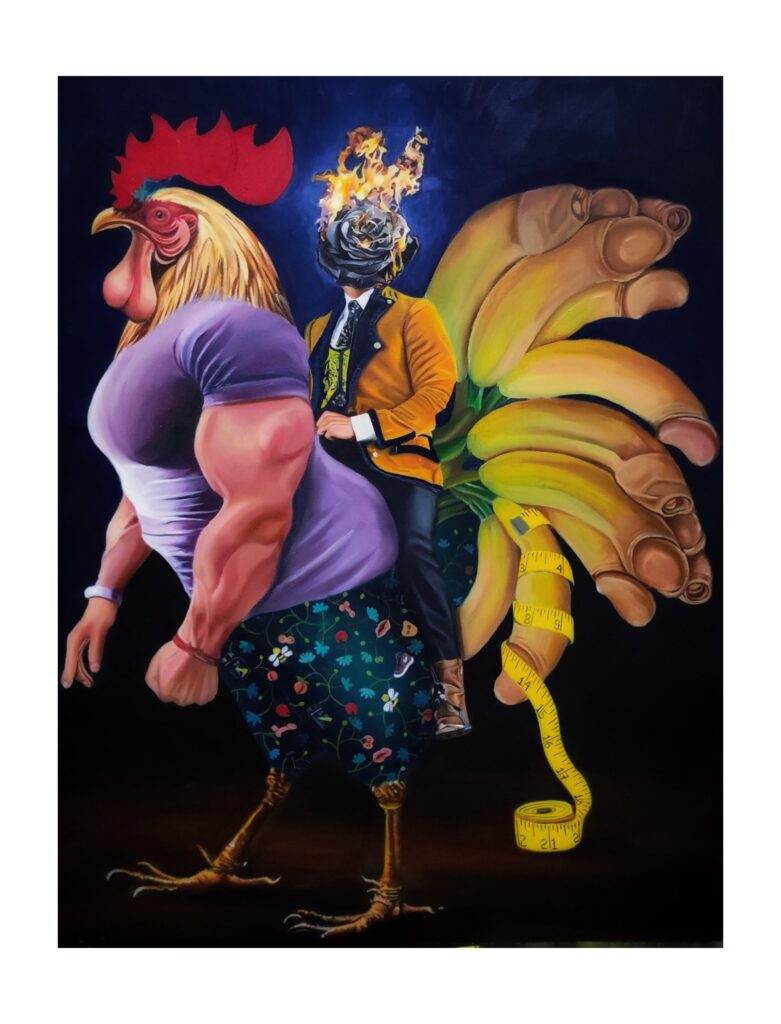
Bhaskar Thakur
Unholy
A rooster in a T-shirt carries a rider whose head is burning
A red comb stands against a night of deep blue.
The rooster wears a lilac T-shirt and walks on yellow claws.
On its back a rider in a mustard coat sits very still.
Where a face should be, a grey rose holds a small fire.
The tail is a bunch of bananas with fingernails.
A yellow tape measure counts them and then lets go, coiling on the dark floor.
Bhaskar Thakur makes Unholy in 2023 with oil on canvas, 76 × 58 cm. Thakur comes from Kala Bhavana, Santiniketan in West Bengal. The work draws on memory, fantasy, queer desire and ordinary life. Thakur shapes such scenes from real conversations and shared stories with other queer people. They are never shown literally. Here a rooster with strong human arms carries a rider whose head is a rose on fire. A tape measure winds around a tail of bananas. Thakur calls obscurity a political stance.
Oil on canvas · 76 × 58 cm · 2023
Theme Queer desire and obscurity
RC-270
From the open call
Hardik
My work explores sexuality, hidden desire, vulnerability, and the tension between what is expressed and what remains unspoken. I use both literal and metaphorical approaches to create visual narratives that examine intimacy, personal experience, and the complexities of human desire. I am interested in how desire exists beneath the surface of everyday life, often shaped by memories and emotions that are difficult to confront or communicate. While some of my…



Hardik
Toys and Desire V
A bouncy castle where nobody plays, watched by six cats
A toy castle with soft walls, drawn in the colour of smoke.
A small figure stands in its doorway, too still for play.
Above it, a face with no features wears its hair in two dark knots.
Six cats cross the grey floor, each with its own short shadow.
The floor ends in points, like a sign that will not say where.
No one jumps. The air waits.
Hardik studies at the College of Art in New Delhi. Toys and Desire V is an etching with aquatint on paper, 30 × 45 cm. Hardik says printmaking asks for patience, technical control and many decisions. It also allows layering and repetition. In this print a small figure stands inside an inflatable bouncy castle. A large head with a blank face rises behind it. Six cats walk across a grey floor. Hardik uses toys and symbols to suggest a desire that stays unspoken.
Etching and aquatint on paper · 30 × 45 cm · 2026
Theme Hidden desire and vulnerability
RC-287
Hardik
Toys and Desire VI
Everyone at the pool wears a cat face except one boy
Grey ink settles like evening on the tiles.
A black ball hangs in the air and never lands.
Cat faces watch with small white eyes.
One boy smiles with his whole bare face.
At the edge two dark shapes lie on the floor like shed skins.
The paper around it all stays clean and quiet.
In Toys and Desire VI a boy stands in a large round tub. His face is the only one we see. Every other figure wears a black cat mask. Hardik, of the College of Art in New Delhi, makes the image as an etching with aquatint. The print measures 30 × 45 cm. Its top edge rises and falls like a line of hills. For Hardik printmaking is slow. It asks for patience and many decisions. Its layers help show how complex desire is.
Etching and aquatint on paper · 30 × 45 cm · 2026
Theme Hidden desire and vulnerability
RC-288
Hardik
Toys and Desire III
A toy car waits in the middle of a grown-up room
Grey settles into every square of the floor.
A small car carries shirts like passengers.
Two shoes face away from the bed.
The boy holds something thin and dark and watches.
A cat stands up as if it heard its name.
The ink pools where the light will not go.
White paper waits on every side, holding the room in its sharp shape.
Toys and Desire III is an etching and aquatint on paper from 2025. It measures 33 × 50 cm. The image has an uneven outline with sharp corners. Inside it, a tiled floor runs back to a shuttered door. Two adults sit on a bed. A boy sits on the floor and a cat rises on its back legs near the door. In the centre is a toy car under a pile of clothes. Hardik, from the College of Art in New Delhi, says printmaking asks for patience and repeated decisions.
Etching and aquatint on paper · 33 × 50 cm · 2025
Theme Hidden desire and childhood
RC-289
Hardik
Monsoon
Under one umbrella, she turns to him with a cat's face
Rain falls in fine grey lines across the black.
One umbrella holds two people and the street lamps behind them.
His hand rests on her arm.
She turns to him with the face of a cat.
Her white shirt is the brightest thing in the night.
The wet road carries their silence home.
In Monsoon, two people stand close under one umbrella on a wet street at night. One of them has the head of a cat. Hardik, of the College of Art in New Delhi, makes this image as a mezzotint. The method demands patience and many careful decisions. Soft greys rise slowly out of deep black. Hardik's prints deal with hidden desire and what stays unspoken. Here the cat's head hides a face at the closest moment.
Mezzotint print · 25 × 35 cm · 2025
Theme Hidden desire and intimacy
RC-290

Hardik
Not me, Not Mine
Flowers held behind a back, never quite offered
A cat's head turns toward a dark window.
One arm presses flat against the wall as if to hold it up.
Beside it a figure in a patterned shirt keeps both hands behind.
The flowers there are as dark as the ink around them.
A white vest is the only light in the yard.
The paper around them stays empty and says nothing.
Hardik makes this print in 2025 with etching and aquatint on paper. It measures 40 × 30 cm. Two figures stand outside a building with their backs to us. One has the head of a black cat and presses an arm flat against the wall. The other keeps a bunch of flowers hidden behind the back. Hardik is from the College of Art in New Delhi. The work looks at desire that stays under the surface of daily life. Printmaking asks for patience and many careful decisions.
Etching and aquatint on paper · 40 × 30 cm · 2025
Theme Desire left unspoken
RC-291

Hardik
Toys and Desire II
A boy, a toy bike and a poster he will not look at
Grey ink settles like night on a rooftop.
Stars are small white scratches in the black.
A boy holds his own hands close to his face.
Behind him a woman on a poster looks over her bare shoulder.
The toy bike throws a shadow far too long for it.
Cats keep watch from the wall and the door.
No one says what the boy wants.
Hardik makes Toys and Desire II as an etching with aquatint on paper. The print measures 33 × 50 cm. Its outline is sharp and uneven. A boy stands on a tiled terrace at night. A small motorbike, cats and a poster of a woman share the space with him. Hardik works in New Delhi at the College of Art. Hardik says printmaking asks for patience and many decisions. Its layers help Hardik show how complex desire can be.
Etching and aquatint on paper · 33 × 50 cm · 2025
Theme Childhood and hidden desire
RC-284

Hardik
Toys and Desire I
On the roof at night a string pulls toward something unsaid
Purple ink settles over the roofs like late smoke.
A boy leans back and holds a string that goes somewhere we cannot see.
Water tanks keep still. A cat keeps walking.
The moon is small and hard as a coin.
Something white slips out of the dark and does not wait.
The city goes on sleeping around what it wants.
A boy stands on a flat roof at night and pulls a long string. Behind him a crowded city rises in grey and purple layers under a heavy sky. A black cat walks along a wall. Near the moon hangs a round shape like a wheel. A soft white form pushes past the edge. Hardik makes this print in 2025 with etching and aquatint. The artist is interested in desire that sits under everyday life. Here it hides in small things: a toy, a string and a cat.
Etching and aquatint on paper · 22 × 17 cm · 2025
Theme Hidden everyday desire
RC-285

Hardik
Toys and Desire IV
A quiet room keeps what no one says aloud
Grey settles on the tiles like dust that was never swept.
A boy listens with a stethoscope to a silence on a metal cot.
Two shoes wait on the floor, their laces loose.
Above, iron weights pile on a little table and a doll hides beneath.
The pale wall melts at its edges like milk left out.
His shadow spills from his bare feet and does not move.
In Toys and Desire IV a boy with a stethoscope stands beside a metal cot where a figure lies still. A pair of shoes rests on the tiled floor. Behind him, iron weights sit on a small table inside a pale shape that seems to melt. Hardik makes the print with etching and aquatint on paper, 25 × 35 cm. The artist studies at the College of Art, New Delhi. Printmaking is slow and demanding. Its layers suit a desire that stays under the surface.
Etching and aquatint on paper · 25 × 35 cm · 2026
Theme Desire left unspoken
RC-286
From the open call
Ajay Kushwah
I am Ajay Kushwaha, a resident of Delhi. I was born in Etah district of Uttar Pradesh and brought up in Delhi. I have done my Bachelors in Painting from College of Art Delhi and currently pursuing my Masters from College of Art Chandigarh. The goal of my artistic journey is to show the reflection of nature to humans. Through my art, I aim to depict the complex and symbiotic…

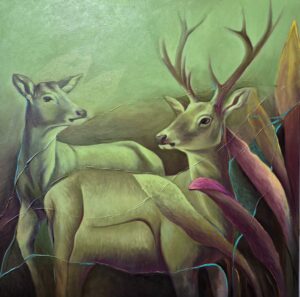


Ajay Kushwah
Kasturi mirag
A tusked deer runs through gold light, trailing purple wind
Amber pours down between the trunks like late honey.
The deer is mid-stride, one hoof lifted over the grass.
Two white tusks, small as new moons, hang from its lip.
Violet ribbons leave its mouth and lie on the air.
Behind it a flower opens in the same cool colour.
The trees go dark at the edges.
Only the animal is warm all the way through.
A musk deer runs through a forest full of gold light. Two long white tusks curve down from its mouth. Purple lines flow from its mouth and trail behind its body like wind or scent. A pale purple flower rises in their path. Ajay Kushwah paints the scene in acrylic. He was born in Etah district of Uttar Pradesh and grew up in Delhi. Since childhood he has loved the sky, animals and birds. In his paintings he tries to tell a story and to show the changes taking place in nature.
Acrylic · 2026
Theme Animals and the natural world
RC-256

Ajay Kushwah
Aakarshan
Two deer stand still while the world around them cracks
Green light settles on two backs like pond water.
The stag lifts his antlers into the empty air.
The doe turns her head and waits.
Plum leaves press in from the right edge.
Thin lines run through fur and leaf alike, turquoise at their edges.
The two deer keep looking at each other anyway.
Ajay Kushwah paints two deer in oil. A doe turns her head. A stag with tall antlers looks towards her. Both stand in soft green light. Pink and plum leaves rise on the right. Thin raised lines cross the whole picture. They look like cracks or wire. Kushwah lives in Delhi. He loves the quiet of animals, birds and sky, far from the noise of the city. In his paintings he shows people how nature is changing.
Oil · 2026
Theme Animals and changing nature
RC-257

Ajay Kushwah
Untitled
Deer stand still while pink city blocks rise behind the grass
Green light pools like water in a wide glass bowl.
A pale deer turns away, her ears lit pink at the edges.
The stag holds still and looks back at you.
Far off, two small deer wait in the wet grass.
Pink walls stand at the corner of the field.
Leaves drawn in thin lines grow over all of it.
Ajay Kushwah paints this untitled work in acrylic in 2025. Two deer fill the front of the picture. A pale deer turns her head to the left. A stag with tall antlers looks straight out at us. Two smaller deer stand in a green field behind them. In the top left corner, pink blocks look like buildings. Kushwah grew up in Delhi and studied painting at College of Art Delhi. He wants to show that people are part of nature.
Acrylic · 2025
Theme Nature meeting the city
RC-258
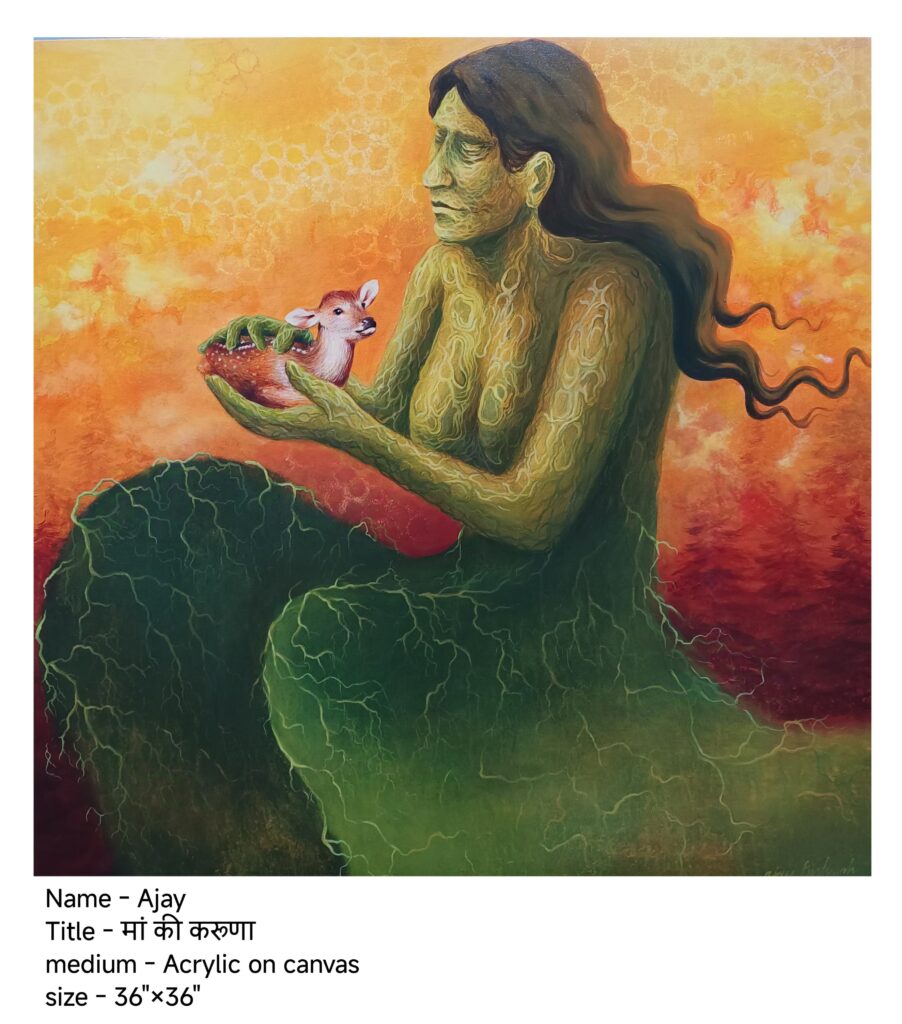
Ajay Kushwah
Maa ki karuna
She holds the fawn the way soil holds a seed
Her hands are a cup of moss.
The fawn inside is the only warm brown thing.
Her arms carry the lines of old bark.
Below her lap the green spills out and grows roots.
The sky behind her is honey and fire.
She looks down and does not hurry.
The title means a mother's compassion. A woman holds a small spotted fawn in her cupped hands. Her skin is green and lined like bark. Below her waist she becomes a hill of earth with pale roots running through it. Behind her the sky burns orange and red. The work is acrylic on a square canvas of 91 × 91 cm. The artist lives in Delhi and has loved the sky, animals and birds since childhood. Here he shows a person as part of nature.
Acrylic on canvas · 2025
Theme Nature as mother
RC-259

Ajay Kushwah
Family
A stag keeps watch while the city fades behind the trees
Green light, the colour of pond water, settles on four backs.
The stag lifts his antlers like bare winter branches.
One deer bends to the grass. Another looks at me and does not move.
Their edges are drawn in pale yellow thread. The land shows through their bodies.
At the corners, blue flowers crowd in close.
Far back, the grey squares of buildings wait in the haze.
In Family, a stag stands at the centre with three deer around him. One lowers its head to the grass. One looks straight out at us. Ajay Kushwah paints them in acrylic in soft greens and yellows. Their pale outlines overlap, so the animals seem to pass through each other and the land. Behind them, faint square shapes suggest buildings. Kushwah grew up in Delhi and spent his childhood with sky, animals and birds. He sees people as part of nature.
Acrylic · 2025
Theme Kinship with nature
RC-260

Ajay Kushwah
Ksharan
A young deer looks up at one that will not rise
Light drips down from the top like wet rust.
The roots below are red as a scratch on skin.
One deer lies long and quiet, its ear still open to the wind.
The small one lifts its chin and waits.
Two stags stand pale in the back, almost paper.
On both sides the smoke curls in, pink as a healed burn. It closes the room.
Ksharan is an acrylic painting from 2026 by Ajay Kushwah. A deer lies still on a floor of tangled roots. A young deer below lifts its head towards it. Two pale stags watch from the bare trees. Kushwah grew up in Delhi. Since childhood he has loved being with animals and birds. "I try to weave a story in my paintings," he says. He wants people to see the changes taking place in nature. Bands of smoky pink frame the scene and the edges of the painting follow their curves.
Acrylic · 2026
Theme Nature and loss
RC-261

Ajay Kushwah
Barrier for whom
Three deer look back at us through a wall of grass
Green comes in short strokes, like grass laid flat by wind.
It crosses the deer at the chest, at the mouth, at the eye.
Three pairs of soft ears turn toward us.
Behind them, trees stand on pink and violet legs.
The light is the yellow of late afternoon.
Who put this fence here, the deer seem to ask.
And who is it keeping out.
In this painting from 2026, three deer stand close together in a green wood. The one in the middle looks straight at us. The other two turn their heads. Bands of quick grass strokes run across the painting and pass over their bodies like a screen. Behind them, trees rise on pink and violet trunks. The artist grew up in Delhi. He wants his paintings to show people the changes taking place in nature. Here the title asks a plain question: a barrier for whom?
Acrylic · 2026
Theme Humans and the natural world
RC-262
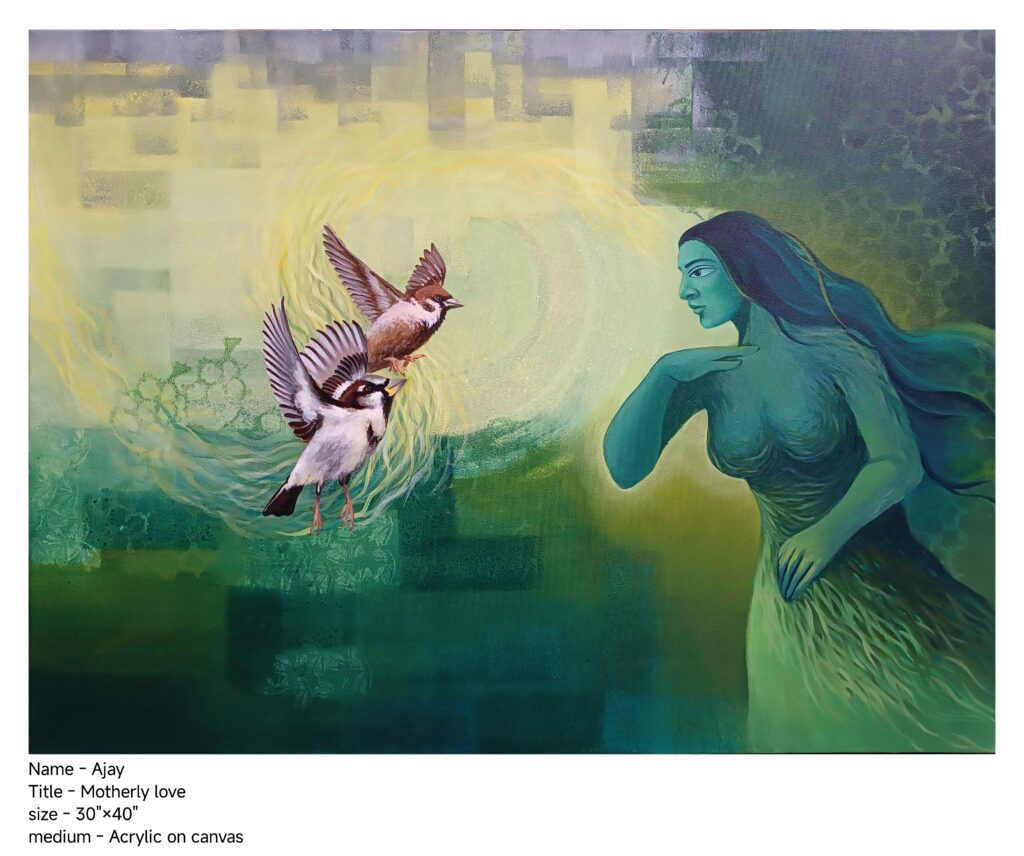
Ajay Kushwah
Motherly love
Two sparrows meet in the light while she holds her breath
Green rises from the bottom of the canvas like deep water.
Two sparrows turn inside a coil of yellow light.
Their wings are open. Their feet are pink and small.
She stands at the edge with a hand at her throat.
Her hair runs dark blue down her back.
Her dress becomes grass. She does not reach out. She only watches them go.
Two sparrows fly into a ring of pale yellow light. A woman with green skin stands at the right and watches them. One hand rests at her throat. Her long hair moves like water. The space behind them is made of soft squares of green, yellow and grey. Some parts carry a pattern like lace. The work is acrylic on canvas from 2025. It is about 76 × 102 cm. The artist grew up in Delhi. Since childhood he loves the sky and birds.
Acrylic on canvas · 2025
Theme Motherhood and nature
RC-263
From the open call
Aman Kumar
"Lately, I’ve been completely immersed in architectural forms and spiritual narratives, trying to capture that heavy, timeless feeling of ancient spaces and sacred stories. My goal was to translate that sense of permanence into ink and paper, using stark contrast and textured line work to give these historic structures and figures some real physical weight. To bring these to life, I primarily worked with woodcuts for the landscape and narrative…

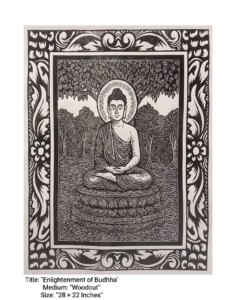

Aman Kumar
“Ancient Citadel”
Every white line here is wood the knife took away
The sky is cut into white streaks, like wind made of wood shavings.
The temple holds the last light on its hill.
Its columns stand in a thin row against the cloud.
Below, rocks crowd the path in black and white.
Small trees lean along a broken fence.
Every bright mark is a place the knife went in.
Aman Kumar studies at RIMT University in Ludhiana. For this 2025 woodcut Kumar carves a view of the Parthenon on its rocky hill into a wooden block. Cutting away the wood leaves deep blacks and crisp white spaces. The hardest part is the small detail. Every column must stay sharp and not turn muddy. As Kumar says, "One slip of the carving tool and an entire window or texture is gone forever." The aim is to give old stone real weight on paper.
Woodcut print on paper · 2025
Theme Weight of ancient stone
RC-307
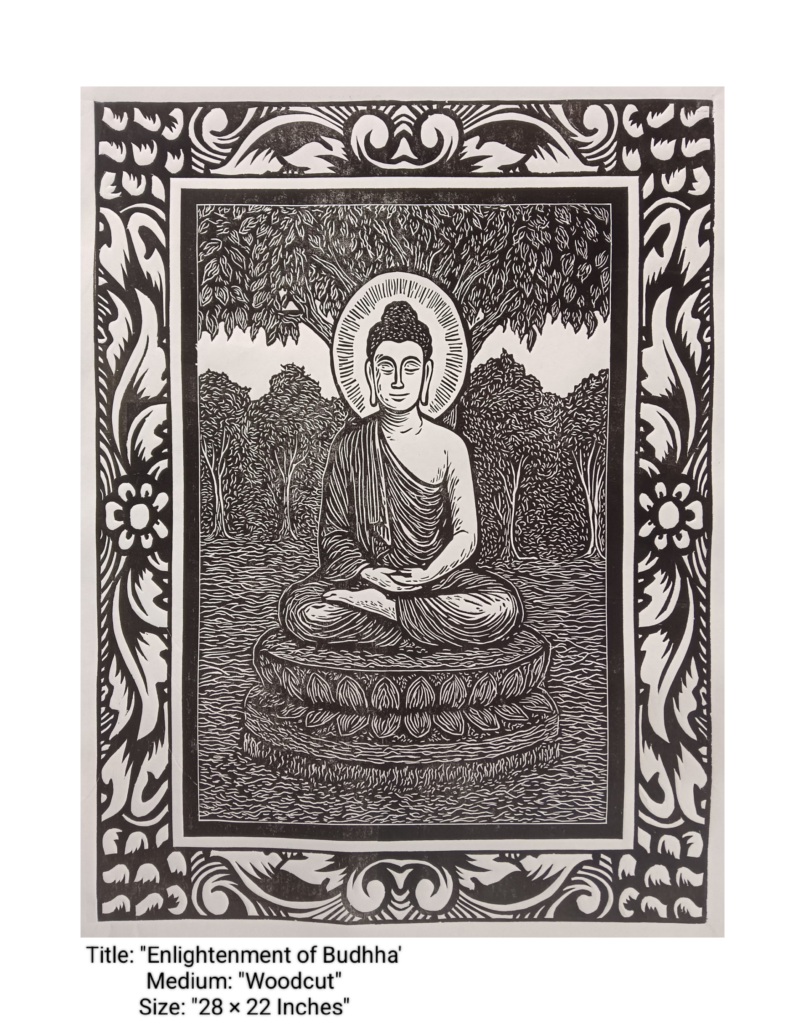
Aman Kumar
“Enlightenment of Buddha”
Many small cuts in wood around one calm face
Black ink holds the dark of the forest.
White leaves fall in thin lines around a still head.
The halo spreads out like rings in a cut tree.
His hands rest in his lap, one over the other.
The petals of the lotus seat curl up like small flames.
At the edges, carved flowers keep watch.
Aman Kumar makes this woodcut in 2025 at RIMT University in Ludhiana. He carves into the wood block to get deep blacks and clean white spaces. The Buddha sits on a lotus seat under a large tree. A forest stands behind him. A carved border of leaves and flowers frames the scene. Kumar says the border is the hardest part. He must cut it evenly and still keep the seated figure calm at the centre. The print measures about 71 × 56 cm.
Woodcut on paper · 2025
Theme Stillness under the tree
RC-308
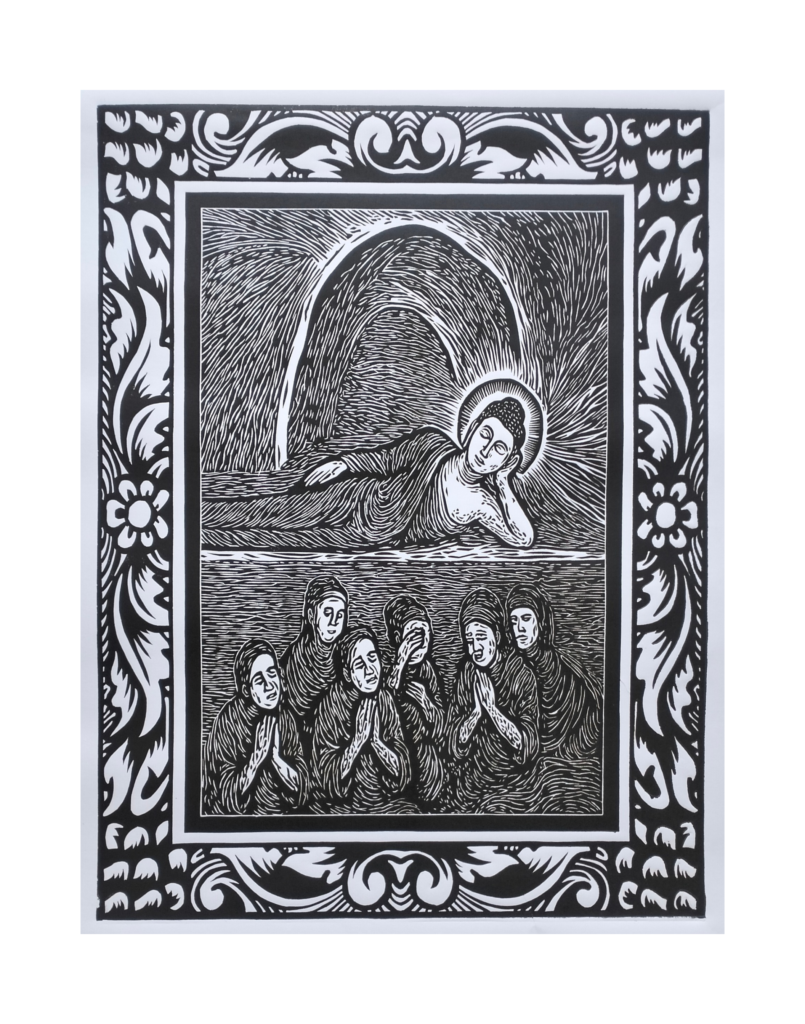
Aman Kumar
“Mahaparinirvana (The Final Passing)”
Below the resting Buddha, six faces carry all the grief
The Buddha rests his head on one hand. His eyes are almost shut.
Light runs out from his halo in short white cuts.
Below him the ground moves like dark water.
Six faces rise from it with hands pressed together.
One mourner hides behind a hand. Another opens his mouth to cry.
Around them all, black leaves curl and two white flowers stay still.
Aman Kumar studies at RIMT University in Ludhiana. This 2025 print shows the Buddha's final passing. Kumar carves into a block to make deep blacks and clean white spaces. The Buddha lies at rest under a tall arch. Below him, six followers pray and weep. For Kumar the hardest part is the border. He must carve its leaves and flowers evenly. He must also keep the central figures quiet and clear. The work asks for great patience.
Printmaking on paper · 2025
Theme Grief and stillness
RC-309
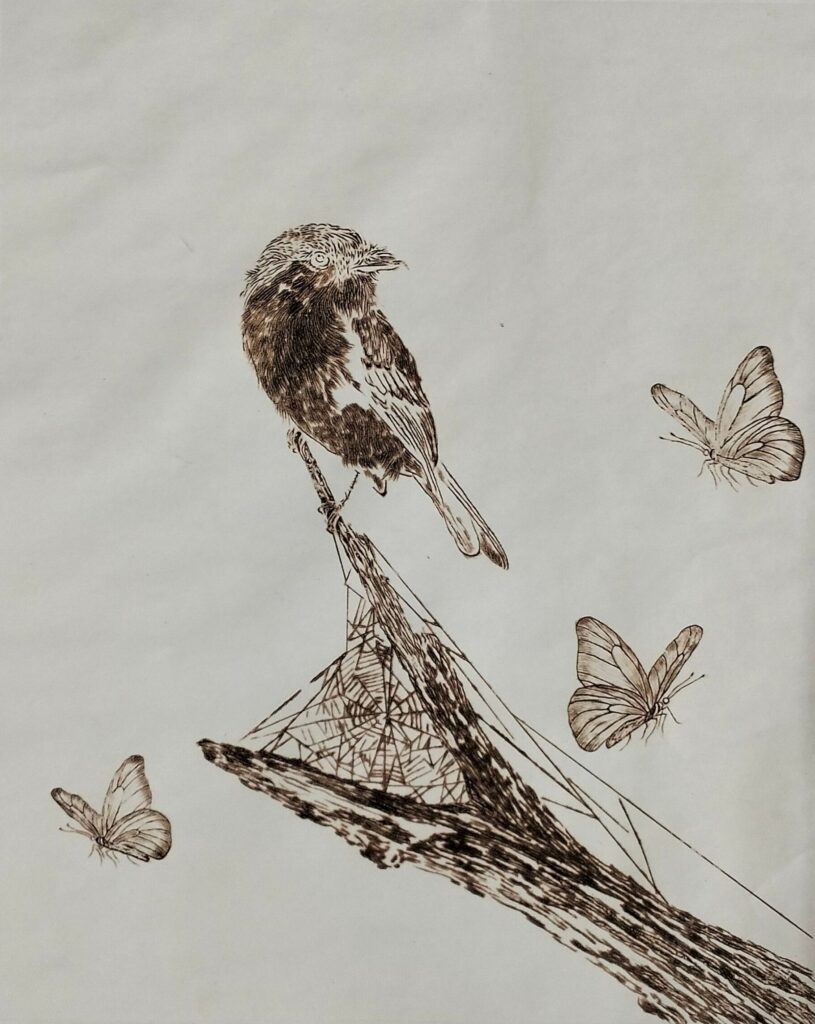
Aman Kumar
“A Sparrow”
Three butterflies drift close to a web they cannot see
Brown ink on pale paper, the colour of tea left too long in a cup.
The sparrow turns its head away from the butterflies.
Below its feet, a web holds the broken wood together.
Three butterflies drift, light as dry leaves.
No one in this picture is hungry yet.
The branch points down and out of the frame.
The paper keeps its quiet.
Aman Kumar is a student at RIMT University in Ludhiana. He makes this print in 2025. A sparrow sits at the top of a broken branch. A spider has spun its web where the thin twig meets the thick wood. Three butterflies float in the empty space around the bird. Every line is printed in a warm brown. In his other prints, Kumar says the hardest part is keeping tiny details from getting muddy. Here the thin threads of the web stay sharp and clear.
Printmaking on paper · 2025
Theme Stillness and quiet danger
RC-310

Aman Kumar
“Nature Miniature”
A butterfly pauses beside two hibiscus flowers in pressed brown ink
Brown lines on a cream page, thin as hair.
Two hibiscus flowers turn their dark throats to the light.
A butterfly holds still at the edge of the square.
The plate has pressed a quiet window into the paper.
One corner of it is soft and round.
Nothing here is loud. The ink settles like dust on an old ledge.
Aman Kumar, of RIMT University, is a printmaker from Ludhiana. Most of his recent prints show old buildings and sacred stories. Nature Miniature is quieter. Two hibiscus flowers open beside their leaves. A butterfly comes in from the top left. Fine lines in brown ink shade each petal. Kumar marks the print AP 1/1 and writes "Acrylic sheet" in pencil below the image. In his statement he speaks of intaglio and "a rich, sepia-toned plate tone". This small print carries the same warm brown.
Print on paper · 2025
Theme Small life in nature
RC-311
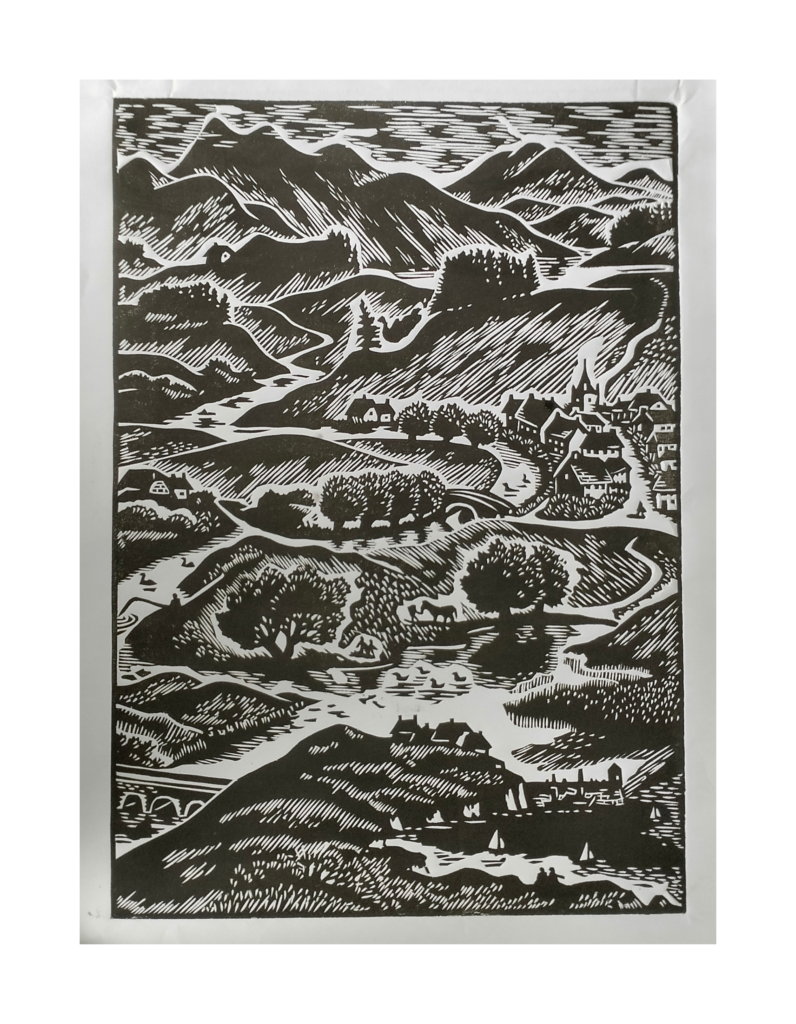
Aman Kumar
“Life in series”
A whole valley, every roof and ripple cut by hand
Black hills breathe out white lines of wind.
A river folds back on itself, a ribbon cut from the dark.
A church spire, crowded roofs, a bridge with small arched mouths.
Two horses drink where the birds drift.
Sails lean near a far town.
At the bottom, two people sit and look at all of it.
Every white mark is wood taken away for good.
Aman Kumar carves this landscape into a wood block and prints it in black ink on paper. Hills, a river and a village fill the sheet from top to bottom. Kumar studies at RIMT University in Ludhiana. Kumar works with stark contrast and textured lines to give old places a sense of weight. The hardest part is the small detail. The distant houses in the valley must stay clear. One slip of the carving tool and a window is gone for good.
Printmaking on paper · 2025
Theme Valley, river and village
RC-312
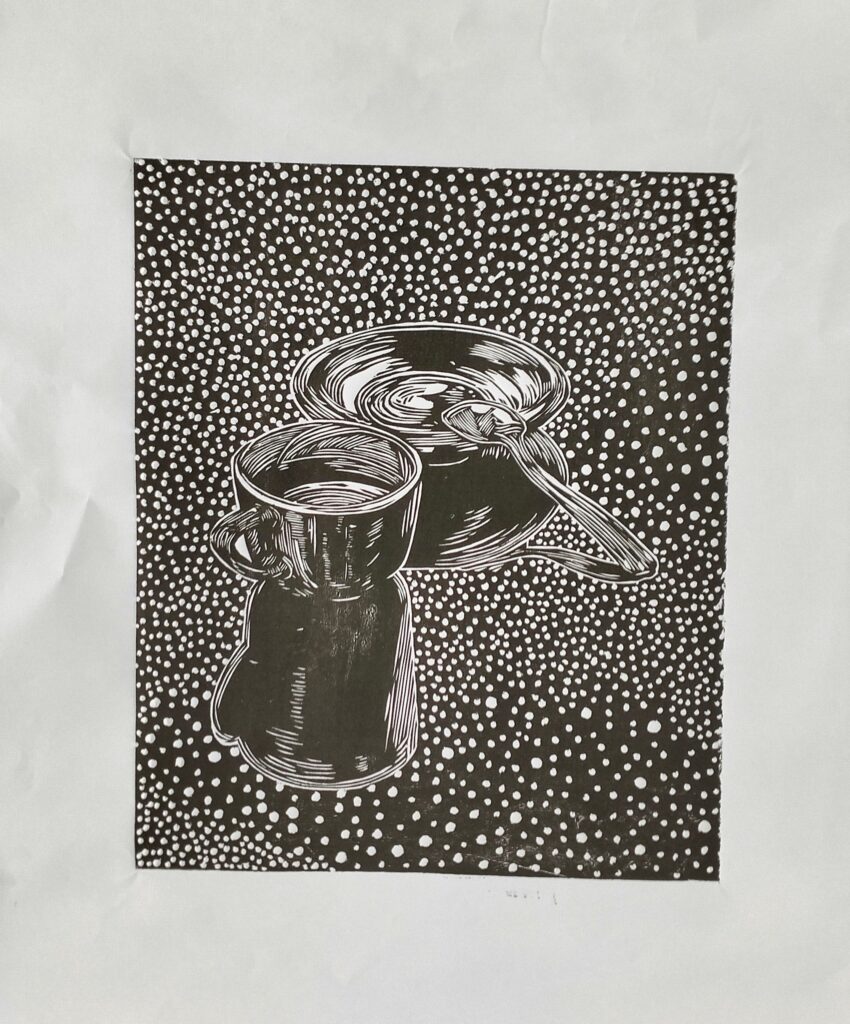
Aman Kumar
“A Tea-Cup”
A teacup given the weight of a temple
Black ink and a cup that holds more black.
Light runs down its side in white scratches, like rain on a window.
A spoon rests on the plate with its bowl still bright.
Around them the table fills with white dots, salt spilled in the dark.
No steam. No sound.
The tea waits the way a morning waits.
Aman Kumar is a printmaker from Ludhiana. His college is RIMT University. This 2025 print shows a quiet table. A cup with a handle stands in front of a tall dark pot. Behind them lies a round plate with a spoon on its rim. Thin white lines cut into the black give each object its curve and shine. Hundreds of white dots fill the space around them. Most of Kumar's recent prints turn to old buildings and sacred stories. Here he gives a tea cup the same weight.
Print on paper · 2025
Theme Stillness in everyday objects
RC-313
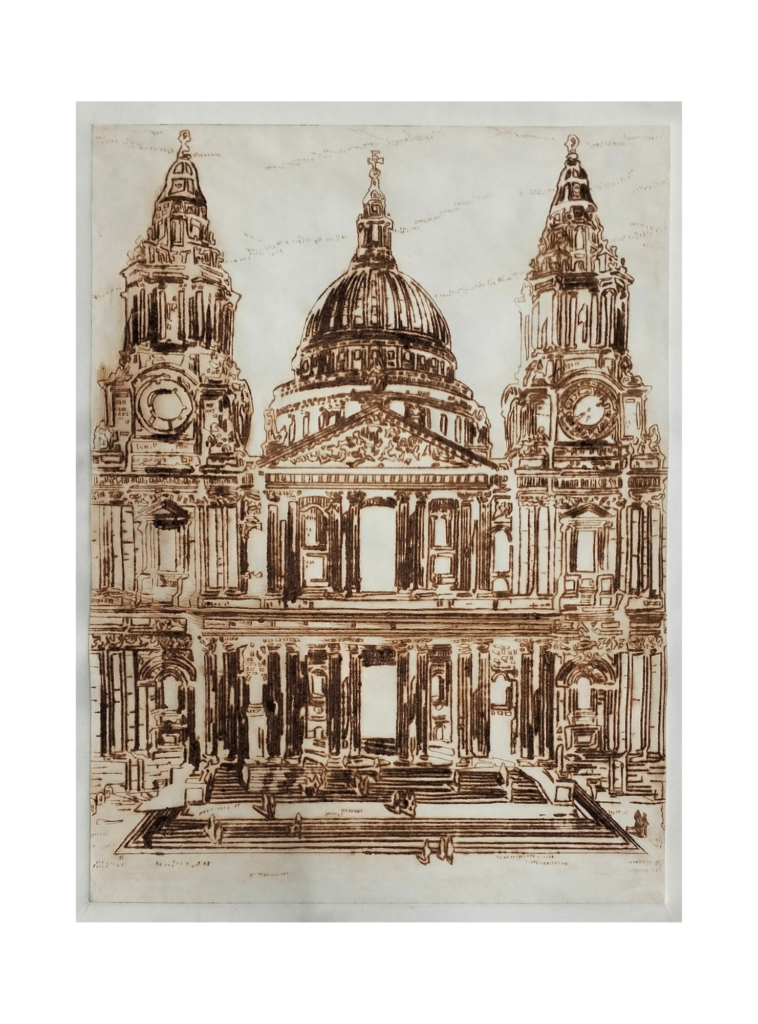
Aman Kumar
“A cathedra”
A great dome built from nothing but brown lines
Brown lines climb out of pale paper like smoke settling into stone.
Two clocks keep a time that feels like late afternoon.
The dome holds its breath under a small cross.
On the wide steps a few tiny people stop and wait.
Faint marks drift across the sky like notes no one finished.
The tall doors stay open and white, full of nothing but light.
Aman Kumar makes this print in 2025 at RIMT University in Ludhiana. It is part of a group of prints about old buildings and sacred stories. For most of the group he carves woodblocks. For this cathedral he changes his method and uses etching. Etching lets him draw fine lines that feel like a quick sketch. A thin layer of ink left on the plate gives the paper a warm brown tone. Kumar wants old stone to feel heavy and lasting in ink and paper.
Printmaking on paper · 2025
Theme Sacred buildings and time
RC-314
From the open call
Siddharth
My artistic practice emerges from personal experiences of movement, uncertainty, and the search for belonging. Throughout my life, I have lived between family homes and rented spaces, witnessing how the simple act of carrying a key can hold memories, responsibilities, aspirations, and the desire for stability. These experiences led me to develop the recurring motifs of keys and locks, which have become central to my visual language. Working primarily through…


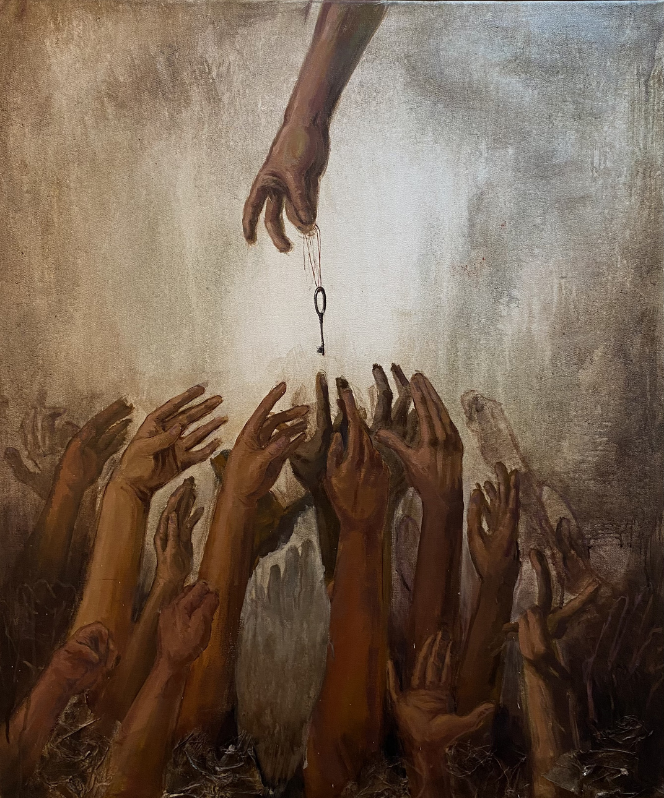
Siddharth
Beyond reach
One key hangs from a thread. Every hand reaches for it
A hand comes down out of brown fog.
From one finger, a thread. From the thread, a small dark key.
Below, the arms rise in ochre and umber, almost black at the edges.
Some are only shadows, painted thin, still reaching.
The light gathers where the key would fall.
No one has touched it yet.
In Beyond reach, a single hand comes down from a pale sky. A small key hangs from its fingers on a thin thread. Below it, many arms rise from a dark, rough ground. Some are solid. Some fade into shadow. Siddharth, of the College of art in New Delhi, makes the work in 2025 with acrylic paint and pasted tissue. The tissue gives the surface its layered skin. Keys appear often in his work. They come from years of living between family homes and rented spaces.
Mixed media: acrylic and pasting tissue · 91.4 × 61 × 3 cm · 2025
Theme Access and longing
RC-292

Siddharth
Bound across time
Two padlocks, one knot and every rented room in between
Two locks hang on one knot of rope.
Neither one is open.
Behind them, brown rings cross like the mesh of a fence.
At every join sits a small knot. The colour runs down like rust after rain.
The paper is the colour of an old wall.
Which key fits which door after so many rooms?
Siddharth, from New Delhi, paints locks and keys again and again. He has lived between family homes and rented spaces. For him, a key holds memory and the wish for a steady home. In Bound across time, two padlocks hang on knotted cord over a net of rust-brown circles. One is old and round. The other is square with rows of small buttons. He paints in watercolour on a sheet he prepares with chalk powder and glue. The work is 64 × 74 cm.
Watercolour on a sheet prepared with chalk powder and glue · 64 × 74 × 0.4 cm · 2026
Theme Access and belonging
RC-294
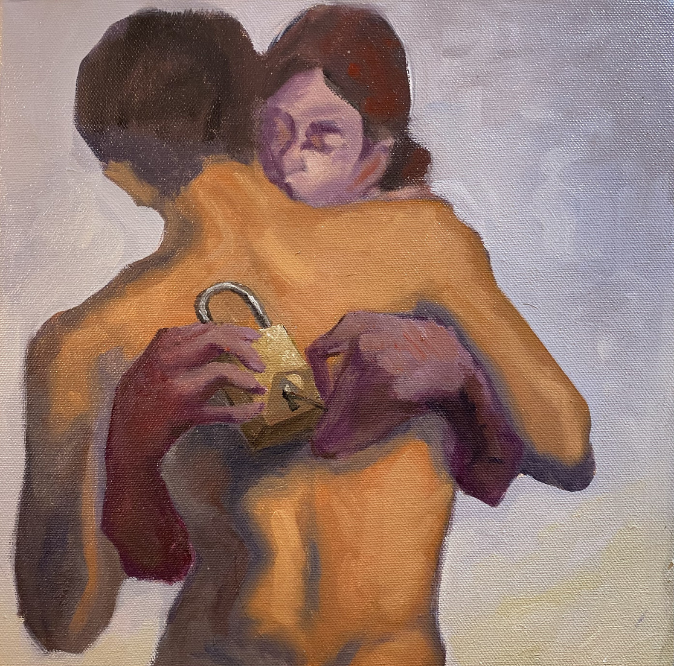
Siddharth
possession
An embrace that holds a lock, open or about to close
Lavender air, thin as early light.
A bare back the colour of turmeric and clay.
Over the shoulder a face rests with closed eyes.
Plum-dark hands turn a brass lock in the small space between them.
The shackle stands open.
Is this a gift or a keeping?
To be held close is also to be held.
Siddharth is an artist from the College of art in New Delhi. Siddharth has lived between family homes and rented spaces. In that life a key carries memory, duty and hope. So keys and locks return again and again in the paintings. In Possession two figures hold each other close. One presses an open brass padlock to the other's bare back. The colours are earthy and warm. The brush marks stay visible on the canvas as a record of the hand at work.
Oil on canvas · 30.48 × 30.48 × 2.54 cm · 2026
Theme Closeness and control
RC-295
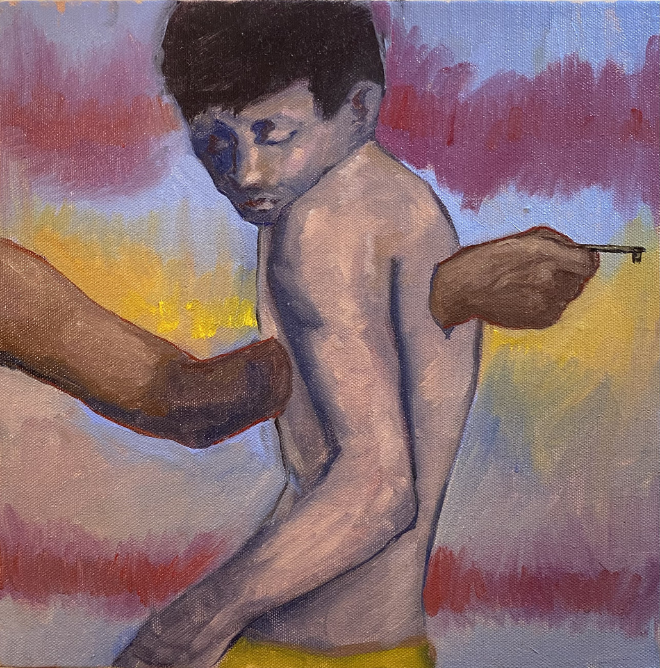
Siddharth
Between desires and control
Two hands reach in. Only one of them holds a key
A boy looks down at his own shoulder.
Blue gathers under his eyes like the edge of evening.
From the left an arm comes in, open and waiting.
From the right a closed hand holds out one small key.
Behind him the sky runs in wet bands of red and yellow.
He turns toward neither.
Siddharth paints this small oil on canvas in New Delhi in 2026. A boy stands with his back half turned and looks down. One arm reaches in from the left. A closed hand on the right holds out a small key. Keys and locks return again and again in Siddharth's work. They come from a life spent between family homes and rented spaces. The paint sits in soft dragged bands behind him. The work measures 30.48 × 30.48 × 2.54 cm.
Oil on canvas · 30.48 × 30.48 × 2.54 cm · 2026
Theme Access and belonging
RC-296
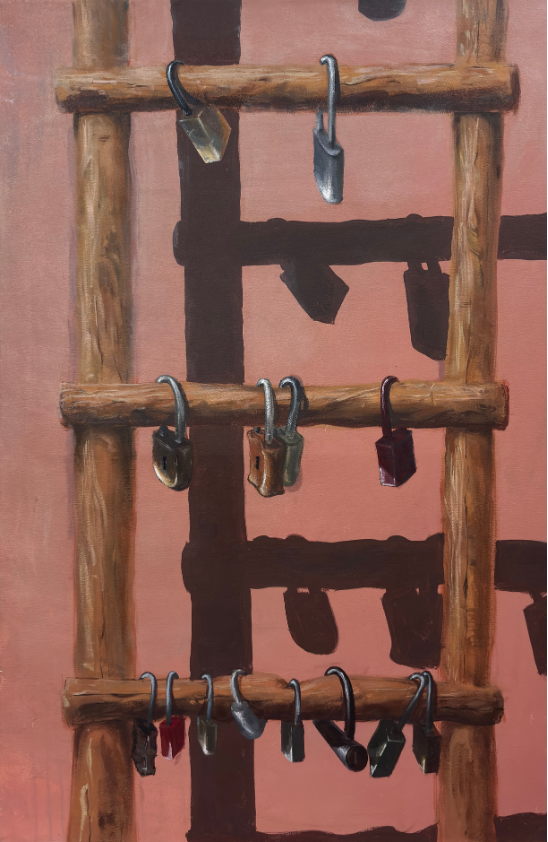
Siddharth
Archive of constraints
Every rung holds a lock but there is no key in sight
A ladder of rough branches leans on a wall the colour of dry clay.
Small locks hang from its rungs like fruit that will not fall.
Two at the top. A crowd at the bottom, grey and rust and one dark red.
The shadow slips down and to the right, darker than the wood.
It carries the locks with it, every one still shut.
Nowhere on the wall is there a key.
In Archive of constraints, Siddharth paints a ladder made of rough wooden poles. It stands against a dusty pink wall. Padlocks hang from each rung. Two hang at the top and many crowd the bottom. A dark shadow of the ladder and its locks falls across the wall. Siddharth has lived between family homes and rented spaces. Keys and locks return again and again in these paintings. The work is in acrylic on canvas. Its earthy colours come from nature and everyday life.
Acrylic on canvas · 50 × 76 × 2.58 cm · 2025
Theme Access and exclusion
RC-297
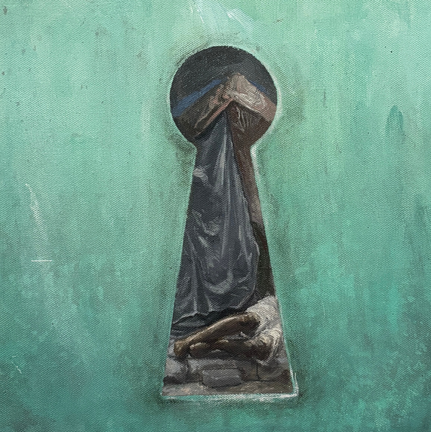
Siddharth
Traces of a Deluge
Look through the lock and the flood has already passed
A green door, rubbed thin by years of weather.
The keyhole is the only way in.
Inside, a grey cloth falls like heavy water.
Hands at the top still hold on to it.
Below, a body rests on broken stones.
The flood has gone. Only its marks stay.
Siddharth has lived between family homes and rented spaces. In those years a key came to hold memories, duties, hopes and the wish for a settled place. Locks and keys now return again and again in the paintings. In this small square oil painting from 2025, a keyhole opens in a wall of worn green paint. Through it we see a dark hanging cloth and a figure lying on stones. The colours inside are earthy. The rough texture comes from the rhythm of the brush.
Oil on canvas · 30.48 × 30.48 × 2.58 cm · 2025
Theme Belonging behind locked doors
RC-298
From the open call
Deepak
Through Through these works, I am trying to capture the small and ordinary moments of everyday life that we usually experience without giving them much attention. Our daily lives are made up of many simple activities—reading the newspaper, selling things, painting, working with our hands, sitting quietly, spending time with animals, or simply being surrounded by nature. These moments may seem very normal, but for me, they have their own…



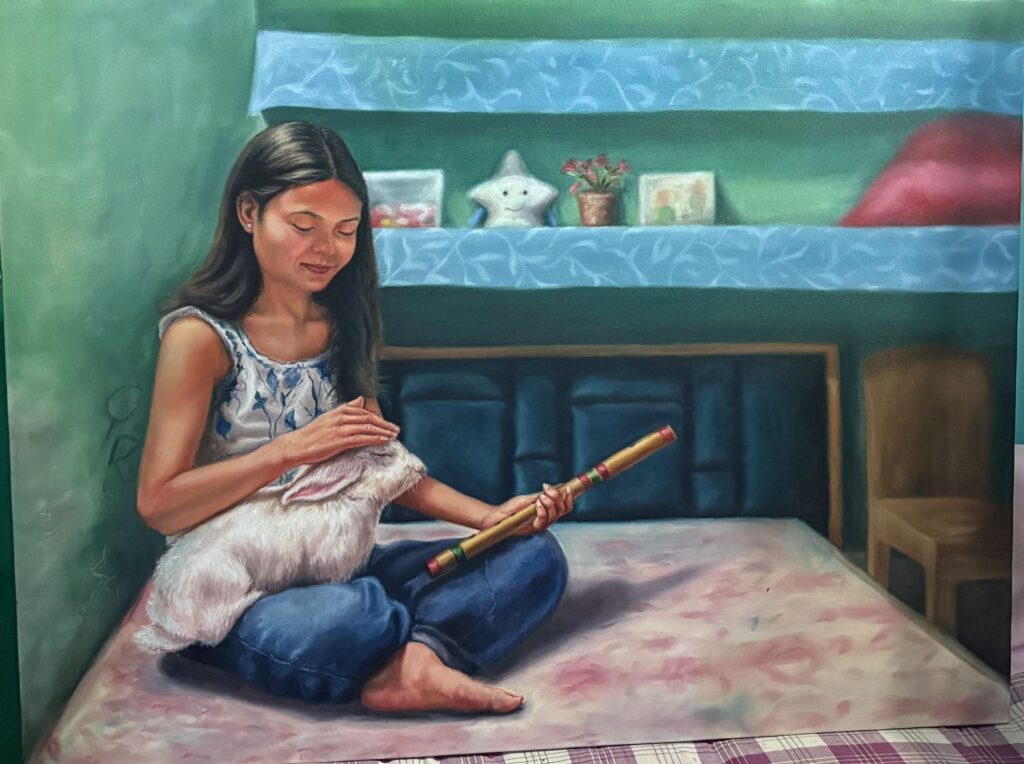
Deepak
A moment with my flute
The flute waits while the rabbit gets all her attention
Green walls hold the room close.
Her fingers move through white fur, slow as breath.
The flute lies in her open hand, bamboo banded red and green, silent.
On the shelf a cloth star smiles at nothing.
Red flowers lean towards the light.
She is not playing.
The music is the rabbit's warm weight and the quiet of the room.
Deepak, from the College of Art in Delhi, paints the small moments that most of us do not notice. Here a girl sits on a pale pink mat in her room. A white rabbit rests on her lap. A bamboo flute lies in her right hand but she is not playing it. The shelves behind her hold a star toy, red flowers and a jar of sweets. For Deepak these things are 'not only background elements'. They tell us about her life.
Oil on canvas · 76.2 × 101.6 × 4 cm · 2026
Theme Quiet everyday companionship
RC-280

Deepak
In his own world
The shutters are open but his mind is in the paper
Green shutters stand open like two hands at rest.
Behind him, rolls of cloth hang in yellow, pink and sea blue.
The wall is an old blue, rubbed thin, with a little rose at the edge.
His white shirt holds most of the light in the picture.
The bench takes his weight without a sound.
The folded paper is the only room he needs.
Deepak paints an older man reading a newspaper on a wooden bench. He sits with his legs crossed. He wears a white shirt and glasses. Behind him, green shutters open on a small space hung with rolls of cloth. A box with a red cover rests beside him. Deepak is from the College of Art in New Delhi. He makes this 2025 work in poster colour on paper. He gives a quiet daily habit his full attention.
Poster colour on paper · 38.1 × 55.9 × 0.01 cm · 2025
Theme Quiet everyday attention
RC-281
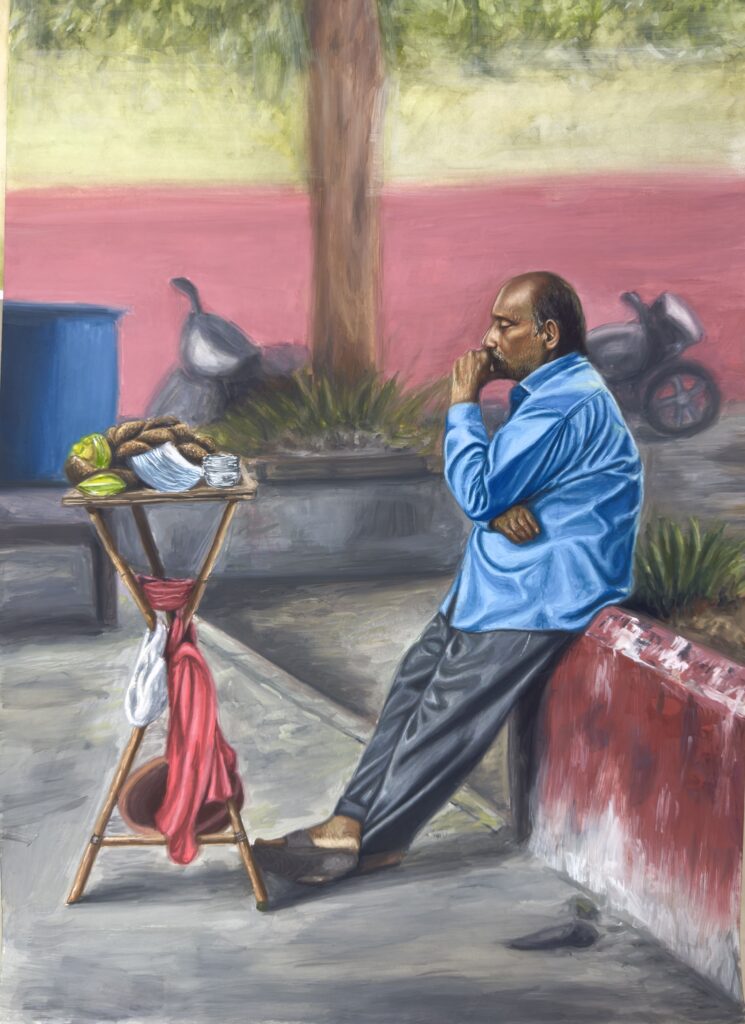
Deepak
The quiet wait
A hand at his mouth, he watches his stall and waits
A blue shirt holds all the light on this street.
His hand rests at his mouth, a thought not yet spoken.
The red kerb is worn to white where many have sat.
On the wooden stand, green fruit and a brown twist wait with him.
Two scooters rest against a pink wall.
No one comes yet. The street is still.
Deepak comes from the College of Art in Delhi. In The quiet wait he paints a man in a blue shirt who leans on a red kerb beside a small wooden stand. A pink wall, a tree and two parked scooters sit behind him. Deepak works in poster colour on ivory paper. His work looks closely at ordinary moments of daily life. "I want to pause these moments and give them the attention that we normally do not give them in our busy lives," he writes.
Poster colour on ivory paper · 38.1 × 55.9 × 0.01 cm · 2025
Theme Everyday waiting and work
RC-282

Deepak
Untitled
Two potters bend over wet clay and forget the room
Grey walls and a grey floor. In the middle the warm brown of clay.
A blue apron spotted where wet hands have rested.
A thin tool touches the lip of a pot and the whole room waits.
Behind him a cap turned backwards and a smaller pot taking shape.
On the shelves pots stand in rows like people waiting their turn.
Nobody speaks. The clay is still soft.
Deepak paints the small moments that most of us pass without looking. Here two men work in a pottery studio. One wears a blue apron and smooths a large pot with a thin tool. The other shapes a smaller pot on a wooden stand behind him. More pots wait on the shelves. Deepak works in poster colour on ivory paper. He says the objects around a person are not just background. The clay, the stools and the tools tell us about a working day.
Poster colour on ivory paper · 38.1 × 55.9 × 0.01 cm · 2025
Theme Hands and daily work
RC-283
From the open call
Ananya Sharma
I am not committed to a fixed artstyle and was simply trying to have fun exploring the different ways to come up and illustrate things, while also polishing my skills. My artworks so far are influenced greatly with my interests (eg- genshin haha) but I am trying to delve deeper into more fantasy and slice of life pieces in the future! Normally an idea pops up in my head when…

Ananya Sharma
Blue
The sea pulls back and leaves white lace on the sand
The sky is one deep blue, poured from edge to edge.
Clouds sit on it like torn paper, each one traced in a thin dark line.
Near the shore the water turns to glass, then to green.
A wave runs out and leaves its white edges on the sand.
Wet sand holds the sky for a moment.
Far off, a dark green hill waits at the end of the beach.
Ananya Sharma studies at MIT SOFA in Pune. Blue is made on a tablet with two digital brushes. A soft brush lays down the deep sky and the clear turquoise sea. A hard brush draws thin dark lines around the clouds and the white foam on the sand. Sharma is not tied to one style. The artist likes to try new ways of drawing things while polishing skills. Here the scene is simple. There is only water, sand and sky.
Digital painting, soft brush and hard brush · 50.8 × 28.58 cm · 2025
Theme Shoreline and open sky
RC-320

Ananya Sharma
Kazuha and Wanderer
One red leaf held up against a whole afternoon of sky
Grass climbs the page in short green strokes.
A white-haired boy lies back and lifts one red leaf.
Beside him a wide blue hat with gold edges blocks out the sun.
The clouds are thick as wet paper.
No one speaks.
The sky does all the work, deep blue at the top, paler near the hill.
Ananya Sharma studies at MIT SOFA in Pune. She usually draws on her tablet. Her ideas come from songs she has not seen the video for, from games she plays and from daydreams. Her interests, such as the game Genshin, shape much of her work. In this digital marker drawing two figures rest on a grassy slope. One lifts a red leaf to the sky. Sharma loves pictures that tell a story. She likes to fill them with small details to find.
Digital marker · 35.72 × 28.58 cm · 2026
Theme Rest under open sky
RC-321
Ananya Sharma
A little too red
One eye open, one eye shut and tomatoes everywhere
Tomatoes ride across a cream scarf, their stems still green.
Under it, black hair falls in heavy strokes.
One eye looks straight at you, rimmed in red.
The other closes, its lid the same red as the fruit.
A red fingernail rests on the cheek.
Light sits on the nose. Freckles scatter below.
The secret is shared with anyone who looks.
Ananya Sharma studies at MIT SOFA in Pune. A little too red is a reference study. Sharma finds an image of a model online and paints from it on a tablet. The tools are digital hard and soft brushes. Sharma does not hold to one fixed style. Each work is a way to try a new approach and to sharpen skills. In this one the red moves from the scarf to the eyelids to a single painted nail.
Digital painting with hard and soft brushes · 28.575 × 28.575 cm · 2026
Theme A study in red
RC-317
Ananya Sharma
A day at mondstadt
Not one blending brush touched this whole sunlit town
Orange roofs crowd the bottom edge like tiles left warming in the sun.
A windmill swings its cloth sails toward us, grey and patient.
Clouds pile up in lilac and cream, each one cut with a clean edge.
Far away a pale mountain points into the deep blue.
Nothing here is blended. Every colour sits beside the next and holds its ground.
A whole town is awake under this sky.
Ananya Sharma studies at MIT SOFA in Pune and works mostly on a tablet. For this picture Sharma sets a strict rule: no blending brush at all. The work is made with one hard brush, probably a marker. So every cloud, roof and tree is built from flat patches of colour laid side by side. The title points to Genshin Impact, a game Sharma names as an influence. Sharma loves busy backgrounds and enjoys hunting for small hidden details in other artists' pictures.
Digital drawing with hard and flat brushes · 79.38 × 99.22 × 79 cm · 2026
Theme Fantasy town in daylight
RC-318
Ananya Sharma
Kitsune no matsuri
Red lanterns, a full moon and one figure with a fox tail
The moon sits inside rings of grey haze.
Orange lanterns hang on thin wires like warm fruit.
Their light falls on the steps in soft round stains.
The hill is deep green and full of small pink sparks.
Halfway down a pale figure stops and looks back.
A tail curls behind her. The red gate waits at the top.
Ananya Sharma is a student at MIT SOFA in Pune. She paints Kitsune no matsuri on her tablet. The work dates from 2025. For this piece she lets herself try every brush in her set. Hard and round brushes draw the long steps and the red gate at the top. Textured brushes break the dark hillside into leaves and specks of gold. Soft circles of lantern light float over everything. Sharma says this work shows her mood while she makes it.
Digital painting with hard, round and textured brushes · 29.7 × 21 × 3500 cm · 2025
Theme Night festival of lanterns
RC-319
From the open call
Tithi Gain
Through my work, I try to explore and describe the idea of womanhood and the different experiences that shape women’s lives. I explore different materials to represent women’s everyday lives, struggles, emotions, and the social expectations they carry throughout their lives. My practice focuses on the ways patriarchal rules and beliefs influence women and their relationships with society. My artistic practice questions patriarchal structures through issues such as caste, religion,…



Tithi Gain
Inner complex
The same face, six times, each wearing a different expectation
Black lines scratched deep, the same calm face, the same small dot on the forehead.
Blue rings sit over the eyes like borrowed glasses.
Red blooms on the cheeks and hangs from the ears.
A green ring pulls at the nose. Red seeds fall across the skin.
Gold lifts from the hair in loose ends.
Purple closes over the head and marks the brow.
Under every colour she keeps looking straight at us.
Tithi Gain prints the same face six times. The image is scratched into a plate in drypoint and printed in black on paper. Each sheet is 35.56 × 30.48 cm. Gain then changes every face with one colour: blue shapes over the eyes, red on the cheeks, a green nose ring, red dots on the skin, gold hair, purple on the head and brow. Gain is from Basirhat. Her course is the M.F.A. at the University of Hyderabad. Her work looks at the rules that shape women's lives.
Drypoint on paper · 35.56 × 30.48 cm · 2024
Theme Womanhood and social expectation
RC-337
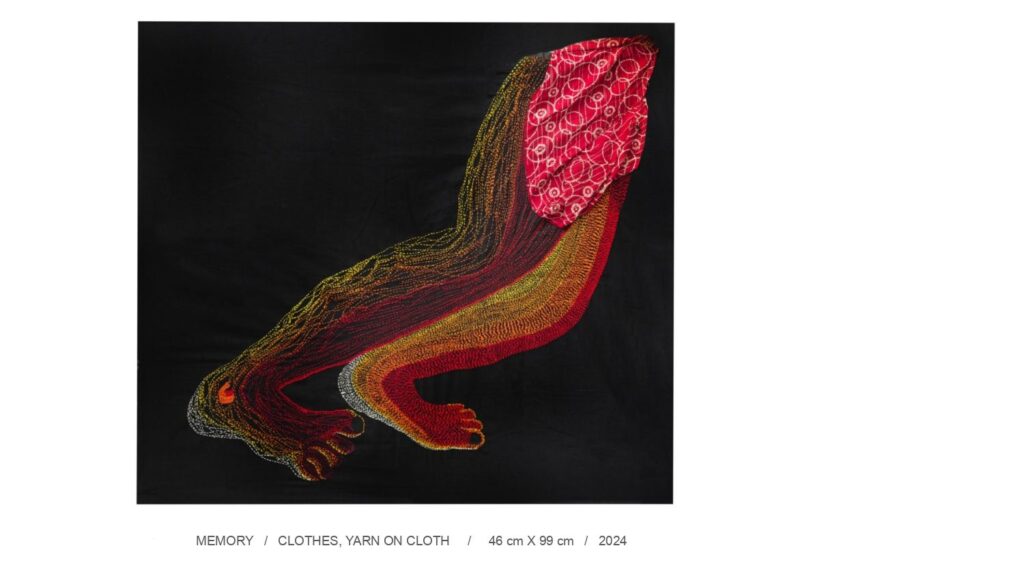
Tithi Gain
MEMORY
Two bare feet, drawn in slow rows of red thread
Black cloth, dark as a room after the lamp goes out.
Two feet step out of it with toes curled and still warm.
Red thread, then orange, then pale yellow, loop after loop.
The legs climb towards a scrap of someone's red dress.
White rings float on it like bangles left on a shelf.
Every stitch is a small hour of sitting still.
Tithi Gain makes Memory from clothes and yarn on black cloth. Two legs and feet reach up towards a piece of red printed fabric. Each line is a row of small stitches in yellow, orange, red and white. Gain's course is the MFA at the S.N. School of Art and Communication, University of Hyderabad. She is based in Basirhat. She stitches because the craft is tied to domestic work and women's labour. For her, one thread can be one woman's life. Many threads together are the larger structures around women.
Clothes and yarn on cloth · 46 × 99 cm · 2024
Theme Women's lives and labour
RC-338
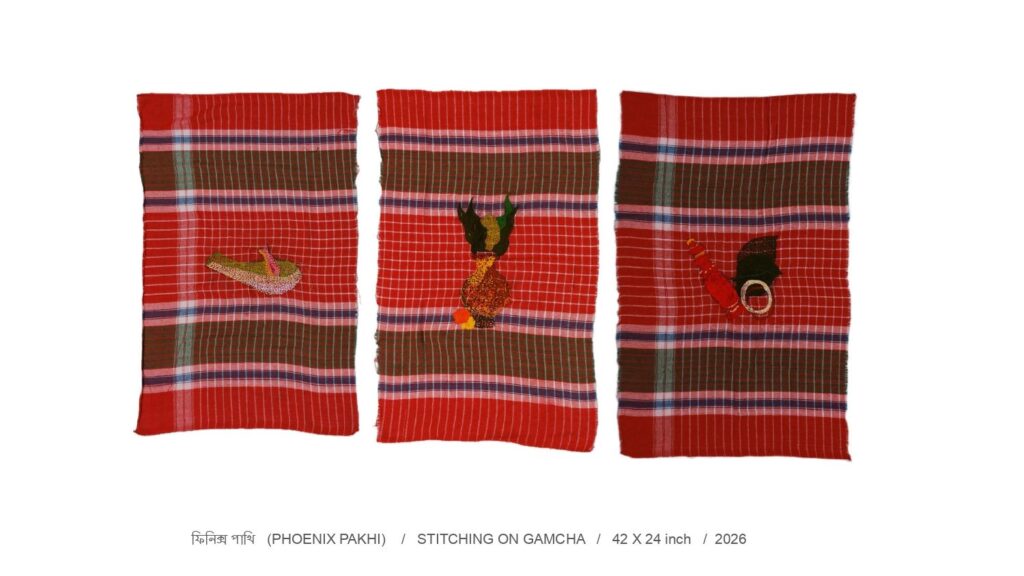
Tithi Gain
ফিনিক্স পাখি (PHOENIX PAKHI)
The cloth that dries hands, stitched until it speaks
Red cloth, checked in white, the kind that hangs by a door.
A pot sits in the middle with leaves like dark flames.
The thread is thick and patient, gold beside red.
On the right a white ring waits, small and closed.
The edges fray where hands have pulled them.
No bird is shown. Only what remains in the heat of the colour.
Tithi Gain stitches on three red gamchas, the thin cotton towels used in many homes. Each cloth holds one object. The first is a long shape in yellow and pink thread. The second is a pot with dark green leaves, sewn in red and gold. The third holds a red form, a dark leaf and a white ring like a bangle. Gain uses thread because stitching is tied to women's work at home. Her course is the MFA at the S.N. School of Art and Communication, University of Hyderabad.
Stitching on gamcha · 106.68 × 60.96 cm · 2026
Theme Women and household labour
RC-336
From the open call
Pooja
My practice explores the psychological landscapes of human emotions and the subtle tensions embedded within contemporary society. I am interested in experiences that often remain unspoken—anxiety, vulnerability, fear, isolation, emotional conflict, and psychological uncertainty. Through painting, I give visual form to these intangible states and examine how emotions shape perception, memory, behaviour, and our understanding of ourselves and others. The human figure is central to my practice, but I move…



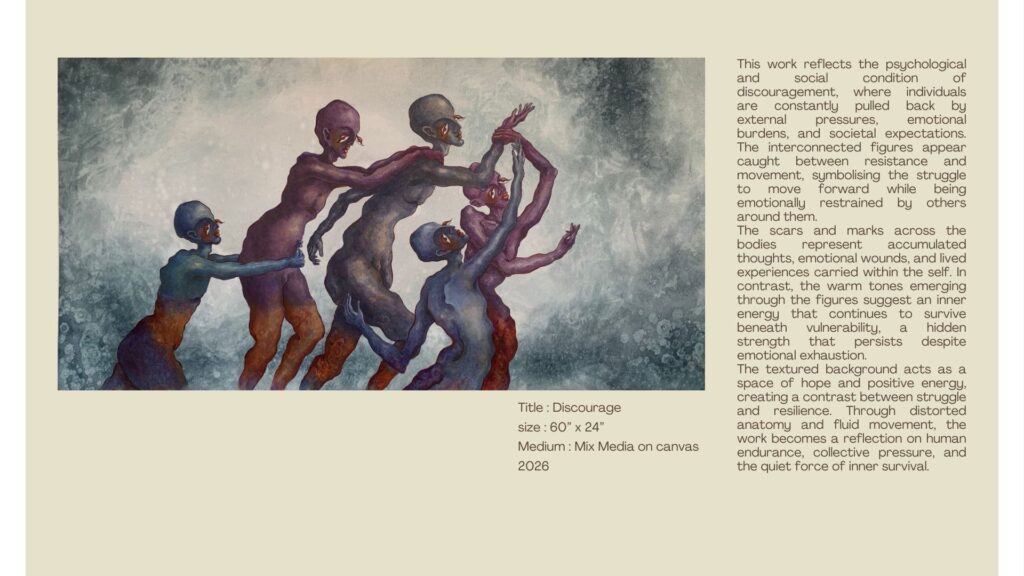
Pooja
Discourage
Every hand that holds them back also holds them up
Five bodies lean into the same grey weather.
A hand closes on a shoulder. Another hand holds a wrist.
The skin is the colour of bruise and slate.
Below the knees, rust climbs like a slow fire.
One arm still reaches up past all the others.
Behind them the mist breaks into small pale rings.
Five bare figures press forward across a long canvas. Each one holds or pulls at the next. Pooja stretches their limbs and shrinks their heads. Their skin is grey, blue and mauve. Small scars and marks cover it. Red and orange rise through the legs like heat. Behind them the background is built up in layers of texture and marks until it opens into pale light. The work is mixed media on canvas and measures 152 × 60 cm. Pooja is based in Delhi.
Mixed media on canvas · 152 × 60 cm · 2026
Theme Discouragement and inner strength
RC-366

Pooja
Psychology of Emotions
Two figures hold each other up under a sky of lotus pods
Olive pods drift across a sky the colour of milk and ash.
Two bodies lean in, thin as dry reeds.
Red threads run under their skin like a knot of small worries.
One hand rests on a chest. One arm holds a back.
Nobody looks up.
The holes in the pods let the light through.
Pooja paints the feelings people often keep quiet. In this work from 2025 two bare figures stand close. One holds the other. Their bodies are long and bent out of shape. Fine red and dark lines cover their skin like tangled thoughts. Behind them large lotus seed pods float on a pale ground. Pooja bends the figure to show pressure inside the mind. The work measures 121 × 60 cm. Pooja studied in Banaras and is based in Delhi.
Mixed media · 121 × 60 cm · 2025
Theme Healing through each other
RC-363
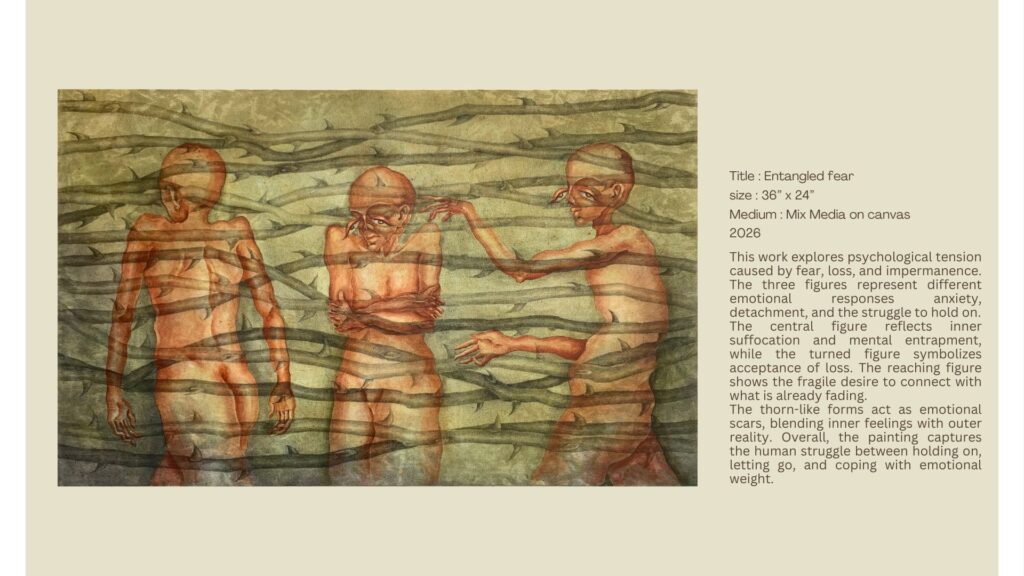
Pooja
Entangled fear
Thorns pass straight through the skin and no one steps away
Rust-coloured bodies, thin as tracing paper.
Branches lie across them like wire across a field.
The middle one folds its arms over its ribs and keeps very still.
A hand comes close to that face but does not land.
The third looks somewhere we cannot follow.
Everything is green the way old pond water is green.
Three figures stand in a field of grey-green. Thorny branches run across the whole surface and over the bodies, so the thorns seem to pass through the skin. The figure in the centre wraps its arms around its body. On the right, a figure reaches a hand towards it. On the left, a figure turns away. Pooja trained in Banaras and works in Delhi. She bends and layers the human body to show fear and pressure that people rarely speak about. The work is mixed media on canvas from 2026.
Mixed media on canvas · 121 × 90 cm · 2026
Theme Holding on to loss
RC-364

Pooja
Untitled
Three bodies flinch from something we cannot see
Blue-green water dries in rings around three pale bodies.
Ink hatches each rib and shoulder like rain on a window.
Fingers curl as if the air has turned sharp.
One head bows. One face hides in an elbow.
The paper keeps the stain of every wave.
Nothing touches them, yet they brace.
Three small panels sit side by side. In each a pale figure twists against a wash of blue-green. Pooja draws the bodies in fine ink lines that cross and build into shadow. Around them the colour pools and dries in soft stains. One figure lifts bent fingers to its face. One holds its own chest. One hides its face in the crook of an arm. Pooja studied in Banaras and works in Delhi. Here the figure is less a likeness than "a psychological presence".
Mixed media on paper · 60 × 88 cm · 2026
Theme The anxious body
RC-365
From the open call
Parigya Gupta (Little Creative Bug)
Some places do not exist on maps. They exist somewhere between memory and imagination - in the places we picture when life gets a little too loud. The Little Escapes Collection was born from that feeling. Six imagined places. Six different ways to feel. A corner to slow down. A street to wander. A court to play. A table to connect. A morning to linger. A pier to begin again.…


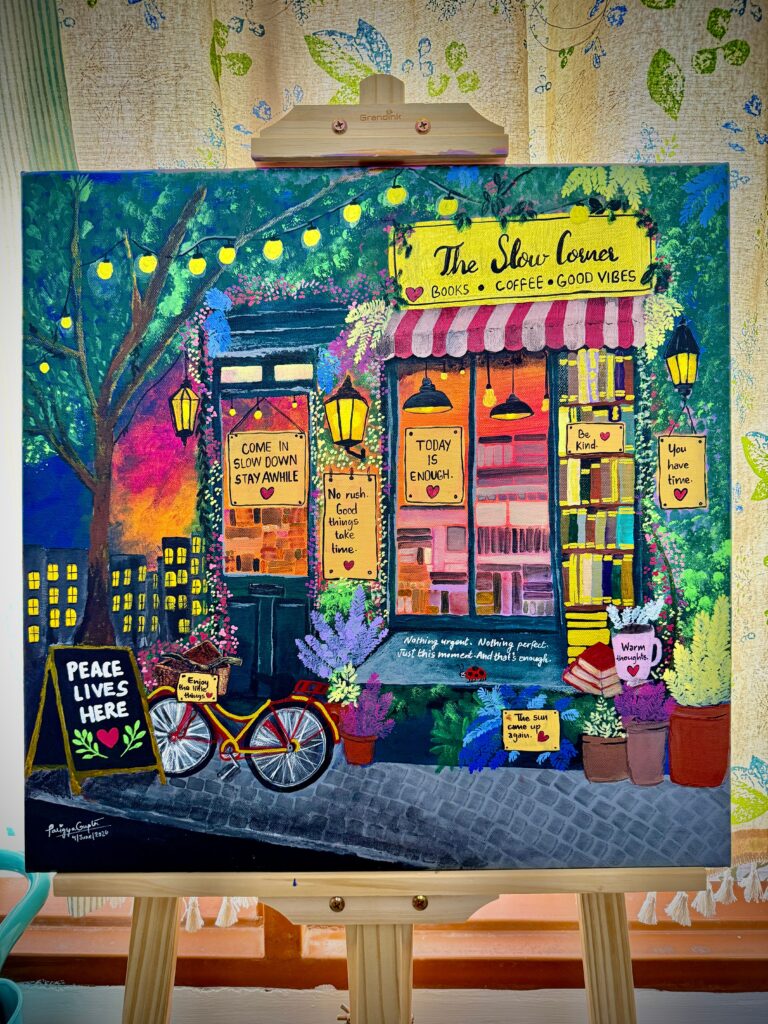
Parigya Gupta (Little Creative Bug)
The Slow Corner
A bookshop where every sign tells you there is no hurry
Yellow bulbs hang on a wire like small moons above the tree.
The sky behind the city burns pink and orange.
Inside, the books stand in tall coloured rows.
A bicycle rests with an empty basket and nowhere to go.
Lavender leans from its pot onto the grey stones.
A red ladybird crosses the step where the words say: just this moment.
The Slow Corner is the first of six paintings in the Little Escapes Collection by Parigya Gupta of Gurugram. Each painting shows an imagined place. Gupta says these places exist "somewhere between memory and imagination". This one is a small shop of books and coffee at dusk. Painted signs hang in the windows. They say "Today is enough" and "You have time". A yellow bicycle waits by the door. The work is acrylic on a small canvas, 20 × 20 cm.
Acrylic on canvas · 20 × 20 cm · 2026
Theme Permission to slow down
RC-382
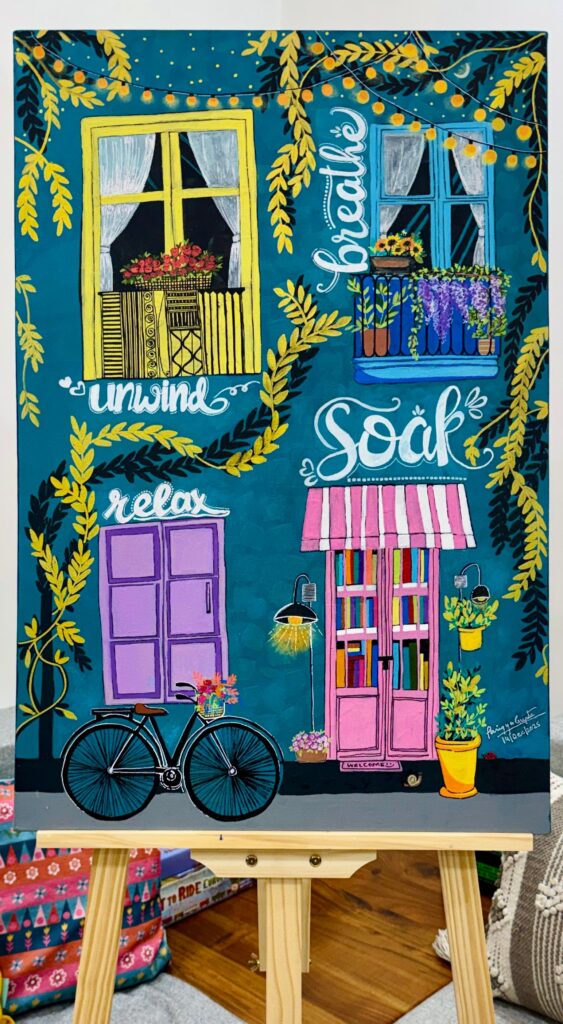
Parigya Gupta (Little Creative Bug)
The gentle street
Flowers spill from every window on a street no map shows
Teal dusk under a thin moon.
A yellow window holds red flowers like a held breath.
Wisteria drips purple over a blue rail.
Small bulbs hang on a wire, each one a drop of honey.
A bicycle leans and waits with flowers in its basket.
At the pink door a snail crosses the welcome mat in no hurry at all.
The gentle street is the second of six paintings in the Little Escapes Collection by Parigya Gupta. Each painting in the set is an imagined place. Here a teal street holds a yellow window full of red flowers and a blue balcony hung with purple wisteria. A string of small lights runs across the top. Below sit a lilac door, a bicycle with a basket of flowers and a pink shop lined with books. Hand-lettered words ask us to unwind, breathe, relax and soak.
Acrylic on canvas · 30 × 20 cm · 2026
Theme Warmth and belonging
RC-383
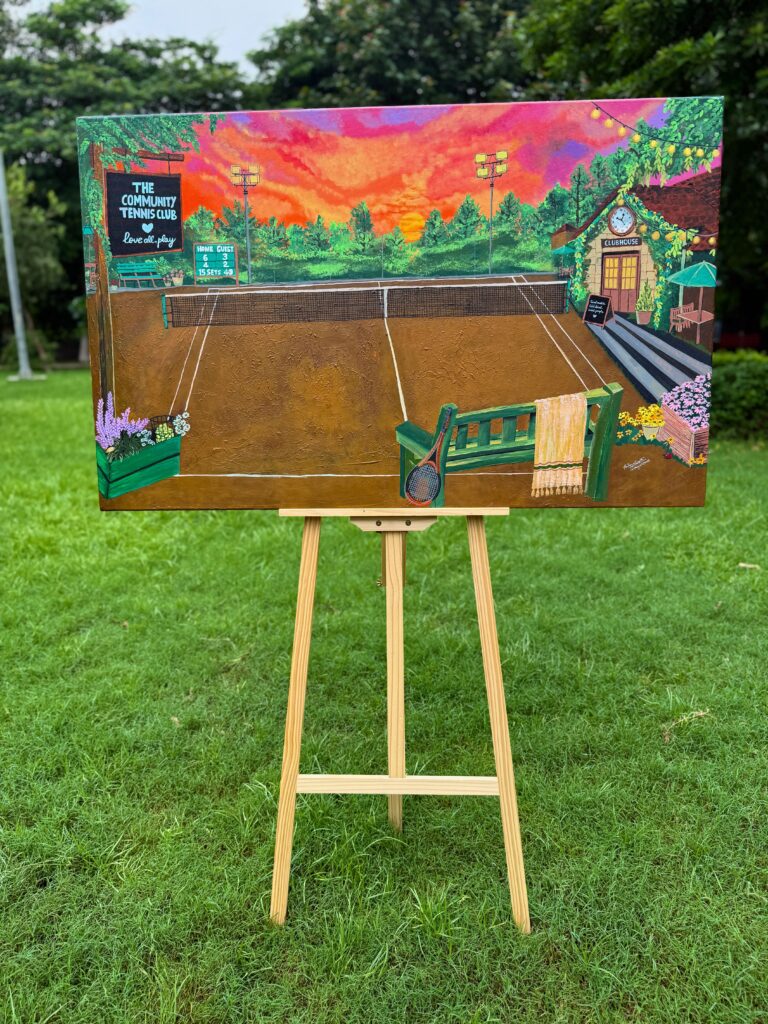
Parigya Gupta (Little Creative Bug)
The community tennis club
The game is over. The towel is still on the bench.
The sky turns orange and pink over the trees.
Two floodlights stand ready for the evening.
The court is brown and rough, like earth in summer.
A racquet leans on a green bench. A towel hangs over the back.
Lavender grows in a wooden box by the line.
Someone has just left. Someone will come back tomorrow.
Parigya Gupta paints places that do not exist on maps. The community tennis club is the third of six paintings in the Little Escapes Collection. Each painting is an imagined place for a different feeling. This one is about play. "Not every escape needs to be quiet," Gupta writes. A clay court fills most of the canvas. Its brown paint has a rough texture. A green bench waits at the front with a racquet and a striped towel. Above the trees the sky burns pink and orange.
Acrylic on canvas · 30 × 48 cm · 2026
Theme Play and belonging
RC-384

Parigya Gupta (Little Creative Bug)
The game night
A Catan board, fairy lights and nowhere else to be
Warm bulbs hang in a row like small suns that agreed to stay late.
Hexagons of wheat yellow, brick red and moss green float on a bright blue sea.
A wooden pawn stands in the middle and waits for its turn.
Dice rest near the edge. Cards fan out, half hidden.
A candle glows beside a dark bottle.
A notebook says win the game for everybody. A ladybird sits on the page.
Parigya Gupta works in Gurugram under the name Little Creative Bug. The Game Night is the fourth of six paintings in the Little Escapes Collection. Each painting shows an imagined place and a feeling. Here the place is a table set for a game of Catan. Gupta paints the board from above in acrylic on canvas. Fairy lights hang over it. A shelf of games and a Diet Coke wait close by. The idea behind it is simple: "Because we need to connect."
Acrylic on canvas · 22 × 15 cm · 2026
Theme Friendship around a table
RC-385
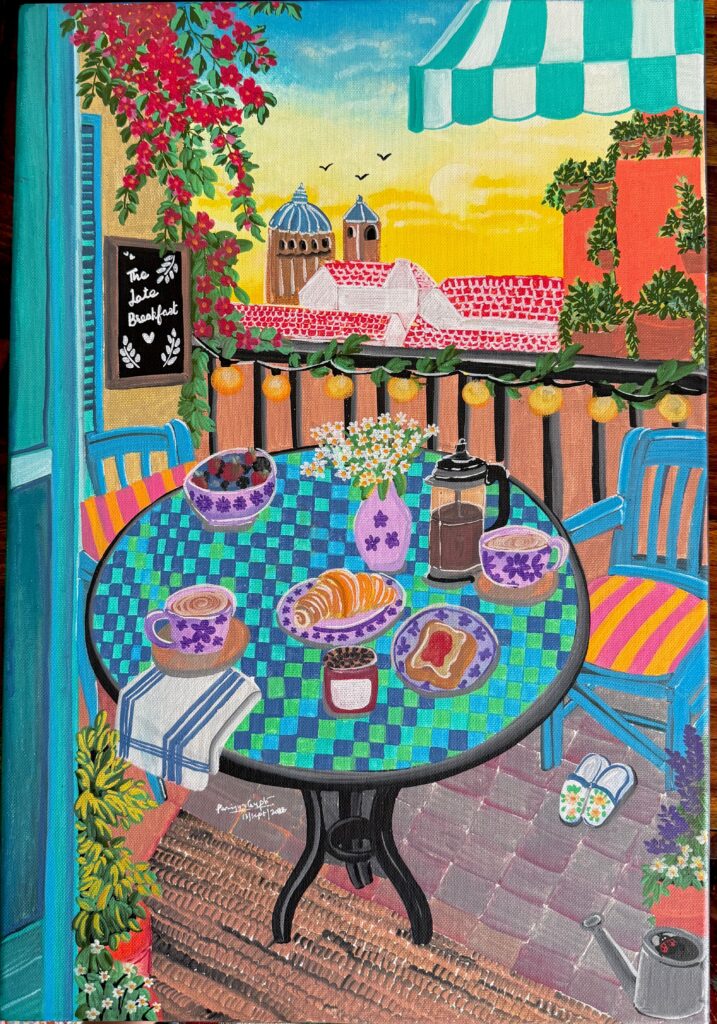
Parigya Gupta (Little Creative Bug)
The late breakfast
Two cups of coffee cooling while the rooftops turn gold
Coffee cools in a cup painted with violet flowers.
The table is a board of blue and green squares that no one is playing on.
Past the rail, red roofs and two domes stand in yellow light.
A pair of slippers waits by the chair. A watering can rests in the corner.
Someone was here a moment ago.
The croissant can wait for them.
The Late Breakfast is the fifth of six paintings in The Little Escapes Collection by Parigya Gupta, who works in Gurugram. Each painting shows an imagined place. Gupta says the paintings are "not really about the places" but about "how we want to feel when we are there." Here she paints a small balcony on a bright morning in acrylic on canvas. A croissant and toast with jam wait on a checked table. Two cups sit with no one beside them. The painting measures 22 × 15 cm.
Acrylic on canvas · 22 × 15 cm · 2026
Theme Unhurried mornings
RC-386

Parigya Gupta (Little Creative Bug)
The sunset pier
Two empty chairs and one warm cup facing the last light
Orange burns low behind the blue hills.
A yellow road of light runs across the water to the boards.
Two pink chairs face it. Nobody sits in them yet.
A cup on one arm. A striped cloth folded on the other chair.
Round bulbs hang on a string between the posts.
Red pots of daisies and a lantern keep the corner warm.
Parigya Gupta works as Little Creative Bug in Gurugram. The sunset pier is the last of six paintings in the Little Escapes Collection. In Gupta's words, "Some places do not exist on maps." Each place stands for a feeling. This one is "A pier to begin again." Two empty chairs wait at the end of the wooden boards. A cup rests on one arm. A small painted sign speaks of endings and beginnings. The sun sinks behind dark mountains.
Acrylic on canvas · 20 × 20 cm · 2026
Theme Endings and new beginnings
RC-387
From the open call
Ranjini A M
Statement of Art My art is an exploration of the emotions, experiences, and quiet mysteries that exist within everyday life. I am drawn to the things that often remain unseen or unspoken—the fleeting thoughts, memories, dreams, fears, hopes, and emotions that shape our inner world. Working primarily in acrylic on canvas, I use colour, symbolism, and surreal imagery to transform personal experiences and observations into visual narratives. My works often…
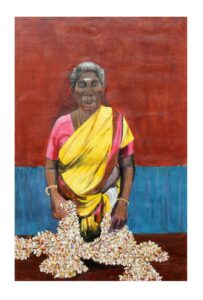
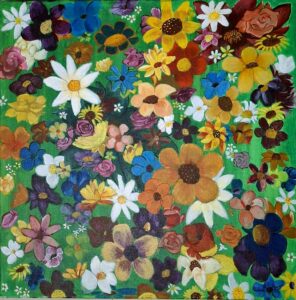


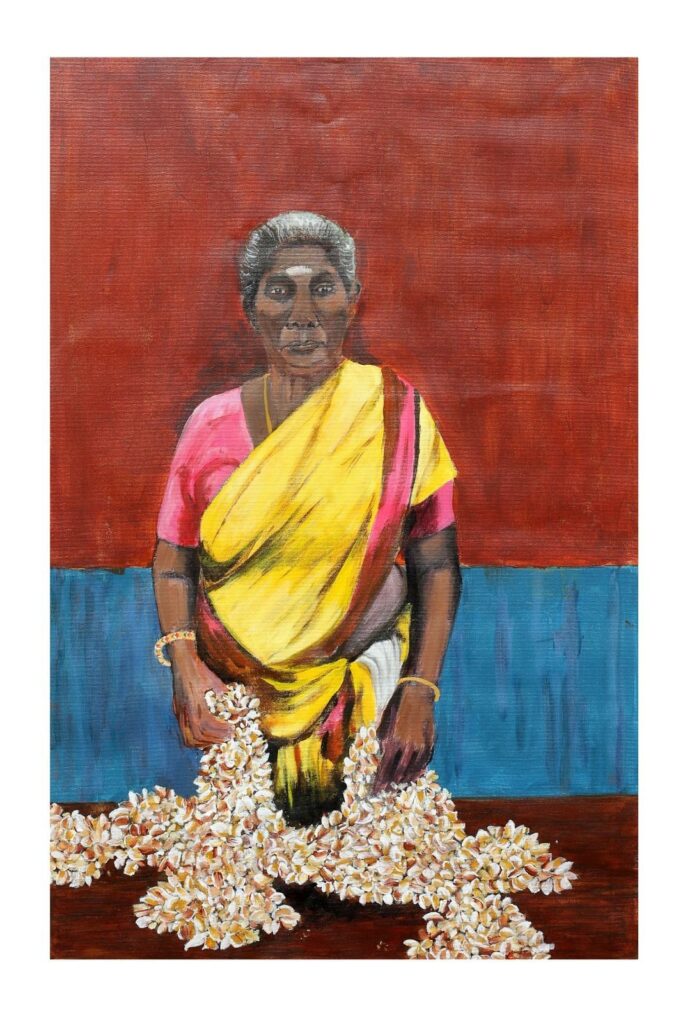
Ranjini A M
Flower seller
Her hands are full of flowers. Her eyes stay on you
Red wall. Blue wall. They meet in a line at her waist.
The yellow sari falls across her like late sun on a step.
Her hands sink into white flowers and gold bangles catch the light.
Each petal is a quick touch of cream, then a touch of brown.
She does not smile. She waits.
The strings spill off the table toward us, heavy and still.
Flower seller is a 2023 painting in acrylic by Ranjini A M. It measures 90 × 60 cm. An older woman stands behind a dark table. Her hands rest in long strings of white flowers. Each flower is a small touch of cream with a brown edge. She wears a yellow sari over a pink blouse. Behind her the wall is red above and blue below. Ranjini often begins with something from daily life. This work stays close to it. Ranjini's college is SIES in Bombay.
Acrylic · 90 × 60 cm · 2023
Theme Daily labour and dignity
RC-398

Ranjini A M
Flowers
Every flower fights for a little room on the green
A green so bright it hums under everything.
White daisies lean on rust roses like tired friends.
A blue flower turns its face to the purple dark beside it.
In the middle, one large ochre bloom holds still.
Small white stars spill into every gap.
No stems, no vase, no ground to stand on.
Only faces, crowding close, waiting to be counted.
Ranjini A M's square work in acrylic dates from 2022. It measures 60 × 60 cm. A green ground holds many flowers from edge to edge. White daisies sit beside roses in pink and rust. Blue and purple blooms press against yellow ones with dark brown centres. Tiny white flowers fill the gaps. Ranjini's college is SIES in Bombay and she is based in Thrissur. She wants to bring "the hidden intricacies of seemingly simple moments into view." Here that moment is a crowd of flowers.
Acrylic · 60 × 60 cm · 2022
Theme Flowers in abundance
RC-399

Ranjini A M
Village
Two clay pots, one blue bucket, a grass roof against the sky
Grass roofs bend low like old brown hair.
The earth is the colour of tea left too long in the cup.
A red cup in her hand, an orange sari against the straw.
Two clay pots lean together as if talking.
The bucket holds a little of the sky.
A palm tree leans in to listen.
In Village the Thrissur artist Ranjini A M paints two huts with thick grass roofs. A woman in an orange sari stands by a thin fence. She holds a small red cup. Two clay pots and a pale blue bucket rest on the brown earth. A coconut palm leans across the left side. Ranjini works in acrylic. The painting is 60 × 90 cm. Her college is SIES in Bombay. She says her work often begins with something familiar. Here she stays close to the ordinary day.
Acrylic · 60 × 90 cm · 20223
Theme Everyday village life
RC-400

Ranjini A M
Uruma
She carries the firewood and looks straight back at you
The path is red earth, dry and bright in the sun.
Split wood rises from her head like a crown no one gave her.
Her arm holds it there without asking for help.
A thin chain catches the light at her throat.
Her blouse is the colour of ripe papaya. Her wrap is the grey green of rain.
Behind her the leaves keep growing. She keeps looking at us.
Ranjini A M paints an older woman on a red earth path. A bundle of firewood rests on her head. One raised arm holds it steady. She looks straight at us. The painting is in acrylic and measures 90 × 60 cm. Ranjini gives care to small things: the thin chain at the neck, the lines of the skin, the folds of the dark wrap. In her statement she says she is drawn to what often remains unseen. Ranjini is based in Thrissur and her college is SIES, Bombay.
Acrylic · 90 × 60 cm · 2023
Theme A woman's daily work
RC-397
From the open call
Shivam Aggarwal
I'm Shivam Aggarwal, an emerging visual artist based in Delhi, India. I am currently completed my Bachelor of Fine Arts (BFA) in Painting from College of Art, Delhi, (INDIA).Throughout my academic journey, I have actively participated in various art competitions, which have helped me strengthen my technical skills and deepen my understanding of visual arts. My artistic practice is multidisciplinary, and I work across painting, printmaking, sculpture, and clay modeling.…


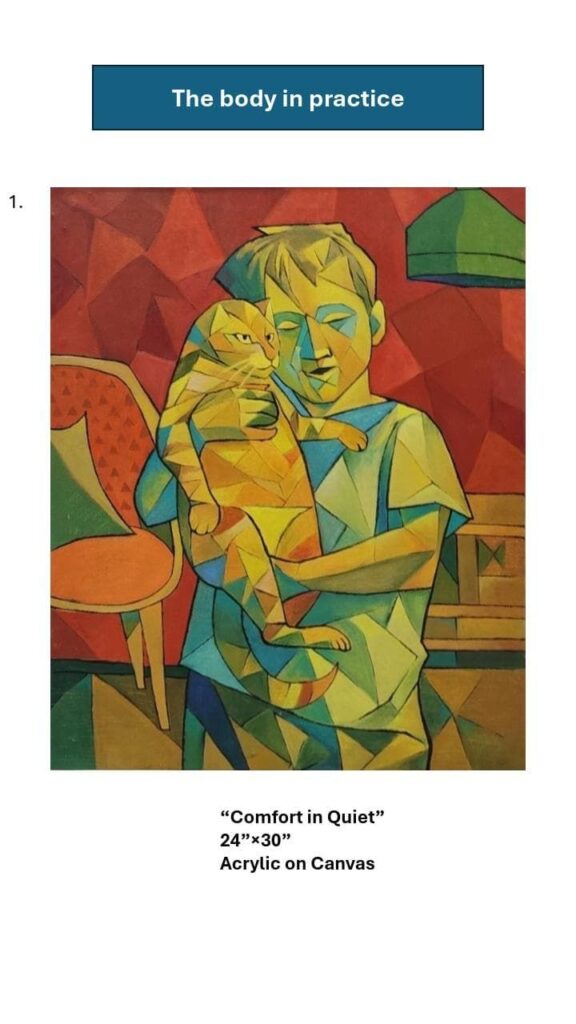
Shivam Aggarwal
Comfort in quiet
The cat looks away. The boy holds on
A red room cut into a hundred small walls.
The cat hangs heavy and gold in the boy's arms.
His eyes are almost closed. Its eyes stay open.
A green lampshade hangs like a folded leaf.
The chair waits with its cushion of tiny triangles.
Nobody speaks. Stripes and angles hold still together.
Shivam Aggarwal paints a boy holding a striped orange cat close to his chest. The cat looks off to one side. The boy keeps his face near it with his eyes half shut. Aggarwal breaks every surface into flat planes of colour. The red wall, green lamp, orange chair and wooden table all split into sharp shapes. The work is acrylic on canvas and measures 76.2 × 60.96 cm. Aggarwal studied Painting at the College of Art in Delhi. He likes to draw and paint from life. He studies form and light.
Acrylic on canvas · 76.2 × 60.96 × 2.54 cm · 2026
Theme Quiet companionship
RC-367
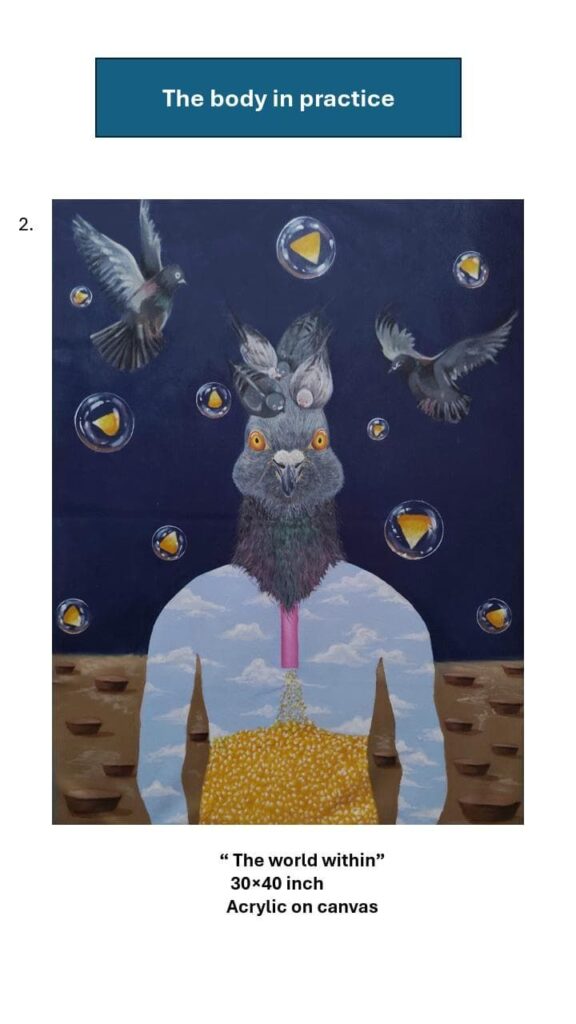
Shivam Aggarwal
The World Within
Sky for a chest, a pigeon for a head
Night the colour of ink. Pigeons cross it without a sound.
A bird's head looks out with orange eyes, calm and a little sad.
Inside the chest there is a summer sky. Clouds drift where a heart should be.
A pink pipe pours grain like sand in a clock.
Bubbles float past. Each one holds a small gold shard.
Below, the brown earth is full of empty holes.
Shivam Aggarwal paints a figure with the head of a pigeon. Small pigeons sit on top of its head. Two more fly across a deep blue night. The body is a shape cut from a pale sky with soft white clouds. A pink tube runs down from the throat and pours yellow grain into a heap. Bubbles float in the air. Aggarwal works in acrylic on canvas at 101.6 × 76.2 × 2.54 cm. He holds a BFA in Painting from the College of Art in Delhi.
Acrylic on canvas · 101.6 × 76.2 × 2.54 cm · 2026
Theme The body as world
RC-368

Shivam Aggarwal
Childhood friendship
Five friends on one wall, a paper boat at their feet
Green and pale yellow, the field goes soft behind them.
Five pairs of bare feet hang above the wet earth.
One arm rests across two shoulders.
A paper boat turns slowly in a ring of ripples.
At the end of the wall a boy hugs his knees and a dog leans in.
The knife has left every blade of grass standing.
Shivam Aggarwal cuts this scene into wood and prints it on paper. Five children sit in a row on a low wall. Their bare feet hang over wet ground. A paper boat floats on the water below. A dog leans on the last boy at the end. Aggarwal has just finished his BFA in Painting at the College of Art in Delhi. He also paints, makes sculpture and models clay. Here the cut lines of the block give the grass, hair and skin their texture.
Woodcut print on paper · 40.64 × 60.96 × 0.055 cm · 2026
Theme Childhood and friendship
RC-369
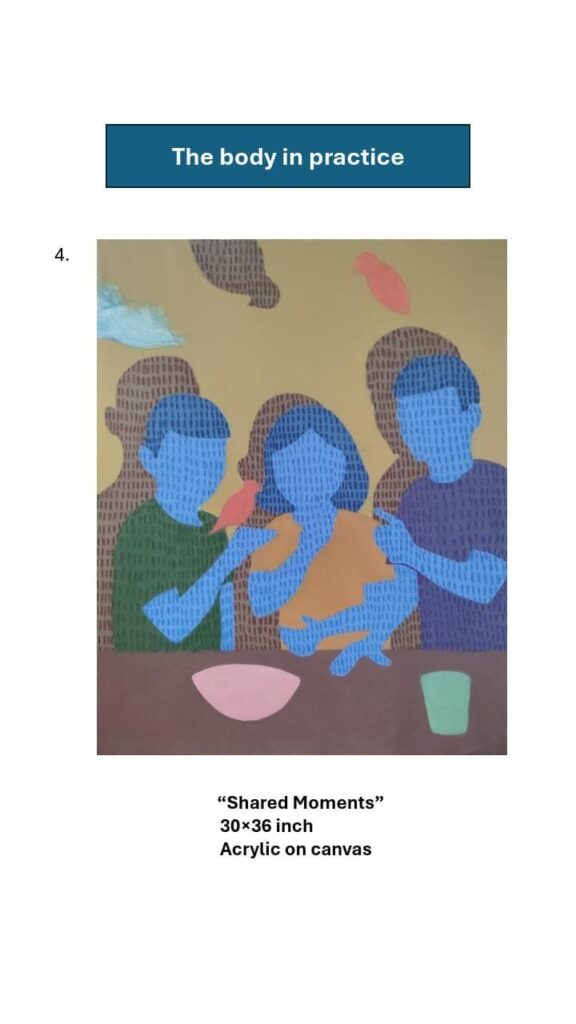
Shivam Aggarwal
Shared moments
No faces, yet every hand reaches for someone
Blue hands rest on a shoulder, on an arm, on a lap.
No eyes, no mouths. Only small dark marks, like rain on a window.
Behind each body a brown shadow waits, taller and older.
A red bird lands where two hands meet.
On the table sit a pink bowl and a green cup, nothing poured yet.
The yellow wall holds everyone in.
Shivam Aggarwal has completed his BFA in Painting at the College of Art in Delhi. He works across painting, printmaking, sculpture and clay modelling. Here three figures sit close together behind a brown table. Their faces have no features. Their blue skin is covered in short dark marks. Brown shadows of the same shapes rise behind them. Aggarwal has a strong interest in still life. It shows in the pink bowl and the green cup at the front of the canvas.
Acrylic on canvas · 91.44 × 76.2 × 5.08 cm · 2026
Theme Family and closeness
RC-370
From the open call
Nathan Biju George
I very much love drawing aquatic life, whether giving them a character or just drawing it coz I feel like it. I always feel comfort when drawing fishies, and I would like for others who like aquatic life to see my art and enjoy it the same way I do. There is something about drawing aquatic life that makes me feel calm and happy, and I think that feeling is…


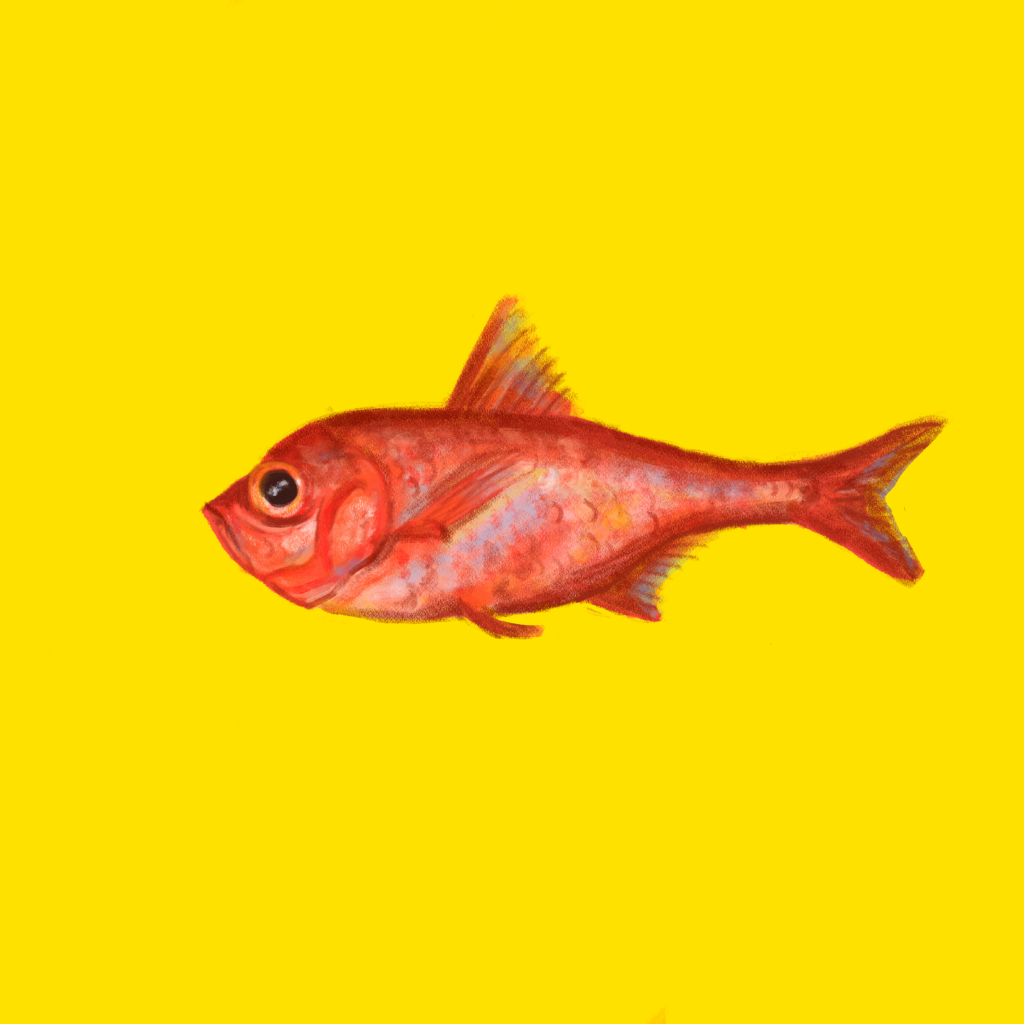
Nathan Biju George
Fih
A small red fish with a big eye, alone in yellow
A red fish hangs in a field of yellow like noon.
Its eye is a black bead ringed with gold. It looks back.
The scales carry a faint lilac, the shine of wet skin.
The top fin opens like a fan of thin bones.
No water is drawn. The yellow holds it up anyway.
It seems about to speak. Then it swims on.
Nathan Biju George studies at the MIT ADT School of Fine Arts and Applied Arts. George is based in Kochi and has made digital art only since 2025. Fih is a digital work from 2026, 40 × 40 cm. One red fish faces left on a flat yellow ground. The scales hold soft touches of pink and lilac. George works hard to make colours stand out. Here the warm red and the strong yellow pull against each other. Each fish, for George, has a small life of its own.
Digital · 40 × 40 cm · 2026
Theme Fish as small characters
RC-322

Nathan Biju George
Trying to smoke here.
A goldfish on his break, blowing bubbles where smoke should be
A goldfish takes his five minutes against a grey wall.
Orange scales, a shirt the colour of thin milk, a brown belt pulled tight.
Behind him a stripe of hard blue stands up like a door left open.
His eyelids sit heavy. The cigarette rests pale between orange fingers.
He breathes out and the air turns to glass.
Bubbles drift up, a small rainbow caught in each skin.
Nathan Biju George draws fish as if they are people. Here a goldfish in a pale blue shirt with rolled sleeves stands with one hand on his hip. He lifts a cigarette to his mouth. What rises is not smoke but soap bubbles. George makes the work digitally in 2026. He has worked digitally only since 2025 and he treats each drawing as a chance to experiment. "I like to believe that each fish has human characteristics, living their own lives, just like us."
Digital · 40 × 40 cm · 2026
Theme Fish with human lives
RC-324
From the open call
K. Shreya
Virat kohli - I was trying to draw a realistic pencil portrait. I used charcoal pencils for sketching and shading. The most difficult part was getting the facial proportions right and creating realistic hair and beard textures. 2. Peacock - I was trying to draw a colorful peacock and highlight the beauty of its feathers. I used color pencils on white paper and focused on adding bright colors and fine…


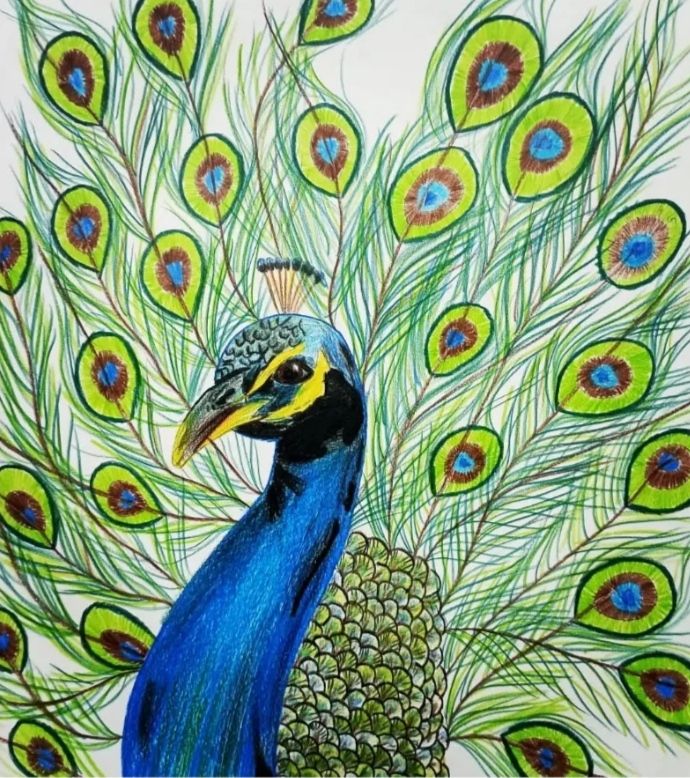
K. Shreya
Peacock – beautiful things don’t ask for attention…
Every eye on this tail was drawn one at a time
A blue neck rises from the bottom of the page and holds still.
Pencil lines pile up until the white paper stops showing through.
Behind the head, thin green strokes lean outwards, hundreds of them.
Each feather ends in an eye: lime, then brown, then a small blue pool.
On the breast, tiny scales sit close, one beside the next.
The bird looks away from us. It does not need to look.
K. Shreya, from Stanley in Hyderabad, makes this peacock in 2024 with colour pencils on white paper. The aim is to show the beauty of the feathers. The bird turns its head to the left. Its deep blue neck rises from the bottom of the page. Behind it the tail opens in fine green strokes and rows of eyes. For Shreya the hardest part is drawing so many feathers neatly. Keeping the colours balanced takes time and patience.
Colour pencil on white paper · 2024
Theme Quiet beauty
RC-339

K. Shreya
Sai Baba
Two points of bare paper give these eyes their quiet light
Three black bands cross the brow like roads seen from above.
A dark seed rests in the middle.
Each eye keeps one white point where the paper is left bare.
The beard falls in short grey strokes, soft as ash.
At the right edge the shading thickens into night.
The face stays still and asks you to be still too.
K. Shreya, of Stanley in Hyderabad, draws this portrait of Sai Baba in 2024. The aim is to show "his calm and peaceful expression." Shreya works with 2H, 8H and charcoal pencils for outlines, shading and detail. The darkest black sits in the mark on the forehead. The hardest task is to balance the face and make the eyes speak. Shreya keeps changing the proportions and shadows until the drawing comes close to the picture in mind.
Charcoal and pencil on paper · 2024
Theme Devotion and calm
RC-340

K. Shreya
Lord durga matha
A calm white face inside a storm of black lines
Black lines crowd the paper like seeds packed in a pod.
Petals, beads and tiny wheels climb into a tall crown.
In the middle the face stays white and still.
Three red points burn: the hairline, the brow, the mouth.
A third eye opens and does not close.
The whole sheet holds the hours it took to fill.
K. Shreya studies at Stanley in Hyderabad. In this drawing from 2025 she shows the goddess Durga. The face is calm and almost empty of line. Around it, every space is full. Lotus shapes, petals, beads and small wheels fill the crown, the hair and the jewellery. Only three things are red: a mark at the hairline, a dot between the brows and the lips. A third eye rests on the forehead. In her other drawings Shreya also works slowly on faces and fine detail.
Black and red ink on paper · 2025
Theme Devotion to Durga
RC-341

K. Shreya
Virat kohli
A sideways glance and a hard frown, built from charcoal
Pale paper. A brow pulled down hard.
The beard is black on black, packed tight like wet soil.
Light rests on the nose, the cheek, one bright eye.
The hair rises in quick strokes, then stops.
He does not smile.
In the corner, two words in a small hand: Run Machine.
K. Shreya draws Virat Kohli in a close three-quarter view. The head turns away but the eyes glance sideways. Shreya wants a realistic portrait. Charcoal pencils do both the sketching and the shading. The hardest part is the face. Getting the proportions right takes care. So do the hair and beard. Each needs its own texture built up in short dark strokes. The words "Run Machine" sit in the lower left corner. Shreya studies at Stanley in Hyderabad. The drawing is from 2024.
Charcoal pencil on paper · 2024
Theme A realistic portrait
RC-342

K. Shreya
Bird
A purple bird waits under its own green roof
A small bird wears the colour of evening.
Short purple strokes stand up like breath in cold air.
One blue stripe, bright as a cut in the sky.
A leaf bends over it, a green roof in rain.
The black mask, the one white spark of an eye.
It holds the stem and waits.
Bird is from 2023. K. Shreya studies at Stanley in Hyderabad. A round bird sits on a thin green stem. Its chest is soft purple, made of many short strokes that look like feathers. A band of bright blue runs down its side and brown covers its back. A black stripe crosses its eye. A long leaf curves over its head like a roof. Shreya leaves the paper plain around the bird so it stands alone.
2023
Theme A bird at rest
RC-343
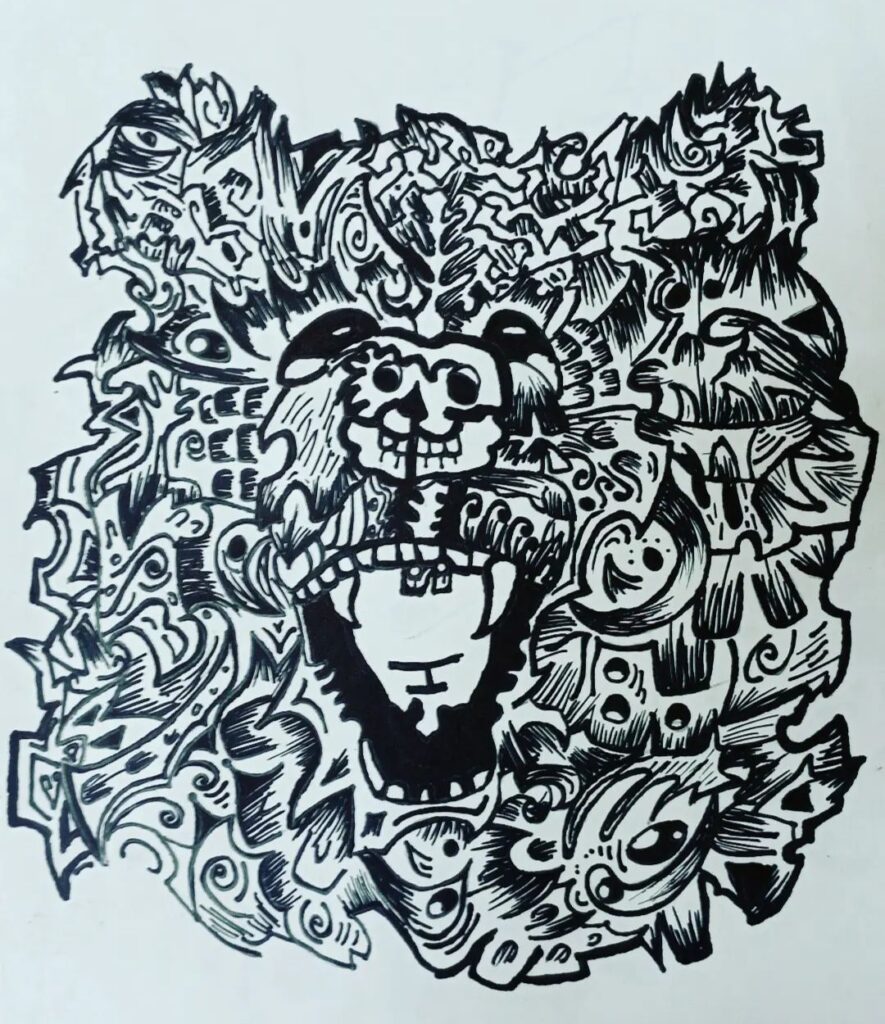
K. Shreya
Bear roaring – doodle art
Every corner of this roar is watching you back
Black ink crowds the white page to its edges.
A bear opens its mouth and the sound is a blank space.
Two fangs hang like hooks over the dark throat.
On its brow a little skull grins back.
Eyes look out from the spirals, from the corners, from everywhere.
The paper is quiet. The drawing is not.
K. Shreya makes this doodle in 2023 while studying at Stanley in Hyderabad. A bear's head fills the centre with its mouth wide open and two sharp fangs bared. A small grinning skull sits on its brow. Around it the page packs tightly with eyes, spirals, teeth and jagged shapes. Almost no gap is left empty. Much of Shreya's other work is careful realism in pencil. Here the pen moves freely and the bear grows out of crowded pattern.
Black ink on paper · 2023
Theme Wildness and pattern
RC-344

K. Shreya
Butterfly – doodle art
Every part of this wing wears a different pattern
Pink scales sit in rows like roof tiles after rain.
A blue drop runs down the wing and darkens as it goes.
One corner turns to brown hair, soft and combed.
Black lines cross and cross until they make a net.
The body is a thin green ladder with two curled feelers.
Around it, ink vines reach outward and leave the white page quiet.
K. Shreya studies at Stanley in Hyderabad. In this drawing a butterfly fills the page, seen from the side. Each part of its wing holds a different pattern: scales in pink and green, blue drops on black, a woven net of black and white lines. One long blue shape is shaded with tiny dots, dark at the bottom and pale at the top. Black curls and loops grow from the edges like vines. Shreya signs her name and the date in the lower right corner.
Coloured pencil and ink on paper
Theme Pattern in nature
RC-345
From the open call
P Juchitra
My artistic practice centers on the human experience, deeply tied to female identity, cultural heritage, traditional rituals, and personal memory. At its core, my work is a reflective journey—an ongoing effort to understand my place in the world while shedding light on the shared and private struggles of women. Culture is not merely a background in my art; it is an active presence. I draw inspiration from traditional rituals passed…
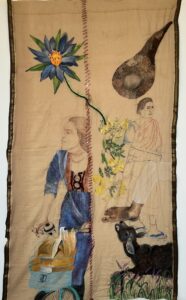


P Juchitra
Mental and emotional boundaries
One red seam of stitches keeps two women apart
Red thread climbs the cloth like a ladder no one uses.
On the left: blue cotton, a bicycle bell, a basket packed full.
On the right: a woman made only of outline, her sari pleats sewn in red.
A bare foot, larger than her face, rests near a black calf in the grass.
The blue lily does not ask permission.
Its green stem slips through the seam.
P Juchitra paints and stitches on a tall piece of cloth with a dark woven border. A line of red cross-stitches runs down the middle like a seam. On one side a young woman holds a bicycle. On the other side a woman in a sari is drawn in thread. A blue water lily reaches across the line. Juchitra writes that "the physical act of piercing the fabric repeatedly with a needle mirrors the pain..." Juchitra is from Tirupati and studies at the Sarojini Naidu School of Arts and Communications, University of Hyderabad.
Embroidery and acrylic on cloth · 80 × 45 cm · 2026
Theme Boundaries in women's lives
RC-401

P Juchitra
Muttu (Menses) I
A belled foot steps into fire on coffee-stained rice paper
A red leg comes down out of nowhere.
Small gold bells close round the ankle like teeth.
Under the foot a lilac petal opens in rings.
Brown flames lick the toes and a red thread wanders off to a white flower.
Across the creased paper a woman stands in green.
Garlands hang to her knees. Her face stays hidden.
The coffee stain spreads slowly, like a day that will not end.
P Juchitra makes Muttu (Menses) I in 2026 with coffee and acrylic on rice paper. The coffee turns the thin paper brown. The sheet is creased all over and measures 23.4 × 33 cm. Juchitra studies at the Sarojini Naidu School of Arts and Communication at the University of Hyderabad and is based in Tirupati. The work draws on rituals passed down through generations and on personal memory. The title names menstruation. A painted foot in bells meets a quiet figure hung with garlands.
Coffee and acrylic on rice paper · 23.4 × 33 cm · 2026
Theme Menstruation and ritual
RC-402
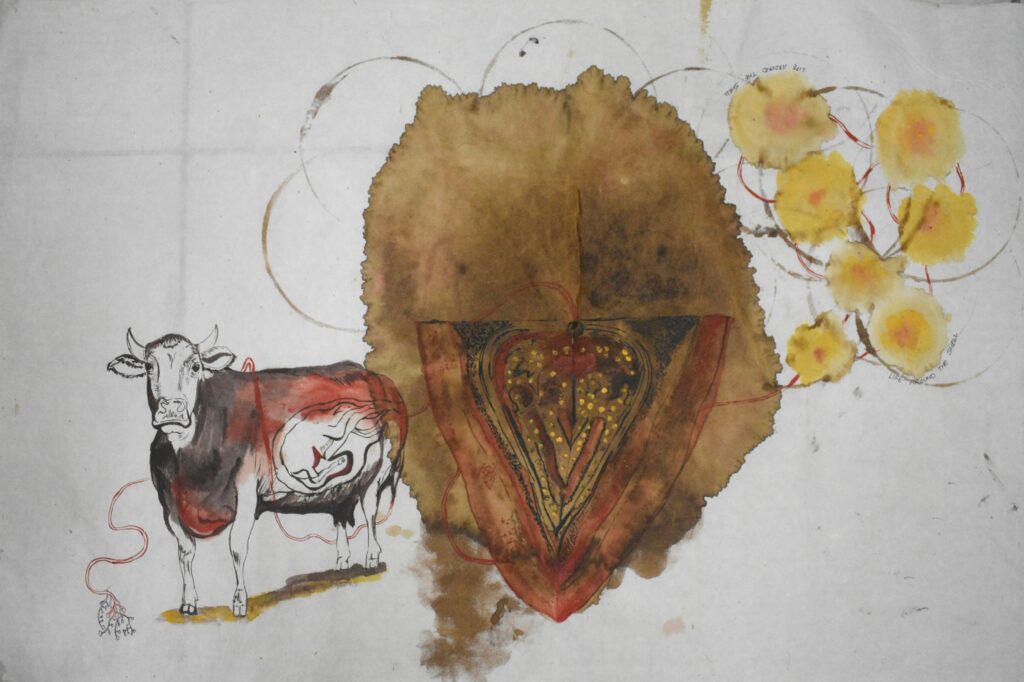
P Juchitra
Muttu (Menses) II
A coffee stain spreads like a body keeping its own time
Coffee sinks into rice paper and dries brown at the edges.
A red triangle sits inside the stain, dotted with yellow like seeds.
The cow stands still with a calf folded into her red side.
A thin red line runs out across the pale ground.
Yellow blooms hang on threads of red.
Old cup rings circle the top of the sheet, quiet as a kitchen at night.
P Juchitra makes Muttu (Menses) II with coffee and acrylic on rice paper. The title names menstruation. Coffee soaks into the thin paper and dries as a wide brown stain. Over the stain Juchitra paints a red and black triangle filled with yellow dots. On the left stands a cow with a calf curled inside its body. On the right yellow blooms hang on red lines. Staining is one way Juchitra builds layered surfaces. Juchitra studies at the Sarojini Naidu School of Arts and Communications, University of Hyderabad.
Coffee and acrylic on rice paper · 23.4 × 33 cm · 2026
Theme Menstruation and womanhood
RC-403
From the open call
Aadeesh Jain


Aadeesh Jain
Vishni Ji
Eyes closed, four hands full, standing still on a lotus
Blue skin, cool as river stone at dawn.
A gold disc turns on one fingertip.
Lilac ribbons cross the chest like slow wind.
The eyes stay closed. The lotus holds the weight.
At the edges, colour thins to paper and breath.
Above, a dark blue stain of night with white sparks.
Aadeesh Jain makes Vishni Ji on a screen, using digital watercolour and a paper texture. A blue figure with four arms stands on a pink lotus. One raised hand balances a golden disc. Another holds a small lotus. A lower hand rests on a golden mace. Lilac ribbons loop around the body. The paint fades into soft white edges, so the figure seems to rise out of mist. Jain is based in Alwar and studies at SOFA. The work is from 2026.
Digital watercolour and texture · 55.56 × 55.56 cm · 2026
Theme Stillness and the divine
RC-325
Aadeesh Jain
A Town Under a Tree
Up the trunk, a house hangs over empty air
Yellow leaves the colour of turmeric on a wet cloth.
A house hangs at the edge of a floating rock, tied to the branches by thin wires.
The stair falls down the trunk like a ribbon of light.
At the roots, towers wait in violet shade.
Paint drifts loose across the grain of the page.
Who lives up there? Who climbs down at evening?
Aadeesh Jain is an artist from Alwar who studies at SOFA. A Town Under a Tree, from 2026, is made in digital watercolour and textures. It measures 99.8 × 70.11 cm. A tall tree rises through the picture. Near the top, a small house sits on a floating piece of land. A long stair curves down the trunk to a town of towers at the roots. Jain keeps to two colours, warm yellow and soft purple. Drops of paint drift across the textured white ground.
Digital watercolour and textures · 99.8 × 70.11 cm · 2026
Theme Two homes, one tree
RC-326

Aadeesh Jain
Scenic Dream
One small red rider under a flood of green light
Green so dark at the trunks it is almost night.
Then the light comes in sideways, wide as a sheet.
On the right the world goes white and quiet.
A fence of thin posts. One lamp, not yet needed.
A rider in red pedals along the bottom edge,
small as a seed, unhurried,
through all that brightness.
Scenic Dream is a digital work by Aadeesh Jain of Alwar, made in 2026. Tall trees fill the left side in deep greens. Light pours through them in wide diagonal beams. The right side is almost white, as if the light has washed away the detail. Near the bottom a small cyclist in red rides past a low fence and a single lamp post. Jain leaves the brush marks rough on the leaves and grass. The figure is tiny. The light is the real subject.
Digital · 101.6 × 101.6 cm · 2026
Theme Light and solitude
RC-327
From the open call
Vatsal Tiwari
## Body, Memory, Space and Survival My practice exists at the tension between distorted figuration and abstraction, where the human body becomes both a recognizable presence and an unstable form. I am drawn to bodily gestures—figures mingling, interacting, withdrawing, or existing together within intimate and private spaces. These moments often occur between directed action and rest, when the body is self-involved, performing only for itself or another. Within these quiet…


Vatsal Tiwari
पाँत Size: 72” x 30” Medium: Mix media on canvas 2026
Bodies heaped like warm stones while the grass keeps growing
Backs like river stones, warm from a long afternoon.
An elbow rests where a neck should be.
A hand closes on something it cannot name.
Ochre, rust, a thin green bruise of light.
No one lifts a face.
Below them the grass keeps its own count,
pressed flat and rising anyway.
In पाँत, Vatsal Tiwari paints a long row of bodies pressed together. Limbs fold over backs. Hands grip arms and knees. Tiwari builds the surface with print, ink, acrylic and charcoal on canvas. Soft layers of ochre, rust and pale green let the figures melt into one another, so they look almost like stones. Grass grows along the lower edge. In his paintings, grass stands for what is stepped on and still keeps growing. Tiwari works in Delhi and is from the College of Art, New Delhi.
Print, ink, acrylic and charcoal on canvas · 186.88 × 76.2 cm · 2026
Theme Bodies, memory and endurance
RC-371

Vatsal Tiwari
Sleeping Beauty
A sleeping body slowly becomes rock, leaf and grass
Rust and rose seep into the canvas like tea into cloth.
A shoulder turns to stone. A hip turns to petal.
Small grains catch the light like dust on a sill.
At the bottom, grass bends under no foot at all.
One orange spark glows deep in the right-hand fold.
The sleeper does not wake. The land breathes around it.
Vatsal Tiwari comes from the College of Art, New Delhi. In Sleeping Beauty, resting bodies sink into a land of rock, leaf and petal. Tiwari paints with acrylic, oil and ink and adds rice to the canvas. Thin, soft colours let forms appear and then fade. A fine line splits the picture into two halves. Low grass runs along the bottom edge. For Tiwari, grass means survival. People step on it and crush it. Still it keeps growing.
Acrylic, oil and ink with rice on canvas · 186.88 × 76 cm · 2026
Theme Body, grass and survival
RC-372
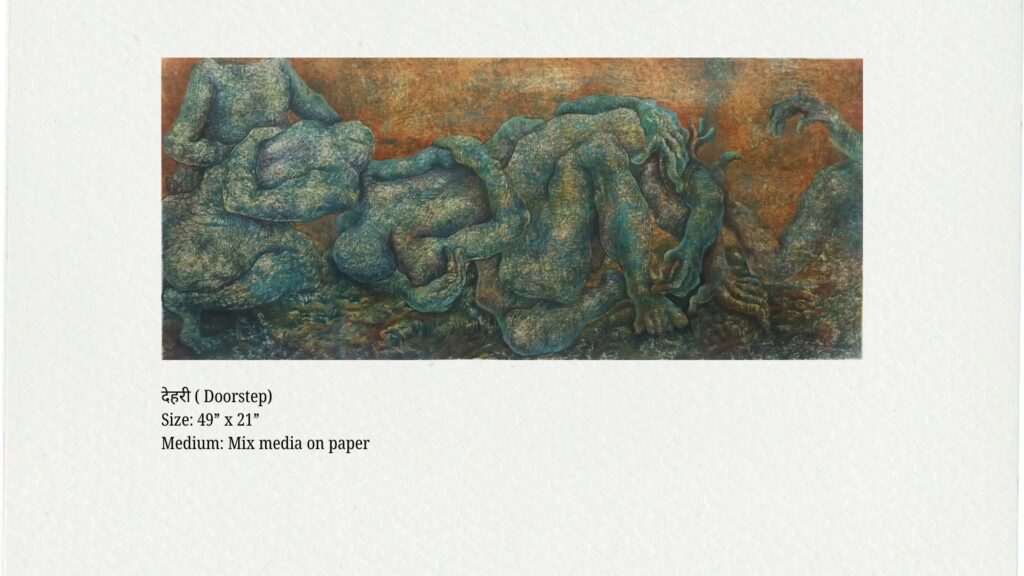
Vatsal Tiwari
Doorstep
Bodies pile like stones while the grass keeps growing
Blue-green backs, rough as river rock.
A rust sky presses down on them.
No faces. Only shoulders, knees, a heel.
One hand reaches out at the edge, fingers open.
Under them the grass is flat but not finished.
Someone has crossed this threshold many times.
In Doorstep, bodies fold into each other across a long sheet of paper. Vatsal Tiwari works in Delhi and comes from the College of Art New Delhi. He builds the surface in layers of mixed media until skin looks like moss or old stone. Faces stay hidden. Hands and feet turn into roots. Grass grows under the figures. For Tiwari, grass is something people step on that still keeps growing. The work dates from 2025.
Mixed media on paper · 92 × 60 cm · 2025
Theme Endurance and the body
RC-373

Vatsal Tiwari
Untitled
Hands hold on while the grass keeps growing
Rust, then olive, then the grey of wet stone, then the pink of an inside wrist.
Hands find other hands and do not let go.
A knee becomes a hill. A shoulder folds like cloth.
Red flecks sit on skin like dust after a long road.
At the bottom of one sheet grass pushes up under the knuckles.
Nobody looks down. It grows anyway.
Vatsal Tiwari works in Delhi and comes from the College of Art New Delhi. Untitled is four panels of mixed media on paper. In each one hands and limbs press together until the bodies are hard to tell apart. Tiwari uses see-through colour, soft edges and layered surfaces. One panel is rust red with dark spots. Two are olive and grey green. One is pale pink. In the grey green panel grass grows at the base. For Tiwari grass is stepped on but keeps growing.
Mixed media on paper · 152 × 76 cm · 2026
Theme Body, memory and survival
RC-374
From the open call
Rakesh
My practice began with a personal shift in the way I experienced space. Growing up in a village in Madhya Pradesh, I understood places through everyday interactions with mud houses, fields, and the rhythms of rural life. Later, living in an informal settlement in New Delhi exposed me to a very different spatial condition, where space was constantly negotiated, altered, repaired, and rebuilt. Experiencing these contrasting environments made me realize…


Rakesh
Accumulated Grounds
A wall of earth where the flowers still hold on
Brown crust rises like a wall after rain.
Pink flowers cling to it in small torn bits.
Above, blue squares of sky sit behind a grid.
Grey paint runs down and does not stop.
A pale shape leans on a thin red stem.
At the bottom, a row of small white marks holds the ground in place.
Accumulated Grounds starts from Rakesh's childhood in a village in Madhya Pradesh, among mud houses and fields. It also draws on his life in an informal settlement in New Delhi, where people repair and rebuild their space all the time. He works with materials such as mud, sand, husk and found objects. He does not use them for nostalgia. He wants them to carry "the physical qualities of the environments from which they emerge." Here the surface is thick and rough, like dried ground.
Mixed media · 61 × 61 cm · 2026
Theme Spaces becoming unfamiliar
RC-388
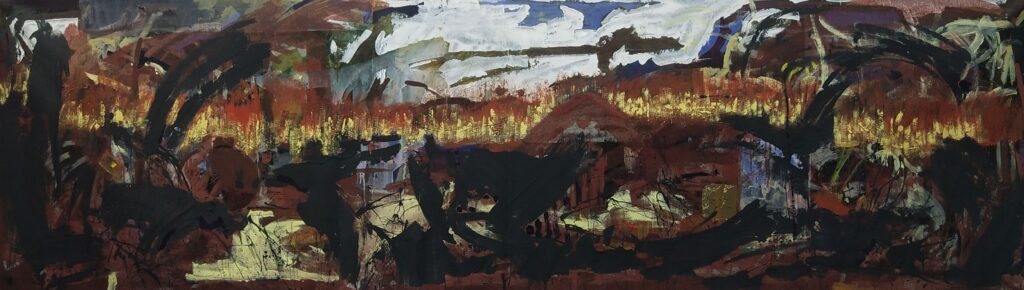
Rakesh
Grass Line
A thin line of grass holds while black strokes close in
A low fire of yellow grass runs the whole width of the field.
Black strokes come down on it like the arms of machines or crows.
The earth is brick red and rust and old mud after rain.
Above it hangs a torn white sky with one blue gap.
Something is being cleared. Something is still standing.
The grass holds its line a little longer.
Rakesh grew up with mud houses and fields in a village in Madhya Pradesh. Later he lived in an informal settlement in New Delhi. There people repair and rebuild their space again and again. His work begins from this change. Grass Line is long and low. A band of yellow strokes runs across it like dry grass. Heavy black marks sweep over red and brown ground. Rakesh does not try to keep the old place. He asks how a place feels as it turns unfamiliar.
Mixed media · 63 × 233 cm · 2026
Theme Disappearing rural land
RC-389
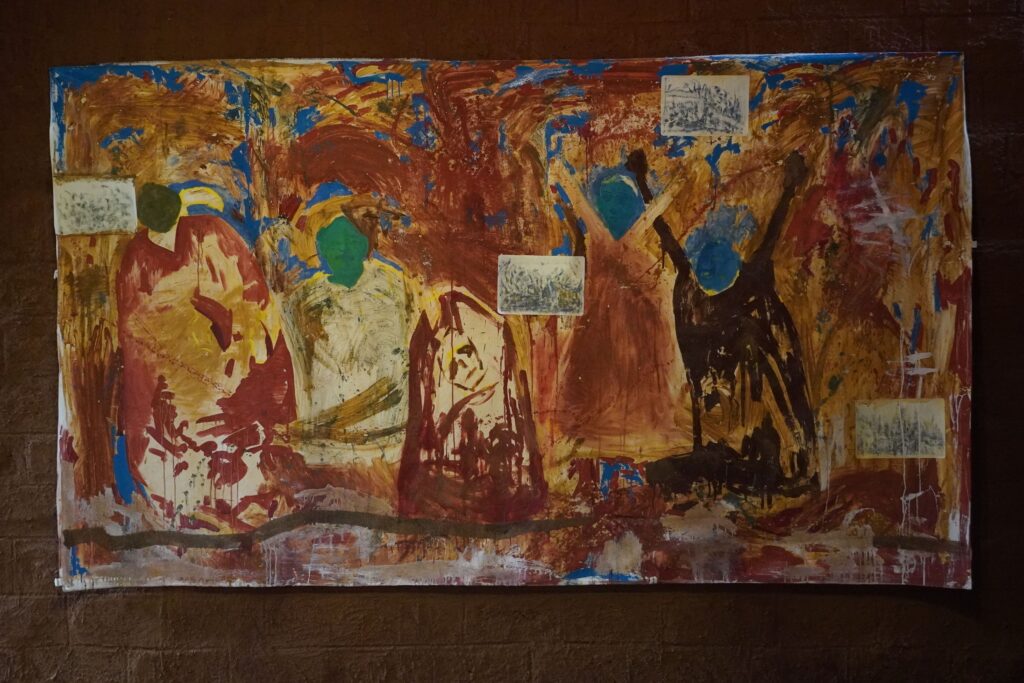
Rakesh
Compressed Ground 1
Where the ground keeps moving, faces dissolve into colour
Brick red runs down the paper like rain on a mud wall.
A blue-faced figure lifts two arms into the heat.
Someone stands in cream, their face a green stone.
Four small grey drawings hang like windows to a crowded street.
At the bottom a dark line wanders, a path or a drain.
Everything drips. Nothing holds still long enough to be home.
Rakesh grew up in a village in Madhya Pradesh. He came to know places through mud houses, fields and the rhythms of village life. Later he lived in an informal settlement in New Delhi. There space is always changed, repaired and rebuilt. His work grows out of this shift. In this large mixed media piece five figures stand in washes of brick red, ochre and blue. Most of their faces are flat discs of green and blue. Small grey drawings are fixed across the surface.
Mixed media · 272 × 155 cm · 2026
Theme Places that keep changing
RC-390
From the open call
Esha Paul
The Plastocene Archive My artistic practice is an investigation into the "Plastocene" a contemporary era where the boundaries between the organic and the synthetic have become permanently blurred. Having grown up in an environment defined by the constant circulation of mass-produced plastic goods, I developed an early intimacy with objects that are often dismissed as trivial or disposable. In my work, I recontextualize these inexpensive toys, industrial fragments, and inflatable…

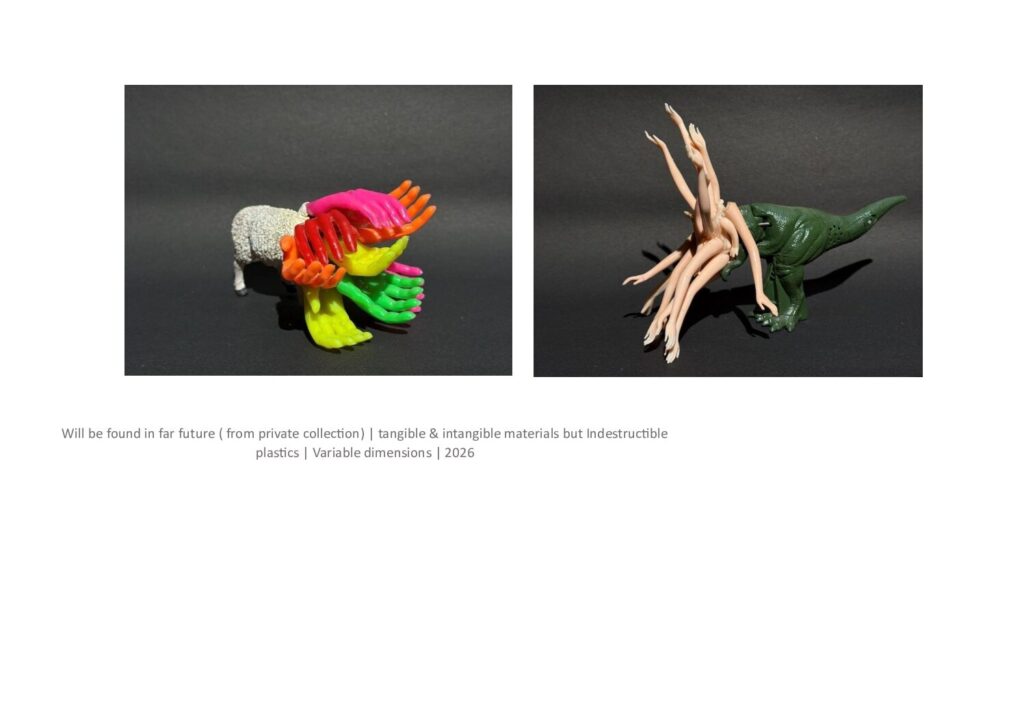
Esha Paul
Will be found in far future (from private collection)
Toy animals grown over by doll hands that will never rot
Pink fingers reach out of a sheep's white wool.
Yellow, green and orange hands fold over each other like petals.
Beside it a green dinosaur carries a bunch of pale arms.
The arms lift toward a sun we cannot see.
Shadows fall hard and black on the grey ground.
Nothing here will soften or fade.
Someone will dig it up long after us and wonder.
Esha Paul joins everyday plastic toys into new creatures. A toy sheep hides its head behind a bunch of neon plastic hands. A green dinosaur sprouts pale doll arms and legs. Paul grew up surrounded by mass-produced plastic goods. The artist calls our age the 'Plastocene'. These hybrids are made as 'future predictions' or museum specimens. Plastic does not decay, so the title imagines them found far ahead in time. Bright colour draws the eye first. Then the strange bodies bring unease.
Tangible and intangible materials but indestructible plastics · 30 × 20 cm · 2026
Theme Plastic as future fossil
RC-404
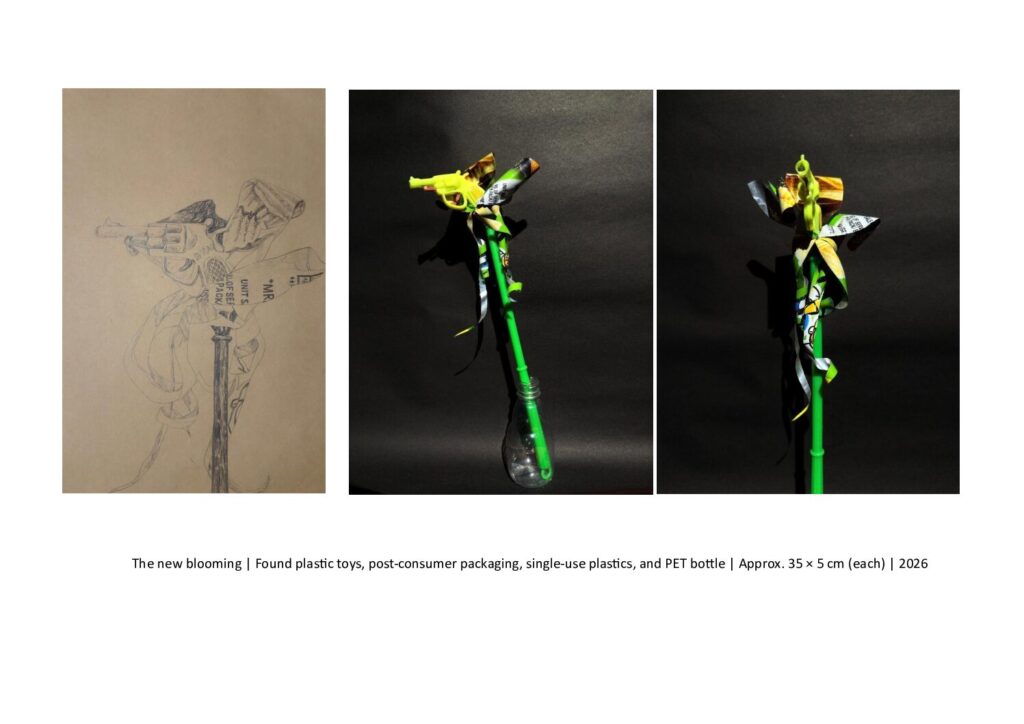
Esha Paul
The new blooming
A toy gun opens where the flower should be
A yellow pistol leans out of the dark like a bud.
Wrappers twist around it with printed words caught in the folds.
The stem is green the way a straw is green.
It drinks nothing from the clear bottle below.
Light finds the plastic and the plastic shines back.
Nothing here will wilt. Nothing here will fall.
Esha Paul, from Alipurduar, studies at the Sarojini Naidu School of Arts and Communication at the University of Hyderabad. In The new blooming a yellow toy pistol sits where a flower head should be. Printed wrappers twist around it like petals. A green plastic stem rises from a clear PET bottle. Paul makes the work from found toys and single-use plastic. A pencil drawing on brown paper shows the same flower. Paul sees these bright colours as a mirror of the "fake happiness" of consumer culture.
Found plastic toys, post-consumer packaging, single-use plastics and PET bottle · 35 × 5 cm · 2026
Theme Plastic in place of nature
RC-405

Esha Paul
Synthetic smile
A happy face on a body that has lost its air
A yellow skin, crushed like a sweet wrapper.
One ear stands up. The other leans away.
The eyes are two small black seeds.
A white muzzle holds a drawn smile that does not move.
Light runs along the folds and turns brown in the creases.
Behind it, grey canvas, quiet as a shop shelf at night.
Two dark blue straps hold up what is left.
Esha Paul comes from Alipurduar and studies at the Sarojini Naidu School of Arts and Communication, University of Hyderabad. She grew up with cheap plastic goods all around her. Now she paints them at a large size. Here a yellow toy bear fills a canvas 183 × 122 cm. Its skin folds and shines like an emptied balloon. Paul paints in acrylic on purpose. It is a plastic-based paint, so the material itself becomes part of the idea. She calls our time the Plastocene.
Acrylic on canvas · 183 × 122 cm · 2026
Theme Plastic and false happiness
RC-406
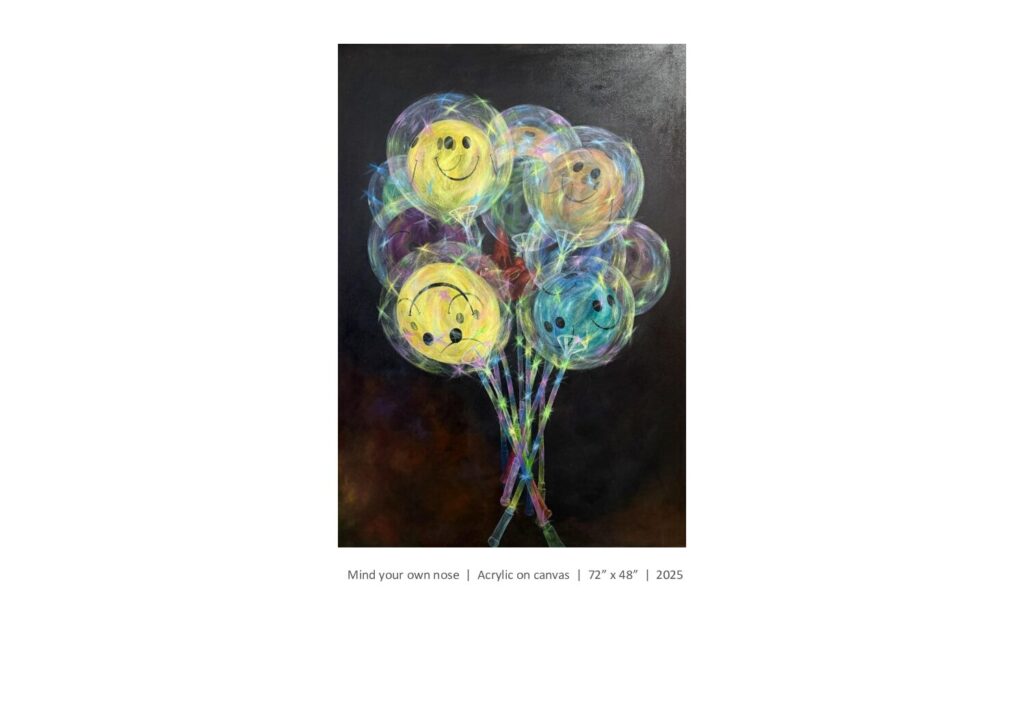
Esha Paul
Mind your own nose
Every balloon is smiling. Look again at the one near the bottom
Clear skins, each holding a small sun of yellow or a cooler blue.
The faces grin through the plastic like faces pressed to a window.
White stars catch on every curve, as if someone has just switched them on.
Below, the sticks cross and tangle in the dark.
One yellow face slips, its smile doubled, turning down.
The black around them waits, patient, warm with rust at the edges.
In this painting, almost two metres tall, Esha Paul shows a bunch of light-up balloons. Each clear balloon holds a smiling face in yellow, orange or blue. One face near the bottom seems less sure. Paul grew up among mass-made plastic goods. Here she makes a child's toy large enough to unsettle. She paints in acrylic by choice. It is a plastic-based paint, so the material joins the story. The bright colours pull the eye in. Paul links them to the "fake happiness" of social media.
Acrylic on canvas · 183 × 122 cm · 2025
Theme Manufactured happiness
RC-407
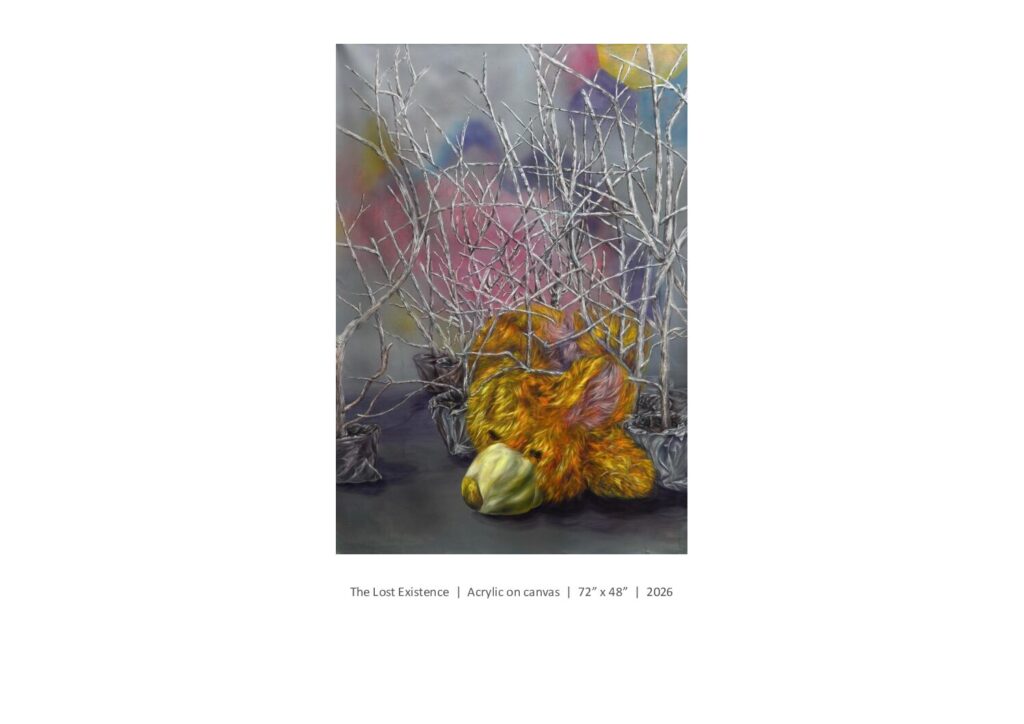
Esha Paul
The Lost Existence
A fallen teddy bear in a thicket of silver branches
A yellow bear lies where someone dropped it.
Its green nose touches the cold grey floor.
White branches rise from pots wrapped in plastic.
They cross over the fur like wire.
Behind them pink and blue balloons go soft and far away.
The party is somewhere else now.
Esha Paul paints a soft toy bear lying among bare branches. The canvas is large: 183 × 122 cm. Paul grew up with mass-produced plastic goods all around. Today Paul paints cheap toys and inflatable forms. Paul calls our time the 'Plastocene'. Here the balloons behind the bear fade into a grey haze. The choice of acrylic is deliberate. It is a plastic-based paint, so the material itself speaks of the artificial. Paul comes from Alipurduar.
Acrylic on canvas · 183 × 122 cm · 2026
Theme Plastic and lost childhood
RC-408
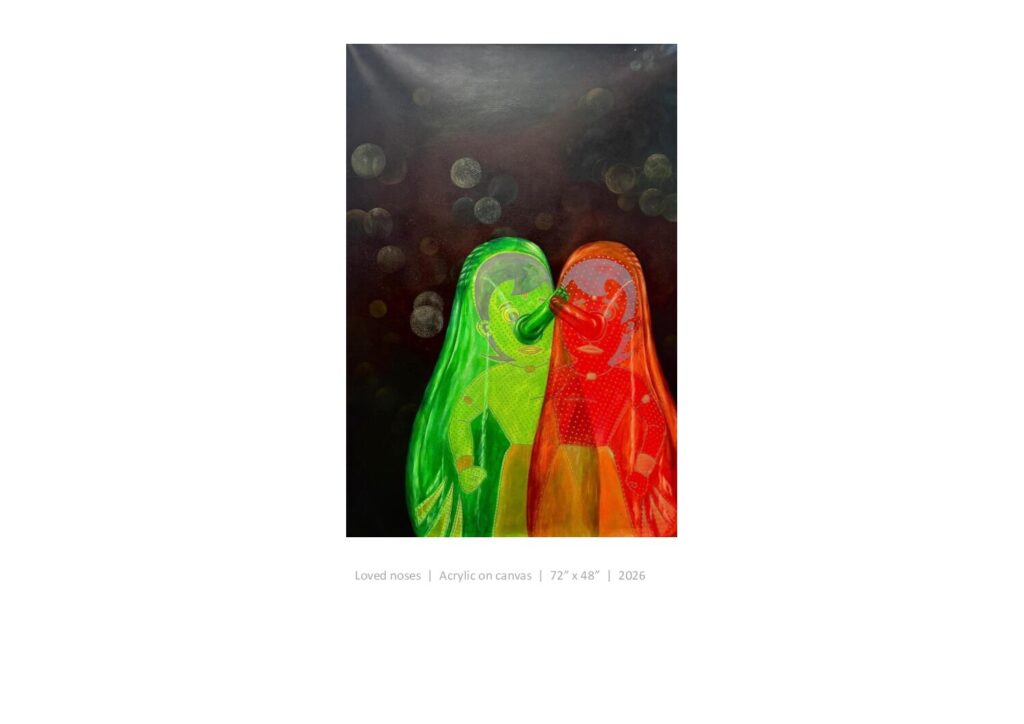
Esha Paul
Loved noses
Two plastic bodies, joined at the nose, sharing one breath
Two bodies of coloured plastic stand shoulder to shoulder.
One green as a sweet wrapper, one red as a warning light.
Their noses stretch and meet in a soft bridge of air.
Inside each skin a small face watches, drawn in pale lines.
Above them, grey bubbles drift in the dark like old coins.
It looks like a kiss. It also looks like no one can breathe.
Esha Paul paints two figures that look like inflatable toys. One is bright green and one is red. Their long noses reach out and meet like a soft tube. Small faces and dotted patterns sit inside their shiny skins. Paul grew up around cheap plastic goods. Her practice looks at what she calls the "Plastocene", a time when the natural and the synthetic mix. She chooses acrylic paint on purpose because it is made from plastic. At 183 × 122 cm, the toys become large and strange.
Acrylic on canvas · 183 × 122 cm · 2026
Theme Plastic, desire and identity
RC-409
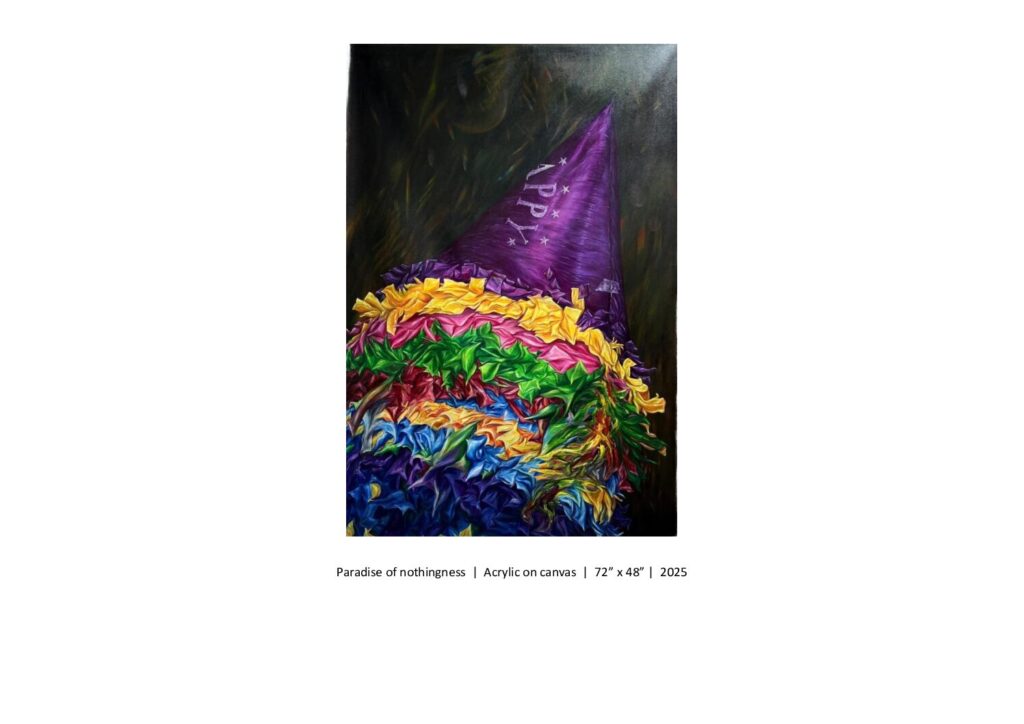
Esha Paul
Paradise of nothingness
A party hat that has forgotten how to say happy
A paper hat leans in the dark, purple as a bruise.
The word on it has lost its first letter.
Below, a mound of torn fringe: lemon, rose, leaf green, deep blue.
Every strip catches the light and holds it too tightly.
The ground behind is green-black, brushed like wet grass at night.
The party is loud in colour and silent everywhere else.
Esha Paul, from Alipurduar, paints a purple party hat. Silver letters on it read APPY, with small stars around them. The hat sits on a heap of crumpled, fringed shapes in yellow, pink, green, red and blue. A dark green ground surrounds them. Paul grew up among mass-produced plastic goods. She uses acrylic on purpose, as "a plasticbased medium". For her, bright colour is "a sensory trap" that echoes the "fake happiness" of social media. Her college is the Sarojini Naidu School of Arts and Communication, University of Hyderabad.
Acrylic on canvas · 183 × 122 cm · 2025
Theme Manufactured happiness
RC-410
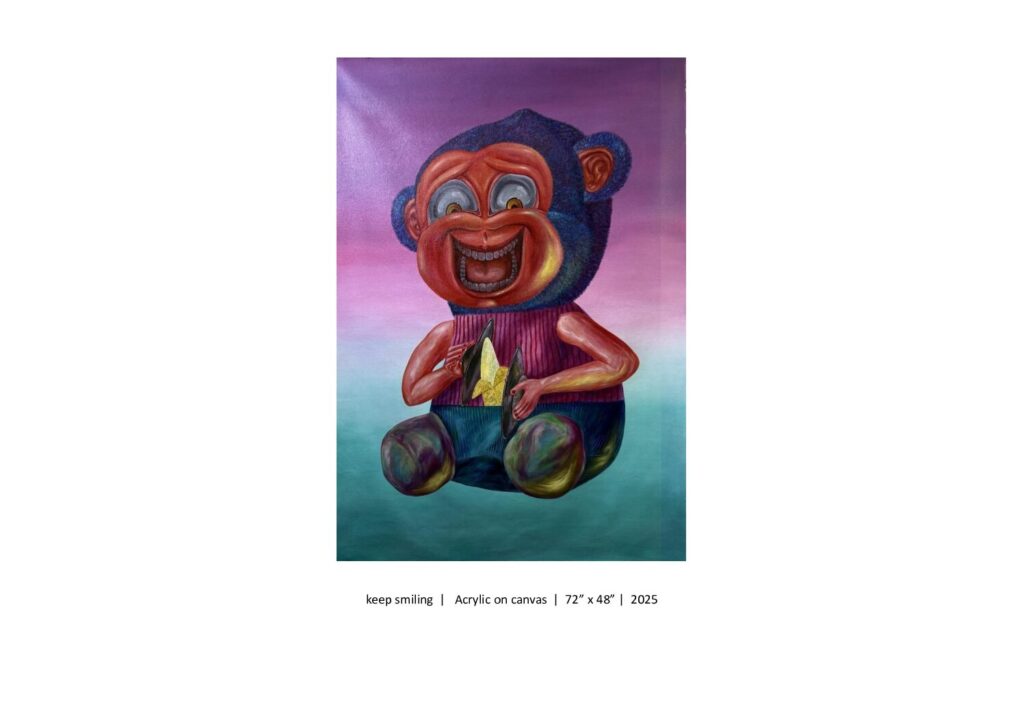
Esha Paul
keep smiling
A toy's grin grows too wide to trust
The sky slides from grape to sweet pink to pool water.
A red face splits open with every tooth counted.
The eyes hold still while the hands keep clapping.
Between two dark cymbals a gold star is caught.
The knees shine like bruised fruit.
The smile was moulded once and cannot close.
A toy monkey sits in soft pink and teal light. It grins with every tooth showing. Its hands close two dark cymbals around a yellow star. Esha Paul, of Alipurduar and the Sarojini Naidu School of Arts and Communication, University of Hyderabad, grew up among cheap plastic goods. Paul paints one such toy at 183 × 122 cm. That is much taller than a child. The paint is acrylic by choice. It is a medium made from plastic. So the material itself joins the story.
Acrylic on canvas · 183 × 122 cm · 2025
Theme Manufactured happiness
RC-411
From the open call
Akash Goenka
My practice is rooted in close observation of the world around me, including trees, landscapes, and everyday objects. I'm in love with oil pastels – their immediacy, their texture, and the way they let me build up colour and atmosphere in layers. A lot of my recent work has been about spending as much time in nature as Delhi weather allows. In my tree paintings, I'm interested in capturing a…



Akash Goenka
Path
A pale path runs under red trees into the shade
Red bark twists up out of yellow light.
The path is grey water, slow and cool.
Purple flowers lean in from both edges.
At the centre the trees close into a dark room.
The pastel lies thick where the leaves are brightest.
You could step in here and keep walking.
Akash Goenka lives and works in New Delhi. Goenka works from close observation of trees, paths and flowers. Path is oil pastel on paper, 33 × 24 cm. The colour goes on in thick layers. Red-brown trunks bend over a pale grey path. Yellow leaves catch the light. Purple flowers crowd the edges. For Goenka the hardest part is knowing when to stop before a picture is overworked. Goenka has made art seriously since 2019. Painting began in a difficult time and still matters deeply.
Oil pastel on paper · 33 × 24 cm · 2026
Theme Walking among trees
RC-328

Akash Goenka
Hauz Khas 1
A green path opens where the mist comes down to the bushes
Grey and white crowd the top of the paper like breath on cold glass.
Below, the bushes twist in black, olive and rust.
A pale green strip opens through them and runs toward you.
Something thin and dark stands still in the middle.
The crayon is pressed hard here and soft there.
You stop and wait with it in the mist.
Akash Goenka makes Hauz Khas 1 in 2025 in New Delhi. The drawing uses Conté crayon and oil pastel on paper and measures 29 × 41 cm. Goenka builds the colour in layers. Small white and grey marks fill the sky and drift down into the dark bushes like mist. A pale green strip runs through the middle. Goenka's landscapes come from looking closely at familiar places and paths. Goenka took up art seriously in 2019. The aim is a picture that moves people, not only a pretty one.
Conté crayon and oil pastel on paper · 29 × 41 cm · 2025
Theme A familiar path in mist
RC-329
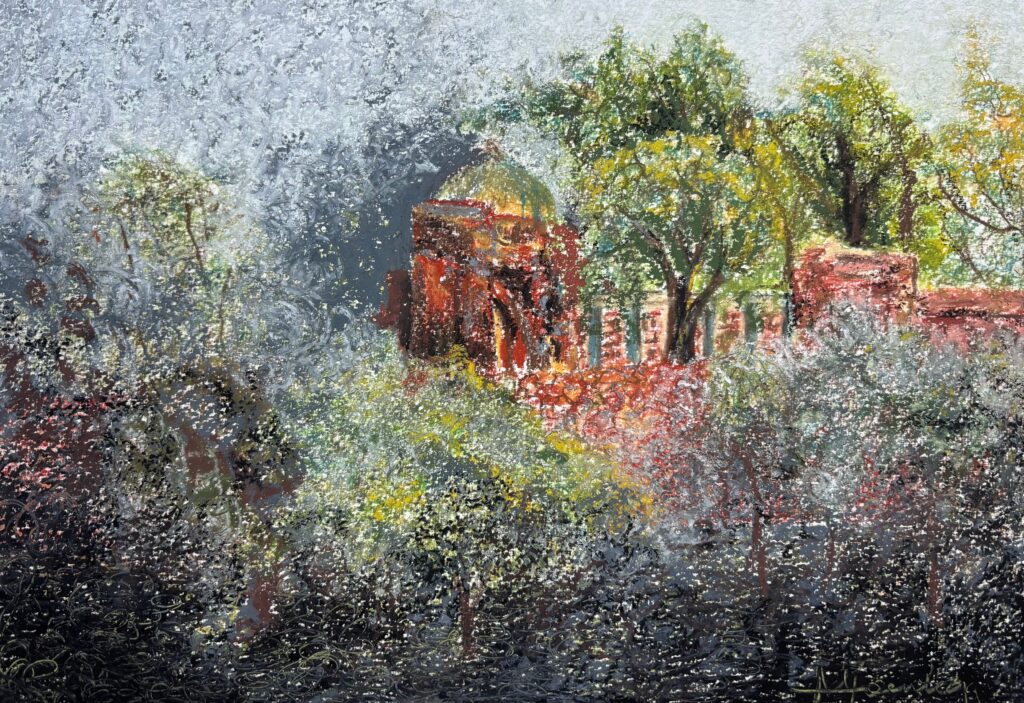
Akash Goenka
Hauz Khas 2
A red dome glows through a storm of grey and green marks
Grey drifts across the top like breath on cold glass.
Behind it a dome keeps its own small gold.
Red brick warms to the colour of tea left in the sun.
The trees lean close and hold the light in their crowns.
Below, the dark ground is scribbled with roots and thread.
You look through leaves to reach the warm wall.
Akash Goenka draws landscapes from familiar places in New Delhi. In Hauz Khas 2 a red building with a pale gold dome stands behind tall trees. Goenka works in Conté crayon and oil pastel on paper and builds the colour in layers. Small marks in grey, green and yellow fill the front of the picture like a screen of leaves. The warm building shows through them. Goenka took up art seriously in 2019. The artist's working life is in environment and climate change.
Conté crayon and oil pastel on paper · 29 × 41 cm · 2025
Theme Familiar places through trees
RC-330

Akash Goenka
Fallen
What a tree lets go of, held still in oil pastel
Leaves that once moved in the wind now lie still on a grey ground.
Green holds on at the edges. Gold and rust take the middle.
Each thin tip points away, as if still reaching for the branch.
Pink light rests in the corners, soft as chalk.
The shadows are blue and deep.
Nothing is falling now. Everything has already fallen.
Akash Goenka draws a small heap of fallen leaves in oil pastel. He builds the colour in layers. Green turns to ochre and rust. Fine veins run across each leaf. Blue shadows gather underneath. Goenka works from close observation of trees and everyday things in New Delhi. He has made art seriously since 2019. For him the hard part is 'knowing when to stop.' He wants a painting that is 'a moving one' more than a beautiful one.
Oil pastel on paper · 28 × 31 cm · 2026
Theme Fallen leaves and time
RC-331
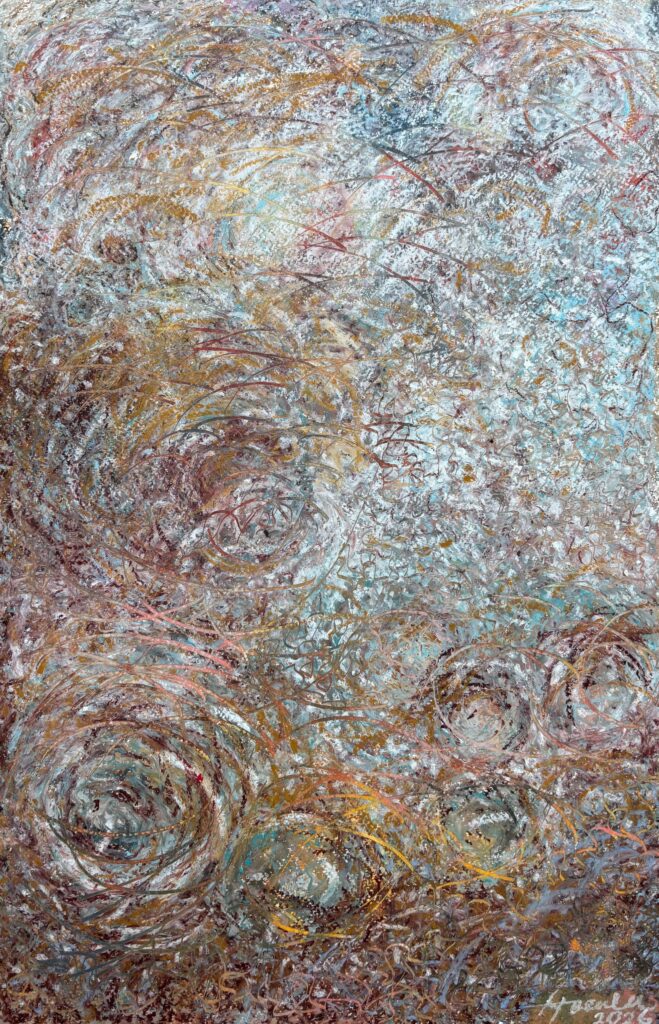
Akash Goenka
Drift
Small storms of colour that never quite settle
Pale blue light rests at the top of the sheet like frost on a window.
Below it, rust and plum lines wind round and round.
Each circle is a small pool that will not keep still.
Gold threads cross the surface and catch on nothing.
The pastel lies thick here and scraped thin there.
You wait for the turning to stop. It does not.
Akash Goenka makes Drift in oil pastel on paper. The work measures 55 × 37 cm. He builds the colour in layers. Pale blue and white sit under long strokes of rust, ochre and dark red. Circles turn across the sheet like eddies in water. Goenka lives and works in New Delhi. He took up art seriously in 2019, during a hard time in his life. For him the hardest part is knowing when to stop, before the picture becomes overworked.
Oil pastel on paper · 55 × 37 cm · 2026
Theme Restless motion in colour
RC-332

Akash Goenka
Green Room
One bottle falls and the green room catches fire
A green wall, pressed on hard until it shines.
Two bottles wait in front of it, one cool as tap water, one the blue of late evening.
The third has fallen and glows red like a coal.
Behind them a brown shadow climbs the wall in steps.
Wax sits thick on the paper, scraped and pressed.
Nothing moves. Still the room feels warm.
Akash Goenka draws Green Room in oil pastel on paper. Two bottles stand against a deep green wall. A third lies on its side in front of them, a hot red on a grey surface. Goenka builds the colour in thick layers and lets every stroke show. The work belongs to his recent still lifes of everyday objects. He uses them to study colour, light and the way forms sit together. He says he is "less interested in making a beautiful painting than a moving one."
Oil pastel on paper · 33 × 24 cm · 2026
Theme Light on everyday objects
RC-333
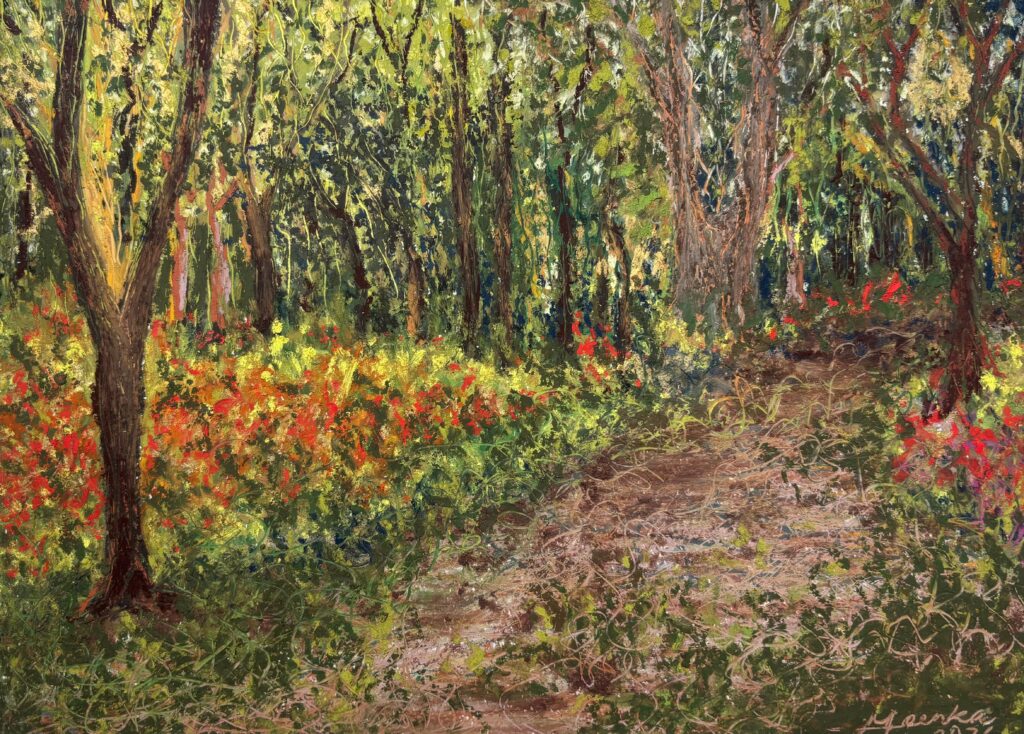
Akash Goenka
Forest Path
A brown path bends into the trees and asks you to follow
A path of brown earth turns right and does not say where.
Red flowers burn low on the left, close as a crowd.
The trunks stand dark, each one holding its place.
Light comes through in yellow pieces, warm on the leaves.
The grass is drawn in loops, like thread pulled loose.
You could walk in. You could stay here and wait.
Akash Goenka spends as much time in nature as Delhi weather allows. Goenka's landscapes come from familiar places, paths and flowers. In Forest Path, a brown earth path bends away into a wood. Red and orange flowers crowd the left side. Dark trunks rise against yellow and green light. Goenka works in oil pastel on paper and builds colour in layers. Small loops and strokes make the grass. For Goenka, the real challenge is knowing when to stop. Goenka has made art seriously since 2019.
Oil pastel on paper · 24 × 33 cm · 2026
Theme A walk through woodland
RC-334

Akash Goenka
Rhododendron
White petals hold red throats while the old leaves turn gold
A white head of flowers, each small mouth speckled red.
Below it the leaves open like the fingers of a hand.
Two have gone the colour of turmeric.
One stem bends away into lilac and grey.
The air behind is soft as breath on glass.
Thin lines run down every leaf like small rivers.
Akash Goenka draws a single rhododendron head in oil pastel on paper. The white flower cluster sits high on the sheet. Below it the leaves open like a fan. Some are dark green. Some are turning orange. Fine lines mark every vein. Goenka builds colour in layers. He took up art seriously in 2019. He says he is "less interested in making a beautiful painting than a moving one." For him "The real challenge is knowing when to stop."
Oil pastel on paper · 53 × 37 cm · 2025
Theme A flower observed closely
RC-335
From the open call
Ania Kaushik
My artistic practice is rooted in my deep connection with Indian culture, heritage, architecture, mythology, and the visual narratives of our ancient epics. I see art as a powerful medium through which stories, traditions, and cultural identities can travel beyond geographical and linguistic boundaries. My aim is to represent the richness and diversity of India to a global audience while presenting it through a contemporary and personal visual language. I…


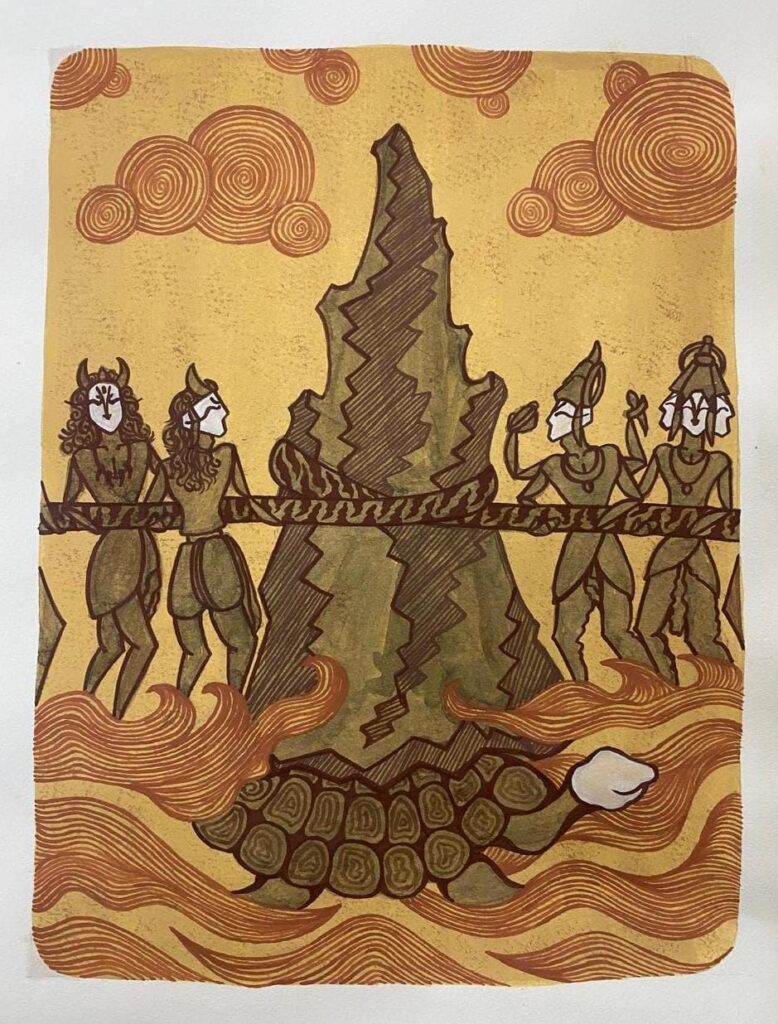
Ania Kaushik
Maha Kumbh
Two sides, one rope and a mountain on a turtle's back
The sea is not blue here. It is ochre, combed into long orange lines.
A mountain rises like a dark tooth from the back of a turtle.
On either side, pale faces lean into the same rope.
No one lets go.
Clouds coil overhead like ink spun on a fingertip.
Everything waits for what the water will give up.
Ania Kaushik paints the churning of the ocean from Indian myth. A mountain stands at the centre on the back of a turtle. A twisted rope wraps around it. Horned figures pull from the left. Crowned figures pull from the right. Kaushik likes to keep to two to four colours. Here she uses ochre, olive, brown and white. She usually works with watercolour, poster colours and fine pens. Thin lines build the waves and the spiral clouds. The work dates from 2025.
Mixed media · 29 × 21 cm · 2025
Theme Myth and shared effort
RC-423

Ania Kaushik
Surya Mandir
A door of night in a house built for the sun
Brown water dries into stone.
Each tier of the roof is one slow stroke laid over the last.
The door is the darkest thing on the page. It is a small square of night at noon.
The steps come down to meet my feet.
Behind the temple the sky is still wet. Blue runs soft into white.
The sun this house was built for is nowhere in the picture.
Ania Kaushik paints a stone temple seen straight on. A wide flight of steps leads up to a dark doorway. Above it the roof rises in tiers to a round crown. Kaushik works in watercolour on a sheet of 21 × 29 cm. She keeps mostly to two colours: warm brown for the stone and soft blue for the sky. She says a small palette lets her focus on form and line. The work is from 2025. Kaushik lives in Ghaziabad. Her college is Banaras Hindu University.
Watercolour on paper · 21 × 29 cm · 2025
Theme Sacred architecture and heritage
RC-424
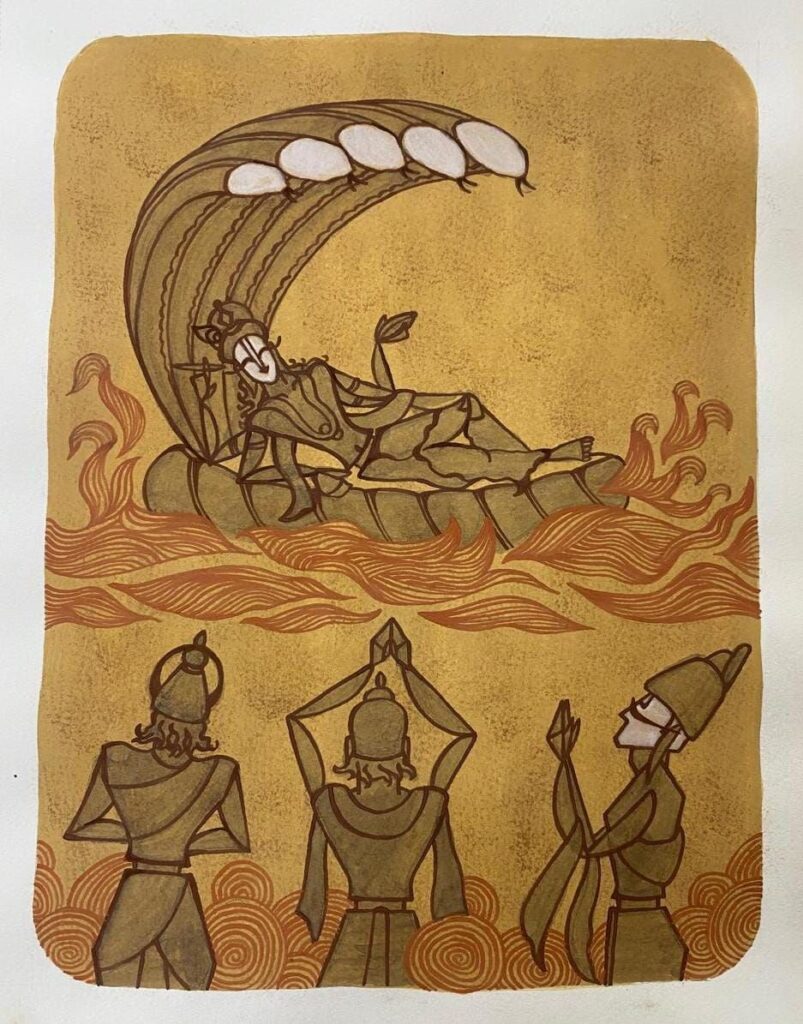
Ania Kaushik
Darshan
Three figures look up at a god resting on serpent coils
Mustard ground, dusted like turmeric on a palm.
Five white hoods bend over a resting god like a held breath.
Orange waves curl under the coils and do not touch him.
Below, three backs turn away from us.
Their hands rise, pressed together, open.
We stand where they stand and look up too.
Ania Kaushik, an artist from Ghaziabad, makes Darshan in 2025. Kaushik's college is Banaras Hindu University. The work is small, 29 × 21 cm. A god rests on a coiled serpent with five hoods. Below, three figures raise their hands to him. Kaushik uses only a few colours here: ochre, olive brown, burnt orange and white. This is a habit. Kaushik usually keeps to two to four colours so that line, form and story can lead. Kaushik tries to start each picture from imagination.
Mixed media on paper · 29 × 21 cm · 2025
Theme Devotion and seeing the divine
RC-425

Ania Kaushik
Shore Temple
A stone temple glows like honey under slow, flat clouds
The sky is the colour of turmeric left out in the sun.
Clouds stand behind the towers like folded cloth.
Stone climbs in steps, arch on arch, roof on roof.
Brown fills the doorways where the cool air waits.
Pink rocks gather at the foot like a low tide.
Nothing moves. The temple holds the warm hour still.
Ania Kaushik of Banaras Hindu University paints the Shore Temple in poster colour. The work measures 28 × 40 cm. Kaushik keeps her colours few. Here she uses yellow ochre, browns and a soft pink. Two stepped towers rise against a sky of flat, rounded clouds. Each tier and small arch is drawn with care. Kaushik researches old buildings and their forms. But she begins every picture from her own imagination. The stone temple becomes warm, quiet and still.
Poster colour · 28 × 40 cm · 2025
Theme Ancient Indian architecture
RC-426

Ania Kaushik
Shiv Parvati
Stone that holds an embrace, drawn without a single chisel
Honey light on old stone.
Two gods lean into each other under a carved arch.
One hand rests near the other's heart.
The trident stands quiet above them like a guard at noon.
Small figures watch from the corners of the wall.
Each grain of stone looks warm to the touch.
The wall keeps this embrace long after the carvers have gone.
Ania Kaushik is an artist based in Ghaziabad with training at Banaras Hindu University. In Shiv Parvati she draws a carved temple wall on screen. Shiva and Parvati sit close together inside a stone niche. A trident and drum rise behind them. Kaushik often limits herself to two to four colours. Here she uses only ochre, sand and deep brown. Fine speckles make the digital surface feel like weathered sandstone. Light falls from the left and leaves deep shadows in the cuts of the stone.
Digital illustration · 2025
Theme Divine love in stone
RC-427
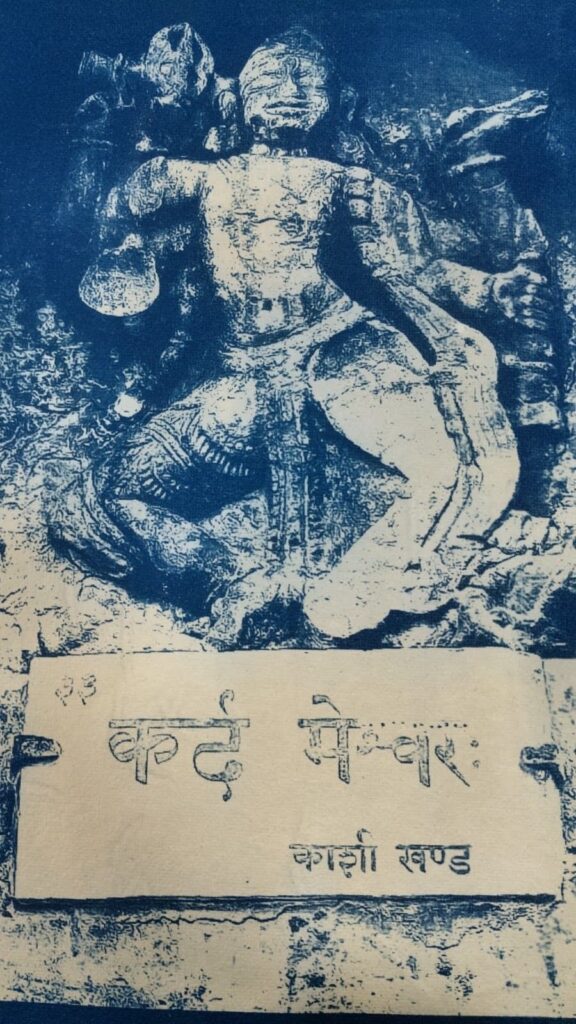
Ania Kaushik
Kardameshwara Mahadev
A worn stone god, printed by sunlight in one deep blue
Blue settles into every crack of the stone.
The face is worn to a soft pale shape, like a thumbprint.
Many arms move, though the stone holds still.
Light did this work. It pressed the figure out of the dark.
Below, a plaque keeps the name in careful letters.
The god is cold blue and old white. It is still dancing.
Ania Kaushik makes this work as a cyanotype from her own photograph. The picture shows a carved stone figure with many arms. Its face is worn smooth. Below it a plaque reads Kardameshwar and Kashi Khand in Devanagari letters. The print holds one deep blue and a pale ground. Kaushik, of Banaras Hindu University, usually works in watercolour and pen. She keeps to two to four colours. Here she keeps to one. The work measures 84 × 59 cm.
Cyanotype print from the artist's own photograph · 84 × 59 cm · 2025
Theme Carved deity in light
RC-428

Ania Kaushik
Kashi
Under the leaves, two old shrines wait with the boats
Two grey shrines, roofs worn soft, each with a dark doorway.
Heart-shaped leaves hang over them like a loose roof.
Someone has left a steel flask and two white bags on the step.
The river is almost the colour of the sky.
Boats rest in it, one name half painted on a hull.
No lamp shows in the arches. Only the leaves move.
Ania Kaushik is from Banaras Hindu University. In Kashi she turns a camera on two small shrines at the water's edge. Worn steps lead past them. A tree hangs its leaves over their pointed roofs. Below, boats wait on pale water. Kaushik usually paints with watercolour and pens. She keeps those works to two to four colours so that line and form can lead. Here she goes further and removes colour. The stone, the leaves and the water stand in shades of grey.
Photography · 2026
Theme Shrines beside the river
RC-429

Ania Kaushik
Surya Mandir, Konark
A sun temple waits under a cloud the size of a hill
Orange steps climb to a door the colour of strong tea.
The tower stacks its roofs like folded cloth.
A grey cloud leans on the sky, heavy as wet wool.
Thin white strokes trace its edges like chalk.
The ground is pale, almost pink, almost dust.
Nothing moves except the eye, going up.
In this 2024 painting Ania Kaushik shows the Sun Temple at Konark in poster colour. The sheet is 29 × 41 cm. Kaushik's college is Banaras Hindu University and she is based in Ghaziabad. She likes to use a few colours so she can think about line and form. The temple is built from flat bands of orange, red and brown. Steps rise to a dark doorway. Behind the tower a grey cloud fills a mint green sky. She researches old buildings but draws them in her own way.
Poster colour · 29 × 41 cm · 2024
Theme Temple architecture and heritage
RC-430
From the open call
Khushi Sahay
Women are conditioned from girlhood to navigate public and familiar spaces through a heightened awareness of their bodies, surroundings, and the possibility of being watched. Emerging from encountered experiences and sociological observation, my practice examines the invisible social networks through which fear, caution, and gendered behaviour are learned and carried across generations. I explore how These learned responses become a persistent psychological framework, shaping identity, confidence, relationships, and everyday choices.…




Khushi Sahay
The Gaze Series
Two men are watching. Neither of them has eyes
Paint sits thick as dried mud on the brow.
Where the eyes should be, two pink ovals, flat as stones.
Behind him, another man in glasses. His lenses hold the same pink.
The weave of the canvas shows through the forehead.
A cold blue corner of sky. Then dark navy, like a shut door.
No one here can look. Still I feel looked at.
Khushi Sahay is from Bokaro Steel City. Her college is The Maharaja Sayajirao University of Baroda. The Gaze Series shows men drawn from daily life. The men who watch have no eyes. Sahay paints flat patches of pale pink where the eyes should be. Thick acrylic builds the faces in brown, red and dark plum. Her work asks how women learn fear from girlhood. She writes that "seeing is not always dependent on vision." She adds: "Sometimes, it is our internalized fear that does the seeing."
Acrylic on canvas · 45.72 × 60.96 × 5.08 cm · 2025
Theme Fear and being watched
RC-359

Khushi Sahay
The Gaze
A wall of red faces that do not look away
Red runs the length of the wall like a held breath.
Faces press against each other, bearded, open-mouthed, close.
Where the eyes should be, the paint stops at pale almonds of nothing.
Three girls in cotton prints stand at the bottom edge.
They are small. The wall is not.
Still they lift their heads and look.
The Gaze is a painting more than nine metres long. Khushi Sahay makes it on several canvas panels joined into one wall. It measures 274.32 × 929.64 cm. Sahay studies at The Maharaja Sayajirao University of Baroda and comes from Bokaro Steel City. Her work looks at how girls learn to feel watched in public and familiar spaces. Here men's faces crowd the whole surface. Their eyes are empty shapes. Sahay asks what it means to be looked at and to look back.
Mixed media on canvas · 274.32 × 929.64 cm · 2026
Theme Gendered fear and watching
RC-360

Khushi Sahay
Untitled (set of 4 panels)
Every body painted alike, yet the eye still sorts them
Hair falls in blue and green threads, laid down stroke by stroke.
A cheek glows orange where two heads almost touch.
Between the crowns lies a sliver of pale sky.
A yellow curve of skin rises behind a shoulder.
I look for a man, a woman, a name.
The paint gives me only closeness.
Everyone here breathes the same small air.
Khushi Sahay paints a dense crowd in egg tempera on four plywood panels. Together they form a square of 182.88 × 182.88 cm. Heads press close. Hair and skin share the same muted earthy colours, so no one person stands apart. The work looks at the balance of men and women in a crowd through seeing, not numbers. The figures are painted equally. Still, as Sahay writes, "the viewer's gaze seeks distinction." Sahay is from Bokaro Steel City. The artist's college is The Maharaja Sayajirao University of Baroda.
Egg tempera on plywood · 182.88 × 182.88 × 1.2 cm · 2025
Theme Sameness, difference and the gaze
RC-361
Khushi Sahay
Untitled
A crowd with no faces, only arms, shoulders and caution
Grey-blue air presses between shoulders.
A white vest, a black shirt, arms folded tight.
Skin the colour of baked clay, brushed flat and warm.
Someone lifts a hand to the back of a head.
No face turns to meet you.
Only elbows, collars, short dark hair.
You stand in the crowd and feel the looking.
Khushi Sahay paints crowds without faces. In these acrylic paintings on canvas, figures stand close together. Arms fold. A hand rises to a head. We see sleeves, shoulders and the back of a neck, but never an eye. Sahay comes from Bokaro Steel City. Sahay's college is The Maharaja Sayajirao University of Baroda. The work grows from lived experience and from watching society. It asks how women learn from girlhood to stay aware of being watched. Flat shapes and muted colours keep the focus on gesture.
Acrylic on canvas · 88.9 × 200.66 × 5.08 cm · 2026
Theme Watching and being watched
RC-362
From the open call
Amrita Kumar
I wanted to create art pieces that exhibit a sense of wonder and are whimsical. Art pieces that transport people into a land of wondrous oblivion, that tune out the noise of the world and make them believe in hope, joy and a sense of mystique. I usually begin my process by researching on vintage art, impressionist art, famous children story books, fairy tales and classics. My art tools comprise…


Amrita Kumar
Hands of a Healer
Two hands pray while strange small creatures crowd every corner
Two hands press flat, fingertips up, like a door kept shut.
Ink fills the white paper. Mushrooms, petals, a round staring face, a dog with soft ears.
A butterfly rests on the wrist and does not move.
Below, a book falls open and the word hope sits in heavy black letters.
Everything here is talking at once.
Only the hands are quiet.
Amrita Kumar is based in Gurgaon and studies at Grenoble Ecole de Management. Hands of a Healer is drawn in black ink. Two hands meet in prayer at the centre. Flowers, mushrooms, faces and small creatures crowd around them. An open book at the bottom holds the word "Hope". The artist starts by looking at vintage art, fairy tales and children's story books. Then Kumar works with micron pens and tries not to think too much. Only at the end do all the characters come together.
Ink drawing · 2
Theme Hope in a crowded world
RC-375
Amrita Kumar
A hopeful world
Flamingos ride balloons up from a pair of cupped hands
Two warm palms open like a bowl at dawn.
Green runs along the fingers as if the skin remembers leaves.
A bee hums past a striped balloon.
Two pink flamingos ride the air with calm faces.
A fish swims inside one drop of water.
Everything spills upward and nothing falls.
A hopeful world is from 2020. In it two cupped hands rise from the bottom of the page. Out of them grow sunflowers, grain and butterflies. Flamingos stand on hot air balloons. Water drops hold a fish and a turtle. A recycling sign sits among the leaves. The artist, Amrita Kumar of Gurgaon, starts with research into fairy tales, children's story books and impressionist art. Then she stops planning. "Logic has no place in doodling." Only at the end does she see the whole picture come together.
Charcoal and pencil on paper · 2020
Theme Hope for the earth
RC-376

Amrita Kumar
Flight of fancy
A whole night sky lands on the tip of her nose
A butterfly lands on the bridge of her nose.
Her eyes turn in to meet it, two brown moons in yellow rings.
On its wings a night sky turns, blue and gold and full of small stars.
The same sky waits under her collar, as if she swallowed it.
Pink suns sit on her cheeks.
Tiny red flowers hold her straw-gold hair in place.
Amrita Kumar draws Flight of fancy in 2023. She wants her art to show wonder and to help people tune out the noise of the world. Before she starts, Kumar studies vintage art, impressionist art, fairy tales and children's storybooks. In this drawing a girl with a yellow bob looks cross-eyed at a butterfly on her nose. Its wings hold a swirling night sky. The same sky fills her collar. Kumar tries not to think too much while she draws. She lets the parts come together on their own.
Charcoal and pencil on paper · 2023
Theme Wonder and whimsy
RC-377
From the open call
Ayushi Singh
My practice comes from a close relationship with textiles, craft, and the everyday visual culture around me. Growing up in India, I have always been surrounded by fabrics, colours, prints, embroidery, and handmade objects. Over time, I began to look at these familiar things differently—not only as beautiful surfaces, but as forms of knowledge that carry stories, skills, memories, and connections between people. Textile design allows me to explore these…


Ayushi Singh
Carpet
A sheet of paper that wants to be a carpet
A cream ground with every inch in bloom.
Red petals, blue petals, a leaf of mustard gold.
Thin stems curl and branch like rivers on a map.
At the edge a wine-dark border keeps the garden in.
Small stripes walk beside it in single file.
There is no thread here, only paint that remembers wool.
Ayushi Singh paints Carpet with poster colour on a sheet of paper 29.7 × 21 cm. The work is from 2023. It shows one corner of a carpet. A deep red border holds large flowers and green vines. Thin striped bands run inside it. Then a cream field fills with small flowers in red, blue, green and gold. Singh studies at Banaras Hindu University and works in textile design. She grew up around fabrics and prints. For her, "textiles are more than something we see or wear."
Poster colour on paper · 29.7 × 21 cm · 2023
Theme Indian textile pattern
RC-391
Ayushi Singh
Gujrati kasida
Embroidery made without a single thread
Green dark as a night pond holds it all.
Loops of pink and lime run like thread pulled tight.
Two peacocks turn their backs and lift their heavy tails.
Small rings wait in rows where mirrors should be.
The eye reaches for a loose end.
There is none. Only paint that has learned to sew.
This square of paper is painted in poster colour by Ayushi Singh. Yet at first glance it looks like cloth. Every line is built from tiny loops of pink, green, blue and yellow paint. They copy the chain stitch of Gujarati embroidery. On a dark green ground two peacocks face away from each other. Two flowers fill the other squares. Rows of rings circle the centre like small mirrors. Singh comes to painting through textile design at Banaras Hindu University. Singh values the small details that handwork leaves behind.
Poster colour on paper · 35 × 35 cm · 2022
Theme Embroidery remembered in paint
RC-392

Ayushi Singh
Traditional Banarsi
Every gold thread here is a brushstroke
Deep maroon, the colour of a wedding cupboard.
Gold vines cross and knot into small windows.
In each window a flower stands upright and still.
The borders crowd with leaves that never stop climbing.
No thread lifts from this surface. No light catches a weft.
Only paint, patient as a weaver, pretending to be silk.
Ayushi Singh paints a Banarasi silk by hand. There is no loom here. The gold trellis, the small flowers and the wide floral borders are all made with poster colour on a sheet of paper 84 × 59 cm. Singh, from Sandila, studies at Banaras Hindu University. Her work grows from Indian textile traditions. She does not want to copy them. She wants to understand them. In this 2025 work she learns a famous pattern the slow way, one petal at a time.
Poster colour on paper · 84 × 59 cm · 2025
Theme Banarasi brocade in paint
RC-393
Ayushi Singh
Traditional patola
A woven cloth, built again one painted square at a time
Red like the inside of a pomegranate.
Black that holds the flowers up the way night holds lamps.
Every petal has corners, small steps of paint.
Green leaves wait between them. Yellow buds point upward.
At the bottom, trees grow in a row of arches.
Gold lines run down the side like a hem catching light.
No thread here, only a hand that remembers thread.
Ayushi Singh paints a patola textile on paper. She uses poster colour. Every edge in the pattern is stepped in small squares, as if each mark were a thread. Red flowers sit on a black field. Below them, flowering trees stand inside dark arches. Thin gold lines run along the side and the foot. Singh studies at Banaras Hindu University. Her statement says she wants to understand Indian textile traditions, not simply copy them. The work measures 59 × 42 cm.
Poster colour on paper · 59 × 42 cm · 2025
Theme Patola remembered in paint
RC-394

Ayushi Singh
Batik
A stone arena held in cloth, cracked by wax and dye
Gold arches rise out of a brown dusk.
Each doorway holds a small night of its own.
Thin dark veins cross the pale sky like rain on old glass.
Below, flat stones of honey and moss lie still in the shade.
A few trees lean in at the edge, warm as late sun.
The cloth keeps every crack the wax let in.
Ayushi Singh comes from Sandila. Her college is Banaras Hindu University. In this batik from 2025 she shows the Colosseum in Rome. Its tall arches stand in gold and deep brown above a wide ground of flat stones. Fine dark lines run across the pale sky like cracks in old plaster. These lines come from the batik process itself. Singh says her projects often begin with looking closely at architecture. She also lets the material guide part of the work. The piece measures 59 × 42 cm.
Batik dye on fabric · 59 × 42 cm · 2025
Theme Ancient architecture in cloth
RC-395

Ayushi Singh
Dabu cushion cover
White leaves, flowers and wings held in deep blue cloth
Dark blue, like the hour before rain.
A white leaf stands up like a small tree.
Thin wings of an insect, pressed flat and bright.
The cloth keeps the soft edge of every mark.
Morning sun comes through the curtain and rests on the cushions.
You want to lay your open palm on the blue.
Ayushi Singh makes this cushion cover with dabu print. It measures 35 × 35 cm. White flowers, leaves and winged shapes sit on deep blue cloth. Singh is from Sandila. Her college is Banaras Hindu University. Her work often begins with looking at nature. Then she draws, tests samples and lets the material lead. She does not want to copy old methods. She wants to understand them and carry them into the present. The small marks of the hand stay in the print. To her, they are not mistakes.
Traditional dabu print on fabric · 35 × 35 cm · 2026
Theme Tradition made by hand
RC-396
From the open call
Shriharsh Chari
My art practice mainly explores wool and crochet in relation to memory, family, home and everyday life. I learned crochet from my mother, who learned it from my grandmother, so the material carries a connection to my family and the knowledge passed between generations. I began with making functional objects like bags and clothes, but gradually started using crochet to create sculptures and spaces. I am interested in the repetitive…


Shriharsh Chari
House
A home made of knots and the empty spaces between them
Cream thread on a grey ground, held up by two white pins.
A grid of small windows, each one left open.
In the middle the stitches close up tight like a wall.
Light passes through the edges but not the centre.
I count the squares and lose my place.
Somewhere a mother's hands are still moving.
Shriharsh Chari makes House from pale thread, one loop at a time. It measures 20 × 15 cm. Open squares form a grid around the edges. In the centre, close stitches fill in a solid shape. Each square is counted. The skill comes from home. It passes from grandmother to mother to Chari. Living in rented houses makes Chari ask what turns a place into a home. The artist studies at the Sarojini Naidu School of Art and Communication in Hyderabad. Chari is based in Bicholim.
Textile thread · 20 × 15 cm · 2026
Theme Home and handed-down craft
RC-315

Shriharsh Chari
Jar
A jug made of wool that will never pour
Mustard and red go round and round, a count kept in the hands.
The handle bends like an arm resting on a hip.
The lid sits close with one small bead on top.
No tea will steam inside this pot.
Only the warm light of a rented room
and the long hours of a mother's loops.
Shriharsh Chari makes a jug that cannot hold water. Jar is made of wool. It rises in bands of mustard yellow and deep pink. It has a curved handle, a lid and a small round knob on top. Chari's mother taught the artist to crochet. She learned it from Chari's grandmother. Here many hours of loops and counting build a common household object, 35.5 cm tall. The soft form asks a quiet question. What makes a place feel like home?
Wool textile · 35.5 × 18 cm · 2026
Theme Home and inherited labour
RC-316
From the open call
Tridisha Dutta
Hello, my name is Tridisha Dutta, and I am from Nalbari, Assam. From my childhood, I have been interested in making crafts and creative works. This interest inspired me a lot. Through art, I can see world as different way, felt that I can express my inner thoughts, feelings, and experiences that are difficult to express in words. That's way I choose this path as my career. As a painting…



Tridisha Dutta
Childhood
Two children ride out while the mice take the hill
The sky is turmeric, stitched with a thousand small red loops.
Mice pour over it like grey ribbon, tails curling into question marks.
One carries a leaf for shade. One carries a red flower up the hill.
Two children sit pressed together on a cart, bare feet in the brown earth.
The older one holds the handle and looks ahead.
A mouse rests in her lap as if it has always lived there.
Tridisha Dutta paints from her own childhood photographs. She uses them as a starting point. Then she changes the figures and adds motifs and designs from traditional art forms. In Childhood two children sit close together on a small cart with wheels. Grey mice leap across a yellow sky and gather on a hill of leaves. Animals often share the picture with people in Dutta's work. She makes this painting with natural extract colours. Dutta studies painting at Assam University in Silchar and comes from Nalbari in Assam.
Natural extract colours · 56 × 76 cm · 2026
Theme Childhood memory and animals
RC-378
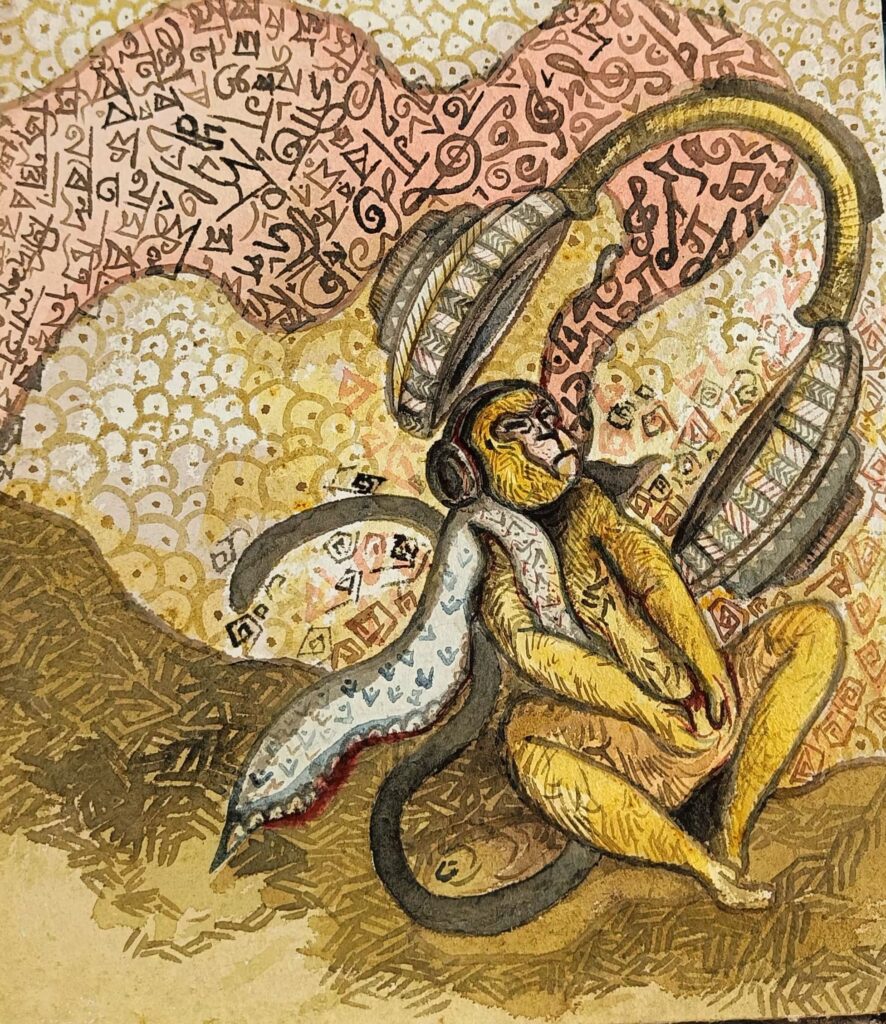
Tridisha Dutta
Moods
A monkey shuts its eyes and lets the letters sing
Ochre and rust, the colours of dry earth and old gold.
A monkey sits on a brown hill and shuts its eyes.
The headphones lift away like two slow wheels.
Letters drift out of a pink cloud and turn into notes.
A white ribbon curls past the long grey tail.
Nothing is loud here. The music stays inside.
Tridisha Dutta comes from Nalbari in Assam and paints with colours made from natural extracts. In Moods a small golden monkey sits with crossed legs and closed eyes. A pair of large headphones seems to break apart around its head. Above, a pink cloud fills with letters and musical notes. Dutta is a painting student at Assam University, Silchar. Animals are an important part of Dutta's work. Letters often appear too. They carry inner feelings and a bond with culture.
Natural extract colours · 30 × 23 cm · 2026
Theme Inner feelings and sound
RC-379
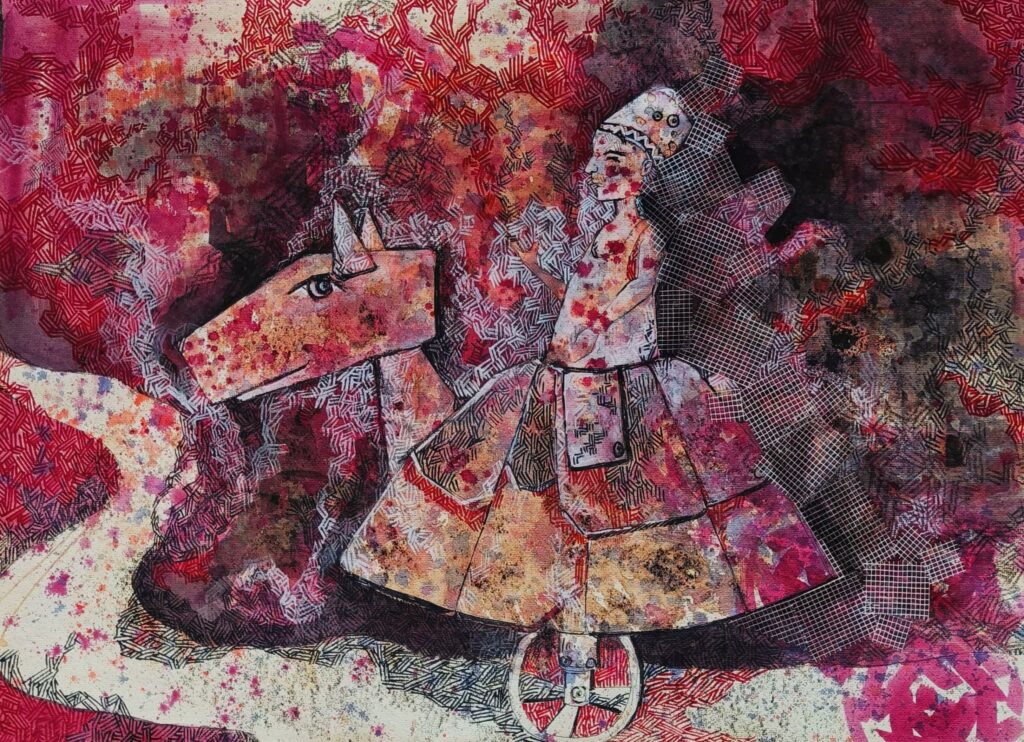
Tridisha Dutta
Journey
A doll on one small wheel. An animal keeps watch
Pink falls like dust after a festival.
A woman stands on one wheel and does not move.
Her skirt is a hill of rust and rose.
The animal's eye is calm and near.
Thin lines run over everything, like rain seen through a window net.
A grid climbs behind her shoulder, a fence or a ladder.
She looks ready to roll if someone pulls a string.
Tridisha Dutta comes from Nalbari in Assam. She studies at Assam University, Silchar. Here a woman in a wide skirt stands on one small wheel, like a pull toy. A large animal head sits beside her. Dutta often begins with her childhood photographs and memories. She changes the figures with motifs from traditional art. She uses natural colours and mixed materials. Fine hatched lines, grids and splashes of pink and red cover the whole surface.
Mixed media · 55.9 × 76.2 cm · 2025
Theme Childhood and animal forms
RC-380
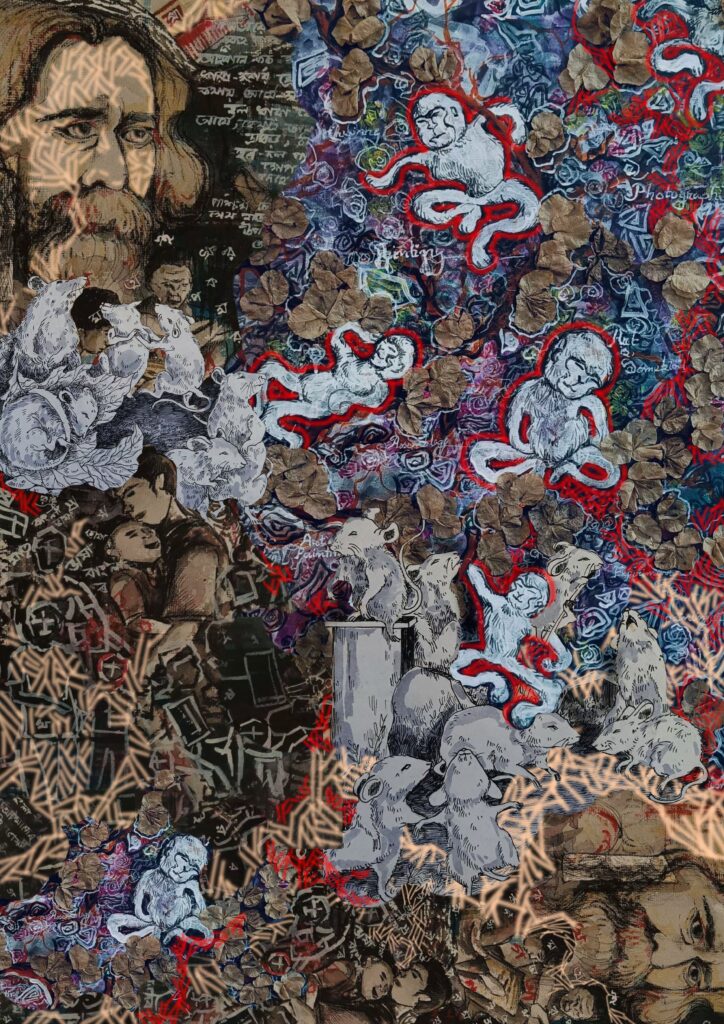
Tridisha Dutta
Surroundings
Rats, red thread and old faces crowd one small sheet
Dry leaves pile up like small brown hands.
White rats climb a pillar and look for the way out.
Pale bodies curl inside a red thread.
An old face watches from behind the letters.
A peach net of lines falls across it all.
This is a room full of what was kept.
Surroundings is a digital photo montage made in 2025. Tridisha Dutta builds it by combining photographs of earlier artworks with other images. Dutta studies painting at Assam University, Silchar. Many of Dutta's paintings start from childhood photographs. The figures change through motifs drawn from traditional art forms. Animals often meet human figures. Here white rats climb a pedestal. Pale crouching figures sit inside red lines. Faces and handwritten letters fill the left side. Dried leaves crowd a deep blue ground.
Photo montage of previous works · 42 × 29.7 cm · 2025
Theme Memory and culture
RC-381
From the open call
Saurav Jyoti Bordoloi
Nature is the true friend and greatest teacher to all. During his childhood to the teenage he used to play and stay around the nature. Playing in the mud, swimming in pond & river, fishing, running through the paddy fields, climbing trees, playing those games of the village children’s and eating seasonal local fruits directly from the trees all are so nostalgic, but all of a sudden it’s all gone…

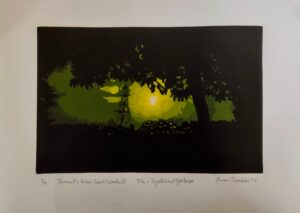
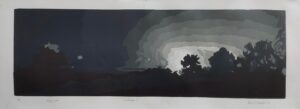

Saurav Jyoti Bordoloi
Digitalized Landscape I
An evening in Santiniketan, carved slowly to look like a screen
Palms stand like burnt matches against the last of the day.
The sky breaks into steps of lime, lemon and slate.
Each step has a ragged edge, as if the light were cut with a knife.
Small lamps wait low in the dark field.
A bare tree lifts thin fingers to the gold.
Nineteen times the paper meets the wood before this evening comes.
Saurav Jyoti Bordoloi makes this woodcut from an evening in Santiniketan. He cuts and prints 19 colour layers to build the picture. Tall palm trees stand black against the sky. Behind them, yellow, green and blue spread out in rough steps. The steps look like pixels on a screen. Bordoloi calls them "analogue pixels". The slow work of carving wood stands against the quick click of a camera. The print asks us to look at the land with our own eyes.
Woodcut print on paper · 66.04 × 81.28 cm · 202
Theme Nature seen through screens
RC-448

Saurav Jyoti Bordoloi
Digitalized Landscape
A field in Santiniketan, carved by hand one pixel at a time
Brown earth runs to the edge of the paper, flecked with small seeds of green.
Trees on both sides break into chips of colour, like a picture zoomed in too far.
The sun is a white coin inside a yellow flame.
Lilac and pale blue clouds rest in flat steps.
Every patch was cut from wood by hand.
I want to stand in this field before anyone lifts a phone.
Saurav Jyoti Bordoloi is from Nagaon. As a child he played in mud, swam in ponds and ran through paddy fields. Today he sees people meet a landscape through a camera lens first. This woodcut shows a quiet field in Santiniketan. Bordoloi prints it from 20 colour layers. Each layer has hard, stepped edges like pixels on a screen. The slow carving of wood stands against the quick click of a camera.
Woodcut print on paper · 66.04 × 81.28 cm · 2026
Theme Nature seen through screens
RC-449
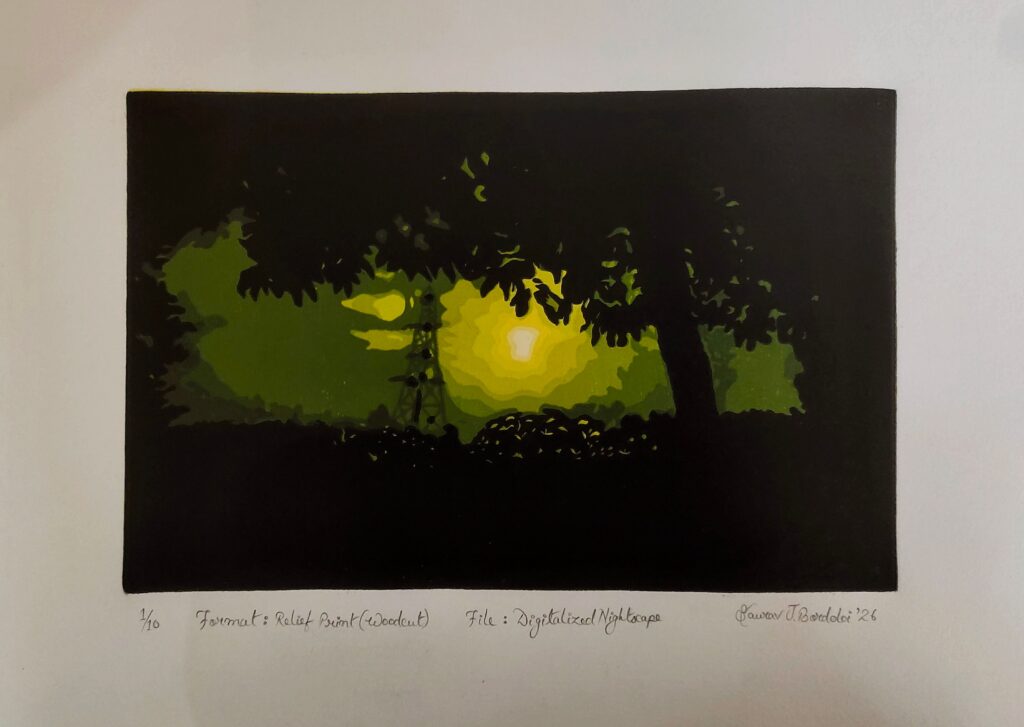
Saurav Jyoti Bordoloi
Digitalized Nightsc
Sixteen layers of carved wood to make a night look digital
Black leaves hang like a closed curtain.
In the gap the light spreads out in rings of lime and mustard.
A power tower stands thin as a pencil line inside the glow.
The greens do not blend. They step from one hard edge to the next.
Each step was cut into wood, slowly.
The night looks like a screen left on in an empty room.
Saurav Jyoti Bordoloi cuts this night scene of rural Assam in wood. He builds the print in 16 colour layers. Black trees frame a bright yellow light. An electric tower stands inside the glow. Bands of green and yellow step out from the centre like pixels on a screen. Bordoloi spent his childhood in mud, ponds, rivers and paddy fields. Now he sees people film a landscape instead of looking at it. His slow carving stands against the quick click of a camera.
Woodcut print on paper · 15 × 18 cm · 2026
Theme Nature through the screen
RC-450

Saurav Jyoti Bordoloi
Landscape
Seventeen layers of carved wood to hold one glowing sky
Night has settled on the fields but the sky will not close.
Grey rings spread out like water when a stone goes in.
At the centre a white light burns behind the trees.
The trees stand black and still. They do not look up.
Seventeen times the ink goes down, each time slower than a click.
You stand here with no screen in your hand. You only look.
Saurav Jyoti Bordoloi makes this woodcut from the Kopai riverside in Santiniketan. The print, titled Landscape I, is built from 17 layers in black, dark blue and grey. Trees and hills sit dark in front. Behind them, rings of cloud open around a bright glow. Bordoloi sees the slow work of carving as the opposite of a camera's quick click. He calls his shapes 'analogue pixels'. He comes from Nagaon and his college is Visva-Bharati University.
Woodcut relief print on paper · 20.32 × 62.23 cm · 2026
Theme Looking past the screen
RC-451
From the open call
Suha Mir
These are the behind the scenes of my plein air paintings. The first picture is of a piece that I did this summer— plein air oil on canvas. I visiting my family for the summer, and over the weekend, we drove about a hundred kilometres out of the city to take in some fresh air. A day after we got there, the weather turned quite moody— it got cold and…

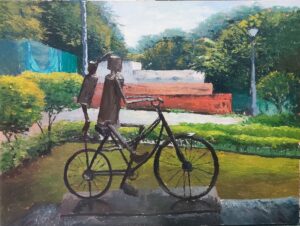

Suha Mir
Roots
Pale hands, tied with thread, rest in the dark
Black ink pressed deep, like soil after rain.
Two pale hands, knuckles soft as worn cloth.
Thread loops around each finger and falls.
It hangs the way roots hang from a cut bank.
Above, white leaves curl out of the square.
They do not wait for the edge.
The hands stay still. They are holding on.
Suha Mir makes Roots as a drypoint print on paper. The lines are scratched straight into a plate and then printed. Here the scratches build soft, deep blacks. Pale hands rest at the centre. Thin threads wrap the fingers and hang down like roots. Dark cloth fills most of the square. At the top left, curling white shapes grow past the edge of the plate. Mir marks this sheet as the first of two prints. Mir is from Srinagar and studies at the College of Art, University of Delhi.
Drypoint print on paper · 2026
Theme Hands, ties and roots
RC-464
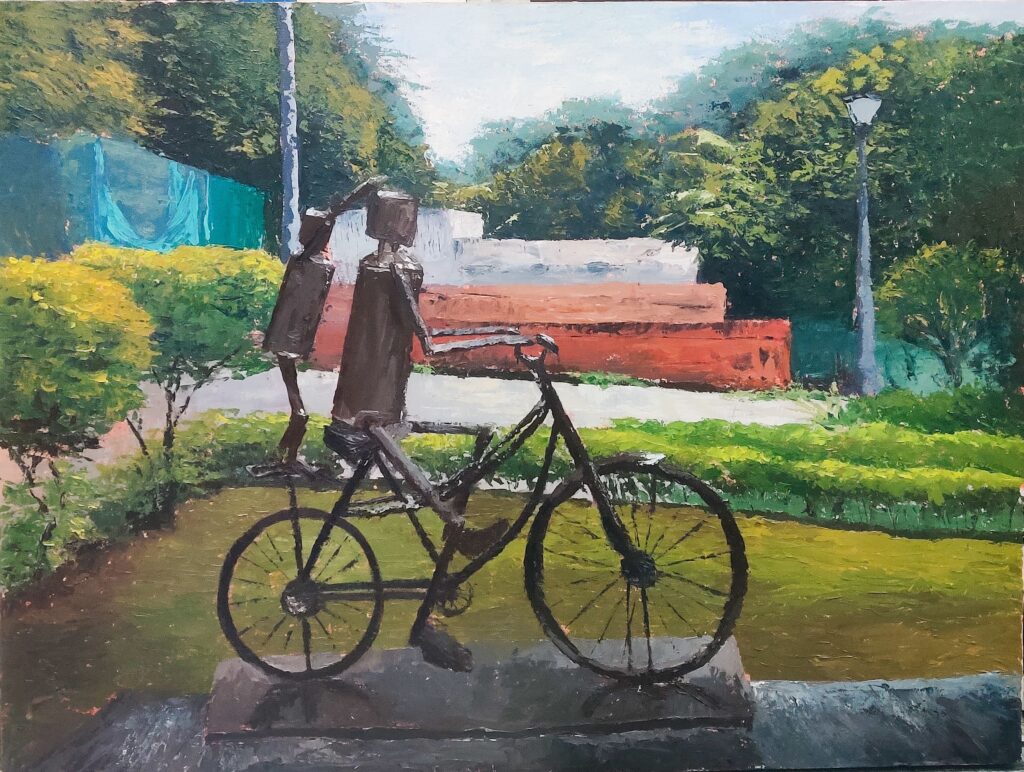
Suha Mir
Bicycle Thieves
Two metal friends and a bicycle that never leaves the park
Two figures with box heads stand in a still afternoon.
One lifts an arm as if to wave at the steps.
The bicycle waits on its stone, wheels thin as wire.
Hedges turn yellow at the edges where the sun lands.
A red wall sits low behind them like warm brick.
The lamp post keeps watch in daylight.
Nobody rides away.
Bicycle Thieves is a 2025 painting in acrylic on canvas. It measures 76 × 101 cm. Suha Mir paints a metal sculpture in a public park. Two figures with box-shaped heads stand beside a bicycle on a stone base. Behind them are bright hedges, a lawn, red and white steps and a tall lamp post. The paint sits thick and the brushstrokes stay visible. Mir often paints outdoors, where the light can change from sunny to grey fast. Mir is drawn to that speed.
Acrylic on canvas · 76 × 101 cm · 2025
Theme Public sculpture in sunlight
RC-465
From the open call
Nikita Dhali
Well, difficult? That really hit me. The word isn't "difficult" for me, but separation—the separation from my core. Like I was meant to make spirals since the beginning, but how again and again I got separated from it. Yet they say that what's meant for you will cross oceans to reach you. Though it didn't have to cross oceans for me, I had to go deep inside myself again—like totally…


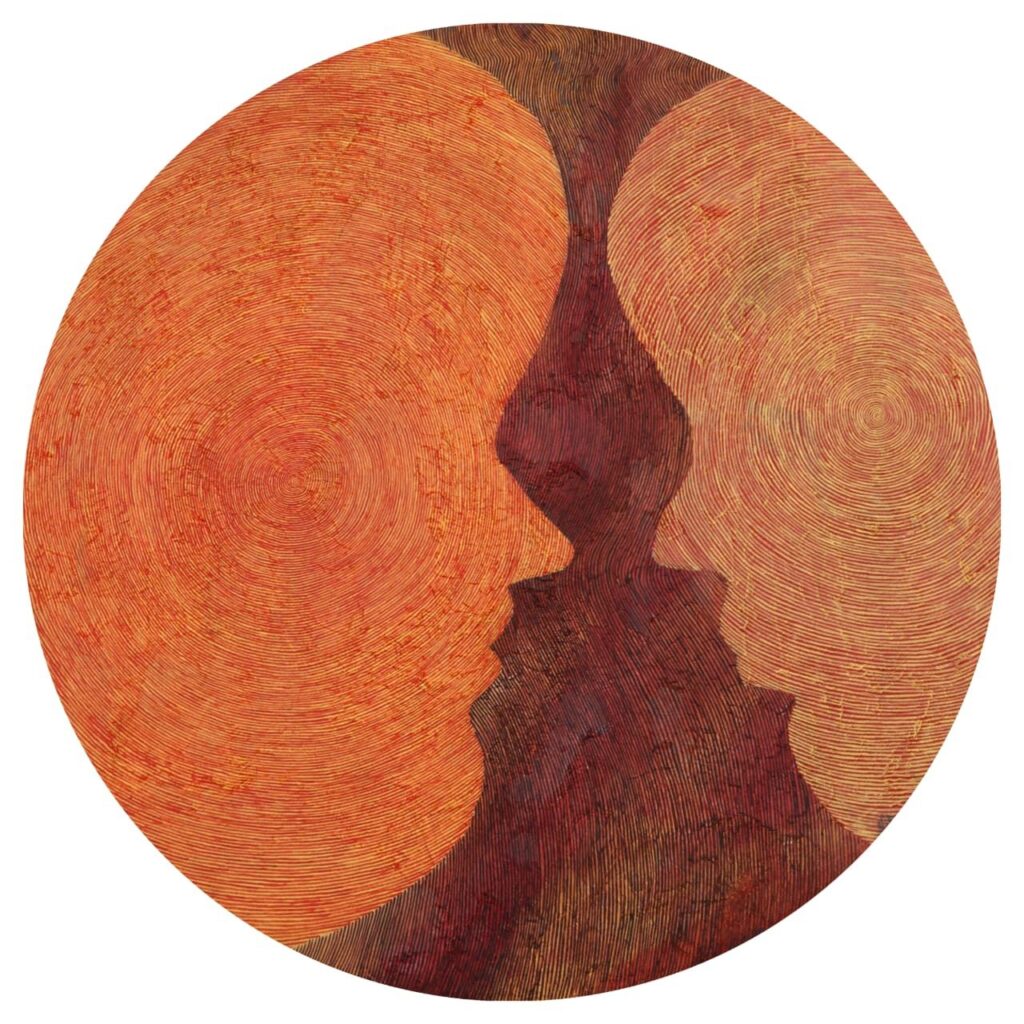
Nikita Dhali
Taalash
Two faces almost touch, each one wound from a spiral
Two heads lean close, the colour of turmeric and dried chilli.
Each one turns around its own quiet centre.
The line goes round and round and never lifts.
Between the lips a dark red space waits like a held breath.
It has a shape too, a vase or a doorway.
The paint is cracked in places, like earth after summer.
Nikita Dhali paints two faces in profile on a round surface. They lean so close that their lips nearly meet. Each head is made of fine lines that turn out from a centre. The dark red space between them has its own shape. Dhali first made spirals after her Bachelor's in Painting. She had "No rules, no guidance." She wanted a circle without any break in the line. Now she studies for her Master's at MSU Baroda in Vadodara.
Acrylic · 60 × 60 × 5 cm · 2026
Theme Separation and return
RC-482
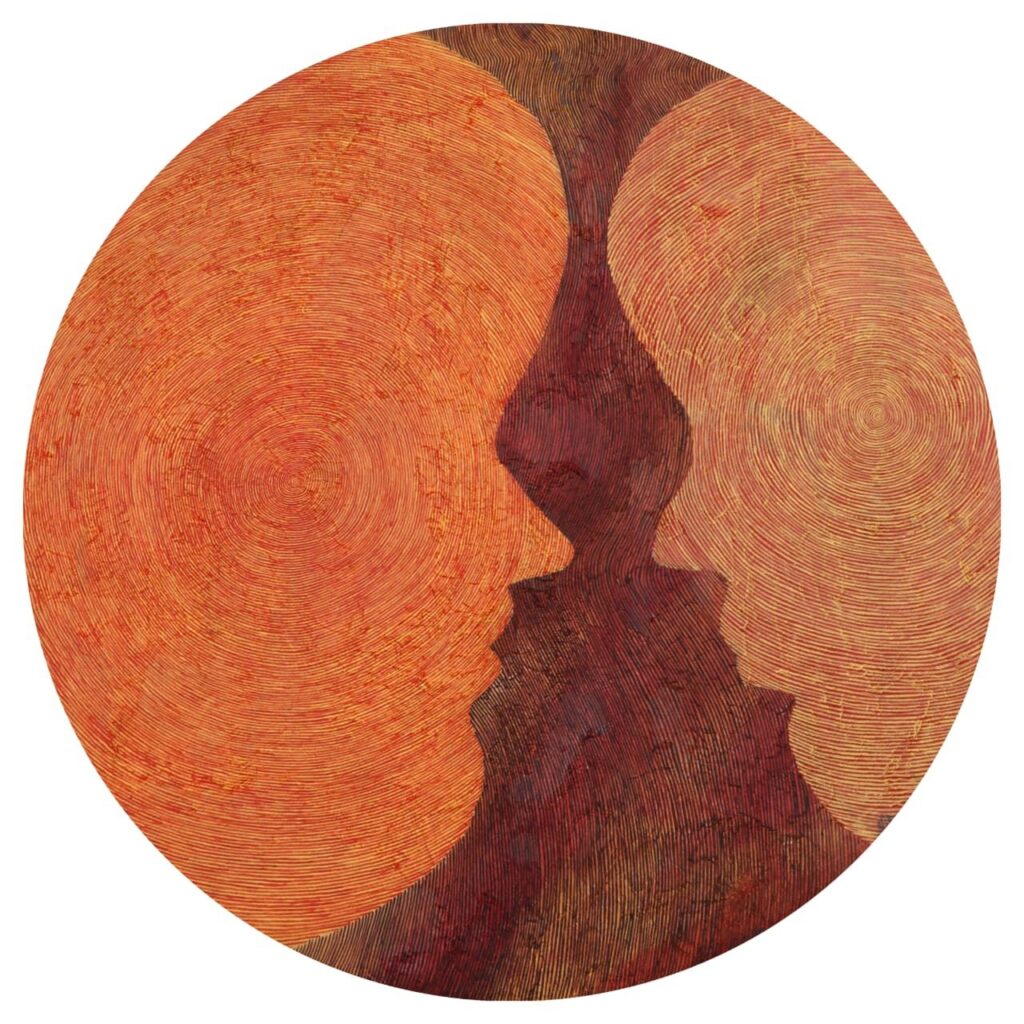
Nikita Dhali
Taalash (Finding)
Two faces lean close, held by lines that never break
Two heads of burnt orange lean in until their lips almost touch.
Inside each head a spiral turns like the rings of a cut tree.
One face glows hot. The other has cooled to the pink of evening.
Between them a dark vessel rises out of maroon earth.
Cracks run through the paint like dry mud in May.
Nothing here is still. Every line keeps going round.
Nikita Dhali paints spirals. Each spiral is a circle made without a break in the line. The spirals begin after Dhali finishes a Bachelor's in Painting. There is no teacher now to set rules. So Dhali asks, "Now what should I paint?" Patterns come first. Then comes the unbroken circle. In Taalash, two faces meet on a round canvas. Fine spiral lines fill both heads and the dark space between them. Dhali is now a Master's student at MSU Baroda in Vadodara.
Acrylic on canvas · 60.96 × 60.96 × 5 cm · 2026
Theme Return to the core
RC-474
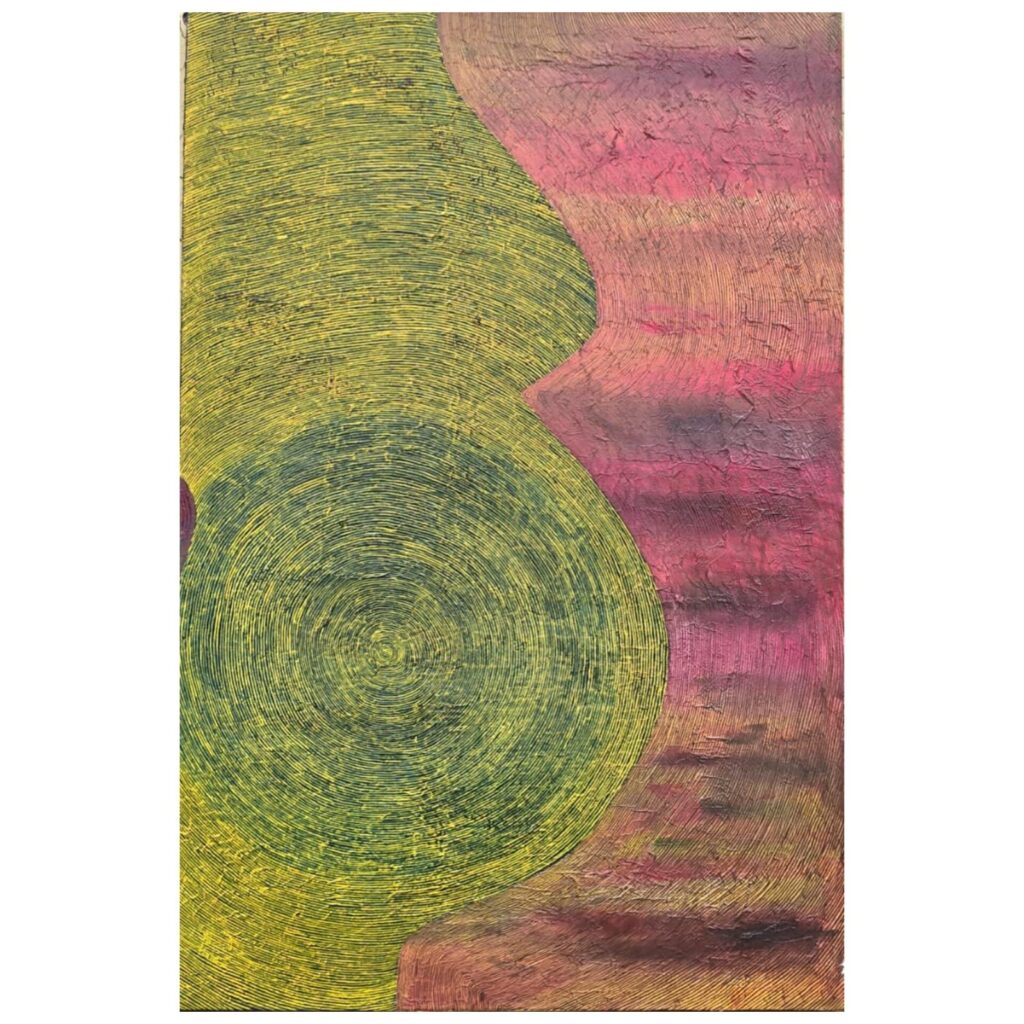
Nikita Dhali
Mitti (soil)
A line that never breaks, turning until it reaches the core
A yellow line turns and does not stop.
Round and round it goes until the centre grows dark green.
Beside it the pink earth dries and splits.
Plum shadows lie across it like old rain.
The edge between them curves like a cheek.
Press a finger here and you might feel warm mud.
Nikita Dhali paints spirals. In Mitti (soil) she builds acrylic into a surface like soil. On the left, yellow and green lines turn around a dark centre. On the right, a pink ground cracks like dry earth. Dhali comes from a very small town. Her first course was CS and B.Com. Now she does her Master's at MSU Baroda in Vadodara. After her Bachelor's in Painting she began to make "a circle without any break in the line". She says "they really chose me to create them".
Acrylic textured as soil · 91 × 60 × 5 cm · 2026
Theme Return to the core
RC-475
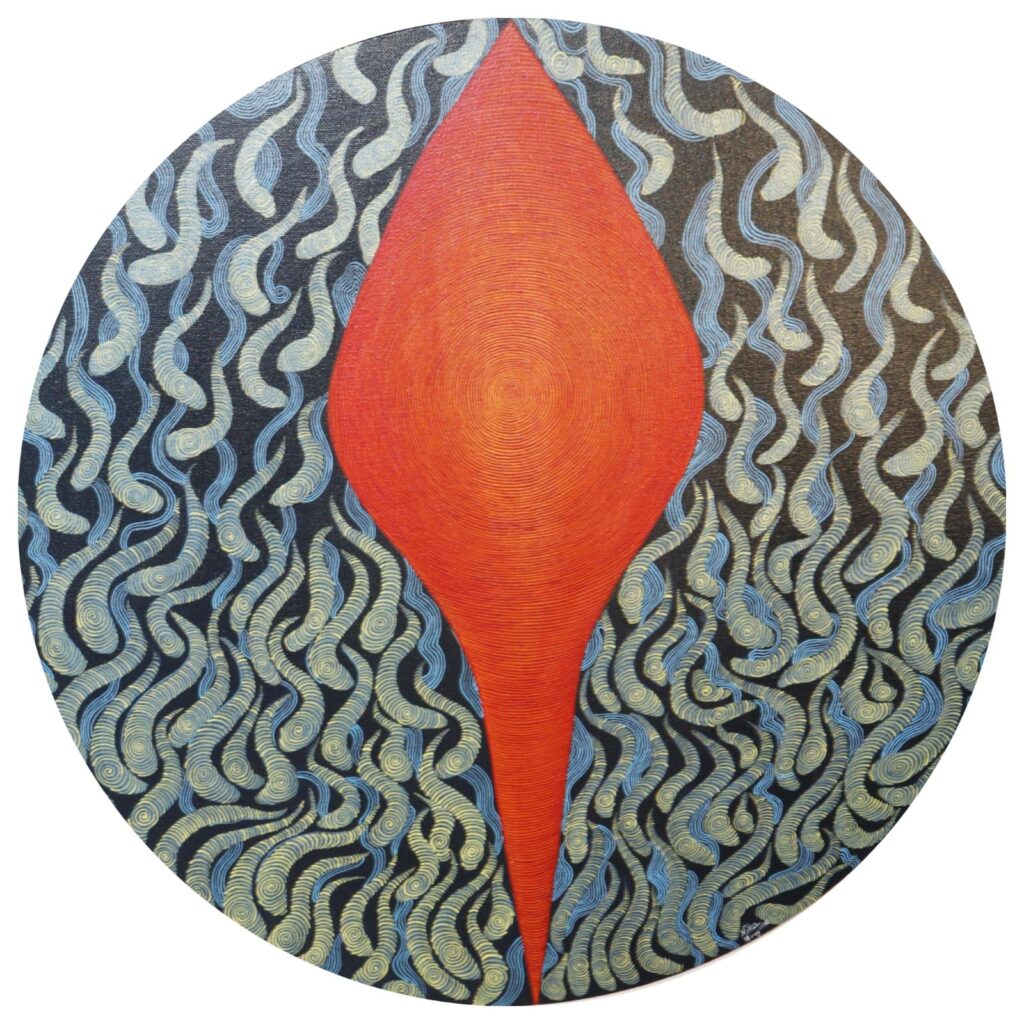
Nikita Dhali
Om
One unbroken line, turned until it became a flame
A red seed stands in a dark round pond.
Its skin is a coil of thread, wound and wound to a still centre.
Around it, pale smoke climbs in slow curls edged with cold blue.
Each curl holds its own small whirl, like a thumbprint.
The black between them is deep water.
The red does not move. Everything else rises past it.
Nikita Dhali paints with a line that does not break. In Om, a red form like a flame fills the centre of a round canvas. It is built from close rings of red line. Pale wave shapes rise around it. Each wave is made of small spirals too. Dhali first studied CS and B.Com in a small town. Dhali now studies for a Master's at MSU Baroda. The spirals began after a Bachelor's in Painting with "No rules, no guidance." Dhali calls the practice "my breath, my sadhana."
Acrylic on canvas · 60 × 60 × 5 cm · 2026
Theme Returning to the core
RC-476
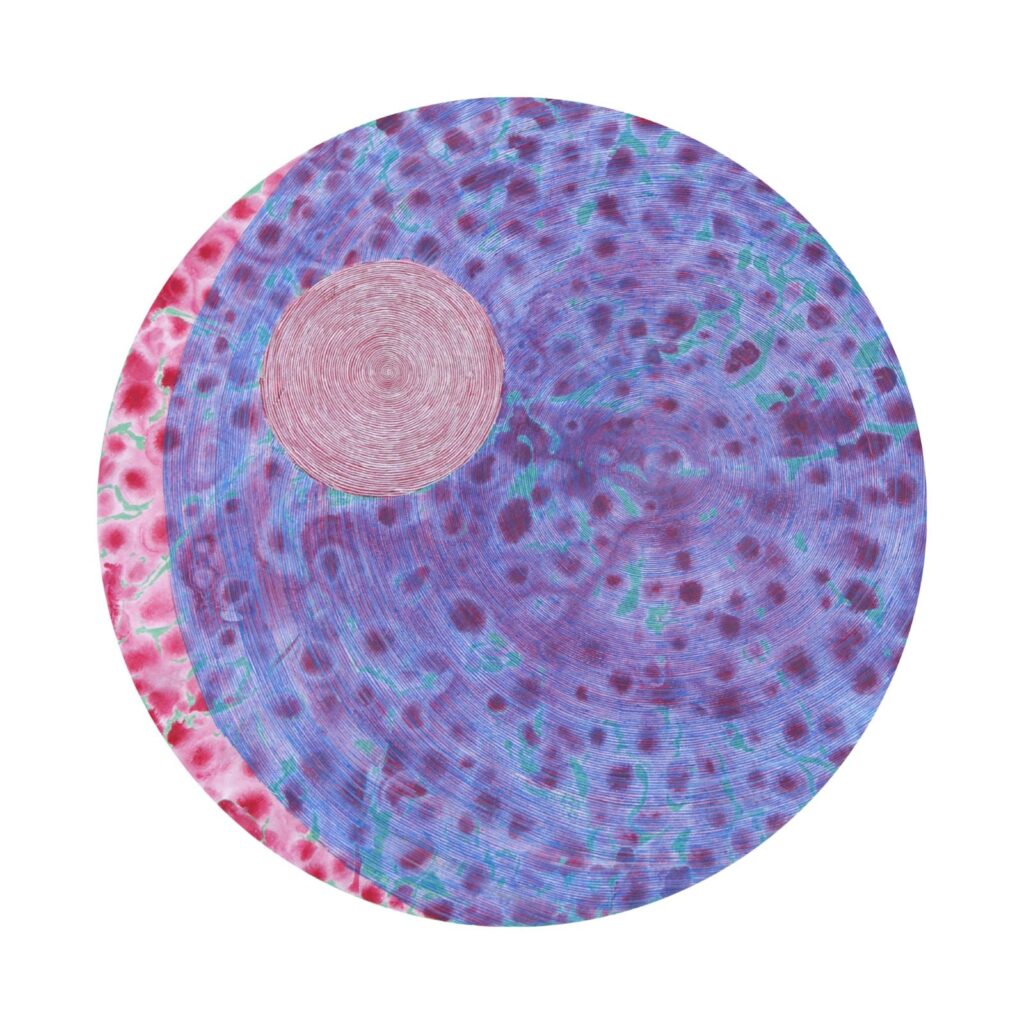
Nikita Dhali
Oneness
One line that never breaks, turning until the circle fills
A blue line turns and turns and does not stop.
Dark red spots float in it like seeds in water.
Thin green threads slip between the rings.
At the left edge a pink moon is rising, wet and blotted.
High up a small rose spiral rests, closed and quiet.
The eye follows the line inward and forgets the way out.
Nikita Dhali makes spirals. Each one starts as a circle drawn with no break in the line. Dhali first studied commerce in a small town where no one knew painting was a subject. Now Dhali is doing a Master's at The Maharaja Sayajirao University of Baroda in Vadodara. After a Bachelor's in Painting there were no rules and no one to give guidance. Dhali began to make patterns and the spirals came. In Oneness a small pink spiral sits inside a large blue one. Dhali calls the practice sadhana.
Acrylic · 60 × 60 × 5 cm · 2026
Theme Returning to one's core
RC-477

Nikita Dhali
The Pause of energy
One unbroken line, wound round and round until it holds still
Blue thread wound tight, then red pulled through it.
Slow whirlpools crowd the edge of a round sky.
At the centre a seed of wine-dark rings.
A gold rim scallops around it like a lit shoreline.
The teal border ripples outward and stops.
Everything turns. Nothing moves.
A breath held at the bottom of the lungs.
Nikita Dhali makes spirals. The first ones came after a Bachelor's in Painting, when there was no one to say what to paint. Dhali began with patterns. Then came the wish to draw a circle without any break in the line. That circle became a spiral. Dhali calls the work sadhana and has not stopped since. In The Pause of energy, a ring of blue and red spirals surrounds a gold oval. Dhali is now doing a Master's at The Maharaja Sayajirao University of Baroda in Vadodara.
Acrylic · 40 × 40 × 5 cm · 2026
Theme Returning to the core
RC-478

Nikita Dhali
The Pause of Cosmo
One line that never breaks, turning until it becomes a world
Blue thread wound tight around a sleeping centre.
The white between the lines hums like breath.
A gold sun rests on the blue and does not sink.
A smaller orange one leans on it, warm as a coal held in the hand.
At the right edge a third one slips out of the circle.
Everything turns. Nothing moves.
Nikita Dhali paints spirals. In The Pause of Cosmo, fine blue and white lines turn around a centre and fill the round canvas. Gold and orange spirals sit on top like small suns. Dhali grew up in a small town where no one knew painting was a subject. The first degree was in commerce. The spirals began after a Bachelor's in Painting, when there were no more rules to follow. Today Dhali is doing a Master's at The Maharaja Sayajirao University of Baroda in Vadodara and calls the spirals a sadhana.
Acrylic on canvas · 40 × 40 × 5 cm · 2026
Theme Returning to the core
RC-479

Nikita Dhali
Divine Eyes
An eye made of unbroken spirals, watching from a wall of stones
Red stones crowd the paper. Each one turns slowly inward.
Between them, grey lines coil like smoke that will not leave.
Six pale blue pebbles keep watch around a wide open lid.
The iris is a half sun, rising or setting in sky blue.
Look long and the whole sheet starts to breathe.
Every line goes round and round and never lets go.
Nikita Dhali is a Master's student at The Maharaja Sayajirao University of Baroda in Vadodara. Dhali grew up in a small town where no one knew there was a subject called painting. Dhali first studied CS and B.Com. After a Bachelor's in Painting, Dhali begins to draw circles without a break in the line. These become spirals. In Divine Eyes, every shape is built from them. A large eye sits at the centre. Dhali calls the spirals "my breath, my sadhana."
Watercolour and acrylic on watercolour sheet · 59 × 42 × 2 cm · 2025
Theme Spirals as daily devotion
RC-480

Nikita Dhali
Pious Love
Every line here is a circle that never breaks
Beetroot pink soaks into rings as fine as thread.
Each leaf turns slowly around its own centre.
Between them the grey ground hums with smaller whorls.
Dark stains sit in the grey like water left too long.
A white seam runs where one shape meets the next.
One pink moon slips off the lower edge, still turning.
In Pious Love, Nikita Dhali fills every leaf and every round form with fine spiral lines. Pink and violet colour pools inside them. A grey ground of smaller spirals holds the shapes together. Dhali first studied CS and B.Com in a small town where no one knew painting was a subject. After a Bachelor's in Painting, Dhali began "making a circle without any break in the line". Dhali now studies for a Master's at MSU Baroda in Vadodara. Dhali calls the spirals "my breath, my sadhana".
Watercolour and acrylic on watercolour sheet · 59 × 42 × 2 cm · 2025
Theme Repetition as devotion
RC-481
From the open call
Riya
also wanted to make my work look attractive while keeping the message clear and easy to understand. Each piece gave me a chance to try something different and improve my creativity. I enjoyed choosing different lettering styles and thinking about how the words should be placed on the page. I tried to keep the design balanced so that the writing and decoration work well together. I paid attention to small…




Riya
Smile is a beautiful makeup
One small line about smiling, written with great patience
Cream paper under a fine rain of blue and plum.
Some round spaces stay clean, like places where a cup once stood.
A little yellow light sits near the top.
The black letters lean and loop, heavy going down, thread-thin coming up.
They stand in a column, one short word at a time.
You read slowly and your mouth begins to move.
Riya is a student at Guru Nanak Girls College in Yamuna Nagar. In this work from 2025 she writes a short line about smiling in tall black letters. Thick downstrokes meet thin hairlines. Around the words she spatters watercolour in blue, violet and pink. She writes some letters again and again until she is satisfied. The task teaches her patience. She wants the writing and the decoration to stay in balance. She believes that "even a simple design can look beautiful when it is made carefully."
Gel pen and watercolour on paper · 29.7 × 21 × 80 cm · 2025
Theme The beauty of smiling
RC-498

Riya
The best view comes after the hardest climb
Each word takes a different shape on the way up
Black ink on white paper, nothing else.
HARDEST stands tall as a cliff, its strokes thick and heavy.
Above the first words, a thin mountain ridge with small tufts of grass.
The word view waits on a curled ribbon, small, almost hidden.
climb loops away in a light hand, as if the pen can finally rest.
A plain black frame holds the whole slope still.
Riya makes this work with a black gel pen on paper, 29.7 × 21 cm. She studies at Guru Nanak Girls College in Yamuna Nagar. Each word of the saying has its own lettering style. Tall capitals with serifs carry ‘BEST’ and ‘HARDEST’. A light script runs through ‘the’ and ‘climb’. Two small ribbons hold ‘view’ and ‘after’. Above the words, fine lines draw a mountain ridge. Riya repeats some letters many times until she is satisfied with them.
Black gel pen on paper · 29.7 × 21 × 0.01 cm · 2025
Theme Effort before reward
RC-483

Riya
Never let anyone who hasn’t your shoes how to tell you tie your shoes
The last word loops and knots like a real shoelace
Blue letters stand tall, each one painted only at the top, the rest left as thin black line.
The word shoes leans forward in warm orange, its shadow striped like a woven strap.
Purple script speaks the instruction quietly.
At the bottom, laces runs loose across the white page and ends in a small hard tip.
Black pen holds every edge in place.
The advice is old. The hand that writes it is new.
Riya, a student at Guru Nanak Girls College in Yamuna Nagar, letters this saying in several different styles. Black gel pen draws the outlines. Watercolour fills them in blue, orange and purple. The word shoes carries a striped shadow. The word laces loops like a real lace and ends in a small tip. The work does not come easily. "I had to repeat some letters and designs until I was satisfied with them," she says. It teaches her to be patient.
Black gel pen and watercolour on paper · 29.7 × 21 × 0.01 cm · 2026
Theme Living by your own experience
RC-484
Riya
Laugh when you apologise when you should let go what you change
One black pen, two kinds of letters, three small rules for living
Black ink sits on white paper like wet thread.
The word laugh lifts its tail and curls away.
Apologize drops a long loop under itself, a bow after a hard sentence.
The plain capitals stand straight between them and wait.
Each line ends on a small open circle, a breath.
A black frame holds it all still.
Riya, of Guru Nanak Girls College in Yamuna Nagar, makes this piece in 2026. She uses one black gel pen on a white sheet 29.7 × 21 cm. Four phrases flow in a looping script. The words between them stand in tall capital letters. A small circle closes each line. She repeats letters until she is satisfied. She wants the writing and the decoration to work well together.
Black gel pen ink on paper · 29.7 × 21 × 0.01 cm · 2026
Theme Kindness and letting go
RC-485

Riya
Don’t put your life in someone hand because they are bound to steal it away
Who is holding your life right now?
One black pen and a white page inside a black frame.
A hand reaches down from the top edge and closes on nothing.
Below it a figure in a buttoned coat wears a small badge.
It holds a tight knot of scribble near its face.
The big outlined letters stand open and empty.
LIFE at the top. AWAY at the bottom.
Riya makes this drawing in black gel pen on a sheet of paper 29.7 × 21 cm. She is at Guru Nanak Girls College in Yamuna Nagar. The work joins a short warning to a drawn figure. Riya chooses a different lettering style for the lines and thinks about where each word sits on the page. She wants the writing and the drawing to balance. Some letters do not look right the first time. She draws them again until she is happy with them.
Black gel pen on paper · 29.7 × 21 × 0.01 cm · 2026
Theme Trust and loss
RC-486

Riya
If everything around seems dark look again you may be the light
Even the word Dark is written in pink
Pink at the top of each letter, green at the root.
The word Dark is the biggest thing on the page.
It is written in the same bright ink as the rest.
Blue thins into purple where the pen pressed down.
A thread of ink curls off the last word and loops back.
The white paper shows through every gap.
Riya writes a short line of hope with gel pens on a small sheet of paper, 21 × 14.8 cm. She is a student at Guru Nanak Girls College in Yamuna Nagar. Each letter is split into two colours. Pink sits above green and blue sits above purple. The largest word on the page is "Dark". Riya chooses the lettering styles and plans where each word sits. She writes some letters again and again until she is satisfied.
Gel pen on paper · 21 × 14.8 × 0.01 cm · 2026
Theme Hope in hard times
RC-487

Riya
Romantic vibes
A question about lipstick, written out in careful letters
Pink mouths pressed again and again, edge to edge.
Each one leaves fine lines like the grain of a leaf.
Over them black letters walk in slow, careful rows.
The words do not know what comes next.
They ask the page to wait while the colour dries.
The question stays, written as neatly as an answer.
Riya studies at Guru Nanak Girls College in Yamuna Nagar. In this small work from 2026 she writes in black gel pen over a field of pink lip prints. The words ask a real question. Should she leave the lipstick as it is after it dries or add something on top? Riya chooses her lettering style with care. She often repeats letters until she is happy with them. The sheet is 21 × 14.8 cm.
Black gel pen on paper · 21 × 14.8 × 0.01 cm · 2026
Theme Doubt in the making
RC-488

Riya
You deserve the universe unfortunately I am just a star
A face that ends where the stars begin
Black ink on white paper, nothing else.
The big words lean and swell. The small ones stand straight and thin.
A little word hides inside a larger one, almost an apology.
The last letter of star lets out a long breath of ink.
Below it a face stops at the nose.
Above that line there are only stars and dots.
The mouth stays shut and keeps its secret.
Riya draws this piece in black gel pen on a sheet 21 × 14.8 cm. She studies at Guru Nanak Girls College in Yamuna Nagar. Two kinds of lettering share the page. Thin capitals carry the plain words. A heavy script carries the words Universe and star. Under the words stands a small figure whose head turns into stars. Riya repeats some letters until they satisfy her. She says the work teaches her patience.
Black gel pen on paper · 21 × 14.8 × 0.01 cm · 2026
Theme Love and feeling small
RC-489
Riya
Your wings already exist all you have to do is fly
A butterfly waits at the edge of a sentence
Grey wings, ridged like folded paper, made with the side of a pencil.
A dark body striped with thin white gaps where the pen held back.
Flowers drawn in one black line, petals left mostly empty.
Below them the words lean and loop, big and then small.
The last word is drawn tall and heavy.
It waits at the bottom of the page, ready.
Riya studies at Guru Nanak Girls College in Yamuna Nagar. In this drawing she joins calligraphy and illustration on one sheet of paper. A large butterfly fills the top of the page with flowers at its side. Below it the words run in several lettering styles. She draws the outlines in black gel pen and adds soft grey with a shading pencil. She chooses where each word sits so the writing and the drawing stay in balance. Some letters she repeats many times until she is happy with them.
Black gel pen and shading pencil on paper · 29.7 × 21 × 0.01 cm · 2026
Theme Believing in yourself
RC-490

Riya
Wings of Hope
A butterfly that already has everything it needs
Grey pencil fills the wings like smoke that has stopped moving.
The body is dark ink, ringed with thin pale bands.
Two antennae curl at the tips like young fern.
White petals open around small round centres.
The words lean and loop across the paper.
The last word is the biggest. It says fly.
Riya studies at Guru Nanak Girls College in Yamuna Nagar. In Wings of Hope she brings drawing and calligraphy together on one page. A butterfly rests above a small cluster of flowers. Beside it, a line of words tells the reader to fly. She draws the outlines in ink pen and shades the wings and petals with pencil. She mixes several lettering styles in one line. Some letters she draws again and again until she is satisfied with them.
Ink pen and shading pencil on paper · 29.7 × 21 × 80 cm · 2026
Theme Hope and self-belief
RC-491
Riya
Hope of Light
Every letter changes colour halfway down, like light finding its way in
Pink ink runs down into green, halfway through every letter.
Blue sinks into purple the way evening sinks into a courtyard.
The word Dark is the largest thing on the page. Its tail curls away like a loose thread.
Below it the smaller words lean forward, patient.
At the bottom Light opens its arms in the same two colours.
The paper stays white all the way through.
Riya studies at Guru Nanak Girls College in Yamuna Nagar. In Hope of Light she writes a short message of hope in colour pen on paper. Each word is in two colours. Pink sits over green and blue sits over purple. The word "Dark" is the biggest on the page. Riya chooses the lettering styles and plans where each word goes. She repeats some letters again and again until she is happy with them. She says the work teaches her to be patient.
Colour pen ink on paper · 21 × 14.8 × 270 cm · 2026
Theme Hope in darkness
RC-492

Riya
Outshine Yesterday
The colour runs out just where yesterday begins
Pink ribbon letters curl at the top, their tails like a loose thread.
Today is blue and deep, a swimming pool with light on its skin.
Orange follows, warm as a stove flame.
Then the colour stops.
Yesterday stands in thin black wire, small circles gathered at its feet.
The last words are almost only breath on white paper.
Riya is a student at Guru Nanak Girls College in Yamuna Nagar. In this work she writes one cheerful line in five different lettering styles. She uses watercolour for the colour and an ink pen for the outlines. She thinks about where each word should sit on the page. She wants the writing and the decoration to balance. Some letters do not look right the first time. She draws them again until she is happy. The work is part of a collection of her calligraphy.
Watercolour and ink pen on paper · 21 × 14.8 × 270 cm · 2026
Theme Making the most of today
RC-493

Riya
Legacy of Love
Rows of lipstick kisses under a note full of doubt
A field of mouths in rose and brick red.
Each kiss leaves its small lines like the grain of a leaf.
The pink thins to white where the lips lifted away.
Across it black letters lean forward and wait.
They ask what to do with something already made.
The question dries on the page with the colour.
Nothing answers. The kisses stay.
Riya studies at Guru Nanak Girls College in Yamuna Nagar. In this work she covers a rectangle of pale paper with lipstick kiss marks. They overlap in pinks and deep reds. Over them she writes in black ink pen in a slanted hand. The words ask a simple question about the work itself. Should the lipstick stay as it is after drying? Should something go on top? In her calligraphy Riya repeats letters until she is satisfied. She wants the writing and the decoration to stay in balance.
Lipstick and ink pen on paper · 21 × 14.8 × 270 cm · 2026
Theme Doubt in making art
RC-494

Riya
Art of Heartbreak
A warning, drawn so carefully it starts to sound like an answer
Black ink on white paper with nothing filled in.
Every letter is an empty room with clean walls.
The word NEVER stands tall, but you can see right through it.
The tops of DRAWING melt like candle wax.
Sweetheart curls along the bottom in one long loop.
A rose opens under it. A small heart floats above.
The pencil lines are still there, like the first try.
Riya draws this work in black gel pen on a single sheet of paper. The words sit inside quotation marks, as if someone once said them aloud. Each line has its own lettering style. Bold capitals, letters with dripping tops and a looping script share the page. A rose and a small heart sit under the last word. Faint pencil guidelines still show. Riya redraws some letters again and again until they look right. The work is made in 2026 at Guru Nanak Girls College in Yamuna Nagar.
Black gel pen on paper · 21 × 14.8 × 270 cm · 2026
Theme Answering doubt with craft
RC-495

Riya
“…unfortunately, I am just a shadow.”✨
When someone deserves the universe and you are only a star
Black ink on pale paper with a little blue at the edge.
The word "the" squeezes in late, like a guest at the door.
"Universe" leans and swells. "Unfortunately" stands straight and thin.
A line runs out from "star" like a loose thread.
It ends at a head full of small points of light.
Only the mouth is left, quiet and closed.
Riya studies at Guru Nanak Girls College in Yamuna Nagar. Riya makes this drawing in 2026 with an ink pen on paper. Thin capital letters sit beside thick flowing script. A small word "the" slips in over "deserve". Riya chooses each lettering style and plans where every word goes. Some letters are drawn again and again until they look right. Below the words a figure stands with stars where the top of the face should be.
Ink pen on paper · 21 × 14.8 × 270 cm · 2026
Theme Love and feeling small
RC-496

Riya
Love have to be perfect
A gown of roses gone brown that still holds its shape
The roses have let go of their first colour.
Now they are the brown of tea left in a cup.
They overlap like roof tiles on a skirt that never moves.
A thin yellow line keeps them from spilling off the page.
The face is only a pale shape with no eyes.
The black words lean beside her and do the speaking.
Riya studies at Guru Nanak Girls College in Yamuna Nagar. This work is from 2024. A figure in a wide gown stands on pale blue paper. The gown is made of rose petals. They have dried to a deep brown and lie close together like scales. A thin line of yellow watercolour holds them in. Beside the figure, black hand lettering runs down the page. Riya thinks about how each word should sit on the page. She repeats letters until she is satisfied.
Ink, rose petals, watercolour and gel pen on paper · 29.7 × 21 × 80 cm · 2024
Theme Imperfect, true love
RC-497
From the open call
Nancy Dalal
These five paintings beautifully express courage, spirituality ,divine power, balance, love, and innocence. Veer abdul hamid represents bravery, patriotism, sacrifice,and dedication to the nation . Lord Shiva is peaceful form represents mediation, purity,inner strength,and spiritual peace . Maa kali symbolize shakti, protection,fearlessness, and the victory of good over evil. Shiv shakti represents the unity of consciousness and energy, showing balance, harmony , and divine love. Bal Krishna represents innocence,joy ,devotion,…

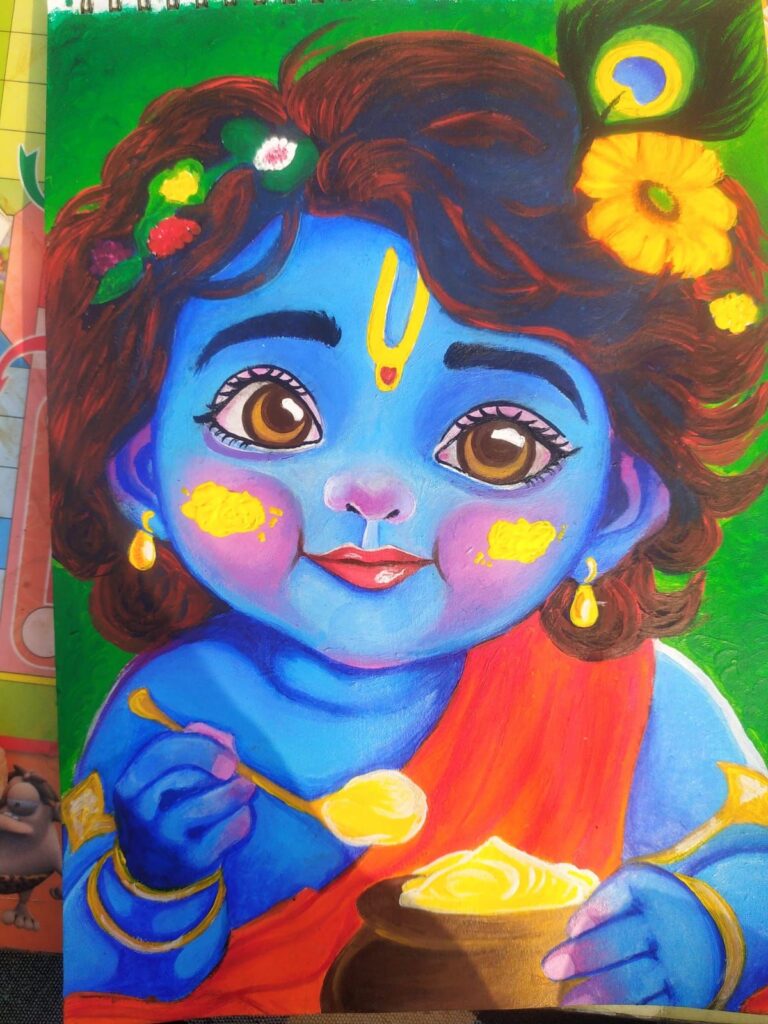
Nancy Dalal
Krishna
Butter on the spoon, butter on his cheeks, no shame at all
Blue skin against green, the colour of a field after rain.
Butter on the spoon, butter on both cheeks, caught mid-theft.
Brown curls hold a peacock eye and one yellow flower.
His eyes are wide and brown with a white spark in each.
The clay pot is still full.
Nobody has told him yet.
Nancy Dalal studies at Guru Nanak Khalsa College in Yamuna Nagar. Krishna is one of five paintings she makes in 2025 about faith, courage and love. Here the god is a small child. He holds a clay pot of butter and lifts a gold spoon. Yellow butter marks both his cheeks. Dalal paints him in acrylic on a sketchbook page. For her, Bal Krishna stands for innocence, joy and devotion. He also shows "the playful beauty of childhood".
Acrylic on paper · 2025
Theme Innocence of childhood
RC-527
From the open call
Uttam prajapat
Uttam’s practice emerges from his lived connection to Vatera village in the Sirohi district of Rajasthan and is deeply rooted in an engagement with the ecological and socio-political landscape of the Aravalli region. His work critically examines the impact of ongoing mining activities that continue to reshape both land and life, leading to displacement, environmental degradation, and the gradual erasure of indigenous ways of living. Grounded in close observation and…



Uttam prajapat
बिलखती काय , series 2 (the broken )
Children under branches, printed on clay that is already cracking
Rust-orange clay, the colour of a hillside after rain.
Children look out from under a roof of thin branches.
A crack runs through a small shoulder and keeps going.
On the smaller piece a sheet of cloth hangs from sticks.
The black ink sits in the clay like smoke.
Everything here was fired to last. Everything here is splitting.
Uttam Prajapat comes from Vatera village in the Sirohi district of Rajasthan. Mining in the Aravalli hills is changing the land and the lives of people there. In this work Prajapat prints images onto fired terracotta using serigraphy. One piece shows children sitting under a roof of branches. The other shows a shelter of sticks and cloth. Cracks run across both surfaces. He often works with soil from the Aravalli hills. He does not show the mines. He shows what is breaking.
Serigraphy on terracotta · 15 × 20 × 0.5 cm · 2026
Theme Land, mining and displacement
RC-499

Uttam prajapat
बिलखती काय
Children printed in black on fired clay, fading at the edges
A boy half hidden behind a tree trunk.
A small child held close against an older chest.
Black ink sits on red clay like soot after a fire.
The ground around them breaks into dark patches.
One child walks away across the open earth.
The clay edges curl, soft as torn bread.
Uttam Prajapat's work begins in Vatera village in the Sirohi district of Rajasthan. Mining in the Aravalli hills is changing the land there and pushing people to leave. Prajapat works with soil from these hills and with fired surfaces. Here he screen prints photographs in black onto four flat pieces of terracotta. Each piece has soft, uneven edges. The images show children on open, rocky ground. Some prints are clear. Others break into patches like the land itself.
Serigraphy on terracotta · 20 × 20 × 0.5 cm · 2026
Theme Land, mining and displacement
RC-500
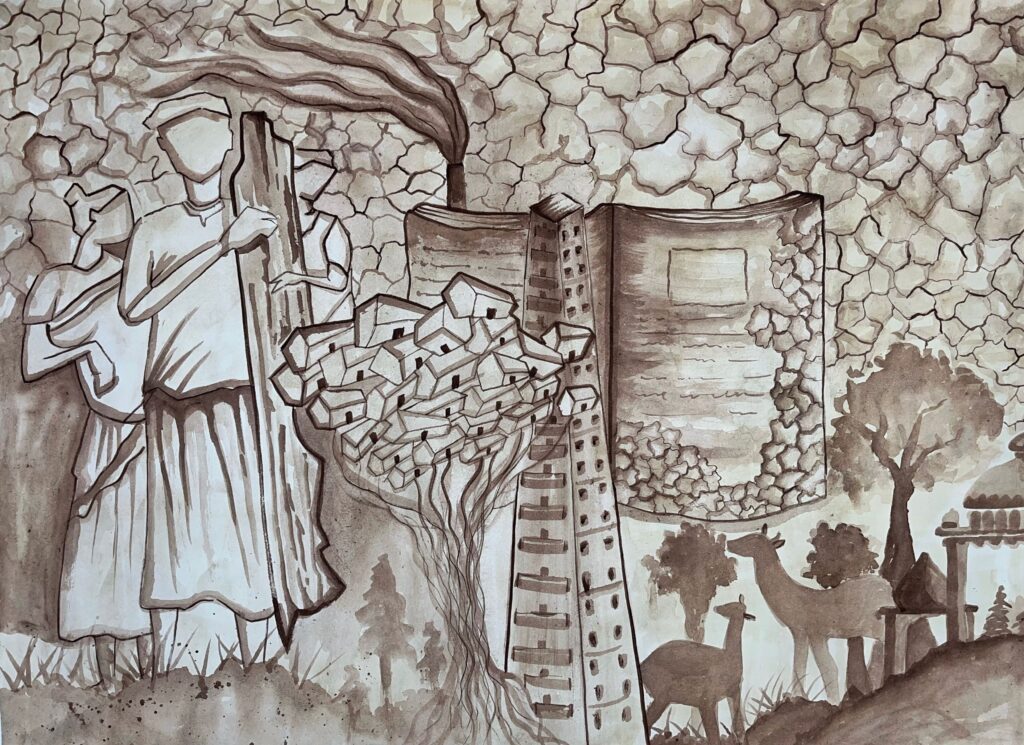
Uttam prajapat
ARID LANDSCAPE
When the ground cracks, even the sky turns to dry earth
The whole page is the brown of mud after the water has gone.
The sky has split into plates, like a field with no rain.
A woman holds a post of wood and does not look at the smoke.
Houses pile on a tree whose roots hang loose in the air.
Two deer stand at the edge, small, near a little shrine.
The book is open. Its last page is turning into ground.
Uttam Prajapat's work comes from his ties to Vatera village in the Sirohi district of Rajasthan. Mining in the Aravalli region is changing the land and the lives there. Prajapat does not draw the mines. He uses signs instead. Cracked ground fills the sky and a chimney sends up smoke. Houses crowd on a tree with bare roots. A tall block rises like a ladder. A book lies open as the cracks eat its page. Prajapat's college is Sir JJ School of Art, Architecture and Design in Mumbai.
Mixed media · 23.4 × 33.1 cm · 2025
Theme Mining and lost land
RC-501

Uttam prajapat
URBAN LADER
A barefoot man crosses the rooftops with one suitcase
Orange turban, red scarf, white cloth against a sky of storm blue.
Bare feet step on the tops of houses, green and ochre and rust.
The suitcase leans back, heavy with somewhere else.
A street lamp bends to look at it and pours down yellow light.
Below him, small dark windows keep their quiet.
He does not look down.
Uttam Prajapat paints a man in an orange turban and white clothes. He walks barefoot across the roofs of small coloured houses. He pulls a suitcase behind him. A street lamp bends down and lights it. The work grows from Vatera village in the Sirohi district of Rajasthan. There, mining in the Aravalli hills pushes people from their land. In this acrylic painting from 2024 Prajapat shows migration as a forced move. His college is Sir JJ School of Art, Architecture and Design in Mumbai.
Acrylic · 24 × 24 cm · 2024
Theme Forced migration from land
RC-502
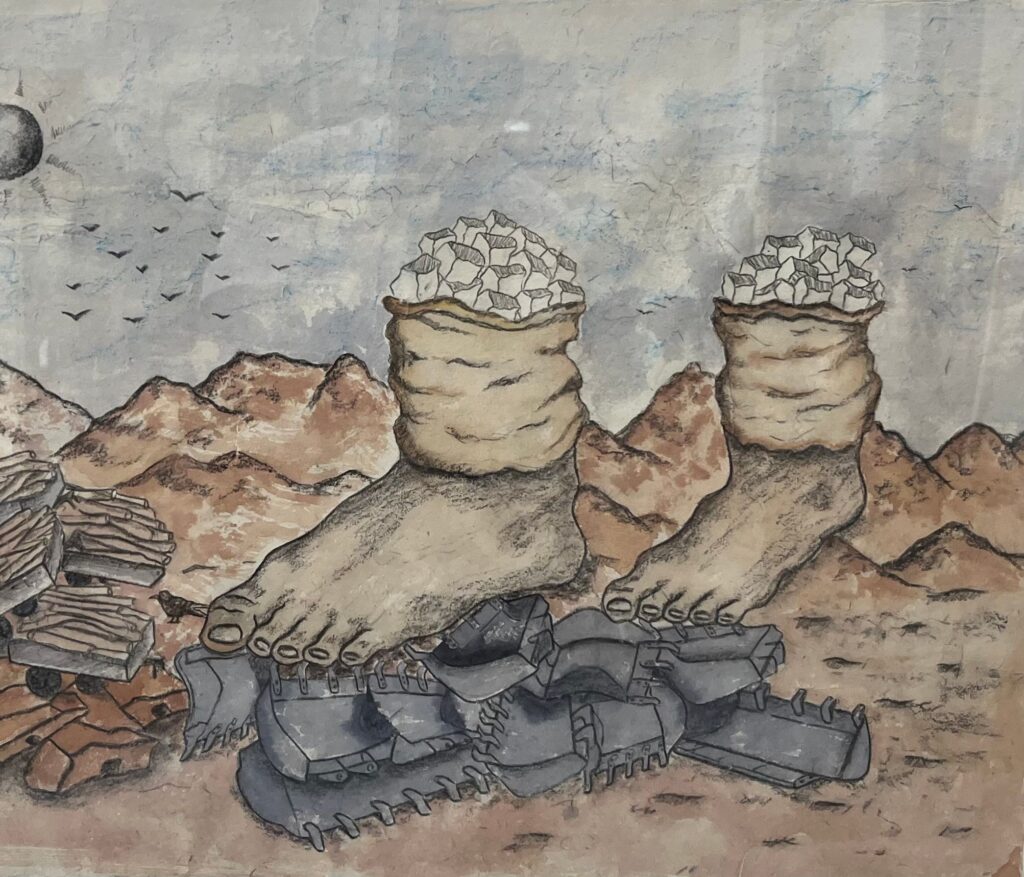
Uttam prajapat
SCARS OF EXTRACTION
Where the legs should be, there are only sacks of stone
Two bare feet, cracked and grey with dust, press down on iron teeth.
Where the legs should be, cloth sacks hold white stone.
The hills behind are the colour of old brick.
A dark sun hangs low. Birds leave in a thin line.
Near one toe a small bird waits, unsure where to stand.
At the edge, cut slabs ride away on wheels.
Uttam Prajapat's practice comes from his lived connection to Vatera village in the Sirohi district of Rajasthan. Mining in the Aravalli hills is changing the land and the lives of the people there. In this mixed media work two giant bare feet stand on a heap of digger buckets. Sacks of white stone sit where the legs should be. Prajapat does not show mining as it looks. He uses symbols instead. He studies at Sir JJ School of Art, Architecture and Design in Mumbai.
Mixed media · 22.28 × 31.2 cm · 2026
Theme Mining and lost land
RC-503
From the open call
Kamal Kishore
I strive to create unique, one-of-a-kind artworks, with the making process involving countless creative decisions from start to finish. I put my heart and soul into every detail, often working day and night for weeks to bring my vision to life. Because of the time, effort, and emotion I invest in each piece, I develop a deep personal connection with my artworks. I always try to blend multiple mediums in…


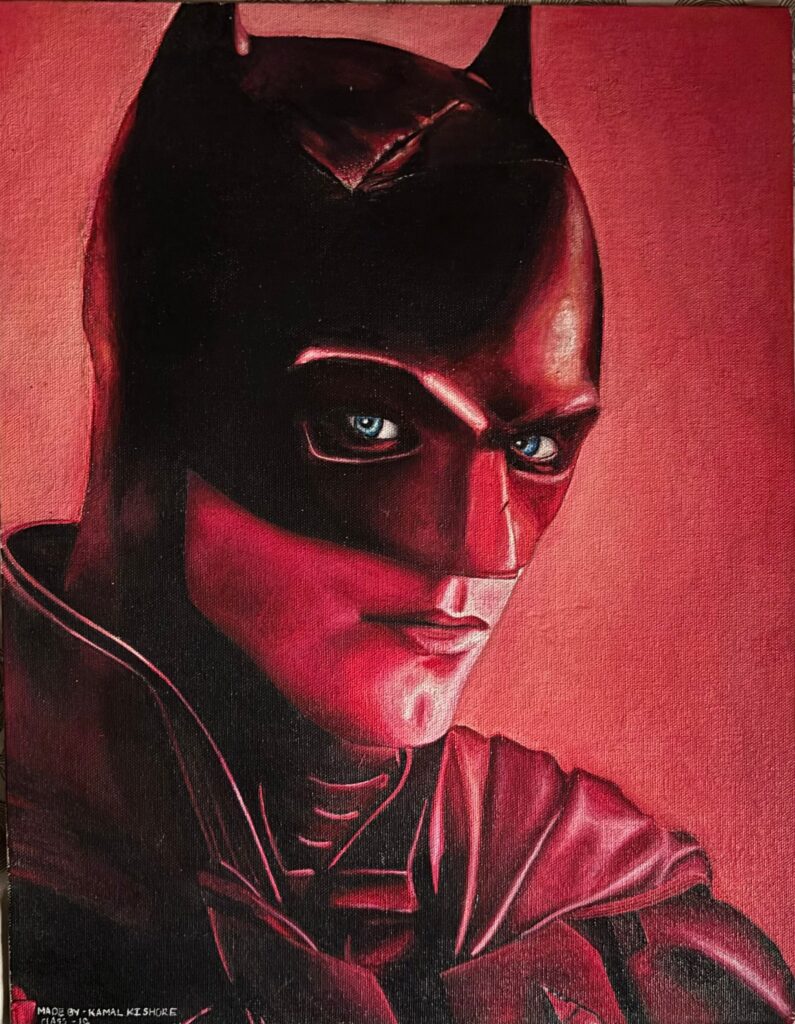
Kamal Kishore
Robert Pattionson’s Batman
One cold blue look out of a room full of red
Everything here is red: the wall, the mask, the cape.
Red going dark, like a stove at night.
Light finds the lip, the chin, the hard edge of the cowl.
Then two small blue eyes, the only cold thing in the room.
They look to the side, past us, waiting.
The weave of the cloth shows through, like breath under the paint.
Kamal Kishore paints Batman as played by Robert Pattinson. The work is from 2024. It is in acrylic and measures 42 × 30 × 0.5 cm. Almost the whole picture is red. Only the eyes are blue. Kishore studies at Deen Dayal Upadhyaya College. He is based in Nainital. He likes to turn comic-book heroes into realistic faces. He often works day and night for weeks on a single piece. Here that care shows in the soft light on the lips, the chin and the edge of the mask.
Acrylic · 42 × 30 × 0.5 cm · 2024
Theme Comic-book hero made real
RC-533
Kamal Kishore
Harley Quinn
Two colours of hair, two blue eyes, everything else in grey
Grey skin, built from a thousand soft strokes of charcoal.
Two eyes the blue of a gas flame.
One pigtail red as a fresh cut, the other cold as a swimming pool.
A thin silver rod rests on dark lips.
The word on her collar sits half in shadow.
She smiles as if she knows a secret about you.
Kamal Kishore, of Deen Dayal Upadhyaya College, draws Harley Quinn, the comic-book character, as a real face. Most of the drawing is charcoal and pencil in soft greys. Only a few parts carry colour: red hair on one side, blue hair on the other and two bright blue eyes. Kishore adds these with coloured pencils and acrylics. Kishore sees this mix of media as a strength of the work. Some pieces take months of planning, testing and detail.
Charcoal, pencil, coloured pencils and acrylics · 347 × 275 × 0.01 cm · 2025
Theme Comic characters made real
RC-534
Kamal Kishore
Logan
A face so close you can count the scars
Black so deep the paper seems to fall away.
Out of it a face leans close, grey skin folded like a dry riverbed.
Each whisker is a single grey stroke.
A cut on the cheek still looks wet.
The eyes hold you and do not let go.
At the edges, steel catches a thin cold light.
You step back before you know why.
Kamal Kishore draws comic-book heroes as if they were real people. In Logan he works in charcoal and pencil on a sheet of sketchbook paper. The face fills almost the whole page. Kishore builds the skin with tiny marks. Deep lines cross the forehead. A fresh cut opens on the cheek. Steel claws rise at the edges. He often works for weeks on one drawing. His college is Deen Dayal Upadhyaya College and he is based in Nainital. The drawing dates from 2024.
Charcoal and pencil on paper · 34.7 × 27.5 × 0.01 cm · 2024
Theme Comic heroes made real
RC-535

Kamal Kishore
The Weeknd blinded by the lights
A whole night of orange light caught in two dark lenses
Grey dust builds a face, one cheekbone at a time.
The hair rises like smoke that will not settle.
Two dark lenses hold a city at night, orange and burning.
Small white lights fall across them like rain on a windscreen.
The lips part as if a word is still coming.
A small stone at the ear keeps what little light is left.
Kamal Kishore draws the singer The Weeknd in charcoal and pencil. The head turns to the left under a high cloud of curly hair. Skin, suit and earring are all shades of grey. Only the sunglasses hold colour. Here Kishore uses acrylic. Orange and red fill the lenses with small white points of light. The artist often mixes several media in one work and can spend weeks on a piece by day and night. Kishore studies at Deen Dayal Upadhyaya College and is based in Nainital.
Charcoal and pencil with acrylic · 34.7 × 27.5 × 0.01 cm · 2025
Theme Fame behind dark glasses
RC-536
Kamal Kishore
Wonder Woman
Her stare holds still while a thousand dark curls move around it
Grey paper, a little creased at the edges.
She looks out and does not blink.
Her hair falls in a thousand dark threads, black on black.
The tiara holds a small star of white.
Light rests on her nose, her chin, her lower lip.
One curl escapes past the edge of the page, still moving.
Kamal Kishore draws Wonder Woman in charcoal and pencil on paper. Kishore likes to make comic-book heroes look real. Here she looks straight at us. Fine dark lines build every curl of her long hair. Soft shading gives her skin small marks and texture. The star on her tiara catches the light. The paper around her is left bare. Kishore often works day and night for weeks on one piece. The drawing is from 2023. Kishore is from Nainital.
Charcoal and pencil on paper · 34.7 × 27.5 × 0.01 cm · 2023
Theme Comic-book heroes made real
RC-537
Kamal Kishore
Superman
A hero drawn in grey, with eyes that have started to burn
Grey skin, drawn one grain at a time.
A dark curl falls across the brow.
Then the eyes: two coals, red at the edges, white at the centre.
Thin red lines run out like cracks in dry mud.
The mouth is almost a smile.
We do not know if he is about to save us.
Kamal Kishore is an artist from Nainital. His college is Deen Dayal Upadhyaya College. In this drawing from 2025 he shows Superman in charcoal and pencil. The face fills the frame and looks straight at us. Small marks build up every pore, hair and line of the brow. Only the eyes are in colour. They glow red and thin red veins spread across the skin around them. Kishore likes to make comic-book heroes look real. He often works day and night for weeks on one piece.
Charcoal and pencil · 34.7 × 27.5 × 0.01 cm · 2025
Theme A hero's darker side
RC-538

Kamal Kishore
Conquest from The Invincible
Scarred, bleeding and still coming straight at you
Grey hair stands up like smoke above a split brow.
One eye has gone white. The other still holds you.
Charcoal piles into shoulders, soft and dark as river stone.
A fist of metal plates catches the only hard light.
Red dust drifts across the chest and settles on the knuckles.
The cloth at the waist is torn. The knee is already lifting.
Kamal Kishore, of Nainital and Deen Dayal Upadhyaya College, draws comic-book characters as if they were real people. In this 2025 drawing the character is Conquest from The Invincible. Kishore builds the old fighter in charcoal and pencil on a sheet 34.7 × 27.5 cm. Every muscle is shaded slowly from dark to light. A metal gauntlet covers one fist. Fine red specks mark the face, chest, knee and hand. Kishore often works day and night for weeks on one piece.
Charcoal and pencil on paper · 34.7 × 27.5 × 0.01 cm · 2025
Theme Old age and brute strength
RC-539
From the open call
Zara Malik
I work with painting, photography, printmaking, installation, and found materials. A lot of my work starts from things I see or experience in everyday life memory, silence, identity, emotions, spirituality, and social realities. I often use materials like soil, dust, ash, coal, brick pieces, fabric, paper, and other found objects. I am interested in what these materials already carry their marks, textures, memories, and connection to a place. I like…


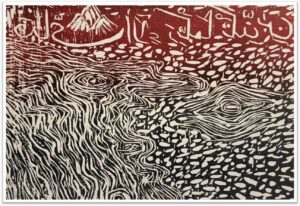
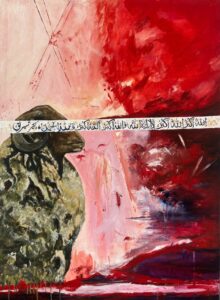

Zara Malik
Gaar-e-soor
A spider keeps watch while the horses run past
Sand you could lift with your fingers, raked into soft rows.
A crust of broken brick, the colour of old roofs.
The sky is burnt honey, scratched with thin white threads.
Two horses hurry under a net they do not see.
The spider is larger than the hills and very still.
At the corner, a deep red waits at the edge of the sand.
Zara Malik of Aligarh Muslim University makes Gaar-e-soor in 2025. Real sand covers the lower part of the work. A line of brick-red crumbs runs along its edge. Above it she paints a brown desert with dark hills. Two horses run under a web. A large spider stands guard on the right. Malik often works with soil, dust and brick pieces. She says ideas from Islamic texts sometimes start her work. She uses them to think about protection and compassion.
Mixed media · 2025
Theme Shelter in the desert
RC-452

Zara Malik
Untitled
A whole landscape pricked into paper, one hole at a time
Cream paper, soft as an old letter.
A needle goes in and out. Each small wound lets in the light.
Rings open from the middle like water after a stone.
Hills drift on the left, quiet as breath.
A hand comes up from the right, fingers spread, made only of holes.
You could read it with your fingertips.
Zara Malik makes this work with a needle on cartridge paper. The paper stays plain. Every line is a row of small holes. In the centre, rings spread out like a fingerprint or the rings of a tree. Wavy lines on the left look like a map of hills. On the right, a hand reaches up beside bands of dots. Malik is an artist from Aligarh Muslim University. Her work often begins with memory and silence.
Needle work on cartridge paper · 2024
Theme Memory, silence and touch
RC-453

Zara Malik
Mujiza
Every white line here is wood the artist cut away
Red sits at the top like late heat over a hill.
Letters lean along the edge of the block.
Below, the wood breaks into water that cannot settle.
Two whirlpools turn, slow as eyes opening.
Stones gather on the right, white and close together.
Everything the knife took away is now the light.
Mujiza is a woodcut print from 2024 by Zara Malik, an artist from Aligarh Muslim University in Aligarh. In a woodcut, every white mark is a place where wood is cut away. Here the cuts make lettering, a small mountain, lines that move like water and a field of pebble shapes. The ink moves from deep red at the top to black below. Malik sometimes starts from ideas in Islamic texts, 'not as a way of explaining religion, but as a way to think about compassion'.
Woodcut print · 2024
Theme Script and landscape
RC-454

Zara Malik
Qurbaani (A story of Ibrahim A.S)
A ram stands still as the red rises behind it
Wool the colour of dry leaves and river mud.
A curled horn, heavy as a closed door.
Behind it, red climbs the wall like heat from an oven.
A pale band crosses the eye, full of words of praise.
Paint drips from the fleece to the floor.
The ram does not turn. It only waits.
Zara Malik comes from Aligarh Muslim University in Aligarh. In this acrylic painting from 2024, a ram stands on the left in olive and brown. Red fills the rest of the picture and runs down in thin drips. A pale band of Arabic writing crosses the whole work and covers the ram's eye. The words close with "Takbir Tashreeq". Malik often starts from Islamic texts. The texts become a way to think about compassion, responsibility and protection. They are not there to explain religion.
Acrylic · 2024
Theme Sacrifice and faith
RC-455
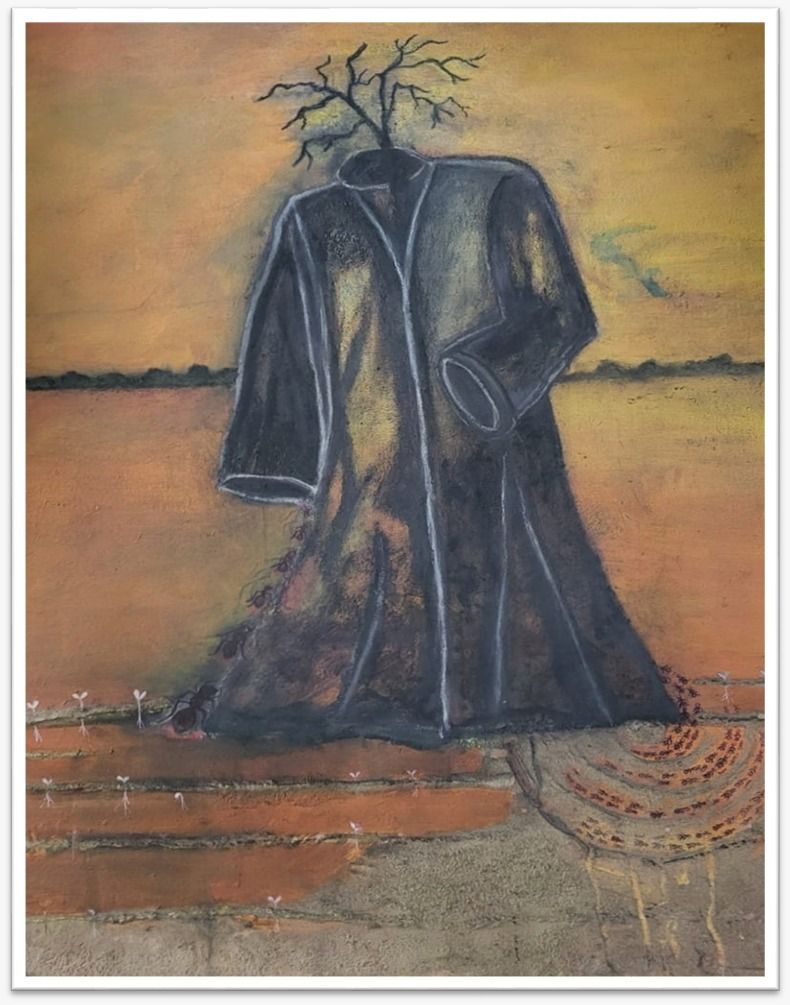
Zara Malik
Before you know me
No body in the coat. Only branches where a face should be
An ochre sky, warm as a brick left in the sun.
A dark coat stands up on its own and waits.
Where the face should be, a small dry tree.
Ants climb the hem in a slow red line.
Near its feet they turn in rings, like ripples in mud.
White seeds open in the furrows.
Nobody has come to wear it yet.
In Before you know me an empty coat stands in a ploughed field. Bare branches grow where a head should be. Ants climb its hem and circle the ground beside it. Zara Malik of Aligarh Muslim University makes this mixed media work in 2025. Malik often works with soil, dust, ash and fabric. The artist builds a surface by layering and covering. Here the coat and the field feel rough like earth. Malik says: "Many of my works come from questions rather than clear answers."
Mixed media · 2025
Theme Identity and absence
RC-456
From the open call
Boini Madhusudan
My practice investigates the internal conflict between performative identity and the authentic self, drawing inspiration from the visual language and live intensity of Veedhi Bhagavatham (traditional street theatre). Performed in temporary tent structures, these plays create a unique relationship between the landscape and the community, blurring the boundaries of reality. I assemble and stitch layered tent cloth into symbolic forms, translating theatrical drama, movement, and gestures into physical artifacts. The…


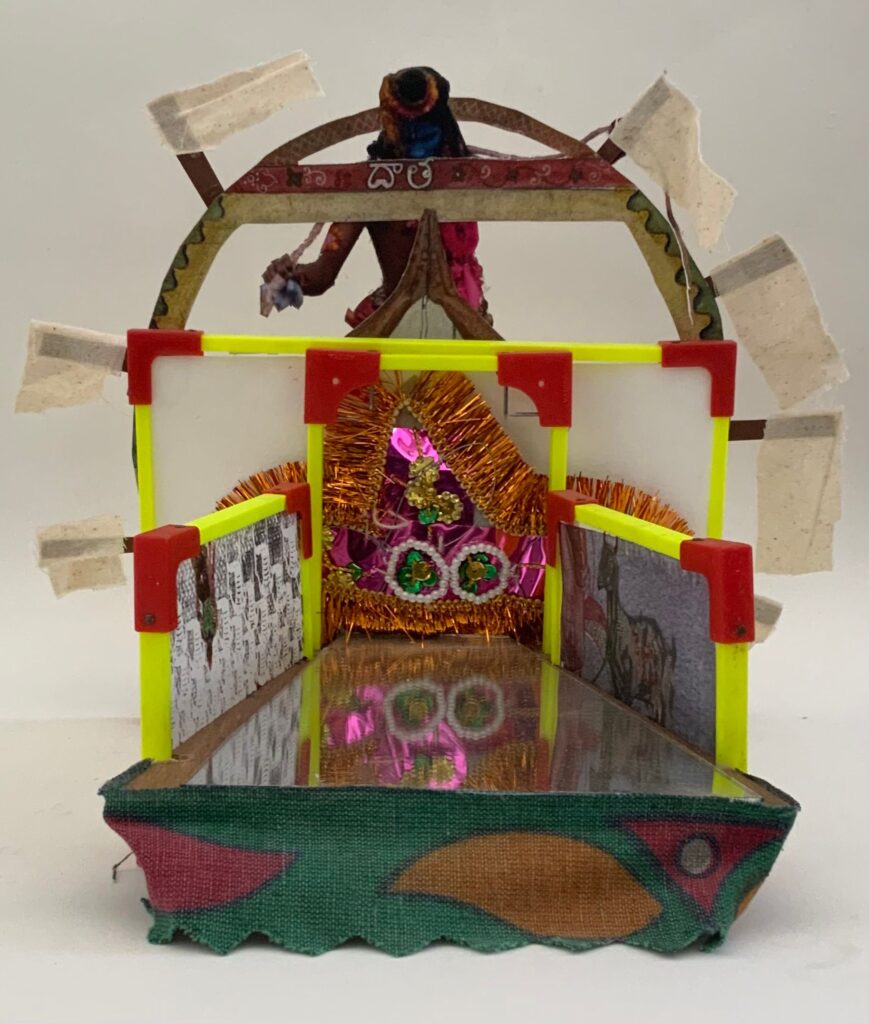
Boini Madhusudan
Rangasthalam
A whole street theatre, small enough to hold in two hands
Orange tinsel curls like a flame that will not go out.
Pink foil holds two beaded moons.
The mirror floor repeats them, so the stage has a second stage beneath it.
Scraps of tent cloth lift from the arch like hands waving after the show.
Behind it all a figure waits, half hidden.
The green cloth hem is cut in teeth, ready to be packed and carried on.
Boini Madhusudan makes Rangasthalam as a small stage, only 15 × 12 × 11 cm. It draws on Veedhi Bhagavatham, a street theatre played in temporary tents. Madhusudan stitches and layers tent cloth into his forms. Here torn strips of cloth hang from an arch like flags. A mirror floor doubles the pink and gold centre at the back. For him the tent is a stage and a landscape. It keeps the memory of a show. It also keeps the masks performers wear on stage and in daily life.
Mixed media and watercolour · 15 × 12 × 11 cm · 2025
Theme Mask and inner self
RC-437

Boini Madhusudan
Who playing
Two empty chairs face a stage no one has stepped onto yet
Dusk the colour of wet slate settles on the dry field.
Two lamps on thin poles throw white light onto a small red stage.
No one is dancing there yet.
Below, two plastic chairs wait beside a dropped microphone.
The ground is cracked like old paint.
Far off, other tents stand on other hills of earth.
Someone will come. Someone will play. Someone decides who.
Boini Madhusudan studies at SN School of Arts and Communication in Hyderabad. Boini's work comes from Veedhi Bhagavatham, a traditional street theatre performed in temporary tents. In this gouache from 2025 the stage sits empty on a mound of earth. Two lights cross above it. Two plastic chairs and a microphone wait below. Words in Telugu ask who makes others play and who plays. Boini wants to show how the roles people play can cover who they really are.
Gouache on paper · 42 × 59 cm · 2025
Theme Performance and the hidden self
RC-438
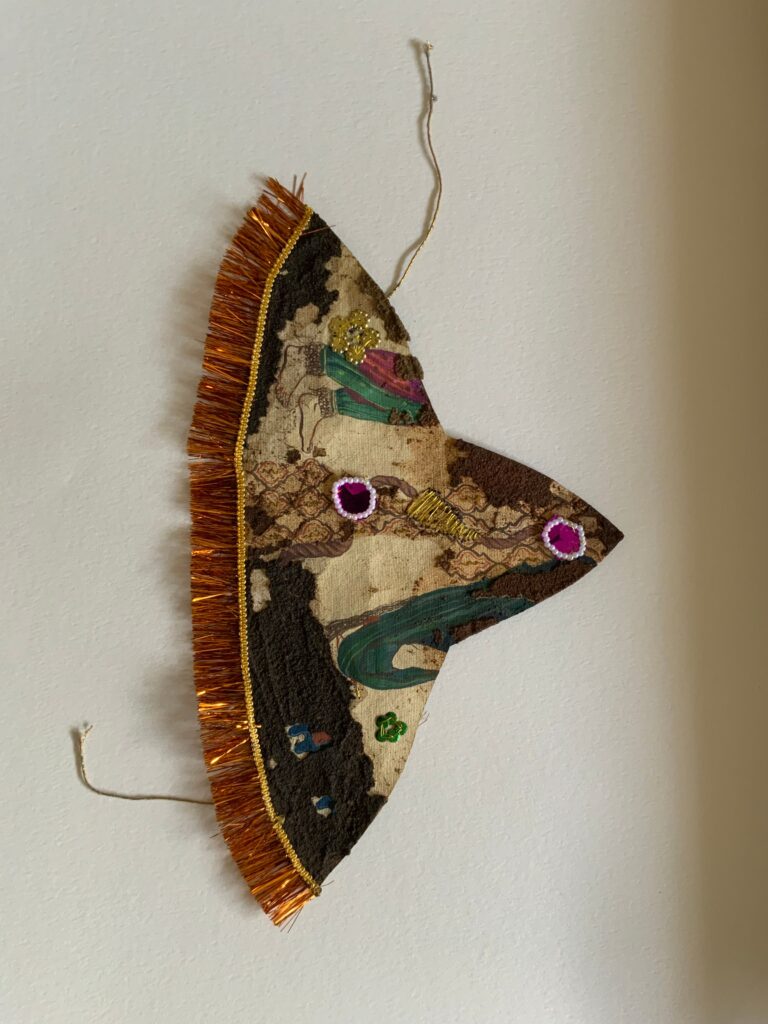
Boini Madhusudan
Alaveni
A stage tent remembers every face that hid inside it
Tea-coloured cloth, stained the way rain stains a tent roof.
A copper fringe catches the light like a lamp left burning after the show.
Two pink eyes sit in rings of white beads and do not blink.
A dancer in green and pink turns at the edge of a brown field.
Gold thread pulls the seams tight.
Somewhere under the paint a face is still breathing.
Boini Madhusudan studies at SN School of Arts and Communication in Hyderabad. The work begins with Veedhi Bhagavatham, a street theatre performed in temporary tents. Madhusudan layers and stitches tent cloth into symbolic forms. Alaveni dates from 2025. Its stained cloth carries a copper fringe, gold thread, beads and a painted figure in green and pink. For the artist the cloth is an archive of the performance. It holds the tension between the character a performer shows and the self kept hidden.
Mixed media · 22 × 38 cm · 2025
Theme Performance and hidden self
RC-439
From the open call
Maitrey Ayare
I mostly enjoy hand-drawn and traditional artwork, especially working with paper and pencil. I believe every idea begins with a rough sketch on paper before it becomes something more refined. For me, art is not about creating something perfect or technically flawless. My drawings may have imperfections, but I don’t try to hide them because I believe those imperfections are part of my artistic expression. Through my drawings, I try…

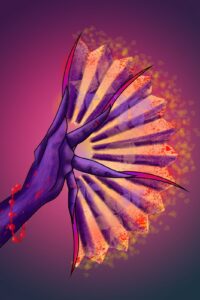
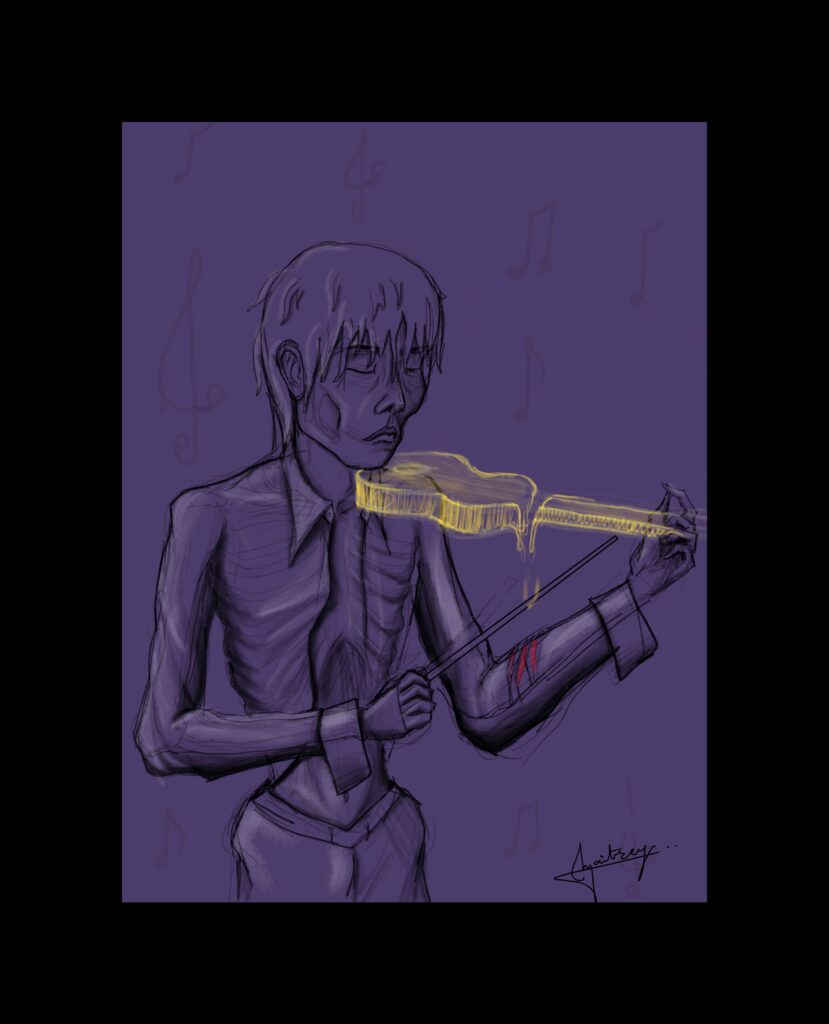
Maitrey Ayare
The violinist
The only warm thing in the room is the music
Everything here is the colour of a late bruise.
The shirt, the ribs, the hollow cheek, all one purple.
Then the violin, gold and soft, melting at the edges like wax near a lamp.
The eyes are shut. The bow is a single dark line.
On the forearm, three red marks the music does not mention.
Notes float in the dark, faint as breath on glass.
Maitrey Ayare of Chiplun studies at the School of Fine Arts and Applied Arts, MIT-ADT. Ayare loves paper and pencil and believes every idea begins as a rough sketch. The violinist is a digital work but the sketch stays alive in it. The lines are loose and easy to see. A thin player stands on a purple ground with closed eyes. Only the violin glows gold. Ayare does not hide imperfections. They are part of the way this artist speaks.
Digital drawing · 60.9 × 45.7 cm · 2026
Theme Music and private pain
RC-472

Maitrey Ayare
Shan
A violet hand opens a fan made of light
A violet hand pulls the fan wide.
Each fold holds a strip of orange heat.
Red specks sit on the paper like sparks that never went out.
Gold flakes drift off the edge into the dark.
The nails curve longer than the fingers.
A string of red beads hangs loose at the wrist.
The sky is plum at the top and night below.
Shan is a digital work by Maitrey Ayare, who comes from Chiplun and studies at the School of Fine Arts and Applied Arts, MIT-ADT. Ayare mostly enjoys drawing with paper and pencil and believes "every idea begins with a rough sketch on paper." Here the work lives on screen. A purple hand spreads a folded fan that glows orange and gold. Ayare does not try to hide small flaws. For this artist, "those imperfections are part of my artistic expression."
Digital · 42 × 29.7 cm · 2026
Theme Gesture and inner light
RC-473
From the open call
Purabi Roy
CONCEPT NOTE I am Purabi Roy from west Bengal. I completed my BFA from Rabindra Bharati University in 2024 . My practicing area is the middleclass community with social things . In this current scenario socity is changing through digitalization , capitalism and machines etc . We can see the human labour replaced by robotic machines or techy peoples . Many peoples are forced to change their profession and I…


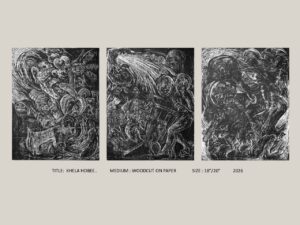

Purabi Roy
BY THE FOOD , OF THE FOOD FOR THE FOOD
Three bodies bend under the weight of what feeds them
Turquoise spills down from the top of the paper.
An old face opens its mouth above a wide pot ringed with letters.
In the middle panel, red curls rise like flowers or like fire.
A bare foot presses into blue.
On the right, a body squats and grips a stick under a long green weight.
The ink sits deep in the grain of the wood, black and patient.
Purabi Roy sets three wood intaglio prints side by side. She comes from a family of weavers in West Bengal. Automatic machines took most of that work and her family turned to other jobs. Roy sees the same change in small grocery shops, pedal rickshaws and cloth stores. Her subject is the middle class, who keep living and keep celebrating. In these prints, figures crouch and strain under heavy shapes of red and turquoise. The title echoes a famous line about democracy.
Wood intaglio on paper · 30 × 40 cm · 2026
Theme Work, food and survival
RC-504
Purabi Roy
BE CAREFULL ! ACCIDENT PRONE AREA
A pink helmet, a toy car and nowhere safe to drive
Teal water or night holds a pale figure that will not settle.
An orange hand reaches down through a crowd of grinning moons.
Red letters sink into the blue like old shop signs after rain.
Next door the air turns to rust.
Someone in a pink helmet grips a green wheel and leans in.
The little car wears a yellow flame it has not earned yet.
Purabi Roy's family were weavers in West Bengal until computerised machines took the work. Roy completed her BFA at Rabindra Bharati University in 2024. In one panel a figure in a pink helmet steers an orange car. In the other, grinning faces and red lettering crowd a teal ground. She works in pastel and pencil over acrylic. Her subject is a middle class whose small traders 'don’t even have the voice to talk about their problems.'
Mixed media on paper · 71 × 55 cm · 2026
Theme Small lives, fast change
RC-505
Purabi Roy
KHELA HOBEE..
15 minutes to your door, cut into wood by hand
Black ground, white cuts, like scratches on a shop shutter at night.
Faces press together until there is no room left to stand.
A cart tips forward on small wheels and someone keeps pushing.
A sign promises fifteen minutes.
Light falls in a hard white rush from one corner.
Every line is a gouge in wood that cannot be taken back.
Purabi Roy comes from a weaving family in West Bengal. Automatic machines took over the looms and her family had to find other work. This woodcut in three panels looks at that kind of change. Faces crowd every print. A sign in the first panel reads "15 MINUTES". In the middle panel a figure pushes a heavy cart. Roy usually works in pencil pastels and charcoal. Here she cuts each white line into wood and prints it in black ink on paper.
Woodcut on paper · 50 × 45 cm · 2026
Theme Work lost to machines
RC-506
From the open call
DEEPAK KUMAR RAI
My practice interrogates how things Disappers, who defines it and why this space becomes visible only when it is threatened or disappearing between rural origins and urban existence, treating the artwork as a site of friction and documenting space with my lens. Working across painting, drawing, watercolor, mixed media, and printmaking, I construct surfaces that register the erosion of identity and the persistence of ritual. Rather than illustrating a specific…



DEEPAK KUMAR RAI
Jaatra
Home, carried in a bucket and scratched into the metal
Copper buckets glow like small lamps against a black cloth.
Grey ones keep the dull shine of a courtyard tap.
Little cups wait beside them for water that does not come.
A needle has walked across every side.
Dry leaves gather at the feet of the white plinths.
Nothing here is empty. Each one is heavy with a house.
Deepak Kumar Rai makes Jaatra from metal buckets and small cups. He scratches their sides with a needle. Then he works the surface with nitric acid and ink. For Rai the bucket holds the blessing of home that he carries with him. The rough marks stand for the wear of moving between a rural birthplace and city life. Here the copper and grey buckets sit on white plinths of different heights. A dark cloth hangs behind them. Dry leaves lie on the ground.
Needle scratching, nitric acid and ink on metal buckets · 2026
Theme Home, memory and displacement
RC-440

DEEPAK KUMAR RAI
Jaatara I
A metal bucket full of blue water, flowers and memory
A grey tin bucket holds more water than it can.
The blue turns in slow rings under red hibiscus and yellow petals.
The wall is rough as dried mud. The moon is a small white button.
One palm leans into the night.
She looks out from her yellow cloth with a purple knot at her throat.
She does not smile. She is keeping something.
Deepak Kumar Rai works in New Delhi. In Jaatara I he paints a large metal bucket filled to the top with swirling blue water. Red hibiscus and yellow flowers float on it. Beside it is an older woman in a yellow sari and purple scarf. Rai uses wood dust and gum to build a rough skin of earth and wall. For him the bucket is the blessing of home that he carries with him. The woman carries ritual forward.
Oil, acrylic, wood dust, gum and oil pastel · 48 × 48 cm · 2025
Theme Home, memory and ritual
RC-441

DEEPAK KUMAR RAI
Jaatra III
The blessing of home, held in an aluminium bucket
A yellow field, rough as spice ground by hand.
One grey bucket stands in it, cut from thin metal.
Inside, a circle of blue water holds small yellow flecks.
Its shadow falls to the left, the colour of rust.
The old frame is worn grey, the wood showing through.
You could lift it by the handle and walk home.
Deepak Kumar Rai makes this small work from wood dust on paper and a sheet of aluminium. A bright yellow ground of wood dust fills the picture. On it stands one metal bucket filled with blue water. For Rai, the bucket holds the blessing of home, which he carries with him. His work looks at how life changes between village and city. He chooses materials tied to the rural economy and to auspicious things. The picture is just 15.2 × 9.5 cm.
Mixed media: wood dust on paper and aluminium sheet · 15.2 × 9.5 cm · 2025
Theme Home, memory and change
RC-443
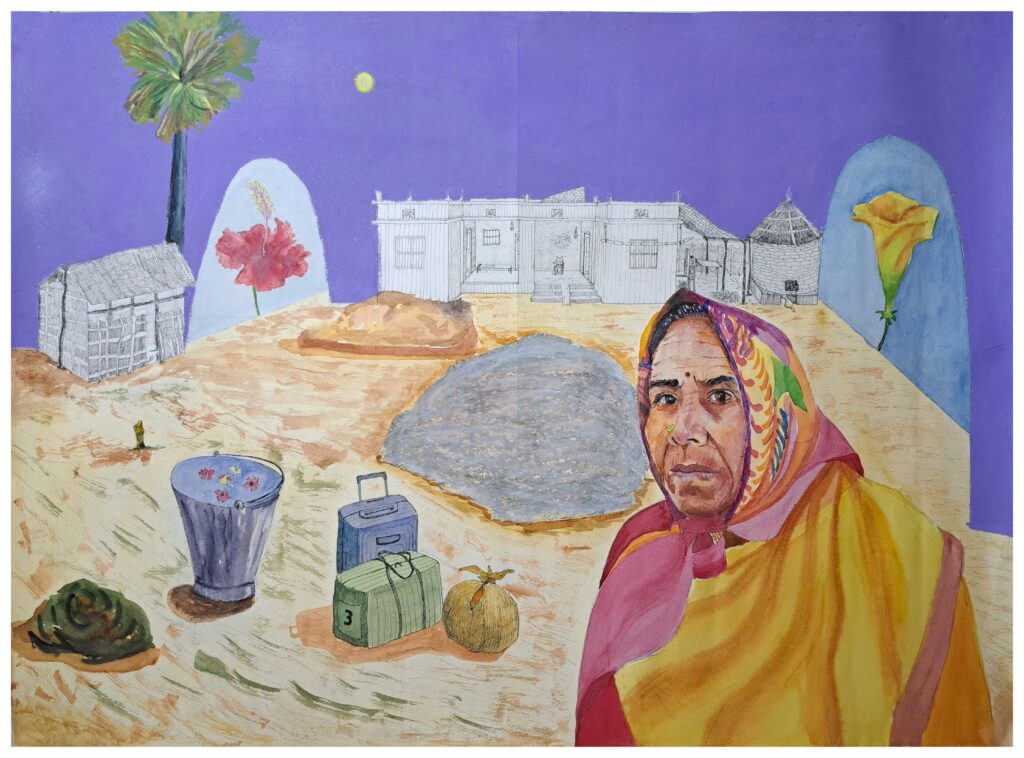
DEEPAK KUMAR RAI
Delhi
Two suitcases, a bucket of flowers and a whole village behind them
Purple sky, a small pale moon, one palm tree.
The village is only ink lines now, white as unfired clay.
On the sand: a tin bucket with red petals, a suitcase tagged 3.
A bundle tied at the top like a closed mouth.
She stands in turmeric yellow and pink, close enough to touch.
Her eyes stay on us. The houses stay behind her.
In Delhi, Deepak Kumar Rai paints what a family carries from the village to the city. Two suitcases and a cloth bundle wait on open sand. A metal bucket holds floating red flowers. For Rai, the bucket is "the Blessing of home which I carry along with me." Behind them, village houses are drawn in fine pen and ink and left almost white. In front stands a matriarch in a yellow sari. Rai made the work in 2024. He is from the College of Art, New Delhi.
Mixed media: watercolour, pen and ink and soft pastels · 30 × 36 cm · 2024
Theme Village memory and migration
RC-444
From the open call
Aakansha Gupta
My practice bridges historical object analysis with personal memory, using sculpture to explore how natural disasters permanently alter our relationship with domestic life. Grounded in my childhood experience of a flood in Kishanganj, Bihar, my work examines the sudden displacement of safety through the eyes of a child. As an art historian, I am interested in the concept of materiality how the physical properties of a medium dictate its meaning.…
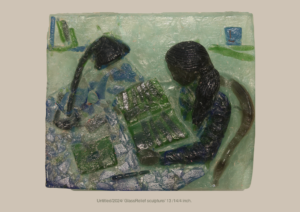
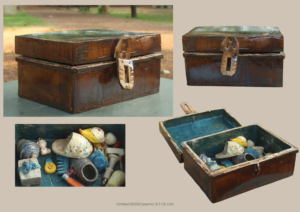
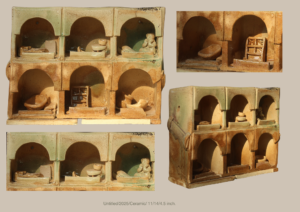


Aakansha Gupta
Untitled
A lamp bends low over a girl lost in her book
Sea green light settles over the desk.
A black lamp leans in like a heron at the water.
The girl's hair falls in one dark rope down her back.
Her book is green as a rice field after rain.
Blue chips gather at the table's edge and shine.
She does not look up. She keeps reading.
Aakansha Gupta studies at Visva Bharati University. She comes from Kishanganj in Bihar. As a child she lived through a flood there. Her sculptures look at how such a disaster changes life at home. In this work a girl with a long ponytail bends over an open green book. A dark desk lamp curves above her. A pen rests on the table. Gupta sets firm clay beside glass. The clay holds still. The glass breaks the light the way water does.
Glazed ceramic · 35.56 × 25.4 × 17.78 cm · 2026
Theme Home, childhood and memory
RC-457

Aakansha Gupta
Box of curiosity
A child's flooded trunk, its toys fired so they cannot drown
A trunk the colour of strong tea, still shining as if just pulled from the water.
The latch hangs loose and pale at the front.
Inside, the lining is the blue of a deep pond.
A yellow duck. A blue comb. A parcel tied with ribbon.
Each one heavy now, each one fired hard.
Nothing in this box will float away again.
Aakansha Gupta lived through a flood in Kishanganj, Bihar, as a child. Box of curiosity returns to that time. It is a small trunk made in glazed ceramic and wire. The brown surface shines as if it is still wet. Open the lid and the inside is teal blue. It holds a yellow duck, a blue comb, a parcel tied with ribbon and other small things. Water ruins such objects quickly. Gupta fires them hard in clay so they last. Her glazes hold the colour of mud and silt.
Glazed ceramic and wire · 35.56 × 27.94 × 20.32 cm · 2026
Theme Flood, childhood and memory
RC-458

Aakansha Gupta
Basera
Six small rooms, each holding what the water left behind
Green settles on the roof like still water.
Below it the walls turn the brown of a riverbank after rain.
A mattress folds in on itself. A chair stands empty.
In one room a small child holds its face in both hands.
The light reaches only halfway into each arch.
Everything here has gone hard, as if the flood stopped and stayed.
Aakansha Gupta builds a small house with six arched rooms in two rows. Each room holds one object: a folded mattress, a stack of bowls, a chair, a round basin and a small seated child. As a child in Kishanganj, Bihar, Gupta lived through a flood. Here she makes soft, easily ruined things in high-fired clay so that they become permanent. The glaze runs from pale green at the top to brown and ochre below. For Gupta, these colours carry the weight of mud and silt.
Glazed ceramic · 11.43 × 27.94 × 27.94 cm · 2026
Theme Flood and childhood home
RC-459
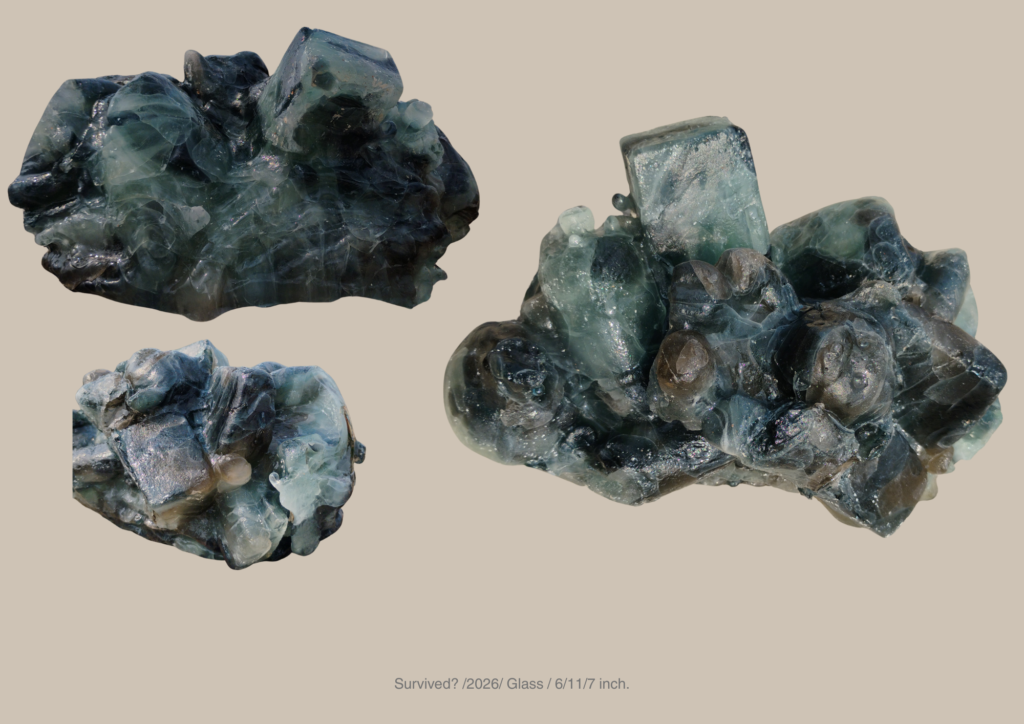
Aakansha Gupta
Survived??
A flood held still in green and smoky glass
A pond stopped in the middle of a thought.
Smoky brown stones sit inside green water that will not move.
One square block climbs to the top and stays there, like a box kept dry.
Small beads of glass cling to its side.
Light goes in and comes back grey.
Everything the water touched is still here, only heavier.
Aakansha Gupta comes from Kishanganj in Bihar. As a child, Gupta lived through a flood there. The sculptures in this series ask how one disaster can break the comfort of daily life for good. In this series, high-fired clay usually holds things still. Glass brings the other side: fragile, broken and see-through like water. Survived?? is made only of glass. Blue-green, grey and smoky brown lumps press together. One pale square block stands on top.
Glass · 17.78 × 27.94 × 15.24 cm · 2026
Theme Flood and childhood memory
RC-460
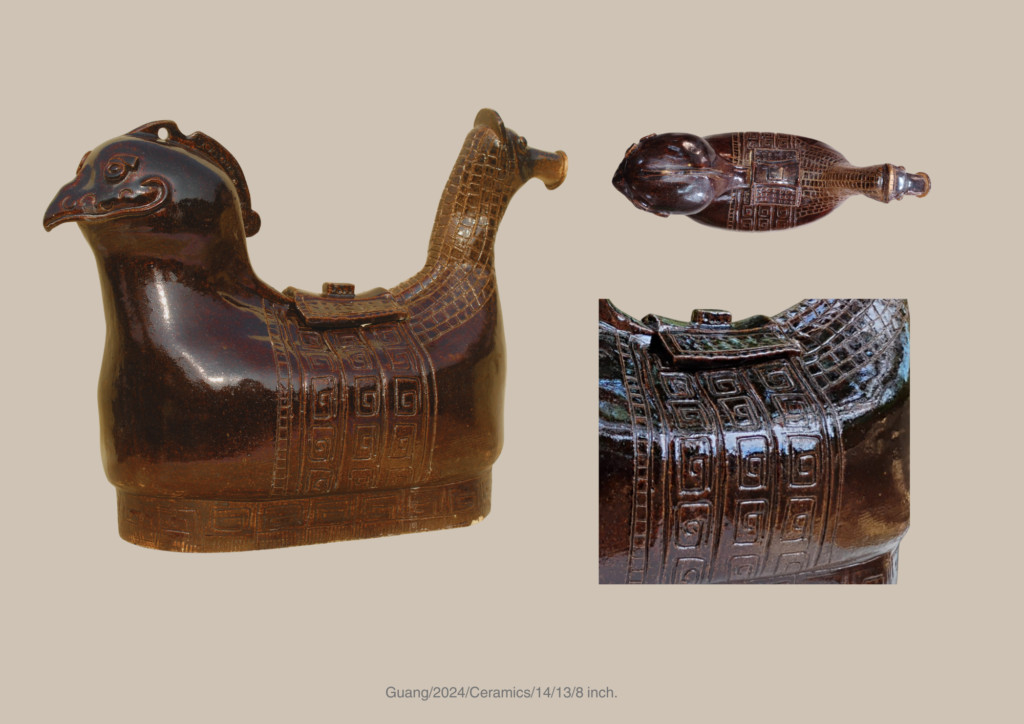
Aakansha Gupta
Guang
A bird with a second neck rising from its back
Brown glaze pools like river water left standing in a room.
A bird lifts its hooked beak and does not fly.
Behind it a second neck climbs, scaled in tiny squares.
Spirals turn and turn, sharp at every corner.
Light slides off the shoulder and turns gold at the edges.
Something soft has been made to stay.
Aakansha Gupta makes Guang in ceramic under a deep brown glaze. A bird's head with a curled crest sits at one end. At the other end a long neck rises to a small open mouth. Bands of square spirals run down the sides and around the base. A grid of small squares covers the neck like scales. A lid sits on its back. Gupta, of Visva Bharati University, grounds her work in a childhood flood in Kishanganj. She uses glaze to hold the weight of mud and silt.
Glazed ceramic · 20.32 × 33.02 × 35.56 cm · 2024
Theme Memory held in clay
RC-461
From the open call
Kotha Revanth
I am trying to explore my connection with the Naikpod tribal community and express our culture, traditions, memories, and relationship with nature through my art. I grew up surrounded by rivers, trees, animals, birds, and the natural environment of my village, and these experiences continue to influence the way I see and create art. My work is also inspired by traditional festivals and community practices such as Laxmi Devara and…


Kotha Revanth
Abandoned
Leaves are already climbing through the back wheel
Coffee settles into the ground like late afternoon.
Black ink knots the fence one diamond at a time.
The saddle still holds the shape of someone.
A coiled lock hangs there, guarding nothing.
Leaves push through the spokes and do not ask.
The front tyre has gone soft on the dirt.
In Abandoned (2025), Kotha Revanth begins with a coffee wash for the background. Then he draws the bicycle and every other detail in black pen. An old bicycle leans on a wire fence. Its seat is worn and a coiled lock hangs below it. Leaves grow up through the back wheel. Behind the fence dark trees and a tiled roof sit in shadow. Kotha uses pen for fine lines. Here many small marks build the wire, the spokes and each leaf. The work measures 40.64 × 55.88 cm.
Coffee wash and black pen · 40.64 × 55.88 cm · 2025
Theme Things left behind
RC-518

Kotha Revanth
Pothuraju
A childhood festival mask, painted to stare straight back at you
A red face fills the square like a held breath.
The eyes are two white moons with black wells at their centre.
A moustache curls up at both ends, a smile saved for the crowd.
Small grey leaves climb the cap in rows.
At the throat a yellow band, beaded white, holds the head still.
Around it the cream ground waits for the festival to begin.
Kotha Revanth paints Pothuraju as one large mask on a pale square ground. Kotha comes from the Naikpod community in Mulugu district. The artist remembers making masks as a child for festivals such as Laxmi Devara and Pothuraju. Here the face is a deep red. Thick black brows and a curled moustache frame wide white eyes. Fine lines mark the lashes and the leaf pattern on the cap. Kotha builds acrylic in layers. The aim is to reinterpret the old form, not copy it.
Acrylic · 46 × 46 cm · 2026
Theme Naikpod memory and ritual
RC-519
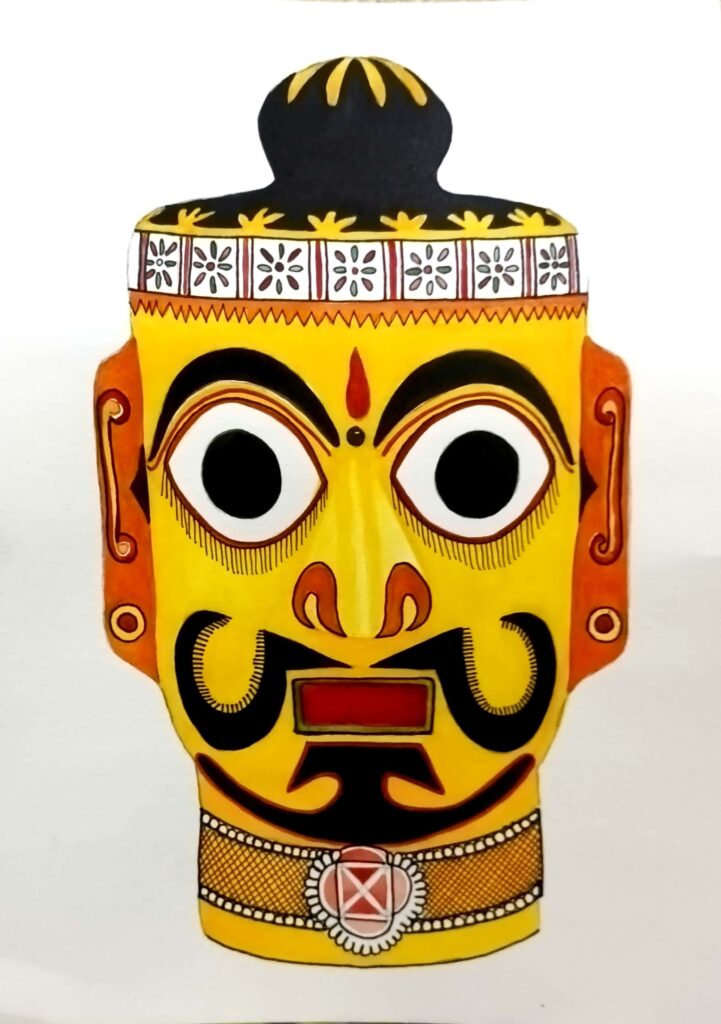
Kotha Revanth
Singaboyadu
Round eyes and a black moustache, remembered from childhood festivals
Turmeric yellow fills the whole face.
Two white eyes hold their black centres and do not look away.
The moustache curls up like a river bend drawn in ink.
A red mouth stays closed, a small square door.
Tiny flowers march around the headband.
Orange ears listen for drums we cannot hear.
Kotha Revanth belongs to the Naikpod tribal community. He comes from Mulugu district. His village is full of rivers, trees, birds and animals. As a child he makes masks for festivals such as Laxmi Devara and Pothuraju. In Singaboyadu he paints a mask in watercolour on a small sheet. A yellow face stares out with round eyes, a red mouth and a curling black moustache. He does not copy the old forms. He gives them a new shape in his own visual language.
Watercolour on paper · 29.7 × 21 cm · 2026
Theme Ritual masks and memory
RC-520
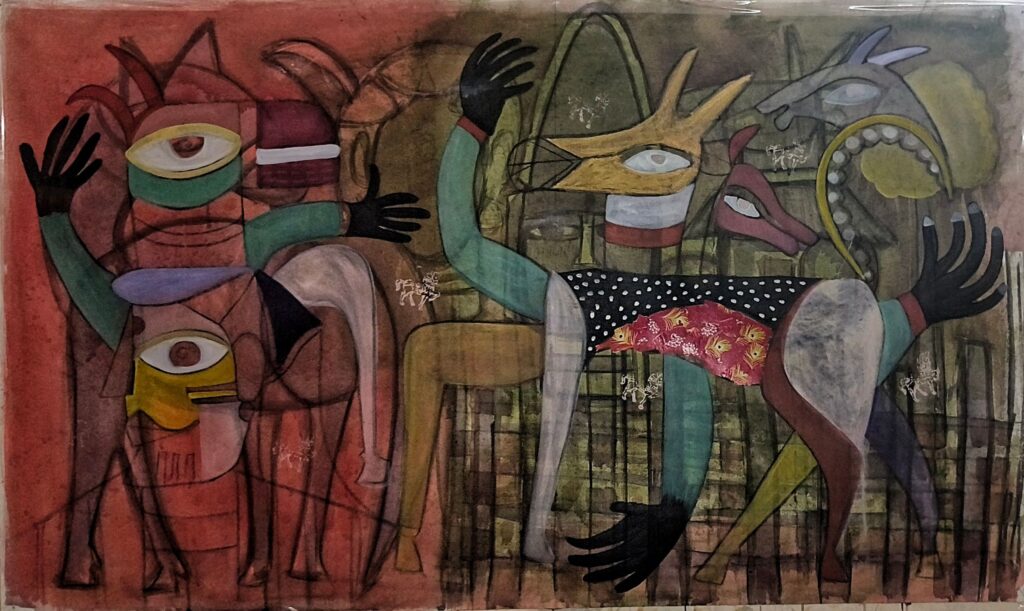
Kotha Revanth
Untitled
Childhood festival masks return with wide eyes and black hands
Rust red on one side, river green on the other.
A single eye opens in a mask and does not blink.
Black hands lift as if a drum has started.
A horned head leans in, teeth set like a string of beads.
Red paper with peacock feathers rides on a moving body.
Charcoal lines run under everything, like roots under a field.
Kotha Revanth grew up in a village in Mulugu district among rivers, trees and animals. The artist belongs to the Naikpod tribal community. In childhood, Kotha made masks for festivals such as Laxmi Devara and Pothuraju. Those memories shape this work. Masked figures with one wide eye stand beside horned animal heads. Kotha builds the surface with layers of acrylic wash. Charcoal adds rough lines. Pasted decorative paper adds texture and depth. The aim is not to copy old forms but to give them a new, personal language.
Acrylic washes, charcoal and pasted decorative paper · 152.4 × 91.44 cm · 2026
Theme Festival masks and memory
RC-521
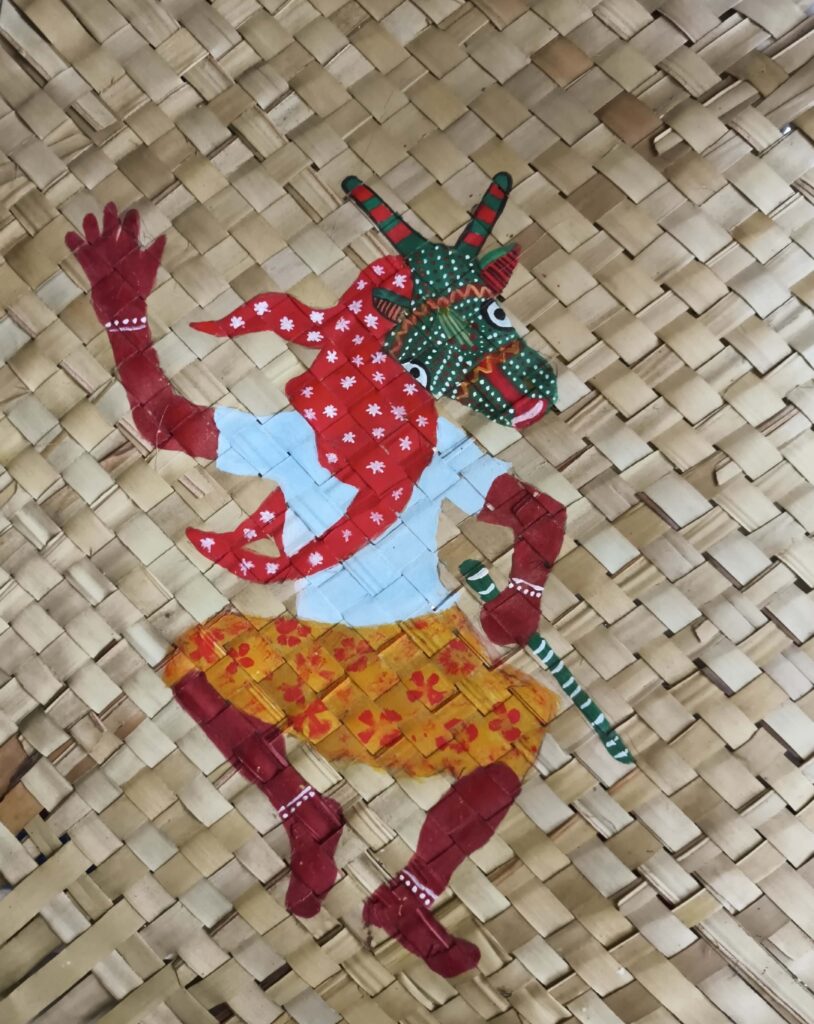
Kotha Revanth
Gurrapothu
A festival dancer painted onto the weave of a leaf mat
A green face with horns striped red and green.
White dots sit on it like grains of rice.
Red cloth with small white stars swings from the shoulder.
One hand is up. One foot leaves the ground.
Under the paint the leaf keeps its weave.
The dancer is made of small squares of mat
and still he will not stand still.
Kotha Revanth grows up in the Naikpod tribal community in Mulugu district. As a child he makes masks for festivals such as Laxmi Devara and Pothuraju. In Gurrapothu a dancing figure wears a green horned mask. Kotha paints in acrylic straight onto a palm-leaf mat handmade in a tribal region. He does not hide the weave. Each square of leaf breaks the colour into small blocks. The body seems to move across the mat.
Acrylic on handmade palm-leaf mat · 40.64 × 30.48 cm · 2025
Theme Ritual masks and memory
RC-522
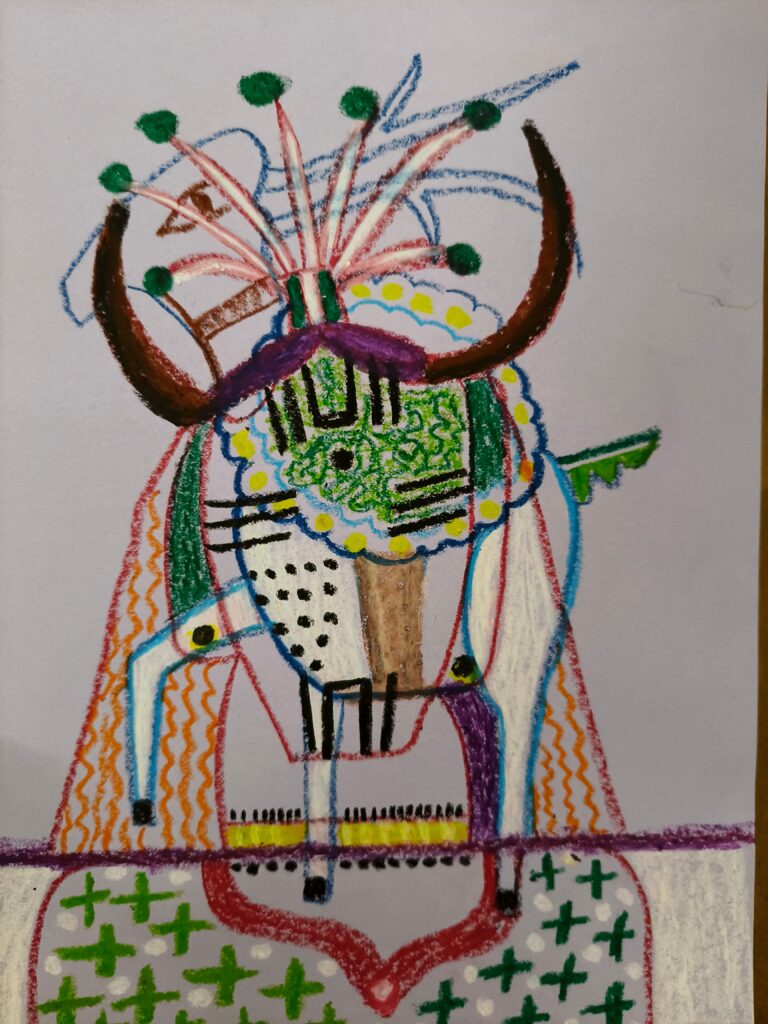
Kotha Revanth
Tribal women
Horns, feathers and a green face built from memory
Two brown horns curve up like the arms of a dancer.
Pink stems burst from the head, each one tipped with a green seed.
The face is a knot of green scribble inside a ring of yellow dots.
Orange lines ripple down the sides like water after rain.
Below, green crosses scatter across white ground.
The pastel sits thick and waxy on pale lilac paper, still warm from the hand.
Kotha Revanth comes from the Naikpod tribal community and from a village in Mulugu district full of rivers, trees, birds and animals. Childhood memories of making masks for festivals such as Laxmi Devara and Pothuraju shape this drawing. A horned mask face rises above a white body marked with black dots. Kotha does not copy old forms. The artist rebuilds them in oil pastel with rows of dots, crosses and wavy lines on a sheet of 29.7 × 21 cm.
Oil pastels on coloured paper · 29.7 × 21 cm · 2026
Theme Ritual masks and memory
RC-523

Kotha Revanth
Naikpod Masks
Three painted faces and a horse, all staring straight at you
Turmeric yellow, indigo blue, two reds hot as embers.
Eight round eyes, white as rice, do not look away.
Moustaches curl like river bends drawn in black ink.
A tall crown climbs in green and red triangles.
The horse lifts its ears between the men.
Festival faces held still on a white ground, waiting for someone to wear them.
Kotha Revanth belongs to the Naikpod tribal community and comes from Mulugu district. As a child he made masks for festivals such as Laxmi Devara and Pothuraju. In Naikpod Masks he paints four faces in a row. Three are human. One is a horse. Kotha builds the colour in layers of acrylic and adds fine patterns with pen. He does not want to copy old forms. He wants to show a culture that is still alive and changing. He studies at Suravaram Pratapa Reddy Telugu University.
Mixed media: acrylic, watercolours and pen · 58.42 × 20.32 cm · 2026
Theme Living tribal tradition
RC-524
From the open call
Khushi Arora
I have always been trying to showcase the world around me, or the society I live in, the power that resides in women, I've been focusing on proving or just making people realize how we as a society have been suppressing women in all the smallest ways, my work has been mostly women centric, be it in a empowerment sense or be it surroundings of women, a woman in love,…
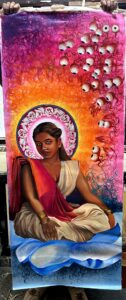
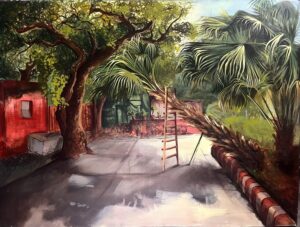

Khushi Arora
Viraajmaan
Every eye in the room is on her. She looks back
Pink burns down into orange, then gold, behind her head.
The halo is a plate of white scrolls, cut like lace.
Eyes drift in from the corner, trailing red threads.
She does not turn to them.
She sits on cold blue petals, bangles heavy on her wrists.
Her half smile says she knew they would come.
Khushi Arora paints a young woman seated on blue petals, like a goddess on a lotus. A red and white halo circles her head. She wears a cream sari with a deep pink drape and gold bangles. She looks straight at us. Dozens of eyes float beside her with red trails behind them. They all watch her. Arora is a student at the College of Art. Her work is about women and the small ways society holds them back.
Acrylic · 152.4 × 60.96 cm · 2025
Theme A woman's quiet power
RC-462

Khushi Arora
Apno ka sahara
A thin stick holds up a falling palm. Who holds you up?
A ladder waits in the lane with no one on it.
The dry palm bends low and a thin stick keeps it from the ground.
Red wall, red and white kerb, green leaves full of sun.
The old tree draws loops of dark line over the road.
Pale patches on the grey hold small pieces of sky.
Something light is keeping something heavy from falling.
In Apno ka sahara a wooden ladder stands alone in a quiet lane. Beside it a dry palm frond leans across the road. A thin stick holds it up. Light falls through an old tree onto a red wall and a striped kerb. Khushi Arora paints the scene in acrylic at 76.2 × 101.6 cm. Arora is a student at the College of Art. Most of her work is about women and how society treats them. She says she has found her genre but is still searching for her style.
Acrylic · 76.2 × 101.6 cm · 2025
Theme Holding each other up
RC-463
From the open call
anurag mankar
Concept: Inner Landscape My paintings explore the concept of **“Inner Landscapes”** — the unseen spaces formed by memory, emotion, experience, and imagination. Rather than presenting a literal landscape, I use abstraction, stains, blurred forms, organic marks, and shifting layers of colour to suggest the way an inner world is experienced: fragmented, fluid, uncertain, and constantly changing. The works emerge through an intuitive process in which water, pigment, and paper interact…


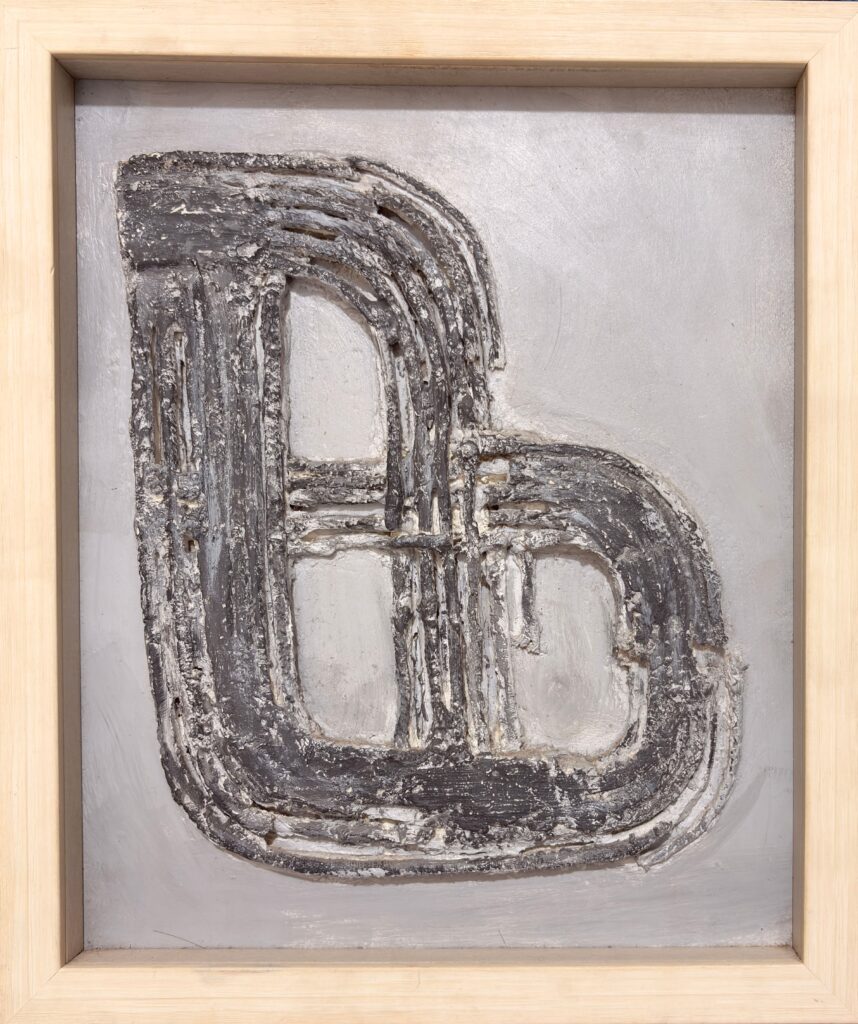
anurag mankar
untitled
A window carved from dark layers on a silver ground
Grey laid on grey, then scraped back to the white beneath.
The edges ripple like wet rope dried in the sun.
Four pale panes hold still in the middle, a window with no house.
Light sits flat on the silver and catches on every ridge.
Small enough to hold in two hands.
You look through it and find only more wall.
Anurag Mankar works around one idea: the inner landscape, a place made of memory, feeling and imagination. In this small mixed media panel a thick grey form rises from a silver ground. Grooves and ridges follow its curves. White shows where the dark layer cracks. Crossing bars inside the form look like a window frame. Like many of Mankar's forms, it suggests a building but never settles into one. The panel measures 13 × 11 × 2 cm. Mankar is based in Nagpur.
Mixed media · 13 × 11 × 2 cm · 2025
Theme Memory as inner landscape
RC-548
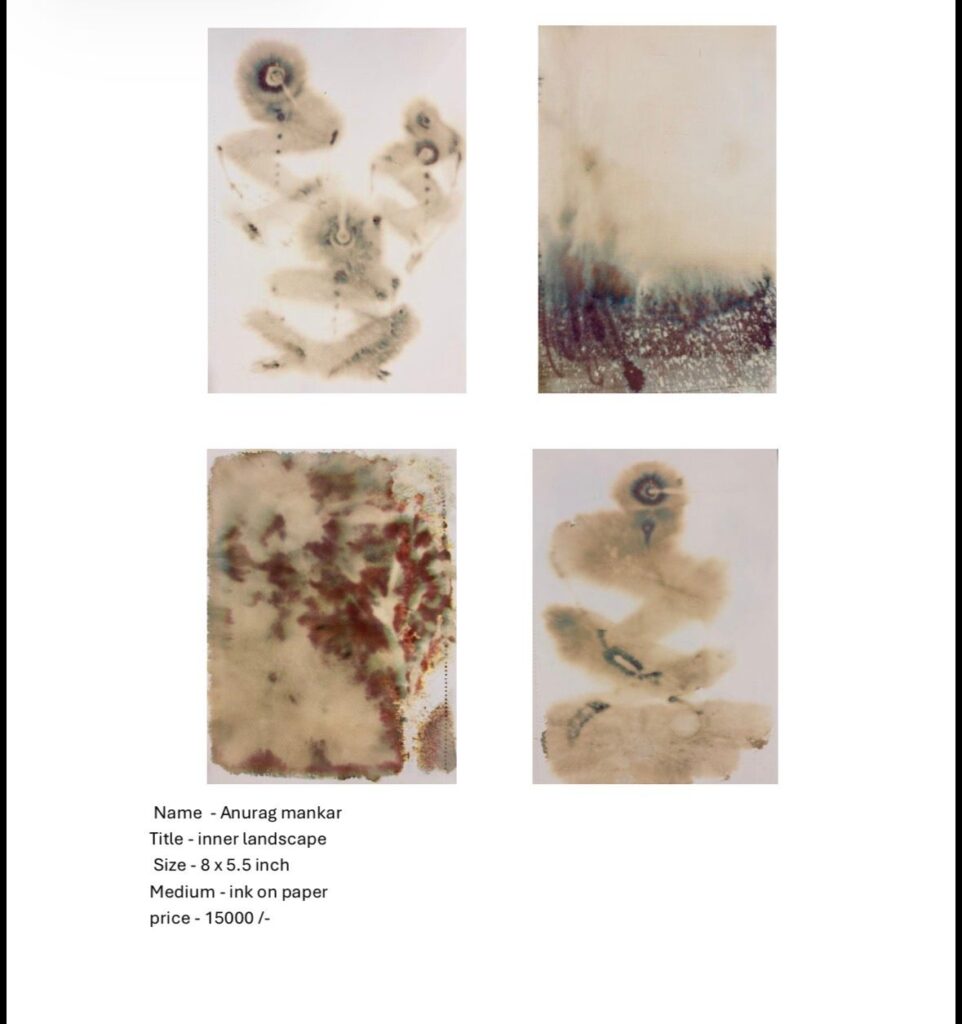
anurag mankar
inner landscapes
Small dark circles look back from pools of brown ink
Brown water dries at the edges and leaves a darker line.
A small blue circle sits on top of a stack, like an eye just opened.
Below a pale sky the ground turns to rust and grey.
Red spots crowd one sheet like leaves after rain.
The paper keeps every place the water stopped.
Anurag Mankar is from Nagpur. The artist's college is the Sir J.J. School of Art, Architecture and Design in Mumbai. The work is a set of four small ink drawings on paper. Each sheet is about 20 × 14 cm. Mankar lets water, ink and paper act freely. Colours bleed and stains spread. Accidents become part of the picture. Two sheets hold stacked shapes with small dark circles like eyes. One looks like dark ground under a pale sky. One is covered in rust-red marks.
Ink on paper · 20 × 14 × 2 cm · 2026
Theme Inner worlds of memory
RC-547
From the open call
Dharti Balasaheb Kaware
My practice explores the relationship between existence, identity, memory, and the social structures that shape human experience. I am particularly interested in the inner and outer dimensions of womanhood, where the body becomes a symbol of natural existence, freedom, vulnerability, and selfhood rather than an object of representation. Faces, masks, locks, keys, birds, and other recurring forms become visual metaphors for identity, observation, restriction, transformation, and release. I work through…
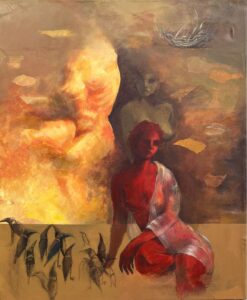


Dharti Balasaheb Kaware
Beauty
A woman in red sits calm beside a burning face
A face the size of a sky burns orange and gold.
The woman in red sits low and does not look at it.
Her white cloth is thin as breath on glass.
Her fingers rest among black birds with long beaks.
Behind her a grey woman stands half made of smoke.
Above them all an empty nest of white twigs waits.
Dharti Balasaheb Kaware paints Beauty in acrylic. She comes from Sir J.J. School of Art in Mumbai. In her practice she builds a painting in layers. She scrapes, erases and paints again. She lets traces of the older surface stay in view. Here a red woman sits beside a group of dark birds. A huge face burns in orange behind her. A pale second figure waits in the shadow. For Kaware the female body stands for freedom, vulnerability and selfhood.
Acrylic · 91.44 × 76.2 × 4 cm · 2026
Theme Womanhood and selfhood
RC-564
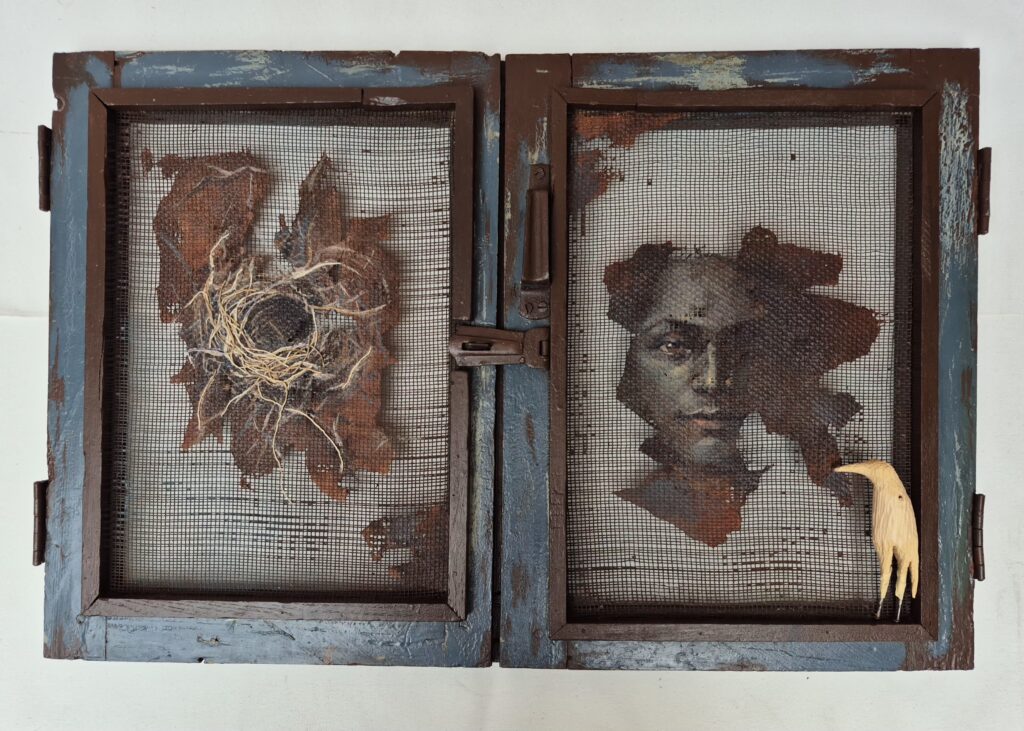
Dharti Balasaheb Kaware
घर
A woman watches through the wire of an old window
Blue paint lifts from the wood like dry skin.
Rust spreads across the mesh, the colour of old tea.
In one window a nest waits with no eggs.
In the other a woman looks at us through the wire.
Her face is half there and half weather.
A small white bird stands in the corner of her frame.
The latch between them could still open.
Dharti Balasaheb Kaware is from Sir J.J. School of Art in Mumbai. घर means home. The work is made on an old pair of window shutters. The blue paint is worn and the wire mesh is still in place. On the left a nest of dry fibres sits on a patch of rust-brown paint. On the right a woman's face looks out through the mesh. A small pale bird stands at its edge. Kaware scrapes and rebuilds the surface so older layers stay visible.
Mixed media and acrylic · 48.26 × 71.12 × 2.58 cm · 2026
Theme Home and confinement
RC-557

Dharti Balasaheb Kaware
ओळख
Behind each orange door, a crowd of faces waits to be known
Two orange doors with small dark handles.
Behind the mesh, faces press together like pressed leaves in a book.
One looks straight at you. Another has already turned away.
A blue bird crosses a cheek and does not stop.
At the threshold a pale bird waits on thin legs.
It cannot say if it is coming in or going out.
In ओळख, Dharti Balasaheb Kaware builds two tall boxes of pale wood. Each holds an orange panel shaped like a narrow door with a small dark handle. Behind fine wire mesh, faces crowd together in ochre, rose and brown. Some eyes look straight out. Others are half gone. A blue bird cuts across the left panel. A small pale bird stands at the foot of the right one. Kaware paints in layers. She scrapes and rebuilds so that older surfaces still show through.
Acrylic and mixed media · 53.34 × 45.72 × 3 cm · 2029
Theme Identity and confinement
RC-558

Dharti Balasaheb Kaware
जन्म
A face arrives through wire, then comes apart
A small face holds still behind a screen of wire.
Rust and clay and the pink of new skin, peeling at the edges.
One eye is open. The other is half lost to a pale ring.
In the second frame the face has let go.
Only petals of brown and orange are left, caught in the mesh.
Pale wood keeps both of them, like a window someone forgot to close.
Dharti Balasaheb Kaware, of Sir J.J. School of Art in Mumbai, makes this work in two square panels. Each has a plain wooden frame and a sheet of fine wire mesh. On the left, a child's face looks out through torn pieces of acrylic paint. On the right, the same reds and browns break apart into loose shapes. The artist works in layers. Kaware scrapes, erases and rebuilds. Traces of earlier surfaces stay visible. The title, जन्म, means birth.
Mixed media with acrylic · 30 × 60 × 4 cm · 2029
Theme Birth and identity
RC-559

Dharti Balasaheb Kaware
मन
Two faces behind wire mesh and one small padlock
Rust-red paint settles on the screen like the colour of old tea.
A woman looks through the fine grey wire. She does not look away.
A small lock holds the latch shut.
On the far side, two pale birds stand with their beaks lowered.
The paint thins where a hand once scraped it back.
The window is closed. The face is still there.
Dharti Balasaheb Kaware paints two faces on the wire mesh of old wooden windows. Each window has two shutters. A small padlock hangs on one latch. Birds wait behind the other shutter. Kaware is from Sir J.J. School of Art in Mumbai. She works in layers. She scrapes and erases. Then she builds again and lets traces of earlier surfaces stay. In her work, faces, locks and birds stand for identity, restriction and release. The title मन means the mind.
Mixed media with acrylic · 45 × 158 × 4 cm · 2026
Theme Womanhood, confinement and freedom
RC-560
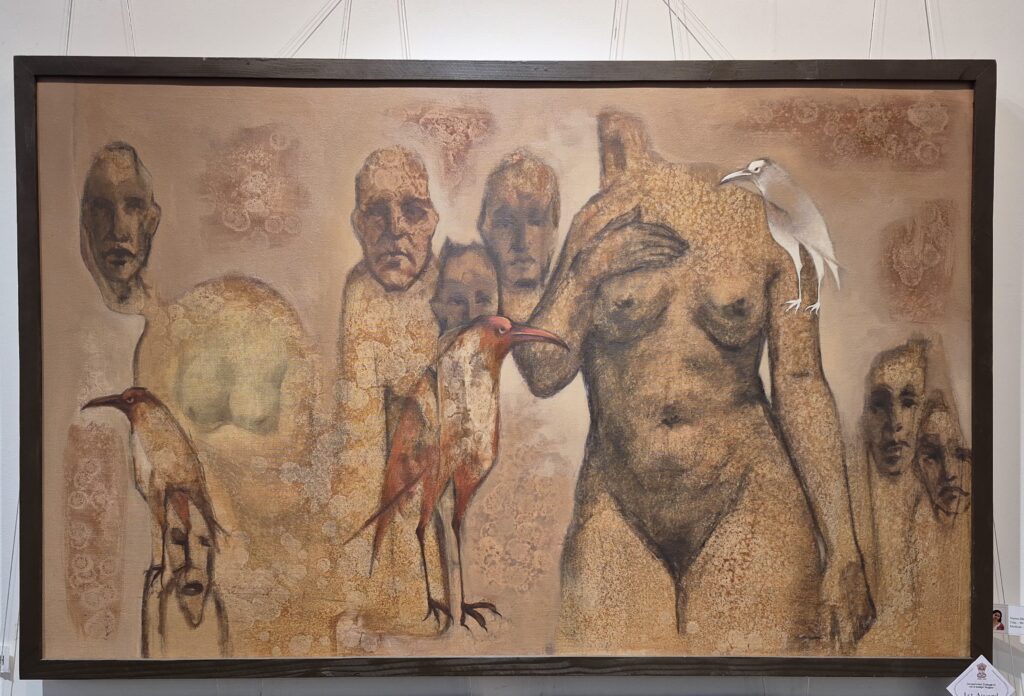
Dharti Balasaheb Kaware
शरीर
She hides her face while the birds keep watching
Sand-coloured skin, worn like an old wall.
Rust lace grows where paint was scraped away.
A white bird holds still on her shoulder.
The red ones lean in with their long beaks.
Heads drift past, half made, half asleep.
She keeps one hand over her face
and stands taller than all of them.
Dharti Balasaheb Kaware, of Sir J.J. School of Art in Mumbai, paints the body of a woman as a sign of freedom and selfhood. The title, शरीर, means body. A tall nude woman stands on the right. Her hand covers her face. A white bird rests on her shoulder. Pale heads float around her. Two red birds with long beaks stand near. Kaware works in layers. The artist scrapes, erases and rebuilds. Traces of earlier surfaces stay visible, like rust-coloured lace on a warm sand ground.
Acrylic · 60.96 × 121.92 × 4 cm · 2026
Theme Womanhood and being watched
RC-561
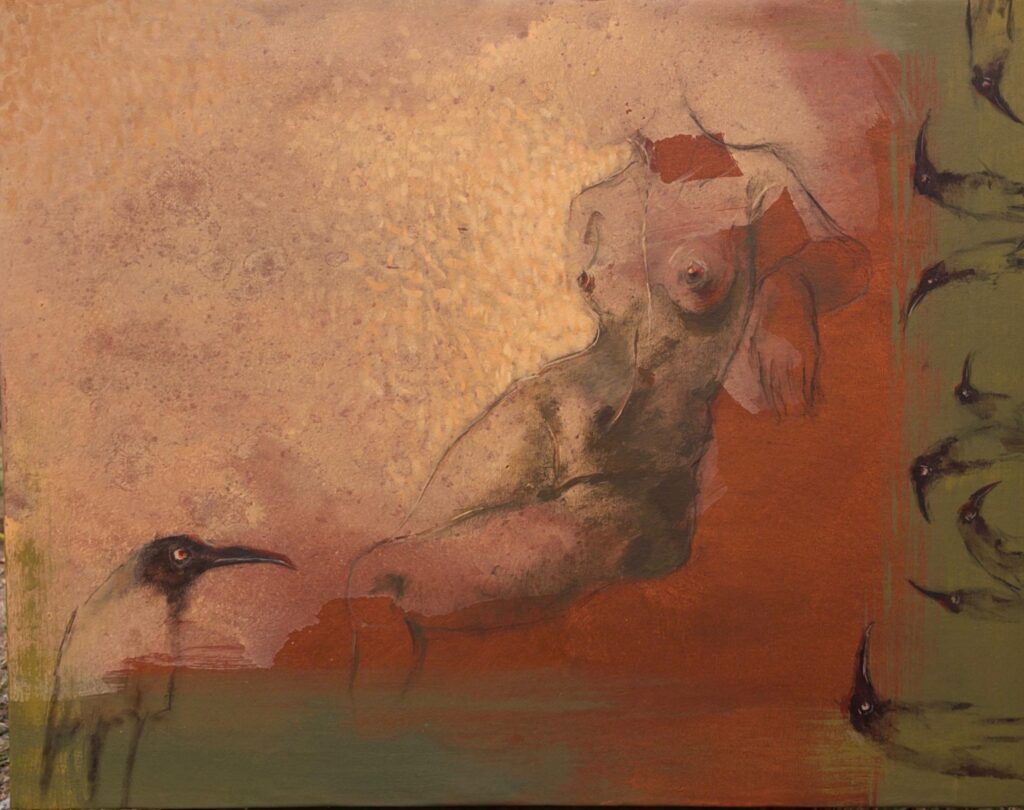
Dharti Balasaheb Kaware
समाज
She rests while a column of birds keeps watch
Rust spreads like a wall warmed by late sun.
A woman leans back into it, drawn with a few grey lines.
Her edges thin into the paint, as if the wall breathes her in.
In the corner a dark bird turns one red eye toward her.
Along the green edge, more beaks wait in a column.
No one moves. The looking is the weight.
Dharti Balasaheb Kaware is from Sir J.J. School of Art in Mumbai. The title, समाज, means society. A woman's body rests across a rust and pale pink ground. It is drawn in loose lines and soft shadow. A large dark bird watches from the lower left. Small birds gather on a green band at the right. Kaware sees the body as a sign of freedom and selfhood. Kaware works in layers, then scrapes and erases them. Here the speckled surface keeps traces of earlier paint.
Acrylic · 71.12 × 76.2 × 4 cm · 2026
Theme The watched body
RC-562
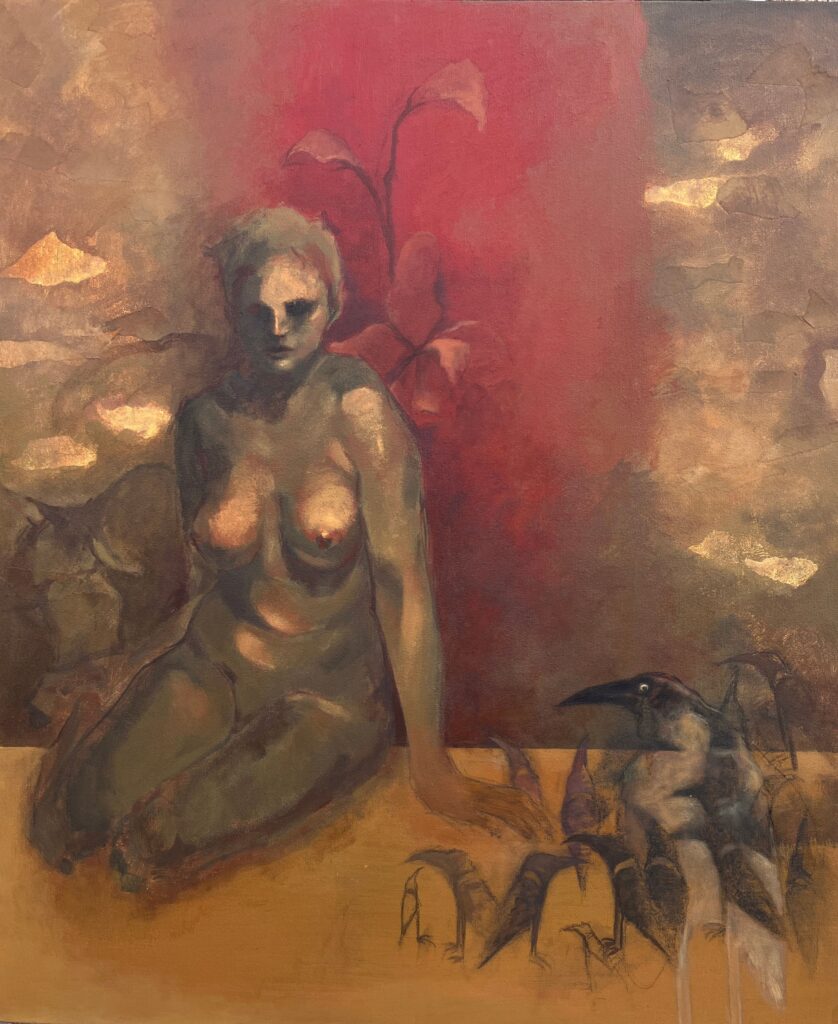
Dharti Balasaheb Kaware
जिवन
She sits very still. The crow is the one watching
A band of red rises behind her, still warm.
Pale flowers lean out of it on thin stems.
She sits on a ledge the colour of turmeric, one hand resting.
The crow beside her keeps one white eye open.
Smaller birds are only lines, half drawn and half gone.
Gold breaks through the brown sky in torn patches.
Dharti Balasaheb Kaware studies at Sir J.J. School of Art in Mumbai. The title of this acrylic painting, जिवन, means life. A woman sits on a yellow ledge in front of a band of deep red. Pale flowers rise behind her. A crow stands near her hand. Small birds drawn in loose dark lines walk beside it. Kaware works in layers. The surface is scraped, erased and built again. Earlier marks stay visible. The work measures 91.44 × 76.2 × 4 cm.
Acrylic · 91.44 × 76.2 × 4 cm · 2026
Theme Womanhood and life
RC-563
From the open call
Prem Shriwas
Art is more than a creative practice for me. It's a journey of exploration, learning, and self-expression. Through each piece I create, I aim to communicate my ideas, emotions, and imagination while constantly improving my technical skills. I love experimenting with different mediums, including sculpture, miniature painting, watercolor, and handmade natural pigments. Each medium teaches me something new and shapes my growth as an artist. One of my works, The…


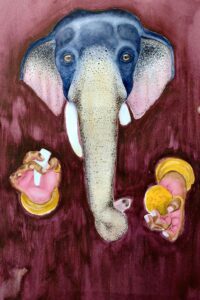
Prem Shriwas
The Blue
A knot of blue clay smaller than your palm
A blue like a gas flame, small enough to hide in a closed hand.
One coil loops over itself and leaves a window of white wall.
A thin tail rises and stops in a point, like a word held back.
The clay keeps the soft marks of fingers.
It rests on a round purple base like a coin.
Pale light falls flat and quiet across it.
Prem Shriwas makes The Blue from soft blue clay. The piece is only 6 × 5 × 3 cm. It does not show a known object. Shriwas builds an open form of curves and loops and leaves its meaning to the viewer. A thick ring turns over the top. A thin tail lifts to one side. Working this small takes patience and close care with proportion. Shriwas comes from the Govt Institute of Fine Arts in Indore. Shriwas also grinds stones by hand to make pigments for miniature painting.
Foam clay · 6 × 5 × 3 cm · 2026
Theme Balance and flowing movement
RC-596
Prem Shriwas
“Swapn Desh”
Every colour here began as a stone, ground by hand
The paper's edge is torn soft like bread.
A blue mist rises from it and never quite clears.
A man in a checked shirt lifts his hand toward a small yellow bird.
A woman leans out of her gold frame and offers a lotus bud.
Above them a god sits on a cloud under a hood of snakes.
Below, white lines curl and curl, the slow breath of water.
Everything here was once stone.
Prem Shriwas studies at the Government Institute of Fine Arts in Indore. For this miniature he makes his own colours. He grinds natural stones by hand and mixes the powder with gum arabic. The process takes hours of trial and patience. Shriwas then paints small figures on a pale blue ground: a young man beside a peacock, a woman leaning from a gold frame, elephants, a cobra, a tiger and a deer. White lines curl like water and cloud around them.
Natural stone colour on paper · 30 × 20 cm · 2025
Theme Dream, myth and nature
RC-591

Prem Shriwas
Royal Grace in Traditional
She holds the lotus as if it might bruise
Saffron cloth falls from her head to her heel.
Green skirt, scattered with small gold leaves.
The lotus opens pink at the tip and white at the heart.
Her eye is long and still. She does not look at us.
Above her a red canopy hangs with tiny flowers.
The wall is almost bare. Thin brown lines hold the quiet.
Prem Shriwas works in Indore and paints in the miniature tradition. In this mixed media miniature from 2026, a woman stands at a pale balcony. She holds a lotus on a long green stem. A red and green canopy hangs above her. Thin brown lines mark the walls and the low ledge. The painting measures 28 × 19.5 cm. Shriwas names patience as one of the most important qualities in making art. Some of the artist's miniatures take nearly three months because each detail needs careful looking.
Mixed media miniature painting · 28 × 19.5 cm · 2026
Theme Stillness and courtly grace
RC-592

Prem Shriwas
Lord Gajraj
Amber eyes look out from a dark blue brow
A wine red wash, thin enough to show each stroke of the brush.
Out of it rises a blue brow and two amber eyes that do not blink.
The trunk is cream and full of tiny dark seeds of paint.
One hand holds a white piece. The other holds a round of gold.
Gold rings shine at both wrists.
Nothing moves. The patience sits in every dot.
Lord Gajraj is a 2024 watercolour by Prem Shriwas. It measures 59 × 40 cm. Shriwas comes from the Government Institute of Fine Arts in Indore. The painting shows Lord Ganesha as a real elephant. The idea comes from the strength and grace of the animal. Watercolour demands careful planning. So every part is thought out first. The work sharpens Shriwas's sense of light, shadow and brush control. Fine dots build the skin of the trunk and ears. Two hands rest on a deep red wash.
Watercolour · 59 × 40 cm · 2024
Theme Ganesha as living elephant
RC-593

Prem Shriwas
Still life
A pink cloth falls between cool blue and warm gold
The jug stands tall and cool, the blue of deep water at the end of the day.
A pink cloth slips down behind it like something set down in a hurry.
The yellow pot holds a small green shadow in its belly.
White marks catch on every rim.
Brown paper breathes between the strokes.
The whole table feels warm, as if the sun has just left the room.
Prem Shriwas is from the Govt Institute of Fine Arts in Indore. In this still life from 2024 he draws three things: a tall blue jug, a round yellow pot and a pink cloth that falls behind the jug and spreads under the pot. He works in soft pastel on brown paper. The paper shows through the strokes and becomes the warm middle tone. Small touches of white sit on the jug and the pot as reflected light. Shriwas says patience is one of the most important things in his work.
Soft pastel on paper · 42 × 29.7 cm · 2024
Theme Light on everyday objects
RC-594
Prem Shriwas
The thinking
A pale statue on blue cloth, watched by drawn ghosts
Plaster skin holds pink at its edges, like a cheek near a lamp.
The blue cloth is night folded over a wooden stand.
Small white stars and coils are scratched into the dark.
A green creature climbs the left wall on its yellow spine.
On the right, an elephant and its people are only lines of light.
The statue lifts one hand, as if to speak first.
Prem Shriwas studies at the Government Institute of Fine Arts in Indore. In The thinking, a white cast of a female figure stands on a wooden stand. Behind it hangs a deep blue cloth marked with small white stars and spirals. A blue creature with a yellow spine climbs the left edge. On the right, thin yellow lines draw an elephant head and human figures. Shriwas also makes sculpture and miniature paintings. Here he paints a sculpture in oil and lets drawn figures gather around it.
Oil colour · 42 × 29.7 cm · 2026
Theme Looking at a sculpture
RC-595
From the open call
Kanika sang
I have always loved expressing myself through art and finding different ways to bring my thoughts, emotions, and creativity to life. For me, art is not just about creating something beautiful; it is also a medium through which I can express ideas, emotions, and stories that hold a deeper meaning. In this artwork, I have portrayed a Goddess as a representation of feminine strength, power, courage, and resilience. One side…

Kanika sang
The divine grace
Half her face is red. The other half is waiting
Gold letters climb down the dark like a prayer said slowly.
Her eye is closed. Her mouth is a small red bow.
Sindoor spreads across one cheek like heat across a stone.
A white ring hangs from her nose, thin as a held breath.
The crown and the collar rise from the surface in coils you could trace with a finger.
She is quiet. The red is not.
Kanika Sang paints a goddess in profile against a dark ground. Bright red sindoor covers one side of her face. A Sanskrit verse to the goddess runs down the left side in gold letters. Sang works in acrylic. Raised lines of 3D outliner and Mouldit give the crown and the heavy jewellery a surface you can almost touch. For Sang the red stands for the strength that waits quietly inside every woman. The work dates from 2023. Sang is from Ambala. Her college is CGC University Mohali.
Acrylic with 3D outliner and Mouldit · 42 × 29.7 cm · 2023
Theme The strength within women
RC-612
From the open call
Leela sivani chellapilla
Art, for me, is not merely a practice of rendering visual forms; it is a vital mechanism of translation. It is the tangible externalization of the silent dialogues, philosophical inquiries, and psychological comparisons that continuously move through my consciousness. Working primarily in the rich, tactile medium of oil, I dedicate my creative inquiry to exploring the complex, often fragile relationship binding human behavior to the natural world. My canvases draw…

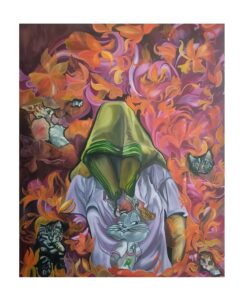
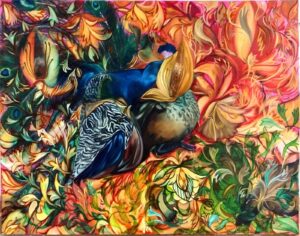
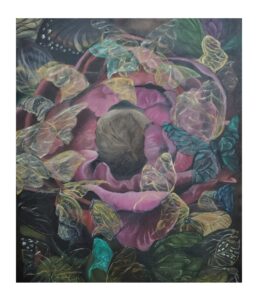
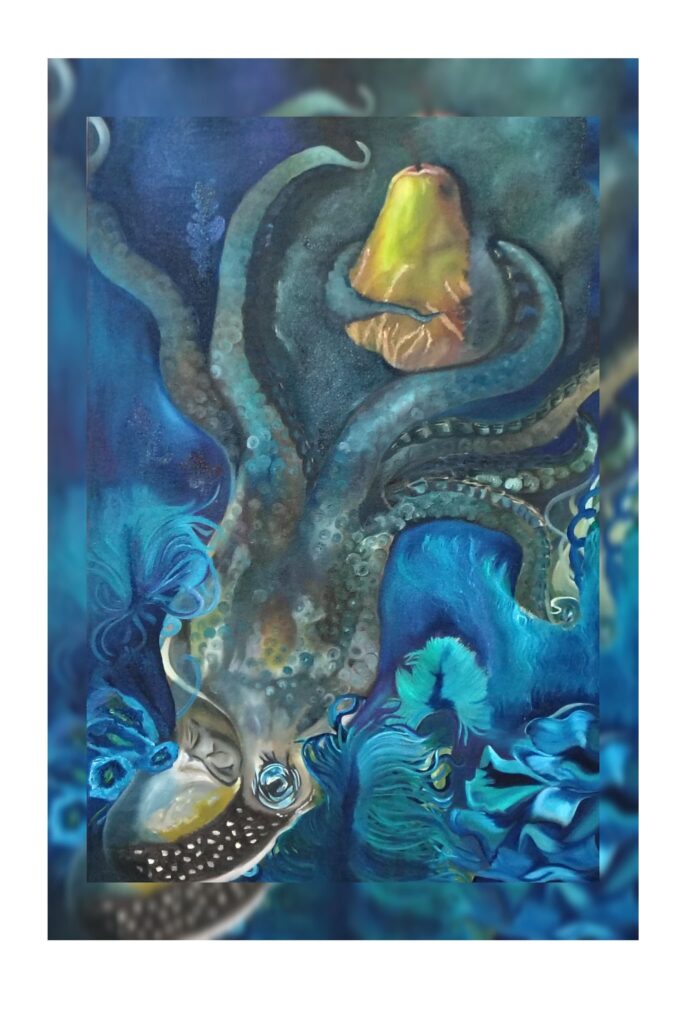
Leela sivani chellapilla
Conceal
An octopus holds a golden fruit while a face sleeps below
Blue water, so deep it turns almost black at the top.
An octopus spreads its arms like slow roads.
One arm lifts a yellow fruit toward a light we cannot see.
Below, a face sleeps with its eyes shut.
White dots on a dark band, soft blue feathers, one round shining eye.
Something is kept safe here. Something is kept hidden.
Leela Sivani Chellapilla paints in oil. She studied at Andhra University and is based in Bangalore. In her work, plants and animals stand in for human feelings, instincts and habits. Conceal is oil on canvas, 91 × 60 × 2 cm. A large octopus fills deep blue water. Its arms curl around a golden fruit. Near the bottom, a pale face rests with closed eyes, half hidden among blue feathers and dark spotted shapes. Chellapilla asks us to see ourselves inside nature, not outside it.
Oil on canvas · 91 × 60 × 2 cm · 2025
Theme Instinct and hiding
RC-634
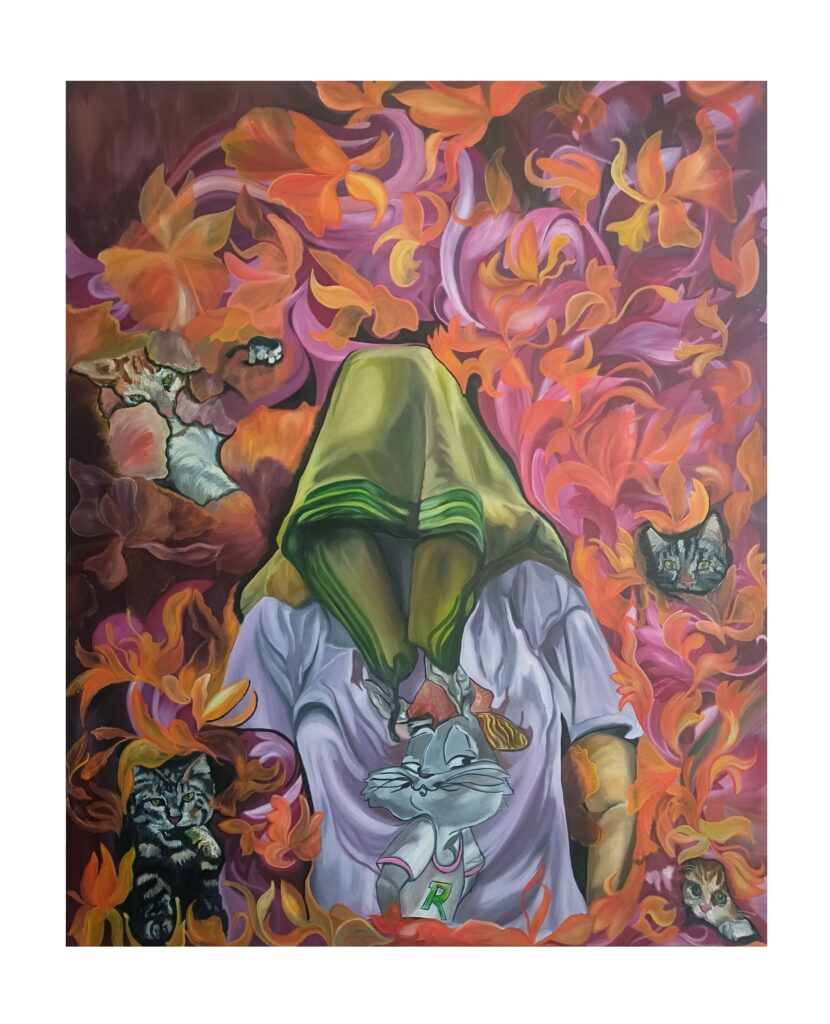
Leela sivani chellapilla
Isolate
A face hidden under green cloth while the cats keep watching
Petals the colour of embers lift from every corner.
A green cloth falls over a face that will not show itself.
On the shirt a cartoon rabbit keeps smiling for both of them.
The cats do not leave. They wait in the folds of flame and look.
The oil lies thick and soft, like warm wax.
Inside the cloth it is quiet. Outside, the whole garden burns.
Isolate is an oil painting on canvas by Leela Sivani Chellapilla, made in 2025. A figure stands in a pale T-shirt with a cartoon rabbit on the front. A green garment is pulled over the head and hides the face. Orange and pink flowers turn around the figure like flames. Small tabby cats look out from the edges. Chellapilla uses plants and animals as signs for human feelings and habits. The canvas is 152.4 × 121.92 × 2 cm. Chellapilla is from Andhra University and is based in Bangalore.
Oil on canvas · 152.4 × 121.92 × 2 cm · 2025
Theme Hiding from the world
RC-630
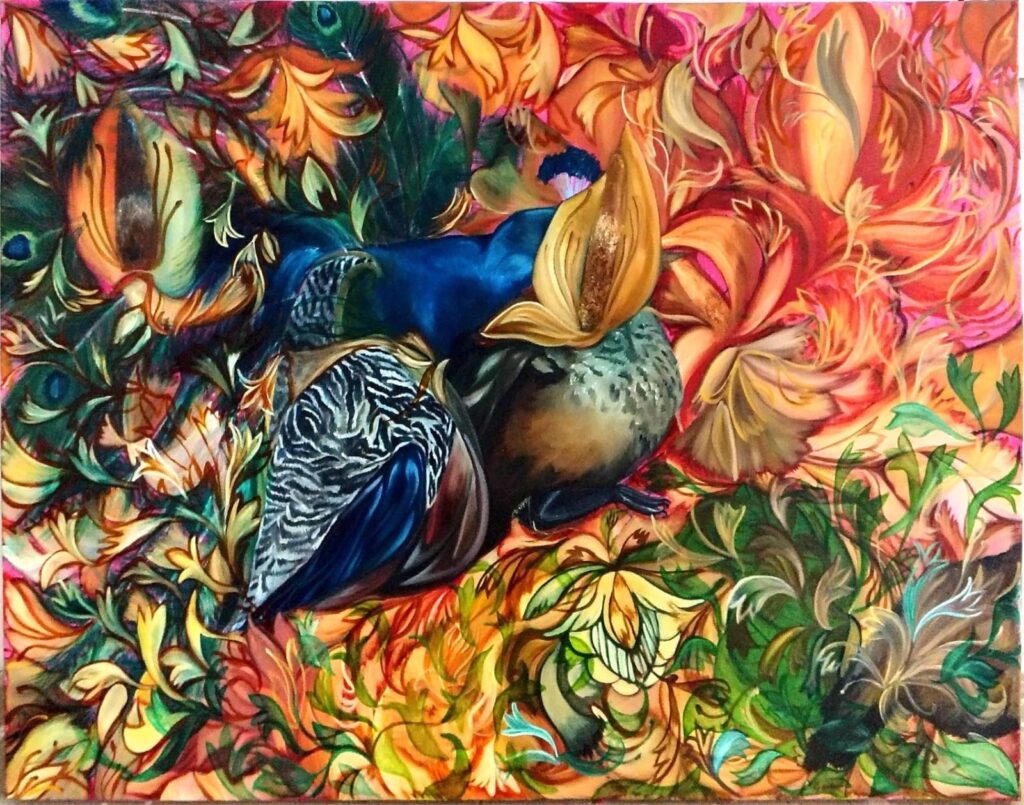
Leela sivani chellapilla
The pull
Where does the bird end and the garden begin?
Orange leaves curl like small flames around a deep blue body.
The bird folds into itself, its wing a page of grey script.
A gold petal falls over the head like a hood.
In the corner, peacock eyes keep watch from the green.
The oil lies thick and glossy, warm as late afternoon.
Everything leans inward, toward the dark centre.
Leela Sivani Chellapilla studied at Andhra University and is based in Bangalore. The Pull is an oil painting on canvas from 2024. It measures 91.44 × 121.92 cm. A dark blue bird with striped grey wings lies folded in a crowd of orange, red and green leaves. A large gold petal covers its head. Peacock eyes glow in the top left corner. Chellapilla uses plants and animals to stand for human feelings and habits. Here the leaves curl around the bird like a strong current.
Oil on canvas · 91.44 × 121.92 × 2 cm · 2024
Theme Instinct and the natural world
RC-631

Leela sivani chellapilla
Birth nectar
A baby rests in a flower, ringed by wings of glass
Pink petals fold over a soft brown crown.
A hundred wings settle like thin sheets of glass.
Gold lines run through them, the veins of a held breath.
One teal insect keeps watch on the right.
The dark edges feel like wet leaves at night.
Everything leans in toward the small head, as if the flower is still deciding to let go.
Leela Sivani Chellapilla paints Birth Nectar in oil on canvas in 2024. A large pink flower opens at the centre. Inside it rests the small head of a baby, seen from above. Wings of butterflies and other insects gather over the petals. Many are clear like glass, with thin gold lines. Chellapilla uses plants and animals to stand for human feelings and habits. Here a new life sits inside a bloom. Chellapilla is based in Bangalore and her college is Andhra University.
Oil on canvas · 60 × 60 × 2 cm · 2024
Theme Birth and natural cycles
RC-632

Leela sivani chellapilla
Untamed curiosity
Two eyes watch from deep inside a storm of leaves
Red like a warm wall at evening.
Pale leaves curl past, thin as onion skin.
In the middle, dark fur and two wet eyes.
Fine red threads lie over the face like veins on a leaf.
Gold petals drift but the eyes do not move.
Who is hiding here and who is looking?
In Untamed curiosity, Leela Sivani Chellapilla paints a dark, furry face in the centre of a red canvas. Two pale eyes look out. Leaves and flowers in gold, rust and cream swirl around it. Thin red lines cross the face like a net. Chellapilla works in oil. For her, plants and animals stand in for human feeling. She calls them "psychological mirrors". Here "the gaze of an animal" holds still while the leaves move. The work is from 2024.
Oil on canvas · 76 × 60 × 2 cm · 2024
Theme Human instinct in nature
RC-633
From the open call
Shreya Shukla
I am Shreya Shukla, an active Indian artist based in Kanpur Nagar (Uttar Pradesh) and a graduate of the University of Allahabad. Growing up in a rural home, art wasn’t something I saw in books or galleries—it was a part of our daily life. I spent my childhood observing how closely people are connected to their surroundings, their daily chores, and the simple objects in their homes. There is an…


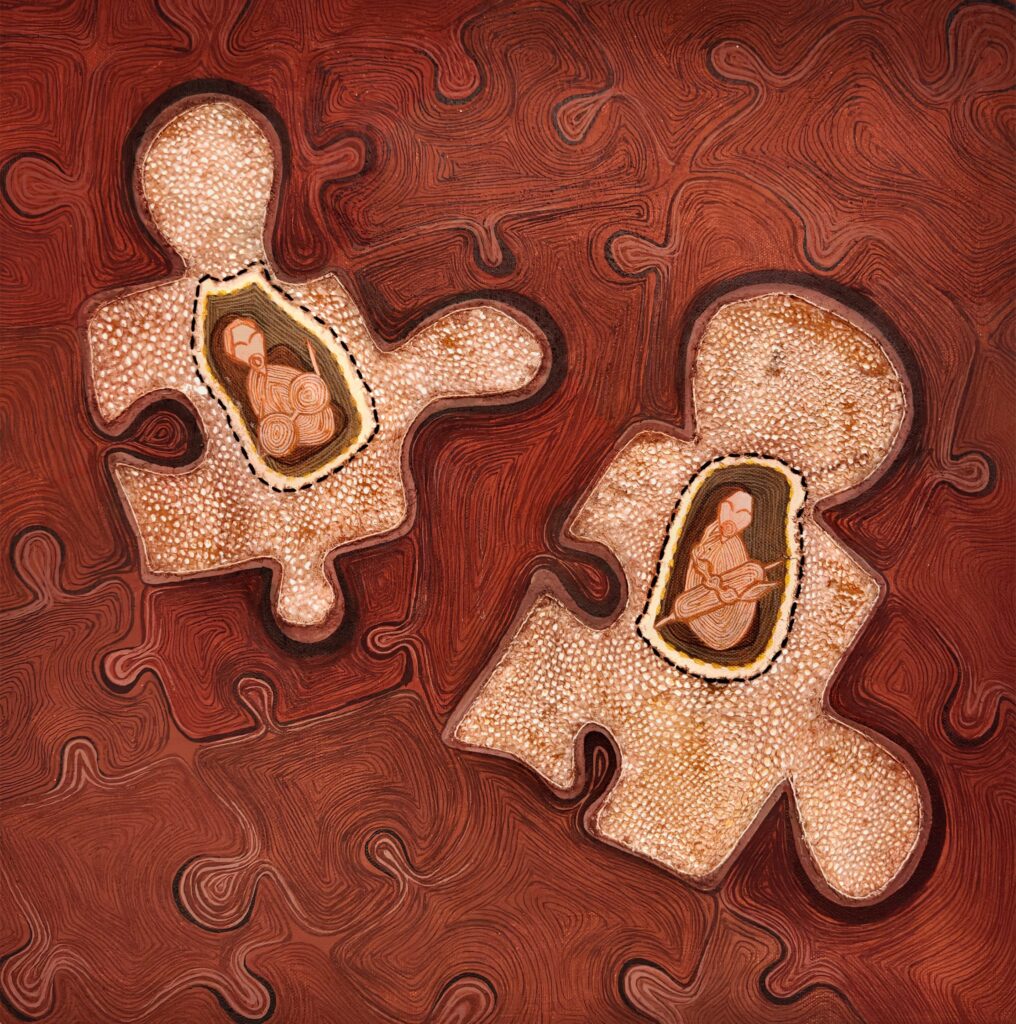
Shreya Shukla
Unbound Connection VII
Two loose pieces of a puzzle, each holding a quiet figure
The red ground moves like a river seen from above.
Every curve is the edge of a piece that is not there.
Two pale shapes float free, rough with tiny white dots.
A dotted line runs round each window like a seam.
Inside, a figure sits curled in warm orange lines.
The other holds something long across its lap.
They lean toward each other but do not touch.
Shreya Shukla grew up in a rural home. Her mother and grandmother taught her embroidery there. In this square work she joins those lessons with geru, the natural earth pigment the women in her family used on walls and floors. Shukla stitches with Chikankari jali stitch and running stitch. She then adds acrylic for structure and contrast. Two pale puzzle shapes sit on a deep red ground. A small seated figure rests inside each one.
Geru natural pigment, Chikankari embroidery (jali stitch and running stitch) and acrylic colours on surface · 45.72 × 45.72 × 2.5 cm · 2026
Theme Connection across generations
RC-549

Shreya Shukla
Unbound Connection VI
A woman lives inside the glasses, the rolling pin, the pot and the shoe
Rust, peach, mustard, moss. Four pieces hold each other tight.
A woman curls inside a pair of pink glasses. She looks out twice.
Another rests in the pale wood of a rolling pin.
Her hair turns in slow rings, like thread around a spool.
A yellow pot lies on its side. A shoe stands empty of its foot.
Around them the dark ground cracks like an old floor washed again.
Shreya Shukla grew up in a rural home in Uttar Pradesh. There she watched how closely people live with the objects of their daily chores. In Unbound Connection VI four puzzle pieces lock together on a dark ground. Each piece holds a woman inside a common thing: a pair of glasses, a rolling pin, a pot and a shoe. Shukla works with acrylic colours and hand embroidery on sun board. In her current work she uses the Chikankari jali and running stitches she learned from her mother and grandmother.
Mixed media, embroidery and acrylic colours on sun board · 76.2 × 60.96 × 2 cm · 2026
Theme Women and household objects
RC-550

Shreya Shukla
Unbound Connection V
Red earth from the walls of home, stitched with a grandmother's thread
Red earth runs in rings, like water after rain on a mud floor.
In each grey-green pocket a woman bends to her work.
A pot. A rolling pin. A stone that turns.
Pale lines draw their faces in small, patient loops.
At the centre a net of stitches hangs like a pale skin.
Around it, pink shapes join hands.
Shreya Shukla grew up in a rural home. She watched the women of her family use geru, a red earth pigment, to wash and decorate the walls and floors. Today geru is the ground of Unbound Connection V. Shukla adds Chikankari embroidery by hand. She uses the jali stitch and the running stitch. Her mother and grandmother taught her both. Acrylic paint brings contrast. In grey-green pools across the red, women work with pots and rolling pins.
Geru natural pigment, Chikankari embroidery (jali and running stitch) and acrylic on canvas · 42.06 × 59.44 × 2.5 cm · 2026
Theme Women, home and memory
RC-551
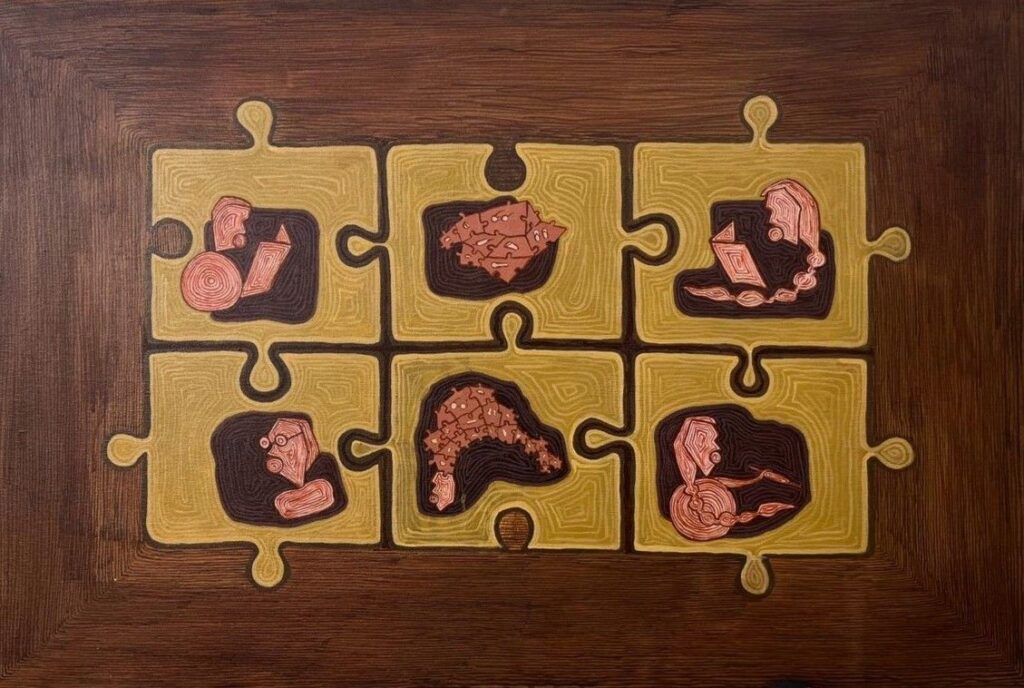
Shreya Shukla
Unbound Connection IV
Six pieces fit together, but what they hold does not
Brown wood grain runs out to the edges like an old tabletop.
Six yellow pieces wait there, already joined.
In each one a dark well opens.
Pink things float in the wells: a face, a page, a knot of beads.
Every line goes round and round, like thread pulled slowly through cloth.
The puzzle is finished. What it holds is not.
Unbound Connection IV is acrylic on canvas from 2025. Shreya Shukla sets six yellow puzzle pieces on a ground the colour of dark wood. The pieces lock together. Inside each one is a dark pool with pink shapes. Some look like faces, open books or coiled rope. Two look like broken maps. Fine lines circle every form like stitched thread. Shukla lives in Kanpur Nagar. Her earthy colours come from a rural childhood. Her love of line comes from learning embroidery with her mother and grandmother.
Acrylic on canvas · 60.96 × 91.44 × 2.5 cm · 2025
Theme Bonds of everyday life
RC-552
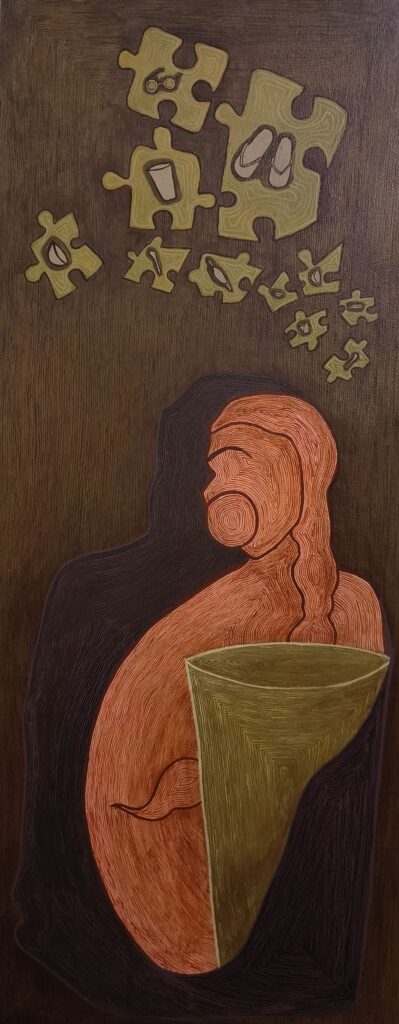
Shreya Shukla
Unbound Connection III
Spectacles, slippers and a glass drift up like missing puzzle pieces
Brown like old wood, every line combed in one direction.
A woman of red earth turns her face up, her braid a dark rope down her back.
She holds a green cone close, empty, open to the sky.
Above her the house comes apart in pieces: spectacles, a glass, two slippers.
The pieces grow smaller as they go.
She does not reach for them. She only watches.
Shreya Shukla grew up in a rural home. There she saw how closely people live with their daily chores and the simple things in their homes. That bond is the root of Unbound Connection III. A woman with a long braid holds a green vessel. Above her, puzzle pieces drift away. Each piece holds a small object, such as spectacles, a glass or a pair of slippers. Shukla paints in acrylic on canvas. Her warm earth colours come from memories of Geru on the walls of her childhood home.
Acrylic on canvas · 95.25 × 46.99 × 2.5 cm · 2025
Theme Memory and everyday objects
RC-553

Shreya Shukla
Unbound Connection II
A meal for four, held inside a single puzzle piece
Ochre the colour of a mud floor after rain.
Four people sit low and eat from small plates.
A face leans in from the next room of the dish.
Around them a hundred cups and bowls wait in their own small pieces.
Thin lines circle each shape like thread pulled through cloth.
One piece of a puzzle. The others are somewhere in the house.
Shreya Shukla paints one jigsaw piece in ochre on dark brown. At its centre sits a round plate with four parts. In the largest part, four seated figures eat from small plates. The smaller parts hold faces. Around the plate, tiny puzzle pieces hold cups, bowls and glasses. Shukla grew up in a rural home. She watched how closely people live with their daily chores and the simple objects in their homes. Thin curved lines fill each shape like rows of thread.
Acrylic on canvas · 45.72 × 45.72 × 3 cm · 2025
Theme Shared meals and home
RC-554

Shreya Shukla
Unbound Connection I
The red earth of a village wall, combed into living lines
Red earth moves like water around a stone.
Each line bends and does not break.
Two pale rings press close, a pair of eyes, two seeds in one pod.
Inside, cream shapes rest like fish asleep in shallow light.
At the bottom a small whorl turns, a knot in old wood.
The colour of a floor washed at dawn, still warm under bare feet.
Shreya Shukla grew up in a rural home. There she watched the women of her family use geru, a natural earth pigment, to wash, protect and decorate the walls and floors. In Unbound Connection I she brings that red earth onto paper and joins it with acrylic. Fine lines flow across the sheet like grain in wood. Two rounded forms meet at the centre and seem to hold small worlds inside. Shukla is a graduate of the University of Allahabad and works in Kanpur Nagar.
Mixed media: geru natural pigment and acrylic colours on paper · 21 × 29.7 × 0.01 cm · 2026
Theme Earth, memory and home
RC-555
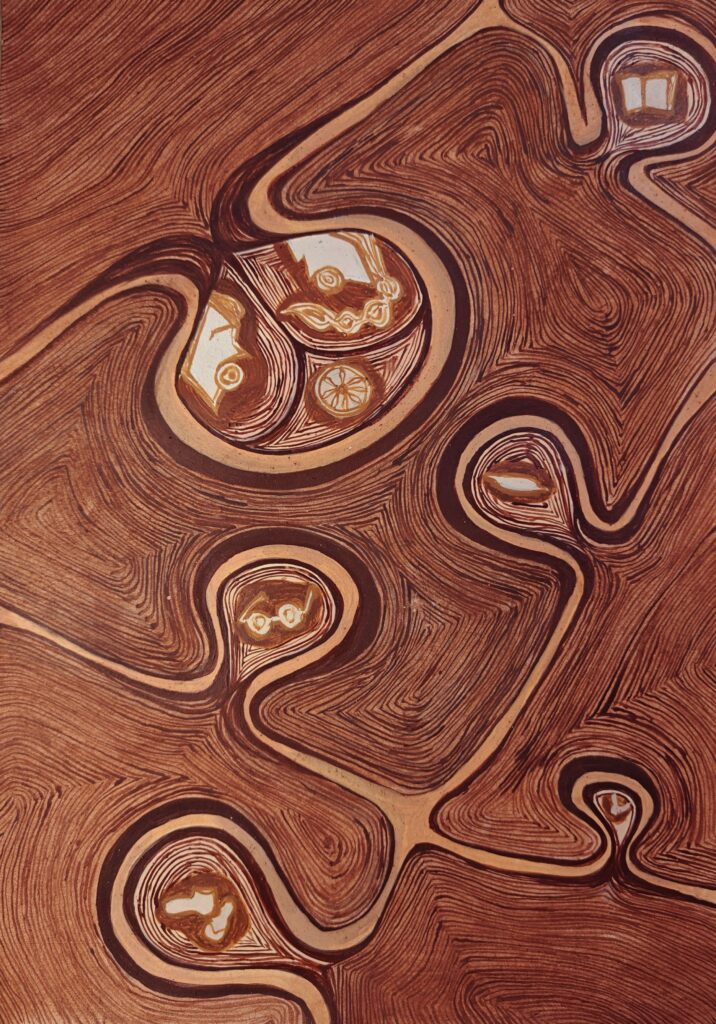
Shreya Shukla
Unbound Connection
The red earth of village walls, combed into a map of home
Red earth combed into many thin lines.
Pale roads run through it like water through a field.
At each bend a road swells into a small room.
One room keeps a book open. One keeps a pair of glasses.
A mouth waits in another, half speaking.
The whole sheet moves the way a floor moves under a wet cloth.
Shreya Shukla makes Unbound Connection with geru, a natural earth pigment and acrylic colour on paper. Geru comes from her childhood in a rural home. She remembers the women of her family using it to wash, protect and decorate their walls and floors. Here fine brown lines swirl across the sheet like the grain of wood. Pale paths wind between them. Each path opens into a small round pocket. Inside are simple things from daily life, such as a book and a pair of glasses.
Geru natural pigment and acrylic on paper · 29.7 × 21 × 0.01 cm · 2026
Theme Home and everyday objects
RC-556
From the open call
Gungun
"Honestly, I was just trying to capture a specific mood and moment—something that felt a bit too subtle to put into plain words. I wanted to create a piece that feels honest, personal, and easy to connect with, rather than something overly complicated. To bring this to life, I used a mix of acrylic paints, textured paper, and a few basic multi-media tools I had on hand. I layered the…


Gungun
Virat Kohli
Only the face stays grey. Everything around it takes colour
Saffron at the top, green at the bottom, a white band for the eyes.
The face is pencil grey, rubbed soft at the cheek.
Every hair of the beard is a small dark mark.
The cap and shirt are blue, as loud as a stadium.
He looks up, past the clip, past the edge of the sheet.
Whatever he sees there, he keeps it quiet.
Gungun studies at Jimeti in Yamuna Nagar. This portrait of Virat Kohli begins in pencil and charcoal. The face, beard and neck stay in soft greys. Then colour comes in. Gungun uses colour pencil and colour charcoal for the blue cap, the blue shirt and the flag behind him. The saffron, white and green bands sit flat and calm. Against them the grey skin stands out. He looks up past the top of the sheet. The work is from 2024.
Pencil, charcoal, colour pencil and colour charcoal on paper · 21 × 29.1 cm · 2024
Theme A hero looking up
RC-565

Gungun
Shiv panting
Three faces of one god, every eye closed in the same quiet
Three faces lean together on a field of turmeric yellow.
Red like kumkum. Yellow like the ground they rest on. Blue like a monsoon sky.
Each pair of eyes is closed.
Three white moons sit in the dark hair.
A blue snake circles one throat and rudraksha beads fall in long ropes.
No one speaks. The quiet is shared three ways.
Three faces of Shiva lean close on a yellow ground. One is red, one is yellow and one is blue. All three have closed eyes and a white crescent moon in the hair. Gungun builds the picture with watercolour, acrylic and colour pencil on textured paper in Yamuna Nagar. The colours go on in loose layers. The middle stage is hard. The light feels wrong and the textures do not match. Several times the artist nearly starts again. In the end the early mistakes stay in the background.
Watercolour, acrylic and colour pencil on paper · 42 × 29.7 cm · 2025
Theme Shiva in stillness
RC-566
Gungun
Commission work
A half smile, held still in pencil and charcoal grey
Grey, then darker grey, then the white of the paper left alone.
His hair lifts like a wave stopped before it breaks.
The eyes hold still. The mouth has not quite decided to smile.
Small crossed lines make a shirt you could almost touch.
A thin chain catches what little light there is.
On the desk he lies quiet, waiting to be seen.
Gungun draws this portrait in 2024 with charcoal and pencil on a sheet of paper 21 × 29.7 cm. A young man looks straight out at us. His hair sweeps up and back in soft, dark strokes. A thin moustache and a short beard frame a half smile. Fine crossed lines build the checks of his collared shirt. A thin chain rests at his throat. Around him the paper stays almost bare. Gungun signs the drawing to his left. The artist works in Yamuna Nagar.
Charcoal and pencil on paper · 21 × 29.7 cm · 2024
Theme Portrait of a young man
RC-567
From the open call
Almaa Solkar
In Still Life I made a woodcut on plywood using multiple impressions. I began with a pencil sketch and carved without strictly planning a three-tone structure. Over three days I pulled more than five color impressions, letting tones develop through carving and printing. My main challenge was choosing where to place the darkest values, so I continuously experimented and adjusted the block to make the image feel more realistic. For…


Almaa Solkar
Still life
A horned skull, a glass jar and three days of carving
The skull is the colour of old turmeric on a wall.
Its horns point into a dark that has no corner.
A glass jar holds nothing but the shape of light.
Pale fruit waits at the edge of the table.
The cloth falls in long lines of grain, the wood still showing through.
Black rises from the floor and stops just short.
Almaa Solkar is at Devrukh College of Art and Design in Ratnagiri. Still Life is a woodcut on plywood. A horned skull, a glass jar, pale fruit and dry twigs rest on a draped table. Solkar begins with a pencil sketch. The carving follows no fixed plan for three tones. Over three days Solkar pulls more than five colour impressions. The tones grow through carving and printing. The hardest choice is where the darkest values go. Solkar keeps testing and changing the block until the scene feels real.
Woodcut on plywood · 49 × 30 cm · 2026
Theme Shadow and still objects
RC-597
Almaa Solkar
Konkan Culture
Fish bones glow on orange earth while the nets dry
The ground is the colour of turmeric warmed in oil.
A net falls from a raised arm, its knots pale as rice.
Small fish hang in rows by the roof, drying into the shapes of leaves.
Someone sits low on a stool in white cloth, hands busy.
Across the earth a great fish skeleton lies open, its eye still round.
The wood leaves its grain in the dark corners, like the shade of late afternoon.
Almaa Solkar studies at Devrukh College of Art and Design in Ratnagiri. Konkan Culture draws on life in the Konkan. Solkar carves the image into a block of MDF. The carving works in large masses of colour. It does not chase fine realistic detail. Over three days Solkar pulls four to five colour impressions from the block. Each colour lands on top of the last. The palette of burnt orange, cream and deep maroon is slightly unusual. Solkar chooses it to match the mood of the place.
Woodcut on paper · 48 × 30 cm · 2025
Theme Fishing life in Konkan
RC-598

Almaa Solkar
temple
Stone dancers and towers rise again from a block of wood
Brown ink settles like old soot in the doorways.
A dancer lifts many arms and fine cut lines run through every one.
A quiet figure waits inside a dark arch.
Towers climb in steps on one side and curve upward on the other.
Stone lions crowd the lower edge.
Cream paper shows through as light on carved faces.
The whole temple is made of lines cut by hand.
Almaa Solkar studies at Devrukh College of Art and Design in Ratnagiri. This woodcut grows out of a study of three styles of Indian temple architecture: Dravida, Nagara and Vesara. Solkar looks at carved figures and towers and uses their details to build the picture. The image is then divided into layers of tone. Solkar pulls more than five impressions. The print stays mostly in browns. The aim is a realistic finish where the carved stone seems to stand out from the paper.
Woodcut on paper · 30 × 32 cm · 2026
Theme Indian temple architecture
RC-599
Almaa Solkar
Stillness and Spirits
One skull hangs above. One rests beside the apples
Green cloth falls behind the table like deep water.
A skull hangs in the dark, its horns pale as old wax.
Below, another lies down on rust-coloured cloth.
Red apples, green pears and one orange glow near its long jaw.
Glass bottles hold a thin line of light.
The fruit is still sweet. The bone has finished waiting.
Almaa Solkar of Devrukh College of Art and Design in Ratnagiri paints this still life in oil on paper. Two animal skulls, two bottles and fresh fruit share the picture. Each object has a role. The skulls stand for death. The fruits stand for life and renewal. The bottles stand for human desire and the pleasure that can push us toward mortality. Solkar arranges them as a full circle from life and joy through indulgence to death. The painting measures 86 × 68 cm.
Oil on paper · 86 × 68 cm · 2026
Theme Life, desire and death
RC-600

Almaa Solkar
Afternoon Arrangement
A blue vase, two pears and the slow gold of afternoon
Blue petals turn around a white belly of clay.
A pear leans close to a red fruit that glows like a small lamp.
Inside the glass something red holds still like a held breath.
The cloth spills off the table, heavy as wine.
On the wall a slant of light goes soft and warm.
It is the hour when the house is quiet
and colour is the loudest thing in the room.
Almaa Solkar is from Devrukh College of Art and Design in Ratnagiri. Afternoon Arrangement is an oil painting on paper from 2025. It measures 81 × 63 cm. A tall blue and white vase stands at the centre. Around it sit a green vase, a glass vessel with a brown neck, two pears and a pomegranate. A dark red cloth hangs over the table. Solkar wants the feeling of late afternoon light. She makes the colours strong and paints the patterns with care to keep the picture fresh.
Oil on paper · 81 × 63 cm · 2025
Theme Colour and afternoon light
RC-601
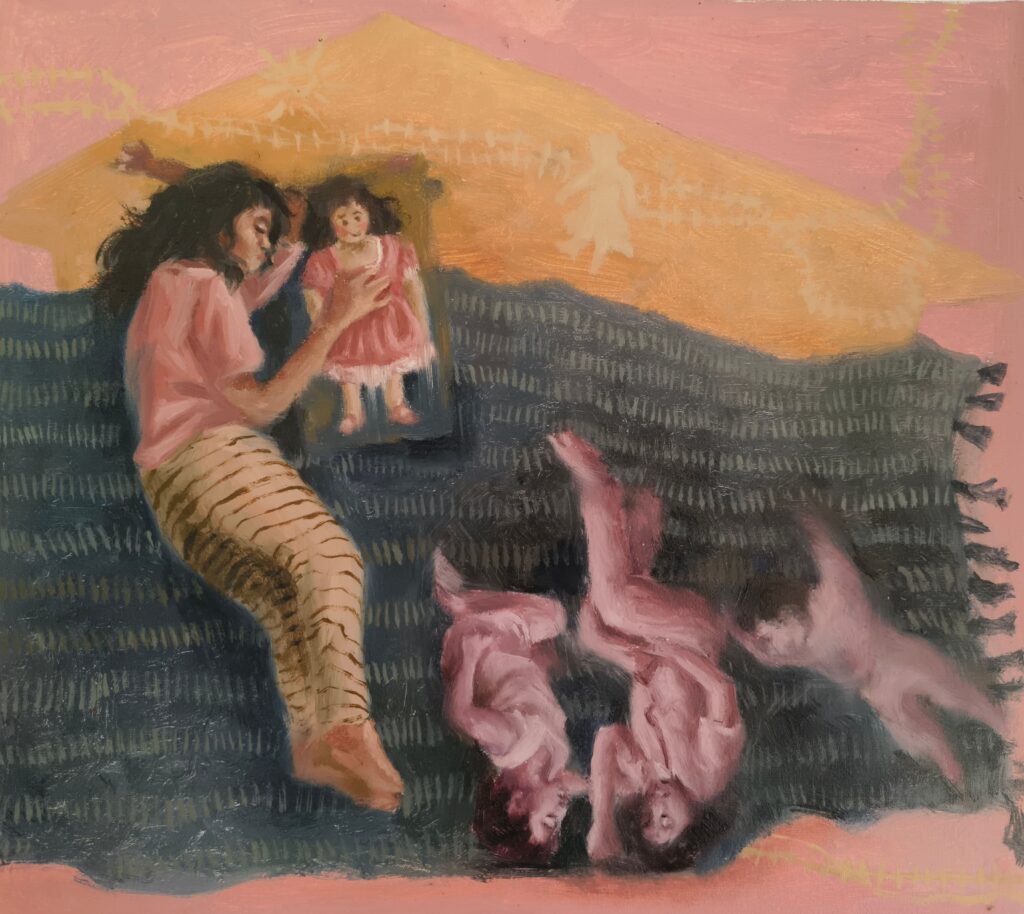
Almaa Solkar
Lost in Time
The toys she waited for were already fading
Pink walls the colour of a cheek pressed to a pillow.
A yellow roof drawn in faint lines holds a sun and a small girl.
The dark blanket is stitched with short pale marks like counted days.
She sleeps with a boxed doll against her chest.
Below her three pink children fall upside down
and thin into the cloth before anyone calls them to play.
Almaa Solkar paints Lost in Time in oil on paper in 2026. Her college is Devrukh College of Art and Design in Ratnagiri. The painting comes from her childhood. Solkar was told to wait for toys. By the time she was allowed to play with them, some had decayed. In the painting a grown woman lies on a dark blanket and holds a doll shut inside a box. Small pink figures tumble beside her and fade into the cloth.
Oil on paper · 30 × 48 cm · 2026
Theme Childhood and deferred play
RC-602

Almaa Solkar
Controlling One’s Mind
Where every head has been swapped for a controller
Pink shirts, hatched like rain on a window.
A man rests his face in his hand and his head is a tray of tools.
White plastic chairs wait with their small round holes.
The floor goes brown and cream, brown and cream, up to the stairs.
On every tray a tiny figure bends over its work.
No one looks up. The room is very quiet.
This painting is by Almaa Solkar of Devrukh College of Art and Design in Ratnagiri. It is made in poster colour on paper. It shows an ordinary room with a chequered floor, plastic chairs and a staircase. The people in it have no heads. In their place sit flat trays of small grey tools and tiny figures. Solkar calls these controllers. The work is a surreal piece about how we try to read or manage other people's thoughts. The colours stay soft: browns, pinks and greys.
Gouache (poster colour) on paper · 58 × 76 cm · 2026
Theme Controlling other minds
RC-603

Almaa Solkar
Dialogues Between Machines and Nature
Where the fish turn to metal and the gears turn brown
Brown earth, brown wood, a sky the colour of rust.
The men are cut from folded paper and polished tin.
A white hand grips a plank as if it were warm bread.
Fish swim through the teeth of a gear and do not bleed.
Grey rods run past like rails with no train.
No one here is quite flesh. No machine is quite cold.
In this gouache painting, Almaa Solkar places machines and nature in one picture. The work comes from Devrukh College of Art and Design in Ratnagiri. People, fish and animals take mechanical forms. The human figures are painted in metallic tones. The machines take on organic colours. Solkar builds every body from flat, sharp planes. Grey rods cross the picture and gears sit among white fish. Slowly the line between the two worlds fades.
Gouache poster colour on paper · 58 × 76 cm · 2026
Theme Machines and living things
RC-604
From the open call
Bhumika
I was trying to create something related to life andin other two series work i was just experimenting with my dream …………………………………………… …………………………………………… ……………………………… ……………………………… …………………………………………… ……………………………… ……… …………………………………………… ……………………………… ………………………………………………………………………………………………… ……………………………… …… …………………………………………… …………………………………………… ……………………………… ……………………………… …………………………………………… ……………………………… ……… …………………………………………… ……………………………… …………………………… …………………………………………… …………………………………………… ……………………………… ……………………………… …………………………………………… ……………………………… ……… …………………………………………… ……………………………… ………………………………………………… …………………………………………… …………………………………………… ……………………………… ……………………………… …………………………………………… ……………………………… ……… …………………………………………… ……………………………… …………………………… …………………………………………… …………………………………………… ……………………………… ……………………………… …………………………………………… ……………………………… …………
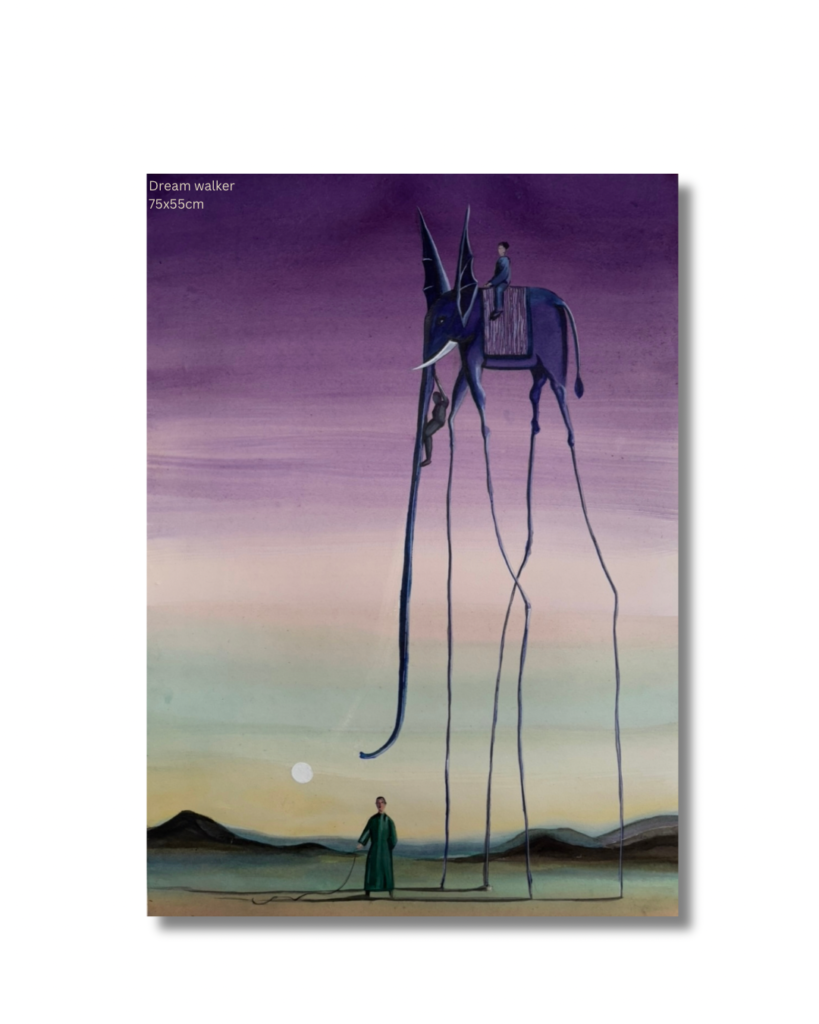
Bhumika
Dream walker
An elephant on legs like thread, walking into the evening
Purple settles at the top of the sky like ink dropped in water.
Lower down it thins to rose, then green, then the yellow of old paper.
An elephant stands on four lines as thin as thread.
A small figure rides its back. A small creature clings to its tusk.
Below, a man in a green robe holds a loose rope.
A white moon waits by the dark hills.
Nobody hurries.
Bhumika of Amity University Rajasthan makes Dream walker in 2025. The work measures 75 × 55 cm. Watercolour and ink wash the sky in soft bands, from deep purple at the top to pale yellow near the ground. Against this sky a tall elephant stands on very thin legs. A small figure rides on its back. A man in a long green robe waits below with a rope. Bhumika describes the work as an attempt to make something about life.
Mixed media: watercolour and ink · 75 × 55 cm · 2025
Theme Life and dreams
RC-613

Bhumika
Apart
One traveller rides near the clouds. The other stays on the ground
Plum at the top of the sky, then butter yellow, then a cold pale green.
A camel lifts its body on legs as thin as a brush handle.
Its ears open like dark wings.
Someone sits up there, wrapped and quiet, closer to the sky than the ground.
Below, a man in green leans on his crook.
A small white moon rests between them.
The cacti hold the edges.
In Apart a camel rises on very long thin legs. Its ears open like wings. A rider sits high on its back near a plum sky. Far below a small figure in a green robe holds a staff. A pale moon hangs low between them. Bhumika works here in ink and watercolour. The work measures 75 × 55 cm. Bhumika is an artist from Bhiwadi and Amity University Rajasthan. She says the work is related to life. In two other series she experiments with her dreams.
Mixed media: ink and watercolour · 75 × 55 cm · 2025
Theme Distance between people
RC-614

Bhumika
The one who never left
A small house glows while someone watches from the far hill
Green so deep it is almost black, like a pond at night.
Thin trees rise on the left and do not end.
A small moon hangs in their branches, pale as lime.
One light line marks where the hills meet the sky.
A figure stands on the top, very still.
Below, a green house, a white fence, a lamp.
Someone waits on the roof, as if the house could not be left.
Bhumika makes The one who never left in 2025 in acrylic mix on canvas. The painting is 60 × 45 cm. Bhumika is based in Bhiwadi and is at Amity University Rajasthan. In other series Bhumika works with dreams. Here the aim is something related to life. The whole canvas is a deep dark green. A small house glows near the centre. Tiny figures stand on its roof, beside a lamp and on a far mountain top.
Acrylic mix on canvas · 60 × 45 cm · 2025
Theme Staying close to home
RC-615
From the open call
Mayank Athwal
I am a digital artist and illustrator whose work is mainly inspired by the history, culture and artistic heritage of Punjab, with a particular interest in Sikh art and history. Most of my artistic practice is based on observing and studying historical paintings and visual material from different periods of Punjab's history. These include Sikh miniature paintings, artworks connected with eighteenth-century Punjab and the Sikh Misldar period, paintings from the…


Mayank Athwal
A voice that refuses to fade
Three young faces turn toward a history still being written
Three faces turn toward the same unseen point.
A turban the colour of ripe wheat holds the light.
Behind it, a gold hoop, a green shirt, a backpack strap worn for the day.
Then dark curls and a blue hood, the youngest chin lifted.
The sky fades from grey to dust.
Across the corner a maroon band cuts in, carrying the old cry in white letters.
Mayank Athwal makes this work in Adobe Photoshop. Three young people stand in profile and look the same way. A Sikh man in a yellow turban and white shirt leads. A young woman with a backpack and a young man in a blue hoodie stand behind him. Words run across the top and a dark red band carries the slogan "Inqlaab Zindabad". Athwal studies old paintings of Punjab and Sikh history. Here that study meets the bold look of a modern poster.
Digital illustration made in Adobe Photoshop · 101.6 × 88.9 cm · 2026
Theme Youth and revolution
RC-658
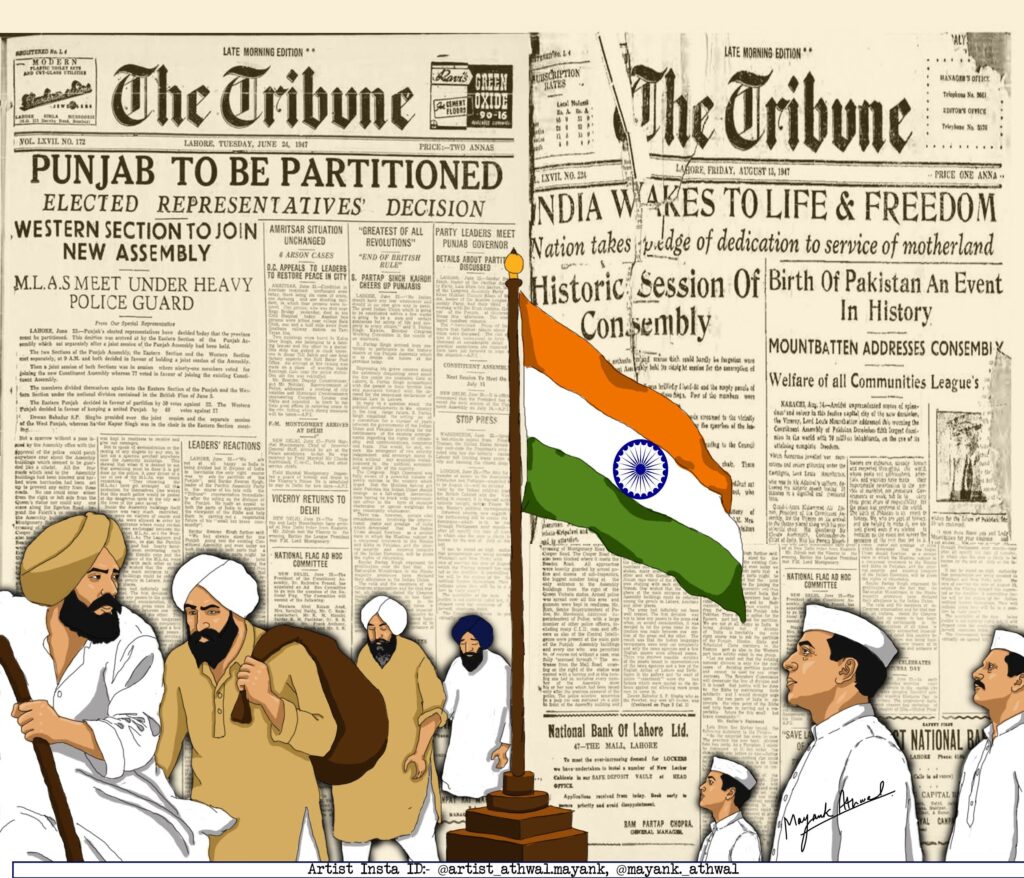
Mayank Athwal
Two Sides of a Coin
Seven weeks separate a divided Punjab from a free India
Old newsprint, yellow as a dry field, fills the sky.
On one side, men in khaki and white carry what they can lift.
A sack bends a back. A stick tests the road.
On the other side, white caps tilt up toward saffron and green.
The wooden pole stands between them like a border.
The same black ink runs under both.
In Two Sides of a Coin, Mayank Athwal sets two front pages of The Tribune side by side. One, from Lahore on 24 June 1947, reads "Punjab to be Partitioned". The other, from 15 August 1947, reads "India Wakes to Life & Freedom". Athwal draws over them in Adobe Photoshop. On the left, Sikh men walk with sacks and sticks. On the right, men in white caps look up at the flag. Athwal is from the Government College of Art in Chandigarh.
Digital illustration in Adobe Photoshop over digital copies of two pages of The Tribune · 76.2 × 88.9 cm · 2026
Theme Partition and Independence
RC-659
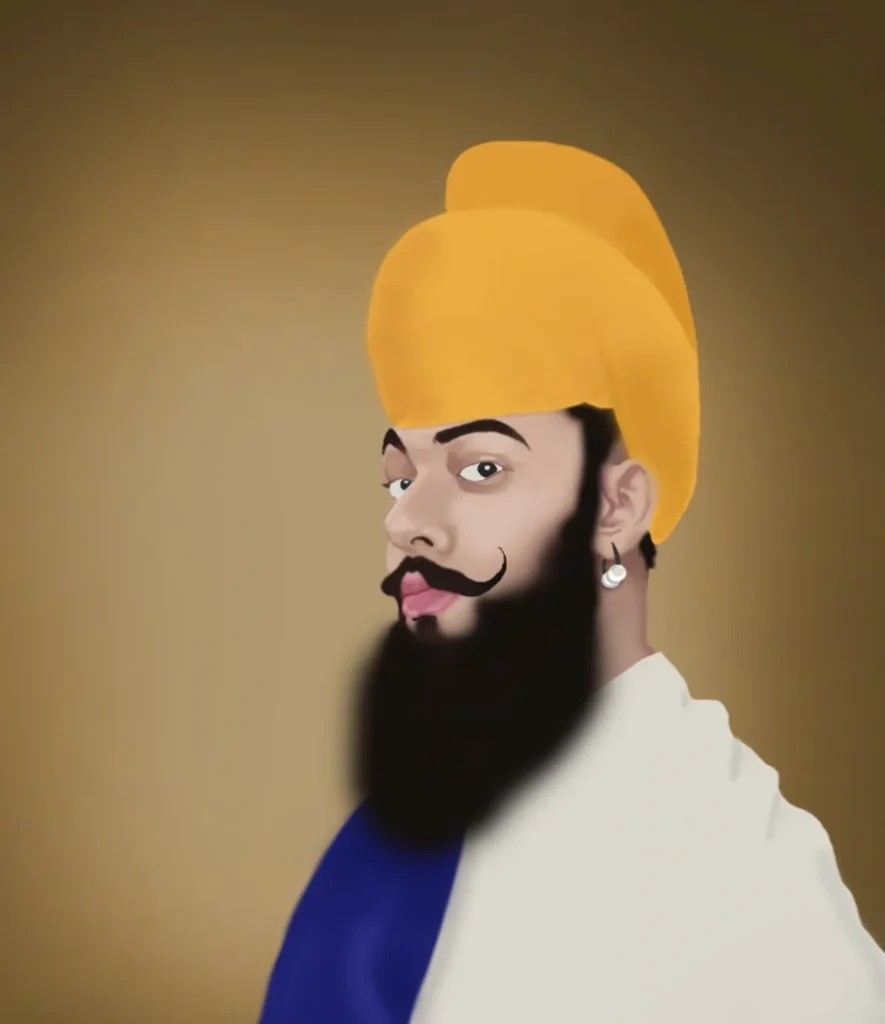
Mayank Athwal
Sikh Misldar
A Misldar looks back over his shoulder at us
A turban the colour of marigolds rises in two slow folds.
His eyes slide sideways, as if someone has just called his name.
The moustache curls up like a thin line of ink.
The beard has no edge. It sinks into the dark.
Two small white drops catch the light at his ear.
Behind him the air is warm and brown, like old varnish.
Mayank Athwal makes his pictures in Adobe Photoshop. He studies old paintings of Punjab closely. These include Sikh miniatures and art from eighteenth-century Punjab and the Sikh Misldar period. His aim is to give history a new form rather than copy it. In Sikh Misldar he paints a man in a tall yellow turban and a white shawl. The edge of his dark beard melts softly into shadow. The work is one of three he has submitted to this exhibition.
Digital painting in Adobe Photoshop · 42 × 29.7 cm · 2026
Theme Sikh history reimagined
RC-660
From the open call
Mohammad Sadikot
I try to paint people the way they feel, not just how they look. My figures don't have hard, clear lines. They blend into the space around them, almost like they're dissolving into it. I do this on purpose. People are never fixed or the same all the time. We change with our mood, our surroundings, the people we're with. So instead of giving my figures a sharp, solid edge,…



Mohammad Sadikot
Negotiated Form LOT-14
A body that drips back into the ground it stands on
Peach skin, heavy as a sack of wet flour.
Brown legs melt like river mud into brown earth.
Thin canes hold the weight. Even the canes run.
Behind, green strokes stand up like broken walls.
The sky is grey water, not yet rain.
The head is a small brown stone with a pale line around it.
No face. Only the back of someone still deciding where to end.
Mohammad Sadikot is an artist from Pune. Sadikot's college is the JJ School of Art, Design and Architecture. In this work from 2025, a large figure stands with its back to us. It leans on thin sticks. Paint runs from its body into the brown ground. Acrylic lets Sadikot build the figure slowly, layer by layer. Charcoal is faster and rougher. The edges stay soft on purpose. Sadikot explains why: "People are never fixed or the same all the time."
Acrylic colour, soft pastel and charcoal on paper · 68.58 × 53.34 cm · 2025
Theme The shifting self
RC-583

Mohammad Sadikot
Negotiated Form LOT-58
A body caught halfway between standing and melting away
A grey ground, like a wall before rain.
A white frame drawn in running stitches, open at one side.
A body of brown knots, combed in a thousand small strokes.
It stands on two pale stems that spread like a bird's feet.
Behind it, dark shapes lean up like smoke from wet wood.
Below, a blue floor of lines, dripping white.
At the top, a black stone holds a small white turn, a head still deciding.
Mohammad Sadikot is a Pune artist from the JJ School of Art, Design and Architecture. In Negotiated Form LOT-58, made in 2025, a figure of rounded brown forms stands on two thin white legs. Fine lines cover its body like fur or wood grain. Behind it rise tall brown shapes. Sadikot uses water-poster colour and builds the painting slowly, layer by layer. The edges stay soft on purpose. The aim is a figure 'forming and dissolving at the same time.'
Mixed media with water-poster colour · 11.43 × 14.43 cm · 2025
Theme A self that changes
RC-584

Mohammad Sadikot
Negotiated Form LOT-03
A body leaning out of itself, toward something small and new
Light the colour of wet sand lies on ribbed paper.
A tall shape leans out of brown earth and bends like a neck.
Inside it the blue is deep as a well at night.
Small pieces break away and float toward the ground.
At the edge a thin plant stands with a few leaves.
Nothing here has a hard line. Everything is still deciding what it is.
This small square painting by Mohammad Sadikot is from 2025. It measures only 11.43 × 11.43 cm. Sadikot works in water and poster colour and builds the image slowly, layer by layer. A tall ochre form rises on the right. Its top bends over like a head around a deep blue centre. Broken pieces drift down toward a small plant at the bottom left. No edge is hard. The figure seems to form and dissolve at the same time.
Mixed media: water-poster colour · 11.43 × 11.43 cm · 2025
Theme The changing self
RC-585
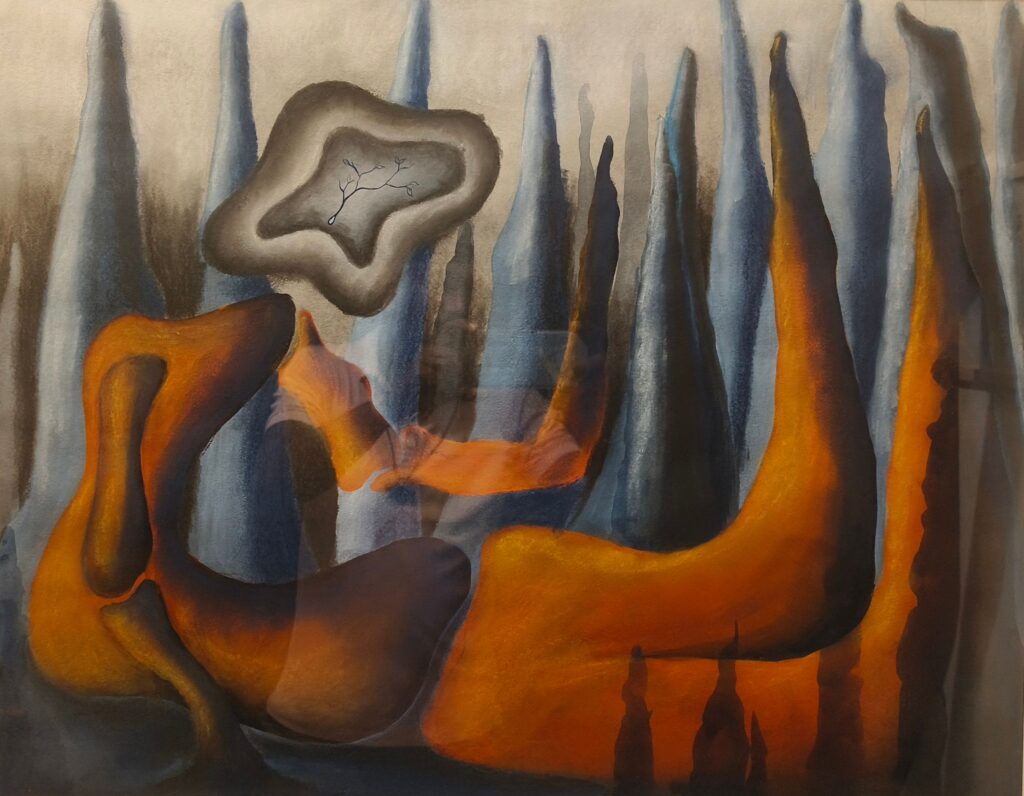
Mohammad Sadikot
Negotiated Form LOT-13
An orange body softening into a forest of grey-blue spires
Orange the colour of a lamp left on in an empty room.
A body lies down and forgets where it ends.
Behind it, tall blue points rise like smoke that has learned to stand.
A second shape moves through the first, thin as breath on glass.
Above, a grey cloud holds one small bare tree.
Charcoal dust settles at the edges like evening.
Mohammad Sadikot is a Pune artist from JJ School of Art, Design and Architecture. He tries to paint people the way they feel, not only how they look. Here an orange figure lies across the paper. Its edges blur into the space around it. A second, paler shape passes through it. Sadikot builds the colour slowly in layers of acrylic. Charcoal adds a raw, fast mark. The hardest part, he says, is knowing when to stop. "People are never fixed or the same all the time."
Acrylic, soft pastel and charcoal on paper · 53.34 × 68.58 cm · 2025
Theme The changing self
RC-586

Mohammad Sadikot
Negotiated Form LOT-01
A head floats free while the body stays heavy
A dark body sits low, heavy as wet clay.
Where a head should be, a small blue stone floats with a thin branch inside.
Grey fingers of earth rise and lean toward the light.
Behind them, pale shapes stand like people half remembered.
Every edge keeps a white line where the water stopped and dried.
Nothing here has finished becoming itself.
Mohammad Sadikot makes this small painting with water-poster colour on paper. It measures 11.43 × 11.43 cm. Sadikot is based in Pune and is connected to the JJ School of Art, Design and Architecture. The colour goes on slowly, layer by layer. No edge is hard. Sadikot wants to paint people "the way they feel, not just how they look." The figure must blur but not vanish. As Sadikot says, "The hardest part is knowing when to stop."
Water-poster colour on paper (mixed media) · 11.43 × 11.43 cm · 2025
Theme The changing self
RC-587
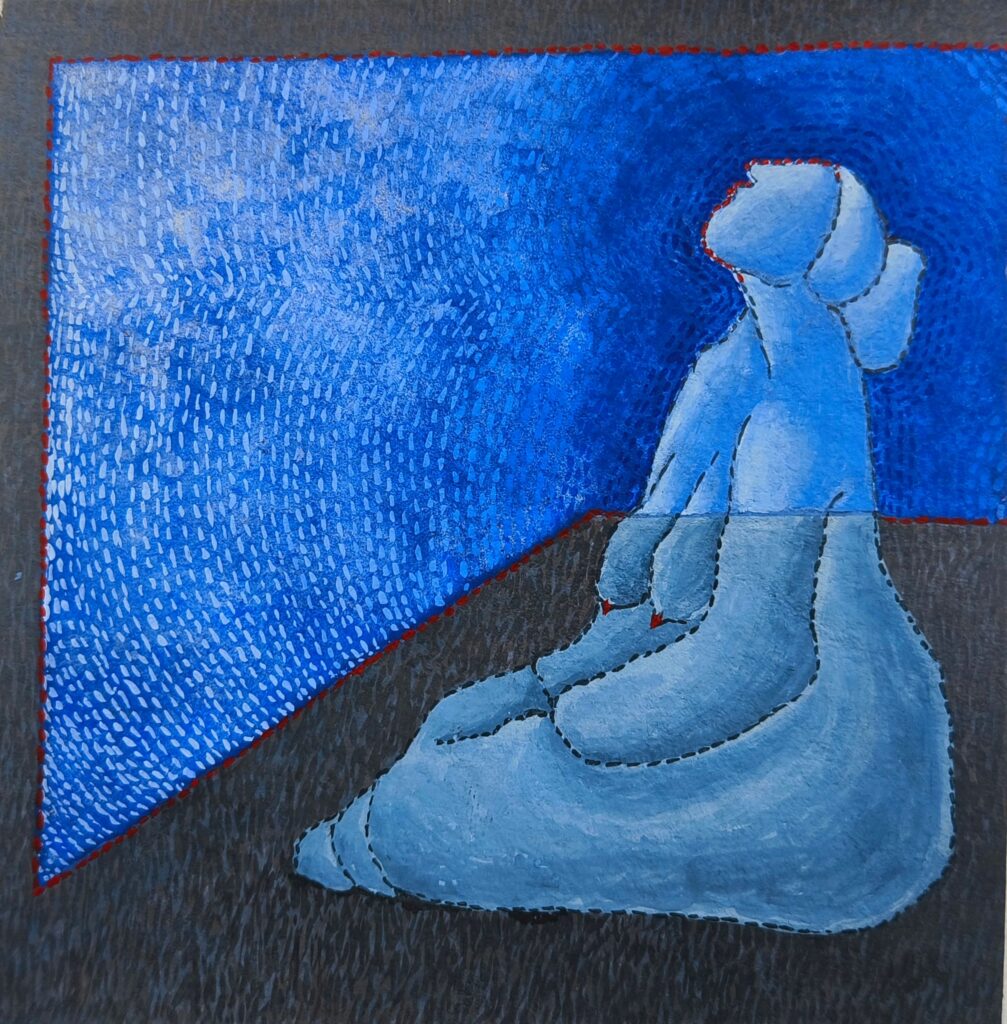
Mohammad Sadikot
Negotiated Space LOT-07
A figure kneels where the blue ends and the grey begins
A wedge of blue opens like a window left on at night.
Thousands of white strokes fall through it, rain or stars.
The figure kneels on grey ground, turned away from us.
Where the blue stops, its body darkens, as if wet to the waist.
Red stitches run along the edges, holding things in place.
Nothing here is fixed. Only sewn, for now.
In Negotiated Space LOT-07, a pale blue figure kneels on dark grey ground. It faces a wide wedge of deep blue filled with small white strokes. Mohammad Sadikot, from JJ School of Art, Design and Architecture, makes the work in water-poster colour on paper. Sadikot builds it slowly, layer by layer. The figure has no solid edge. Dashed lines trace it, so it seems to form and dissolve at the same time. For Sadikot, the hard part is knowing when to stop.
Mixed media: water-poster colour on paper · 11.43 × 11.43 cm · 2026
Theme The changing self
RC-588

Mohammad Sadikot
Negotiated Space LOT-05
A body that melts into the chair it rests in
A red chair, worn to the colour of dried henna.
Pale arms close around a speckled weight, like a loaf held to the chest.
Below the hands, the body stops being a body.
It pours down in brown strokes, slow as river mud.
Ballpoint lines catch the light like thread in old cloth.
No one can say where the sitter ends and the chair begins.
Mohammad Sadikot is an artist from Pune at the JJ School of Art, Design and Architecture. In this small work on paper, 16.51 × 13.97 cm, a pale figure sits in a deep red chair. Sadikot builds the painting slowly with water-poster colour, layer by layer. Black ballpoint pen adds fine, close lines. Below the folded arms, the body melts into brown paint and joins the chair. This is on purpose. For Sadikot, people are never fixed. The hardest part is knowing when to stop.
Mixed media: water-poster colour and black ballpoint pen on paper · 16.51 × 13.97 cm · 2026
Theme The changing self
RC-589
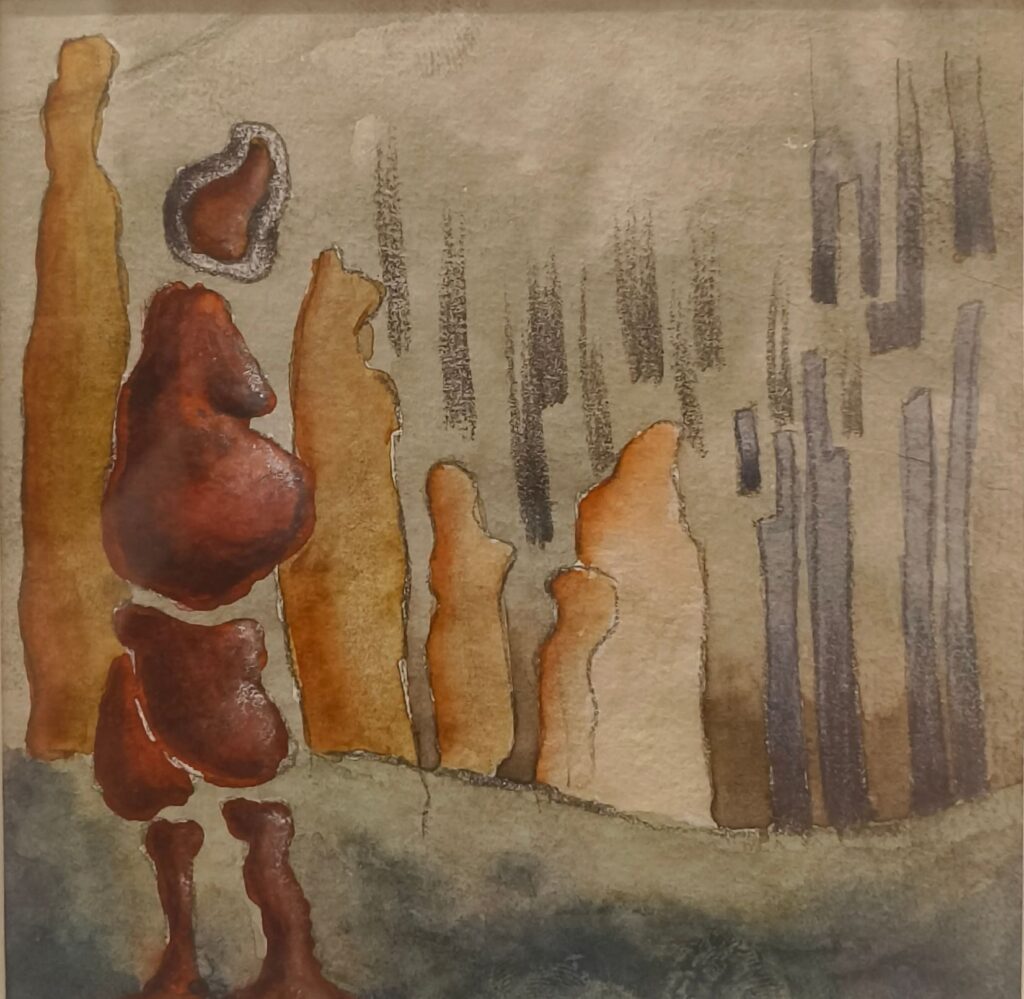
Mohammad Sadikot
Negotiated Form LOT-04
Small figures on a green hill, each one losing its edge
Rust stones stack like a body learning to stand.
Ochre figures lean together on a low green hill.
Behind them charcoal falls in soft grey rain.
On the right the grey columns thin out like smoke.
No edge here holds for long.
Each shape is half a person and half the air around it.
Mohammad Sadikot is a Pune artist from the JJ School of Art, Design and Architecture. Negotiated Form LOT-04 is a small work on paper, 11.43 × 11.43 cm. Tall shapes stand on a low green hill. Some are ochre and rust. Others are grey. Sadikot uses watercolour, soft pastel and charcoal. Watercolour builds slowly in layers. Charcoal is quick. The edges stay soft on purpose, because for Sadikot "we are not fixed".
Watercolour, soft pastel and charcoal on paper · 11.43 × 11.43 cm · 2025
Theme The shifting self
RC-590
From the open call
Piyush Gond
As an art practitioner, I work across sculpture and mixed media, exploring different materials and processes to understand how form can communicate human experiences. My practice is centered on emotions, desires, intimacy, and the relationships that shape our lives. I am interested in exploring feelings that often remain unseen or difficult to express, such as love, longing, vulnerability, care, and the need for connection. Through my work, I try to…


Piyush Gond
Axis of Desire
Two brass forms reach for each other along one dark stem
Brass gone green at the edges, like old coins kept in a pocket.
A dark stem holds a folded bloom above a cupped one.
The lower petals lean up. The upper ones lean away.
Warm light finds the ridges and leaves the hollows dim.
Under it all sits a square of red-brown wood, steady and plain.
Two shapes, almost touching, wait on one thin line.
Axis of Desire is a brass sculpture by Piyush Gond from 2025. Gond is from the College of Art, Delhi University, in New Delhi. Gond works across sculpture and mixed media. Testing new materials is a key part of the practice. Gond lets the material become part of the making. Here two folded brass forms rise from a wooden block. A dark rod joins them. The forms are simple and abstract. They do not tell one story. They ask viewers to think about their own feelings and relationships.
Brass · 3.81 × 20.32 × 20.32 cm · 2025
Theme Longing and connection
RC-568

Piyush Gond
Towards you
Brass that leans forward, as if someone waits just ahead
Green rust on brass, like old coins left in the rain.
A round head tips forward. The body stretches thin behind it.
Two soft lobes trail like wings or like feet that have left the ground.
One bent rod is all that holds it up.
Below, the wood is warm and red. Its grain runs sideways.
The figure does not look down. It is already leaning towards someone.
Piyush Gond studies at the College of Art, Delhi University in New Delhi. Gond works in sculpture and mixed media. In this work a brass figure leans forward through the air. Its round head and soft body end in two lobes like wings. A thin curved rod holds it above a block of wood. Gond uses simple human forms to give shape to feelings such as longing and the need for connection. In Gond's words: "Rather than telling a specific story, I create forms that invite multiple interpretations..."
Brass and wood · 40.64 × 30.48 × 15.24 cm · 2026
Theme Longing and connection
RC-569
Piyush Gond
Chaos
A quiet pillar of metal that cannot keep its head still
Grey metal stands up straight on a block of old wood.
A thin dark gap runs through its legs like a door left open.
Then, at the top, it gives way.
Folds crowd over folds, like cloth caught in wind, like a thought that will not settle.
The light sits dull on the pitted skin.
Below, the wood keeps its own slow grain.
Piyush Gond is a sculptor from the College of Art, Delhi University, in New Delhi. In Chaos, made in 2025, a straight aluminium column rises from a block of dark wood. A narrow opening runs up its lower half. At the top the metal breaks into folds that curl and overlap. Gond often uses simple human forms to give shape to feelings that are hard to say. The column can read as a body and the folds as a crowded mind. Gond leaves the meaning open for each viewer.
Aluminium · 4.83 × 7.62 × 7.62 cm · 2025
Theme Calm body, restless mind
RC-570
From the open call
shweta S
Just being multi hyphenate and exploring every medium of interest. I create vibrant visual narratives using acrylic and oil paints, exploring the deep connection between the natural world, ancient deities, and public spaces. My work transitions between the intimate scale of studio canvas and the expansive, immersive format of wall murals. My creative practice is rooted in the intersection of the natural world, ancient spiritual realms, and the shared spaces…

shweta S
Venkateshwara swamy mdf clay art
A god small enough to hold in one open hand
A blue face the size of a palm.
Gold rises from the dark red board in small curled leaves.
The crown climbs in rings. The necklace falls in rows.
On one side a conch. On the other side a wheel.
Two pink buds wait on green stems.
The white mark on the forehead is the brightest thing here.
Behind the hand, warm stone holds still.
Shweta S makes this small relief of Venkateshwara Swamy in clay on a round MDF board. It measures 15 × 15 cm. The face is deep blue with a white mark on the forehead. The crown, the necklace, the conch and the wheel stand out from the board in gold. Two pink lotus buds hang on green stems. Shweta comes from Sri Venkateshwara College of Fine Arts in Hyderabad. Shweta usually paints with acrylic and oil, on canvas and on walls. This 2025 work brings the same deities into clay.
Clay on MDF board · 15 × 15 cm · 2025
Theme Devotion held in hand
RC-617
shweta S
Peeky owl
An owl in sunset feathers keeps watch from a canvas bag
Two orange eyes, each a ring inside a ring.
Feathers stack like folded saris, blue on purple on red.
The claws hold a brown branch that bends with the cloth.
Pink flowers open at the corners. Teal dots drift like seeds.
A hand grips the top of the bag. The owl goes where the hand goes.
Behind it, dark brick keeps still.
Peeky Owl is a painting you can carry. Shweta S makes it in 2025 with acrylic paint on a cotton tote bag that measures 50 × 40 cm. An owl with wide orange eyes sits on a thin brown branch. Its feathers fall in bands of orange, purple and deep blue. Pink flowers, green leaves and dots of teal and yellow ring the bird. Shweta is from Sri Venkateshwara College of Fine Arts in Hyderabad. She paints in acrylic and oil, on studio canvases and on large walls.
Acrylic on cotton tote bag · 50 × 40 cm · 2025
Theme Nature in everyday life
RC-618
shweta S
Lord murugan
A temple throne, small enough to hold in two hands
A god no bigger than two hands sits on a spiral page.
Gold curls rise over him to meet the face of a lion.
Two peacocks keep watch in blue and green.
His spear stands straight as a lamp wick.
Purple cloth folds across his knee like evening.
Blue wash runs to the edge of the paper
and the painted table glows red underneath.
Shweta S, of Sri Venkateshwara College of Fine Arts in Hyderabad, usually paints in acrylic and oil. She works on studio canvases and on large wall murals. Here she works small. Lord Murugan sits on a golden throne on a sketchbook page of 12 × 15 cm. He holds his spear upright. Two peacocks stand on the pillars beside him. A lion face crowns the arch. Shweta builds the jewellery and carving in warm yellows and browns. A blue wash frames the page.
Watercolour on paper · 12 × 15 cm · 2026
Theme The divine made intimate
RC-619

shweta S
Shiva and nandi
Two closed pairs of eyes under one old tree
Grey water pools under the bull's chin.
His bells and beads hang heavy and still.
The god leans back into that warm side, eyes shut, a string of seeds on his chest.
Above them the tree pulls its dark branches across the page.
On the left a small stone keeps its shadow.
Under the sketchbook, red flowers from an old painting call out.
Here nobody speaks.
Shweta S, of Sri Venkateshwara College of Fine Arts in Hyderabad, paints this small work in acrylic. The palette is only black, white and greys. Shiva sits and leans back against Nandi, the bull. Both have their eyes closed. A tree spreads its branches above them. A lingam rests on the left. Shweta works in acrylic and oil, on canvas in the studio and on large walls in public. In these paintings, trees and skies often hold the figures of gods.
Acrylic on paper · 15 × 15 cm · 2026
Theme Quiet devotion in nature
RC-620
From the open call
Lalit ahlawat
My submitted work explores the complex relationship between the conscious and unconscious mind. I am interested in the way our visible thoughts, memories, emotions, dreams and experiences exist together and continuously influence our identity. The conscious mind represents what we recognize, understand and experience in the present moment, while the unconscious contains hidden memories, emotions, fears, desires and thoughts that often remain beyond our direct awareness. Through these paintings, I…
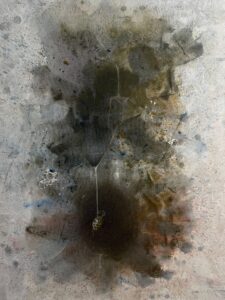
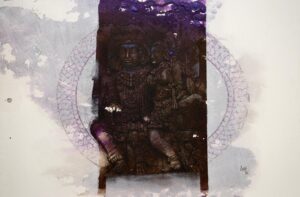
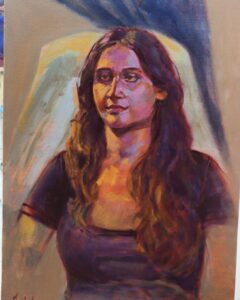
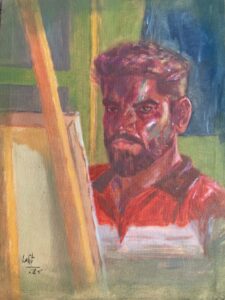
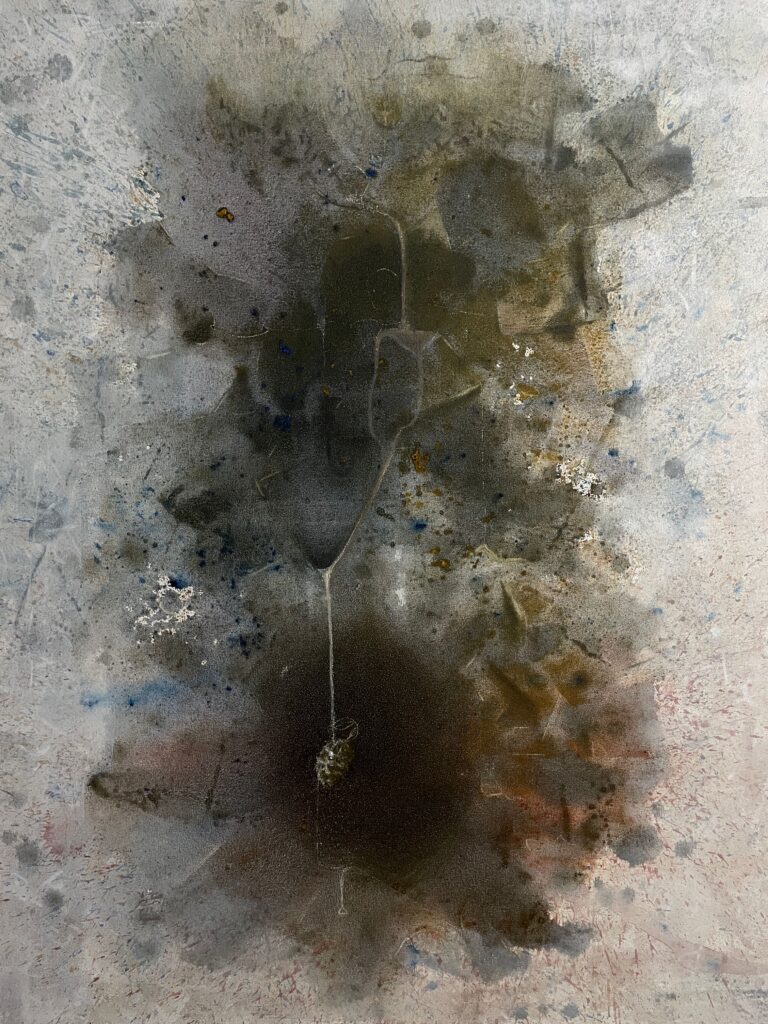
Lalit ahlawat
The unconscious surface
A single thread drops into the dark and holds on
A pale wall, scratched like an old table.
Smoke gathers in the middle and does not leave.
Brown, olive, a little rust, a few drops of blue.
One thin thread falls from the dark.
At its end a small knot, like a seed or a sleeping insect.
Below it the colour sinks into a deep round shadow.
Something is kept here, under the surface.
Lalit Ahlawat of Subharti University in Meerut makes this painting in acrylic on canvas. The work is about the conscious and the unconscious mind. Ahlawat does not begin with a fixed image. The painting grows in layers through "observation, instinct, accident and response to the materials." A cloud of brown, olive and black spreads over a pale scratched ground. A thin line drops through it like a thread. Ahlawat leaves space for viewers to bring their own memories into the work.
Acrylic on canvas · 123 × 68 × 1.9 cm · 2026
Theme The hidden mind
RC-540
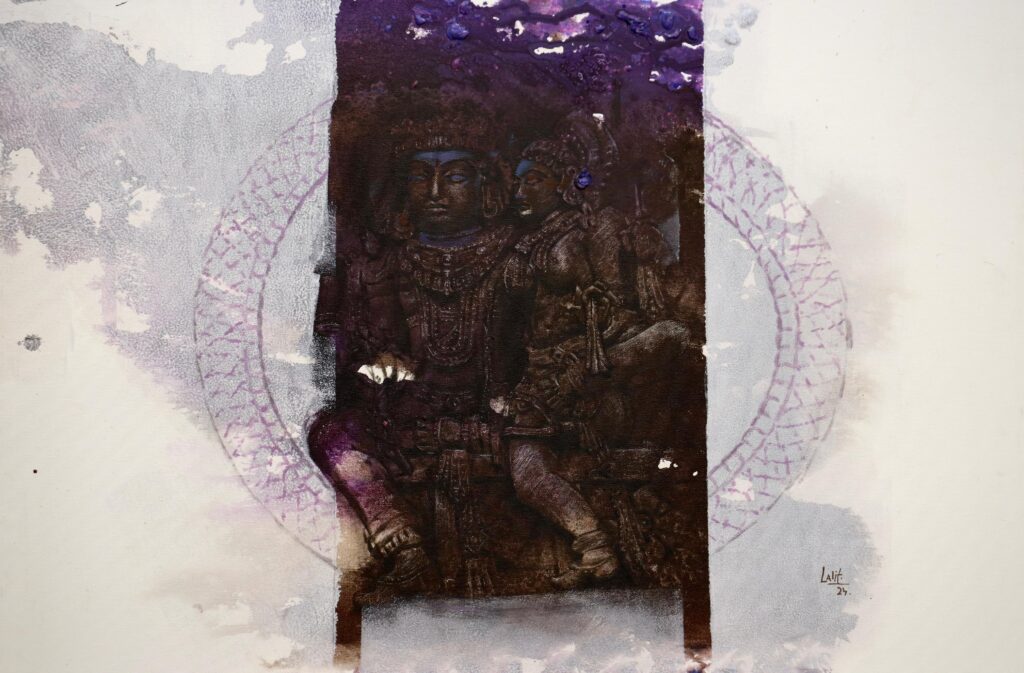
Lalit ahlawat
Ancient india
Two carved figures sit still while purple paint drips above them
The stone couple sits close. He looks ahead and she turns her face to him.
Blue touches their eyes like cold water.
Above them purple pools and breaks into small dark beads.
A ring of scratched lilac circles the pair, worn like an old wheel.
Grey washes drift out to the white edge of the canvas.
One pale mark of light rests on his hand.
Lalit Ahlawat studies at Subharti University in Meerut. In Ancient India, the image of a carved stone couple sits in deep brown at the centre of the canvas. Around it are thin washes of grey and lilac and a wide ring of purple marks. Ahlawat works in layers and does not always begin with a fixed image. The painting grows through instinct, accident and response to the paint. The aim is to hold the conscious and unconscious mind in one space.
Acrylic on canvas · 90 × 60 × 1.5 cm · 2025
Theme Conscious and unconscious mind
RC-541
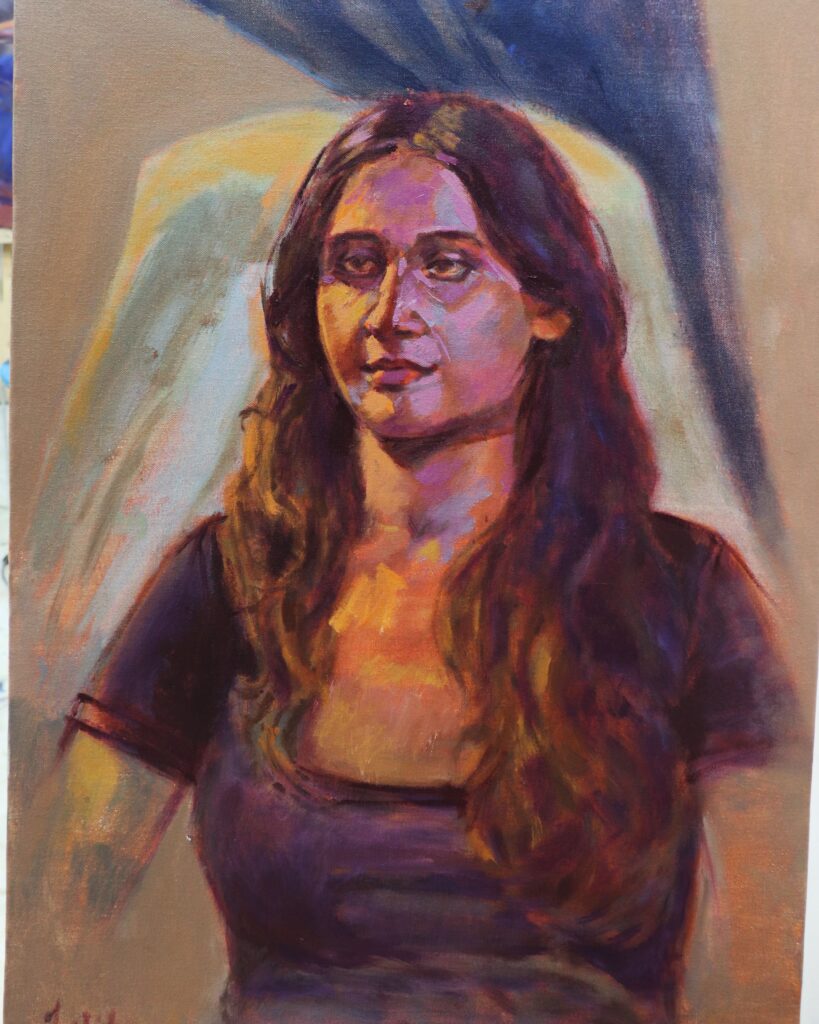
Lalit ahlawat
Untitled
A quiet face, built from violet, orange and bare canvas
Violet sits in the hollows of her cheeks.
Orange catches her collarbone like a lamp left on.
Her hair falls in brown and copper strokes past her shoulders.
Behind her a pale arch glows. A band of dark blue cuts across the top.
The bare tan canvas breathes between the marks.
She looks past us, calm, not yet finished.
Lalit Ahlawat, of Subharti University in Meerut, makes this untitled portrait in 2024. It is acrylic on canvas and measures 121 × 91 × 2 cm. Ahlawat does not always start with a fixed image. He lets the painting grow through observation, instinct and accident. Here the face is built in layers of pink, violet and orange. The tan canvas shows through around the figure. Ahlawat looks for a balance between a clear image and loose marks. He leaves space for the viewer's own memories.
Acrylic on canvas · 121 × 91 × 2 cm · 2024
Theme Conscious and unconscious mind
RC-542
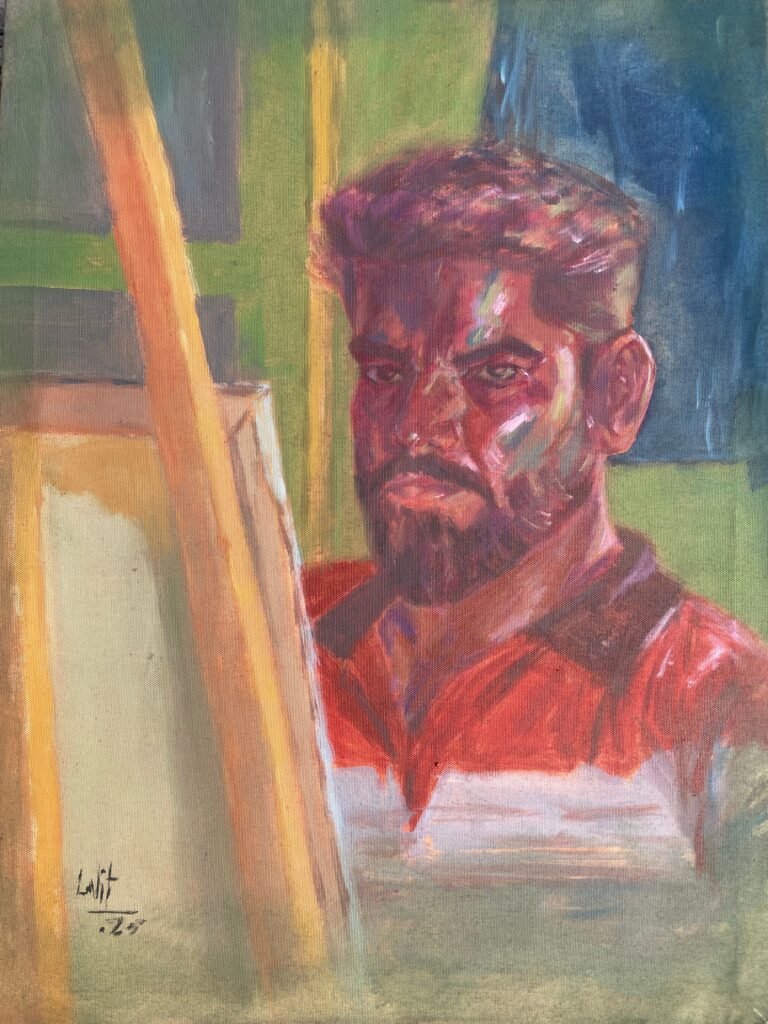
Lalit ahlawat
Self portrait
The painter looks up from the easel and meets your eyes
A red shirt fills the lower half of the canvas.
Pink and violet sit on his cheek like light from a window you cannot see.
The easel leans in, a tall yellow post.
Green walls. A patch of deep blue at his shoulder.
He has stopped painting for a moment.
His eyes ask what you are looking at.
Lalit Ahlawat paints himself at work. He stands behind an easel and looks out past its edge. He wears a red shirt. The painting is acrylic on canvas. Ahlawat says his process is intuitive. He does not always start with a fixed image. He builds the picture in layers and overlapping colours. Here pink, violet and green sit on his face. Flat blocks of green and blue fill the room behind him. He comes to the catalogue from Subharti University in Meerut.
Acrylic on canvas · 60 × 30 × 1.5 cm · 2024
Theme The artist observing himself
RC-543
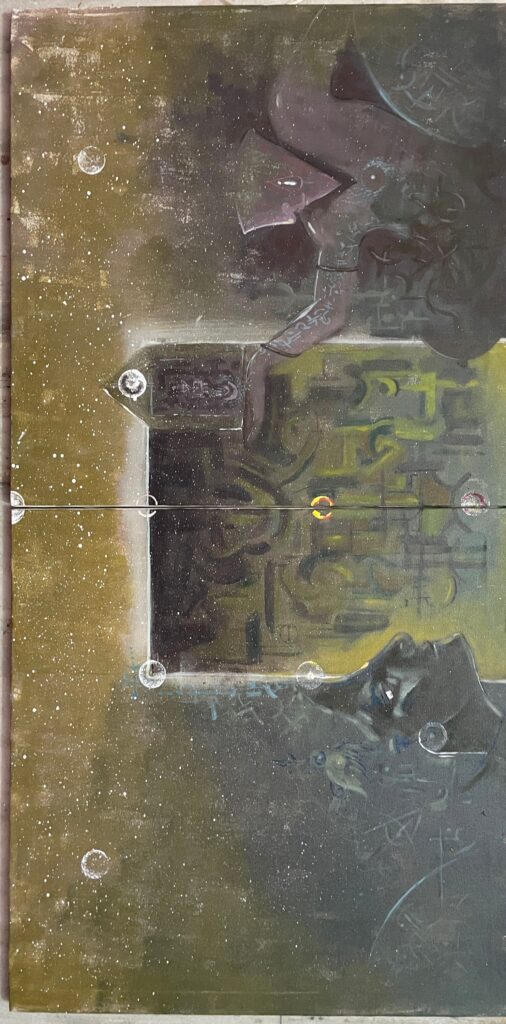
Lalit ahlawat
Light of lineage
A sleeping face, a reaching hand and a window of unread signs
Olive gold thins into grey like smoke at the end of a day.
Small white specks drift across it, dust or far stars.
A dark window holds yellow signs no one has read yet.
A mauve hand rests on its edge.
Below, a grey face sleeps with its eyes shut.
Clear bubbles float over everything, holding a little light.
This 2024 work by Lalit Ahlawat of Subharti University in Meerut is acrylic on canvas. Ahlawat does not begin with a fixed picture. The painting grows slowly in layers through looking, instinct and accident. Transparent forms and broken figures sit over one another. One figure reaches towards a dark panel full of signs like an old script. A second face rests below with closed eyes. For Ahlawat the hardest part is the balance between abstract marks and forms we can recognise.
Acrylic on canvas · 60 × 120 × 2 cm · 2024
Theme Conscious and unconscious mind
RC-544
From the open call
Vishakha Gautam
I paint things I think about and things I go through. A lot of my work comes from moments of change — when something ends, something shifts, or you suddenly see yourself or life differently. I find myself coming back to these moments because they can be uncomfortable, but they can also open up something new. The paintings I’ve shared here are about breakthroughs, transformation, finding strength after difficult experiences,…
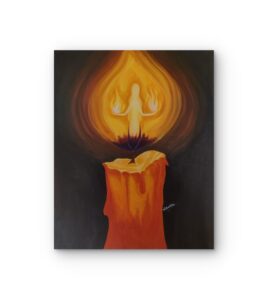
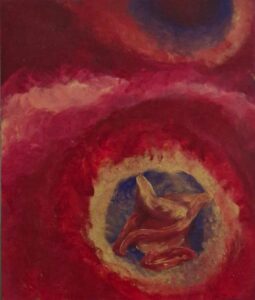


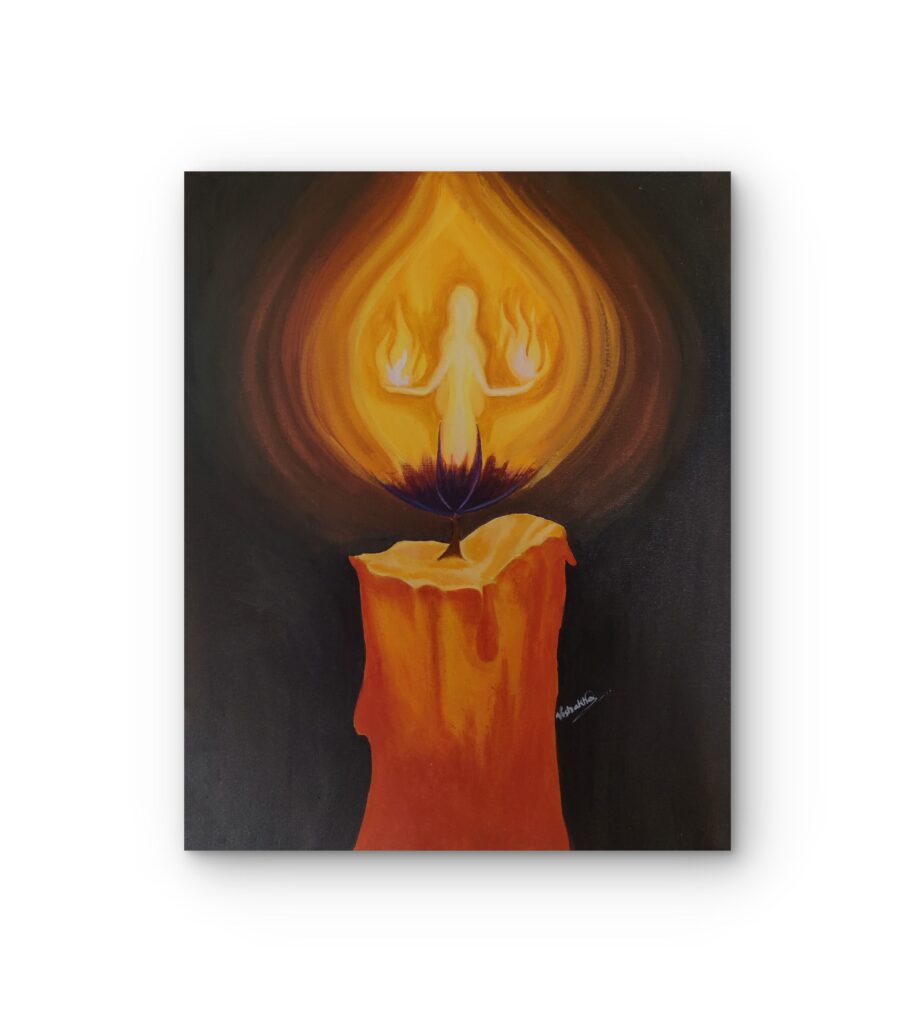
Vishakha Gautam
I lit up the highest when I was burned
The candle melts. Something inside the flame stands up
Orange wax slides down in slow drips.
At the wick a dark purple flower opens.
Out of it a pale body rises with arms wide.
A small fire sits in each palm like something carried home.
Rings of gold and brown spread into the dark.
The candle grows shorter. The light grows taller.
Vishakha Gautam paints moments of change. This acrylic work from 2023 measures 50.8 × 40.64 cm. A tall orange candle stands against a dark ground. The wax melts and runs down its sides. Inside the golden flame a pale figure opens its arms. A small flame burns in each hand. The figure rises from a dark purple flower at the wick. Gautam works in New Delhi. Gautam usually begins with a feeling and lets each painting change along the way.
Acrylic · 50.8 × 40.64 × 0.25 cm · 2023
Theme Strength through change
RC-626

Vishakha Gautam
transformation
Something small and pale pushes up through the red
Red folds over red, like heat closing a door.
High in one corner, a dark blue eye half opens.
Lower down, a ring the colour of old cream holds the night inside it.
Something pale twists there, a beak or a bud, lifting its tip.
The paint is thick enough to show the brush.
Nothing is finished changing yet.
Vishakha Gautam paints moments of change. Gautam works in New Delhi and made this painting in 2025. It measures 60.96 × 50.8 cm. Each work begins with an idea or a feeling. The end is not always clear at the start. Gautam lets the painting grow and changes things along the way. Here deep reds turn in rings around a small pale circle. Inside it a twisting shape lifts upward. Gautam hopes viewers will find their own meaning in it.
Acrylic · 60.96 × 50.8 × 0.25 cm · 2025
Theme Change and new growth
RC-627

Vishakha Gautam
It takes a great change to find your wings
A small dark shape waits at the centre of the light
An orange sun that is not quite a sun.
It turns in slow rings of paint toward the middle.
The night presses in from every corner, blue and nearly black.
On a thin branch a butterfly holds still, wings folded tight and dark as plum skin.
Two curled antennae test the warm air.
Nothing has flown yet.
The light is waiting for it.
Vishakha Gautam works in New Delhi. Gautam paints "things I think about and things I go through." This acrylic painting from 2023 is about change. A butterfly rests on a thin branch. Its wings are closed and dark. Behind it a round orange glow spreads out in circular brushstrokes. The glow fades into deep blue-black at the edges. Gautam often begins with an idea or a feeling and lets the painting develop along the way.
Acrylic · 40.64 × 50.8 × 0.25 cm · 2023
Theme Change and becoming
RC-628

Vishakha Gautam
Breakthrough
Pink and green waves bend toward a single glowing point
Rose and olive bend like cloth pulled through a doorway.
The brush runs dry and the grain of the surface shows through.
Red rises from the bottom edge like heat from a stove.
Everything leans toward one corner.
There a pale knot turns and opens.
At its heart a small coal of orange holds still.
Vishakha Gautam paints moments of change. She thinks of times when something ends or when a person sees life in a new way. Breakthrough is a square acrylic painting from 2024. Gautam is based in New Delhi. She starts with a feeling but does not plan every step. "I let it develop as I work and allow myself to change things along the way," she says. Here long curved strokes of pink, green and orange roll across the surface. They turn into a spiral with a pale, glowing centre.
Acrylic · 45.72 × 45.72 × 0.25 cm · 2024
Theme Moments of change
RC-629
From the open call
Reena Kavediya
Of course. Here is a polished English Artist Statement suitable for an exhibition, portfolio, or art competition. 🎨 Writing Artist Statement – Reena Dhoka I am Reena Dhoka, a professional artist and art educator. For me, art is more than a combination of colours, lines, and forms—it is a powerful way to express emotions, imagination, ideas, and experiences. My artwork is inspired by nature, Indian culture, everyday life, and the…

Reena Kavediya
Nature
A whole hillside climbs in green steps toward the cloud
The hill is cut into steps of lime and moss.
White houses rest on the ledges like chalk left on a sill.
Behind them the ridge turns the colour of ink.
Cloud spills over its edge and keeps going.
In front the field is so bright it almost hums.
One tree on the right leans into the light.
Nature is a digital work on paper from 2025. It shows a steep hill cut into narrow terraces. Small white houses sit on the ledges of land. A dark blue ridge rises behind them under a wide sky full of cloud. The marks look like wet paint that has soaked into the grain of the paper. The artist lives in Pune. She paints and teaches drawing and painting at Reena Arts. She says nature is one of the things that inspires her work.
Digital, on paper · 45 × 40 × 30 cm · 2025
Theme Terraced hills and sky
RC-669

Reena Kavediya
45
A mountain road bends out of sight under a huge blue sky
The road turns before we can see where it goes.
A lilac edge holds it to the hill.
Grass the colour of a cut lime runs down to meet it.
On the ridge the pines stand dark and close together.
One thin mast pins the hill to the sky.
Above, the blue is wide and the clouds break into small white pieces.
This digital painting shows a hill road on a bright day. The road curves in from the lower right and leaves the frame. Grass in lime and yellow fills the slope. Dark pines line the ridge and a thin tower rises behind them. The sky takes more than half the picture. The surface looks like watercolour on rough paper. Colour sits in small soft patches with no hard edges. The artist works in Pune and teaches art at Reena Arts.
Digital · 45 × 40 × 30 cm · 40
Theme Hill road and open sky
RC-670
From the open call
anurag
Concept: Inner Landscapes My paintings explore the concept of **“Inner Landscapes”** — the unseen spaces formed by memory, emotion, experience, and imagination. Rather than presenting a literal landscape, I use abstraction, stains, blurred forms, organic marks, and shifting layers of colour to suggest the way an inner world is experienced: fragmented, fluid, uncertain, and constantly changing. The works emerge through an intuitive process in which water, pigment, and paper interact…

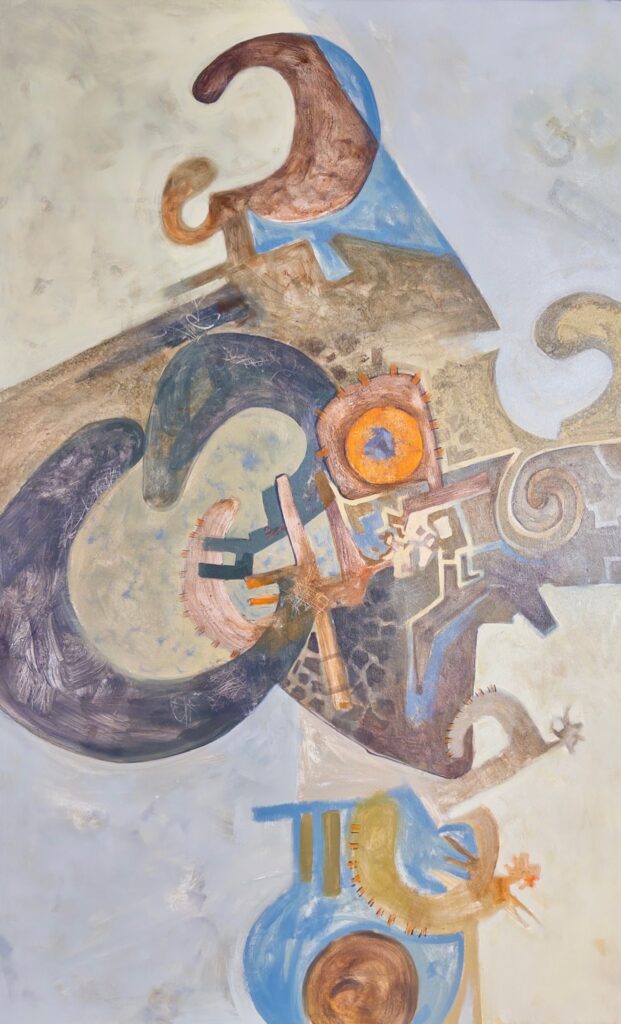
anurag
untitled
An orange eye opens inside a coil of dark violet
A dark violet curve folds over itself like a sleeping animal.
At its edge an orange circle burns, ringed with small brown teeth.
Pale cream and chalky blue fill the corners where nothing moves.
A spiral turns quietly on the right, cut into the ochre.
Below, a blue vessel holds a round brown sun.
Everything leans upward, unfinished, still deciding what it is.
This untitled painting from 2025 is acrylic on canvas. Anurag, of Sir J.J. School of Art, Architecture and Design in Mumbai, makes it as part of an idea the artist calls Inner Landscapes. These are places made by memory, feeling and imagination. The painting does not show a real place. Curved shapes in brown, blue and dark violet press against each other. An orange circle sits near the centre like an eye. Anurag keeps every form open so each viewer can find a meaning.
Acrylic on canvas · 90 × 96 × 2 cm · 2025
Theme Inner landscapes of memory
RC-545

anurag
inner landscapes
Three men cup their hands to listen, look and call
Grey lines on a pale ground, light as breath on glass.
One man leans toward a sound we cannot hear.
One makes two rings of his fingers and stares back at us.
One sends a word sideways, out of the frame.
Their checked shirts fade at the edges, still being drawn.
Small ceiling lights float on the glass like seeds.
Inner Landscapes (2026) by Anurag is made of three frames. In the first, a young man cups a hand to his ear. In the second, a man makes rings of his fingers around his eyes and looks straight out. In the third, a man calls into his hand. Anurag trained at Sir J.J. School of Art, Architecture and Design in Mumbai. His city is Nagpur. He is interested in the visible and the invisible. Here that space sits in a hand held close to the face.
Acrylic on canvas · 60 × 75 × 8 cm · 2026
Theme Seeing, hearing, speaking
RC-546
From the open call
Ram Vishal
Creating these eight artworks has been a meaningful journey of exploration, experimentation, and personal growth. Throughout the process, I faced different challenges, from developing an idea from the initial concept to translating it accurately onto the canvas. Maintaining proportions, achieving the right colour balance, creating realistic details, managing textures, and keeping the overall composition harmonious required patience and continuous effort. There were moments when the artwork did not turn out…


Ram Vishal
Soul in soul
Every ring of colour begins at one small star
Black first, like a night before the lamps are lit.
Then a small star at the centre.
Dots move outward from it in turmeric yellow, marigold orange, a little pink.
Each ring waits for the one before it.
At the edge the colour opens into fans, like hands held up to warm.
Nothing here was quick.
Soul in soul is a square painting in acrylic on stretched canvas, made in 2023. Ram Vishal builds the whole image from small dots of paint. Rings of orange, yellow, red and gold grow out from an eight-pointed star at the centre. Black canvas shows between the dots. Vishal's college is Graphic Era Hill University in Dehradun. In his statement about a group of eight works, he says that keeping proportion and colour balance takes patience. Here the balance has to hold all the way round.
Acrylic on stretched canvas · 61 × 61 × 2 cm · 2023
Theme Patience and balance
RC-678

Ram Vishal
Power
Every line here is light pulled out of the dark
White pencil on black paper, like frost on a night window.
The crown opens behind his head, a flower cut from silver.
Rings sit on heavy knuckles. The mace waits under one hand.
He does not move. He has nowhere he needs to go.
At the edges, flames rise and thin into smoke.
The dark is not empty. It is only what the light has not reached yet.
Power is a 2023 drawing by Ram Vishal from Graphic Era Hill University in Dehradun. Vishal draws with a white glass marking pencil on a black sheet. So each line adds light, not shadow. Slowly the figure of Hanuman comes out of the dark. His crown, armbands and rings are full of fine pattern. His face is calm under heavy brows. One hand rests on a mace. Flames rise at the edges. The work is one of eight in Vishal's collection.
White glass marking pencil on black sheet · 70 × 50 × 200 cm · 2023
Theme Strength at rest
RC-679
Ram Vishal
Kalpvriksh
A tree that seems to give off its own light
Orange deepens at the edges, like a wall at the end of a hot day.
In the centre, yellow pools like lamp oil.
Red lines climb from the roots and split and split again.
Leaves point outward like small flames.
Little rings rest in the branches, quiet as seeds.
Held up in a green garden, the cloth burns brighter than the leaves around it.
Kalpvriksh (2023) is one of eight paintings by Ram Vishal of Graphic Era Hill University in Dehradun. A tree of thin red lines rises from spreading roots into a crown of pointed leaves. Small rings and dots sit along the trunk and branches. Behind the tree, yellow light fades into deep orange at the edges. Vishal paints in acrylic on canvas cloth. In this series he pays close attention to proportion, colour balance, texture and the whole composition. When a painting does not match his idea, he corrects it and tries again.
Acrylic on canvas cloth · 76 × 122 cm · 2023
Theme A tree of light
RC-680
Ram Vishal
Dead soul
Every petal burns bright in a painting called Dead soul
A yellow petal opens wider than a hand.
Orange runs down its ribs like heat from a stove.
Magenta leans in from the left and blue folds over the top.
At the bottom, small pink seeds gather in a tight ring.
There is no sky here, only flower pressed against flower.
And still the name says something has gone quiet.
Ram Vishal makes Dead soul in 2023 as a student at Graphic Era Hill University in Dehradun. It is one of eight paintings in a single collection. Huge petals fill the canvas from edge to edge. Magenta sits beside yellow, orange and deep blue. Vishal works in acrylic on stretched canvas. He says keeping the colour balance and proportions right "required patience and continuous effort." When a part does not turn out as planned, he corrects it and tries again. The dark title sits against all this bright colour.
Acrylic on stretched canvas · 61 × 91 × 2 cm · 2023
Theme Bright flowers, dark title
RC-681
Ram Vishal
Soul
Fire-coloured fish circle in water as dark as night
Orange and white bodies bend through water the colour of ink.
Blue strokes curl behind each tail like marks left by a thumb.
A pink lotus opens at the edge. Lily pads hold a lime-green light.
Small bubbles rise and stay where they are.
Nothing here is still. Even the dark seems to move.
I wait for the fish to come round again.
Ram Vishal paints koi turning in a dark pond. Pink lotus flowers and green lily pads crowd the left edge. Short blue strokes curl around the fish like moving water. Vishal studies at Graphic Era Hill University in Dehradun. Soul is one of eight paintings in his collection. He works in acrylic on stretched canvas. He finds proportion, colour balance and texture the hardest parts. When a painting goes wrong, he corrects it and tries again. For him, art also means "being patient with the work."
Acrylic on stretched canvas · 46 × 61 × 2 cm · 2024
Theme Movement in still water
RC-682

Ram Vishal
Creator
Under the flute player, a machine of gears keeps turning
White lines pull light out of a black sheet.
A crown of rings opens like the inside of a shell.
Four hands rest on the dark as if it were a table.
A flute player sits still and the music is only a line.
Under him, gears turn with small signs on their faces.
An old man keeps his eyes down while grey moons drift past.
Ram Vishal draws Creator in white on a black sheet with charcoal, pencil and white glass marking. Every line he puts down is light. At the top, a four-armed figure sits inside rings of pattern. Below it, a young man plays a flute. At the base, gears with small symbols turn around the face of an old bearded man. Planets float around them. Vishal's college is Graphic Era Hill University in Dehradun. This 2023 work is one of eight in his collection. The sheet is 50 × 70 cm.
Charcoal, pencil and white glass marking on black sheet · 50 × 70 cm · 2023
Theme Creation and the cosmos
RC-683

Ram Vishal
“Peace within”
One raised palm, closed eyes and a sky turning gold
Gold spreads behind his head like late afternoon sun.
At the edges the yellow cools into deep blue.
His eyes are closed. One palm rises, open and still.
In his lap a dark bowl holds a crown of green leaves.
Pink petals curve up under him, heavy as folded cloth.
In the corner, old words in Devanagari: be a lamp to yourself.
Ram Vishal paints "Peace within" in acrylic on stretched canvas. His college is Graphic Era Hill University in Dehradun. The work belongs to a set of eight paintings. Vishal says each one teaches him something new. In this work you can see the skills he names: the proportions of the seated figure, the balance of warm and cool colour and the fine detail of the lotus petals. When a painting does not turn out as he imagines, he corrects it and tries again.
Acrylic on stretched canvas · 76.2 × 50.8 × 2 cm · 2026
Theme Stillness and inner peace
RC-676
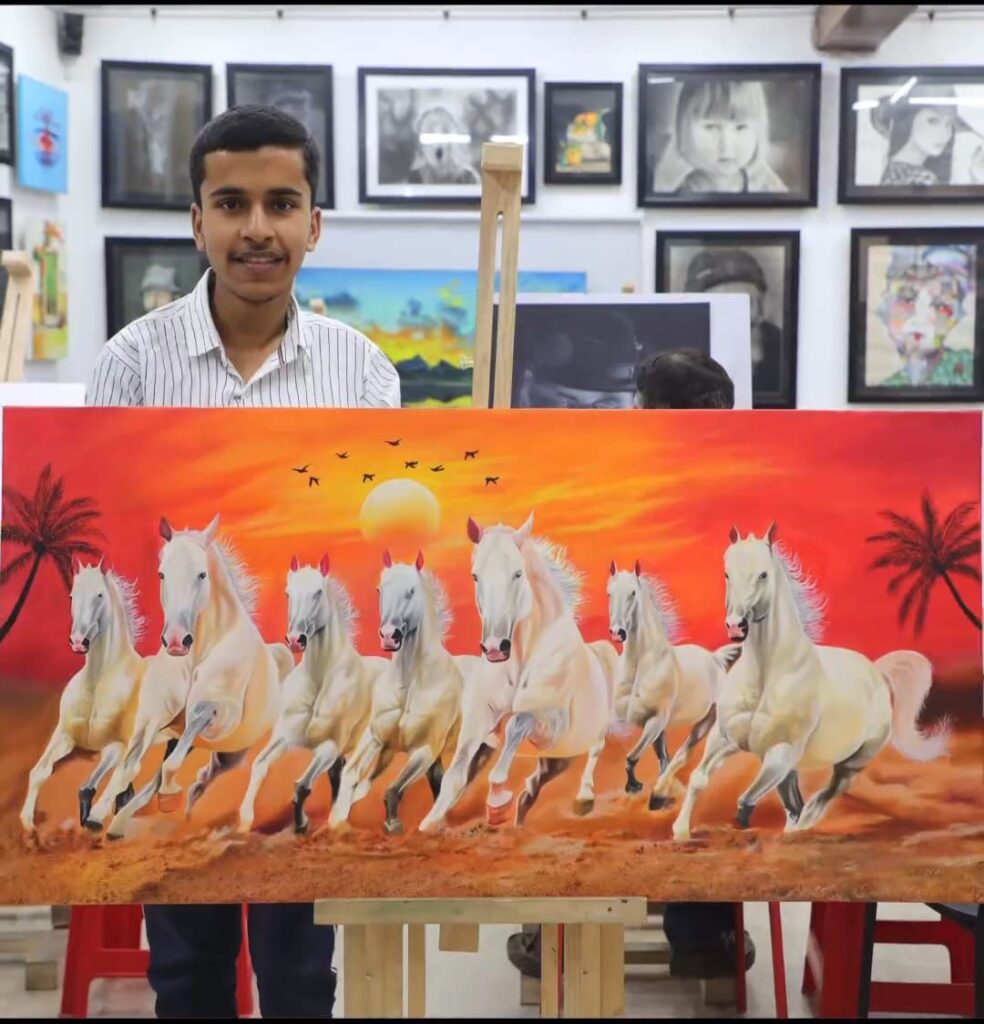
Ram Vishal
“Wings of freedom”
Seven white horses run toward us out of a red evening
The sky is the red of a coal held too long.
A pale sun sits low behind a line of birds.
Seven horses come at us in one long stroke of white.
Their manes lift. Their hooves throw up orange dust.
Two palms stand black at the edges like open doors.
The oil lies smooth where the light falls on their backs.
Wings of Freedom is an oil painting on stretched canvas by Ram Vishal. He is a student at Graphic Era Hill University in Dehradun. He makes this work in 2023. The canvas is wide and low, 60.96 × 121.92 cm. Seven white horses run in a line under a red sky. It is one of eight works Vishal makes as a group. He says the hard parts are proportion, colour balance and texture. When a part goes wrong, he changes it and tries again.
Oil on stretched canvas · 60.96 × 121.92 × 2 cm · 2023
Theme Horses running free
RC-677
From the open call
Asmita Das
I'm trying to explore the emotions, and stories I see in everyday life. In my artwork I use different techniques and materials depending on what I want to express. For example I like to use the wash Technique of Painting most of the time cause I find this whole process very peaceful and calming. I always make sure to merge complicated structures of buildings, Objects and nature with my kind…

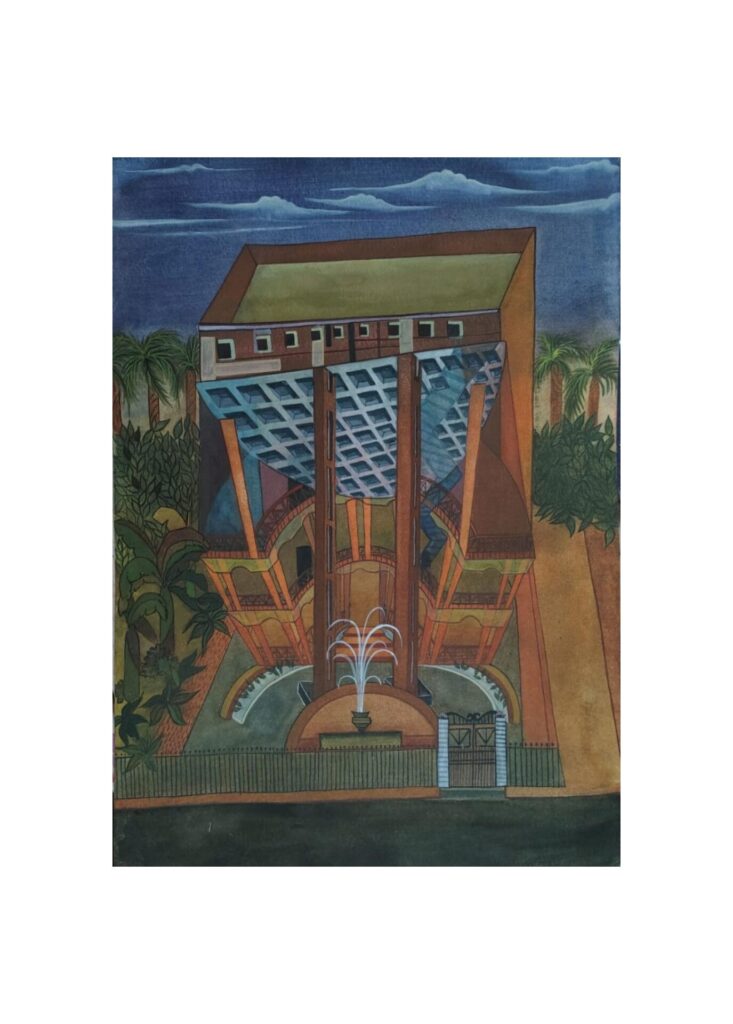
Asmita Das
The College
A building opens its ceiling to the evening sky
Brick red climbs into a dusk of soft blue.
A ceiling of pale squares hangs open like a lid.
Water rises from a stone bowl and falls in white threads.
Palm leaves press close on both sides of the gate.
The iron fence keeps the dark road out.
Everything is still except the fountain.
Asmita Das studies at The Indian College of Arts and Draftsmanship in Kolkata. In The College she paints a building with many parts: brick columns, a grid of blue ceiling, curved balconies, a fountain and a gate. She paints in the wash technique most of the time. She says the process is "very peaceful and calming." Das takes complicated buildings and makes them simple with light, colour and composition. Here, palm trees and dark leaves close in on both sides.
Watercolour in the wash technique on paper · 42 × 29.7 × 0.04 cm · 2025
Theme Architecture made simple
RC-697

Asmita Das
The Frenzy of the Flames
A wandering line looks for fire inside spilled colour
Orange climbs the creased paper like heat up a wall.
Pink and green meet and do not stay apart.
A thin dark line wanders in loops as if it has lost its way home.
Small yellow crescents flicker at the edges.
The paper wrinkles where the water rested.
In the middle a green leaf holds still while everything burns.
Asmita Das studies at The Indian College of Arts and Draftsmanship in Kolkata. She made this small painting in 2025 with watercolour on Nepali handmade paper. The sheet is only 14.8 × 10.5 cm. Its soft creases catch the colour in pools. Orange, pink and green run into each other. A thin dark line loops across the surface and finds shapes like flames and leaves. Das picks her materials to match a feeling. "I want materials themselves to become part of the feeling of the work."
Watercolour on Nepali handmade paper · 14.8 × 10.5 × 0.01 cm · 2025
Theme Chaos and calm
RC-698

Asmita Das
Rays of Hope
Yellow light pushes in where the dark refuses to leave
Yellow comes in like a crowd of brushes, all leaning one way.
Under it red and black hold the dark of a closed room.
Blue strokes run fast, thin as split bamboo.
In the centre a pink shard sits, broken from something larger.
The edges stay dim.
The light gathers on the right and keeps pressing in.
Asmita Das studies at The Indian College of Arts and Draftsmanship in Kolkata. Most of the time she paints in a wash style. She finds that process calm and peaceful. Rays of Hope works another way. It is gouache on wasli board. Short yellow strokes press in from the right. Blue marks cut through red and black. Das names it with Despair and The Frenzy of the Flames as works where materials carry her mood. "I want materials themselves to become part of the feeling of the work."
Gouache on wasli board · 59.4 × 42 × 0.04 cm · 2025
Theme Hope within chaos
RC-699

Asmita Das
Despair
Blue water, rust lines and salt that will not stay still
Blue spreads through wet paper like a bruise under skin.
Rust lines run across it, thin as wire, bent as roots.
Salt leaves a frost of small white stars.
A dark eye opens in the middle and does not close.
Somewhere a pale line tries to hold the shape together.
The water keeps moving after the hand has stopped.
Asmita Das is an artist from Kolkata. Her college is The Indian College of Arts and Draftsmanship. Most of the time she paints in the wash style. She finds it calm. Despair, from 2024, is different. Here she works with ink, gum and salt. She wants the materials to carry the feeling. Blue washes spread across the paper. Rust-brown lines twist over them like roots or wire. Pale grainy patches break the surface. For Das, the spreading colour first feels like losing a battle. Later it becomes a source of strength.
Mixed media: ink, gum and salt · 42 × 29.7 × 0.03 cm · 2024
Theme Despair and inner strength
RC-700
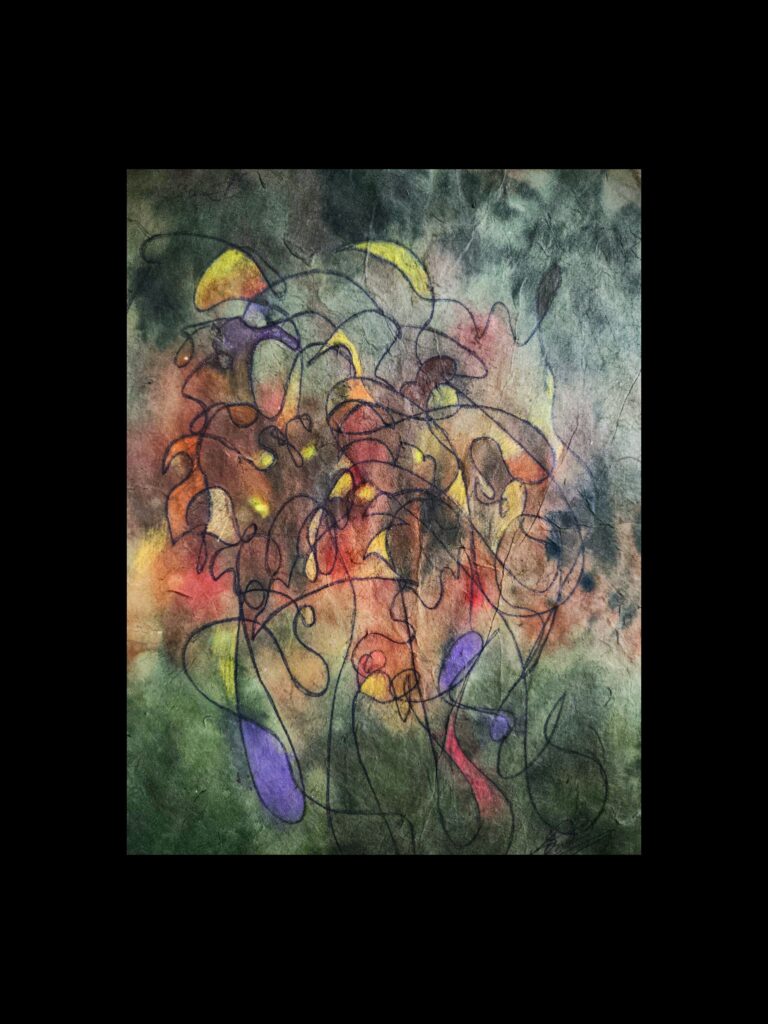
Asmita Das
The Frenzy of the Flames.
One dark line runs through the fire and will not stop
Green smoke gathers at the edges of the paper.
In the centre orange and red push up like heat from a stove.
A dark line runs and runs. It loops back and will not stop.
Small yellow tongues lean out from the knot.
Two violet drops sit cool near the bottom.
The paper is soft and creased like cloth left out in the rain.
Asmita Das paints this small work in watercolour on Nepali handmade paper. Her college is The Indian College of Arts and Draftsmanship in Kolkata. Das often uses the wash technique because it calms her. This painting belongs to another group. In these works she uses materials to show how she feels in that moment. She says, "I want materials themselves to become part of the feeling of the work." Here colour spreads into the soft paper. Dark lines loop over reds and yellows.
Watercolour on Nepali handmade paper · 14.5 × 10.5 × 0.01 cm · 2025
Theme Feeling held in fire
RC-701
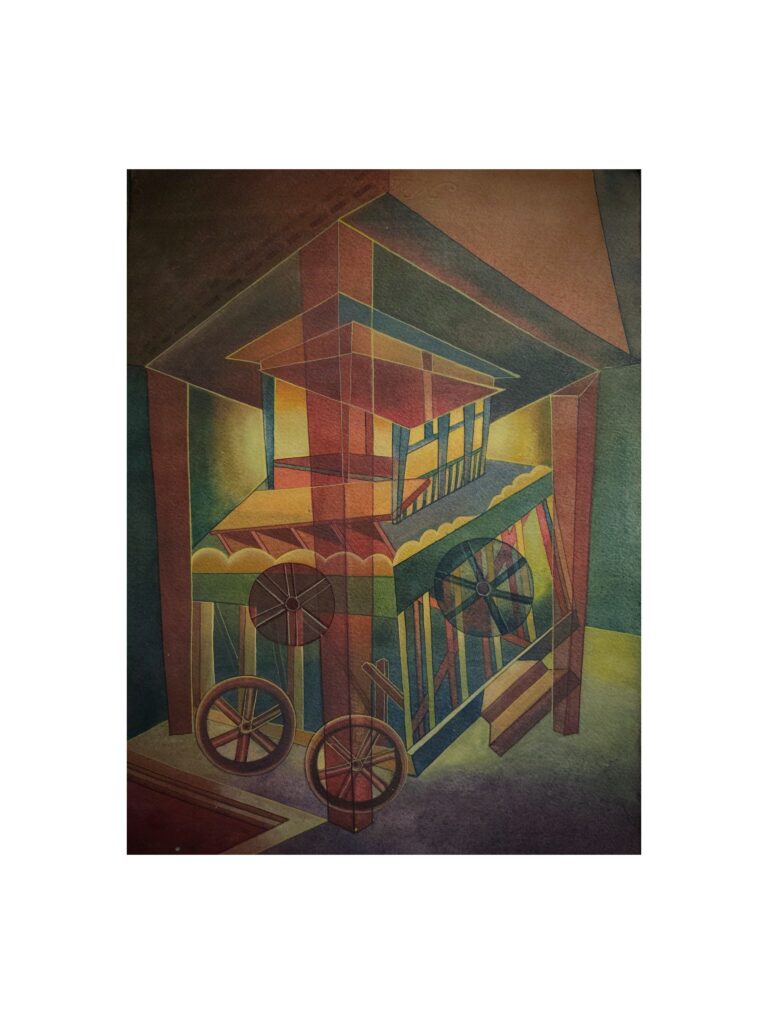
Asmita Das
The Halted Chariot of Time
Four wheels and a lit room with nowhere left to go
Four wheels stand still on a purple floor.
Yellow light burns inside the cart like a lamp left on.
Roofs fold over roofs in thin planes of green and rust.
A small stair waits at the side for someone to climb.
Fine gold lines hold every edge in place.
The room keeps the chariot the way a hand keeps a breath.
Asmita Das paints The Halted Chariot of Time in the wash technique. She uses watercolour on 300gsm Canson paper. Das studies at The Indian College of Arts and Draftsmanship in Kolkata. She chooses wash painting most of the time because she finds the slow process peaceful. It helps her calm her mind in a life where she has always had little space. Here she takes a complicated structure and makes it simpler with light, colour and composition.
Watercolour in the wash technique on paper · 59.4 × 42 × 0.04 cm · 2025
Theme Time held still
RC-693
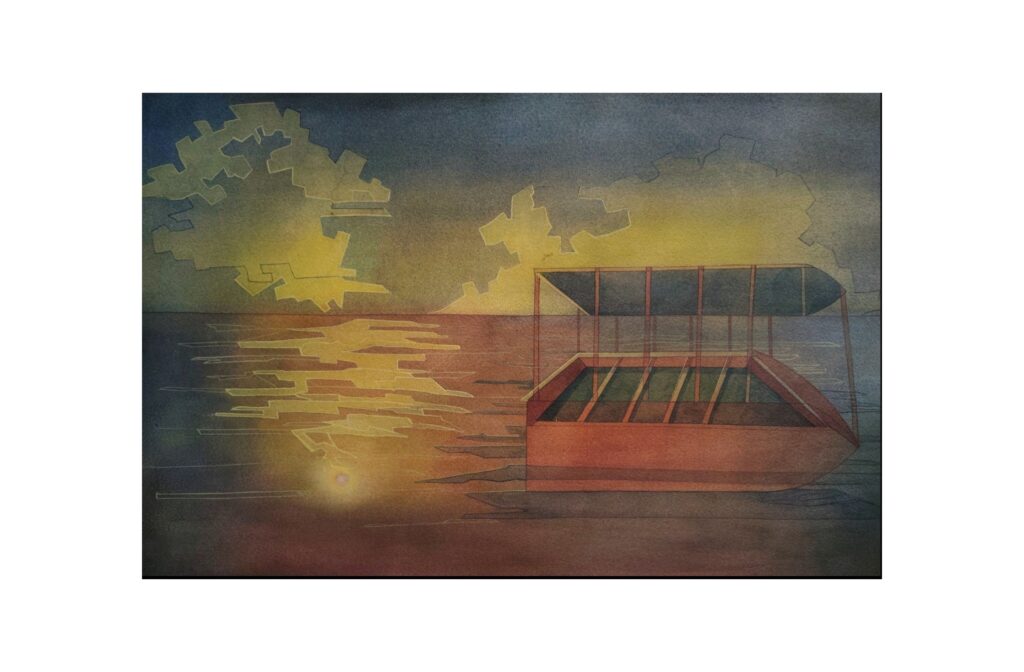
Asmita Das
The Encroachment of the Ganges
A red boat waits where the sun sinks into the river
The sky moves from ink blue to mustard.
Clouds come apart like torn paper with sharp corners.
The sun has slipped under the water and still glows there.
Its light lies on the river in broken gold steps.
A red boat stands empty under its dark roof.
Nobody is aboard. The water keeps the last warm colour.
Asmita Das studies at The Indian College of Arts and Draftsmanship in Kolkata. In The Encroachment of the Ganges (2025) she works in the wash technique, a process she finds "very peaceful and calming." Soft washes of watercolour turn the sky from deep blue to yellow. The clouds and the sun's path on the water break into sharp angular shapes. A red boat with a canopy rests on the right. Das likes "simplifying the complicated with light, color and composition."
Watercolour in the wash technique on paper · 59.4 × 42 × 0.04 cm · 2025
Theme The river at dusk
RC-694

Asmita Das
Decapitated Civilization
A city of stone stands headless under a green moon
A green moon hangs low and holds its breath.
Red stone stands in pillars, cut off at the top.
Thin white lines trace each edge like old chalk.
Between two towers a doorway glows the colour of young leaves.
The sky is deep blue water poured over everything.
Nothing moves. The city waits for no one.
Asmita Das studies at The Indian College of Arts and Draftsmanship in Kolkata. In Decapitated Civilization Das paints a broken city of rock under a green moon. The work uses the wash technique with watercolour on 300gsm Canson paper. Colour spreads softly across the sheet. Das finds this slow process calm. It helps to quiet the mind. Here the hard shapes of buildings and stone become simple forms made of light, colour and composition.
Watercolour in the wash technique on paper · 59.4 × 42 × 0.04 cm · 2026
Theme Ruin and stillness
RC-695

Asmita Das
The Last Spotlight
The show is over. The seats still wait under the stars
Blue night. Thin clouds like chalk pulled across slate.
A room with no roof sits on the green ground.
Two green lamps still burn over a dark wall.
The rows of seats glow yellow like warm bread.
Pale lines hold the walls together. They are almost glass.
One star watches. The audience has gone home.
The Last Spotlight is a 2025 painting by Asmita Das. She studies at The Indian College of Arts and Draftsmanship in Kolkata. Das works in the wash technique. The picture grows from thin layers of watercolour. For her wash paintings she uses 300gsm Canson paper. She finds the process calm. It helps her quiet her mind against the chaos and lack of space she has known since childhood. Here she takes a building full of sharp angles and makes it simple with light and colour.
Watercolour on paper, wash technique · 29.7 × 21 × 0.04 cm · 2025
Theme Emptiness after the show
RC-696
From the open call
DEBJIT GHOSHAL
My artistic practice is primarily focused on painting and visual exploration of urban space, memory, fragmentation, and human experience. Previously I was a self-taught artist from class 4 to high school. After that I took the practice seriously.From childhood I was not able to talk fluently as an normal person, so I expressed myself or my expressions through cutting papers, by drawing on walls, making something by using dough by…


DEBJIT GHOSHAL
Shohoor
Seven yellow houses stand close together under a dark green sky
Seven yellow houses lean together. Their small black windows are open like mouths.
A red stair climbs out of the street and stops.
Above the roofs a brown shape flies with one dark eye.
The sky is deep green, the colour of pond water at dusk.
White ground shines between the walls like paper left uncut.
Small green marks stand at the edge and wait.
Debjit Ghoshal paints in Uttarpara and studies at the Indian College of Arts and Draftsmanship. As a child he could not talk fluently. He spoke through cut paper, drawings on walls and shapes made from dough. That early habit still shows in Shohoor. Its houses and roofs have hard, clean edges. Ghoshal watches streets and buildings. He sketches them and then breaks them apart. He does not copy a place. He builds it again from memory in watercolour, one layer over another.
Watercolour · 40 × 60 cm · 2026
Theme Memory of a city
RC-720

DEBJIT GHOSHAL
Gangar ghat
A riverside town comes apart, piece by coloured piece
Night sits on the hills like wet ink.
Yellow light rubs through a wall, scratched and raised like old plaster.
Arches open into nothing but black water.
Thin white lamps bend over the steps, each with a pink bulb.
Red roofs crowd the bank, tipping into each other.
Below, the river keeps a few specks of light.
Debjit Ghoshal studies at The Indian College of Arts and Draftsmanship in Uttarpara. As a child, Ghoshal could not talk fluently. Cut paper, drawings on walls and shapes in dough became a way to speak. Ghoshal still watches streets, buildings and textures closely. In Gangar ghat, a ghat on the Ganga breaks into flat pieces of colour. Arches, steps and roofs tilt and overlap. Ghoshal does not copy the place. The image is sketched, layered and reworked until it sits between what was seen and what is remembered.
Watercolour · 60 × 30 cm · 2025
Theme A remembered riverbank
RC-721
DEBJIT GHOSHAL
Untitled
Blue rubbed thin, white left whole, like light through broken walls
Blue pressed hard, then dragged until it thins to mist.
White blocks stand in it like shut doors.
A few drops fly loose at the edge.
One dark spot sits low, a coin of blue.
The surface shows its grain through the paint.
Somewhere a street is being remembered wrong.
Debjit Ghoshal studies at the Indian College of Arts and Draftsmanship in Uttarpara. As a child Ghoshal could not talk easily and spoke instead through cut paper, drawings on walls and shapes made from dough. That habit stays in this small mixed media work, only 10 × 15 cm. Deep blue paint drags across a pale ground. Clean white shapes break through it like cut pieces. Ghoshal watches streets, buildings and textures. Familiar forms are broken so a place sits between what is real and what is remembered.
Mixed media · 10 × 15 cm · 2026
Theme Memory of broken cities
RC-722
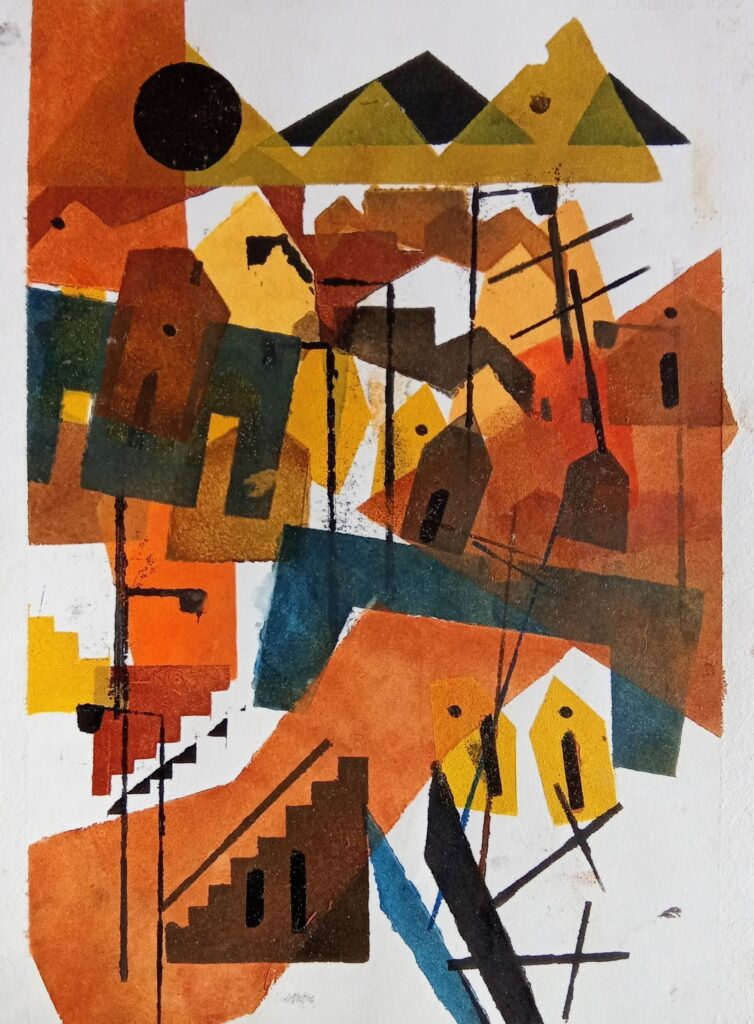
DEBJIT GHOSHAL
BROKEN CITY
Little houses lean as if the ground moved beneath them
A black sun sits low over a row of paper mountains.
Houses the colour of rust and turmeric lean on each other.
Each one keeps a single dark door and one small window.
Thin poles hold up wires that lead nowhere.
A staircase climbs into an orange field and stops.
A blue band, water or road, cuts through the middle.
The white of the paper shows through like quiet between the walls.
Broken City is part of an ongoing series by Debjit Ghoshal of The Indian College of Arts and Draftsmanship in Uttarpara. Small houses tilt and lean. Stairs, poles and wires cross patches of orange, yellow and deep blue. Ghoshal watches streets, buildings and changing cityscapes closely. The aim is not to copy a place but to break familiar forms and build the picture in layers. As a child Ghoshal found speaking hard and made things from cut paper. Shapes with clean edges like cut paper fill this watercolour.
Watercolour on paper · 28 × 20 cm · 2024
Theme Urban memory and loss
RC-723
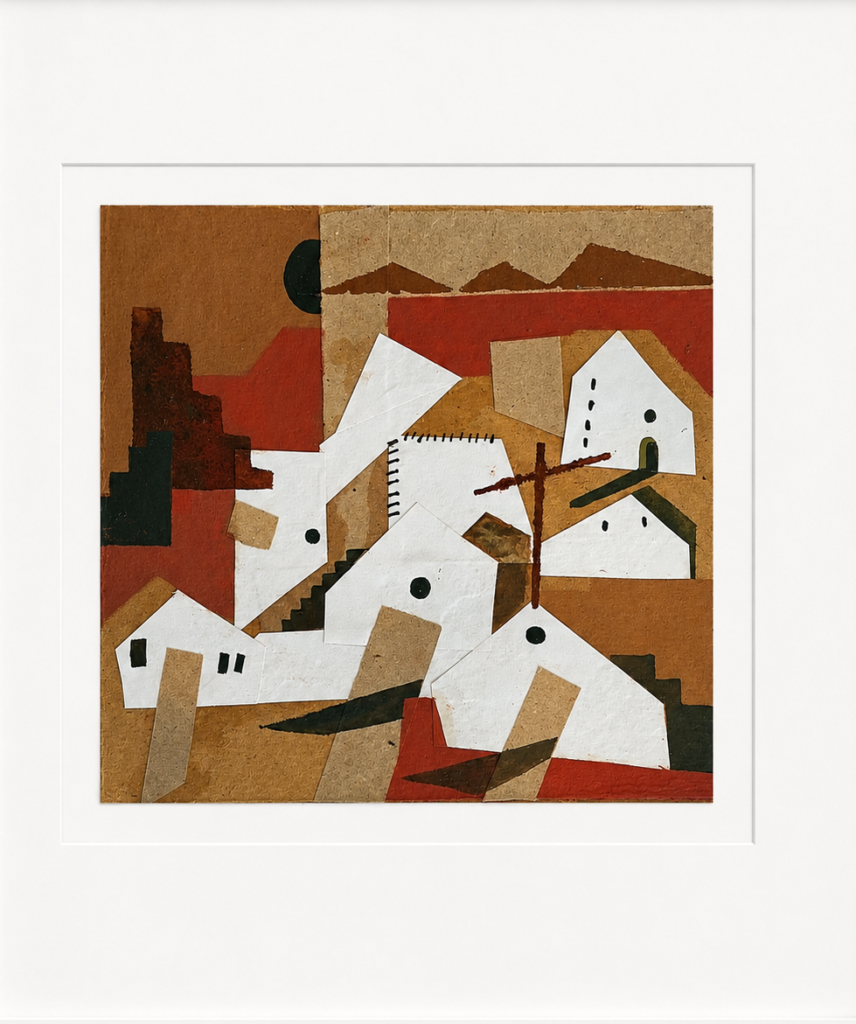
DEBJIT GHOSHAL
Evening in city
A small town of cut paper, leaning into the night
White roofs lean on each other like tired neighbours.
Each house keeps one black eye open.
The card under them is the colour of dust and tea.
A half moon sinks behind a wall of red.
Stairs climb into shadow and stop.
Someone has stitched one wall shut with small black marks.
The hills at the top are only cut brown paper and they hold.
Debjit Ghoshal cuts white paper into small houses and lays them over brown card and bands of red. Then he works into the paper with oil colour. A whole town fits on a square of mount board 10 cm wide. Ghoshal studies at The Indian College of Arts and Draftsmanship. As a child, talking did not come easily to him. He spoke through cut paper instead. In this evening scene the houses tilt and press together. Familiar shapes are broken, so the place feels half seen and half remembered.
Collage and oil colour on mount board · 10 × 10 cm · 2025
Theme A remembered city
RC-724
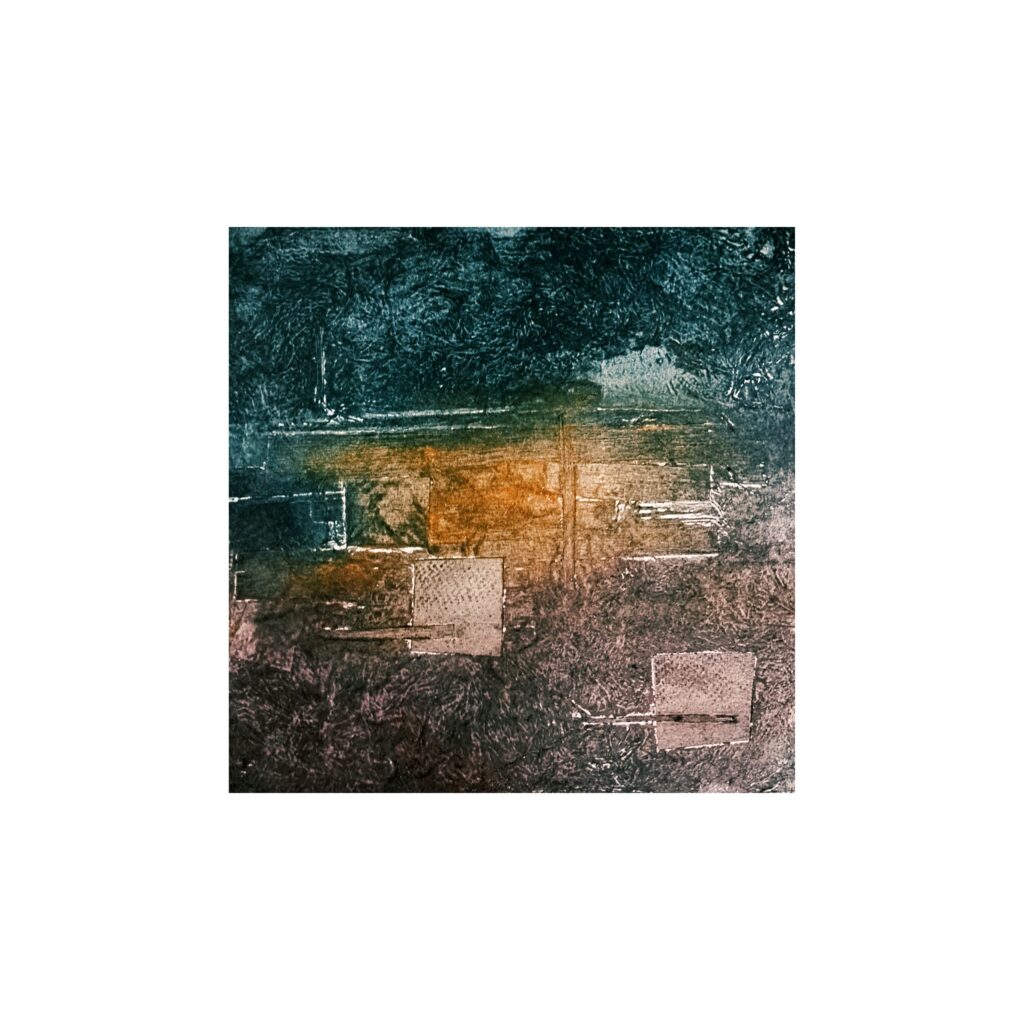
DEBJIT GHOSHAL
Destortion
A city folded flat and pressed into paper
Teal pressed into paper like wet slate after rain.
A seam of rust runs through the middle, low sun on an old wall.
White scratches cut sideways, thin as cracks in plaster.
Two pale squares wait in the grey dust below, windows with the glass gone.
Everything is creased, as if the city was folded and opened again.
The silence has a grain you could press your thumb into.
Debjit Ghoshal, of Uttarpara, studies at The Indian College of Arts and Draftsmanship. He watches streets, buildings and changing cities. Then he breaks what he sees into layers. This collagraph is printed on Canson paper. A collagraph comes from a plate built up from textured material. Here a crumpled surface fills the dark teal top half. A band of rust crosses the centre. Pale squares with a fine grid sit low in the frame. Ghoshal does not copy a place. He bends it towards memory.
Collagraph print on Canson paper · 30 × 30 cm · 2026
Theme Fragments of a city
RC-725

DEBJIT GHOSHAL
AFTERMATH
Three windows onto a city after something has broken
Orange rises like a wall still warm from fire.
Two white crosses mark what will not stand again.
Blue runs low across the ground, a road under smoke.
White scratches cut through the brown like rain on dust.
In the last square small roofs lean close together.
White arrows point up and away, toward somewhere still standing.
Debjit Ghoshal is a young artist from Uttarpara. He studies at The Indian College of Arts and Draftsmanship. He taught himself to draw from class four to high school. As a child he could not speak with ease, so he cut paper, drew on walls and shaped dough. Aftermath is three square panels in tempera on paper. Ghoshal does not copy a place. He breaks familiar forms into layers. He calls painting "a process of discovering rather than simply illustrating an idea."
Tempera on paper · 30 × 90 cm · 2026
Theme Urban loss and memory
RC-718
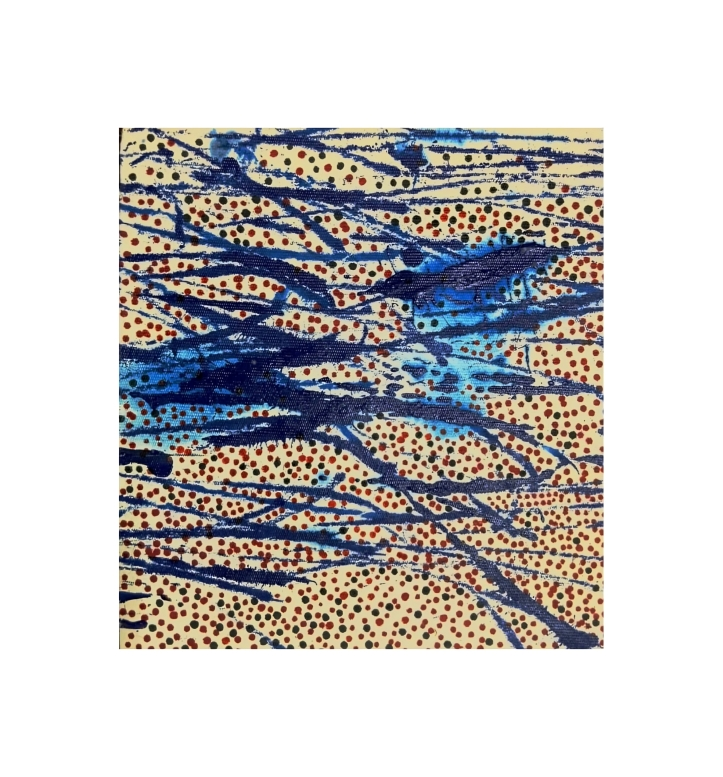
DEBJIT GHOSHAL
BETWEEN RAIN AND ROOTS
Rain that moves like roots across a small square of paper
Blue runs sideways, the way rain runs on a bus window.
It splits into thin roots and holds on.
Under it the paper is the colour of rice water.
Red dots sit in rows like seeds waiting for the ground to open.
A few dark ones keep watch.
Where the blue thins, pale light comes through.
Debjit Ghoshal makes Between Rain and Roots in 2026 with acrylic and pen on handmade paper. The work measures 15 × 15 cm. Dark blue streaks pull across the square. Hundreds of small red and dark dots cover the cream paper between them. Ghoshal studies at the Indian College of Arts and Draftsmanship. As a child Ghoshal could not talk with ease. Cutting paper and drawing on walls became a way to speak. Ghoshal was self-taught from class four to high school.
Acrylic and pen on handmade paper · 15 × 15 cm · 2026
Theme Rain, roots and memory
RC-719
From the open call
Manisha
My art journey began with simple curiosity and the joy of creating. I started by drawing random things and gradually realised that art had become an important part of my life. It gave me a way to express ideas and emotions that I could not always put into words. The two mediums I enjoy working with the most are acrylics and watercolours. I love acrylics because they are bold, vibrant,…
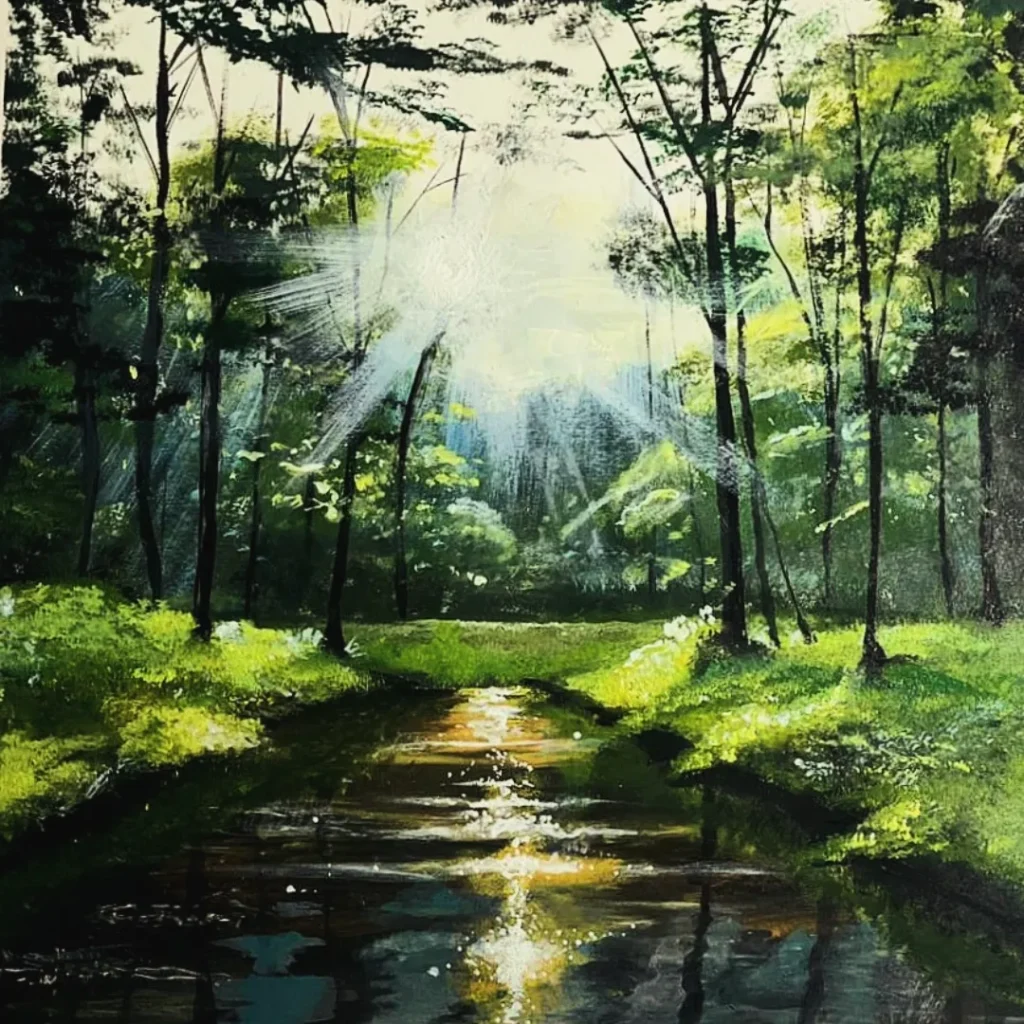
Manisha
Breath of the forest
Sunlight pours through the trees and turns the water gold
Morning light comes in sideways, white as chalk dust.
It catches on thin black trunks and does not stop.
The grass answers in lime and yellow, dab after dab.
Down the middle, dark water carries a line of gold.
Small sparks sit on its skin like spilled salt.
The whole wood seems to hold its breath, then let it go.
Breath of the forest is a small square painting in acrylic, 27 × 27 cm, from 2025. Manisha, of Deen Dayal Upadhyaya College at Delhi University, paints a stream of dark water running through green trees. Light breaks through the leaves in pale, dry streaks of paint. Manisha likes acrylic because it lets her build layers and textures. Here the grass is many dabs of yellow and green. She says a painting does not always match the picture in her mind. Each try teaches her something.
Acrylic · 27 × 27 cm · 2025
Theme Light in the forest
RC-742

Manisha
The fallen angel
Gold wings twist in a storm under one beam of light
Light pours down like milk through a hole in the sky.
The wings are the colour of toast and old brass.
Below him the cloth twists into a long brown tail.
His arms reach out and find only wind.
Blue cloud turns around him like water in a drain.
He is falling or he is rising. The paint will not say.
Manisha, a student at Deen Dayal Upadhyaya College, Delhi University, paints The Fallen Angel in 2025. She comes from Ranchi. The work measures 38 × 27 cm. She mixes the two media she loves most. Acrylic gives her bold colour and room to build layers and texture. Watercolour is softer and less predictable. It teaches her patience and the importance of "letting go of complete control." Here a winged figure turns in a storm of blue cloud beneath a shaft of white light.
Acrylic with watercolour · 38 × 27 cm · 2025
Theme A fall from light
RC-743
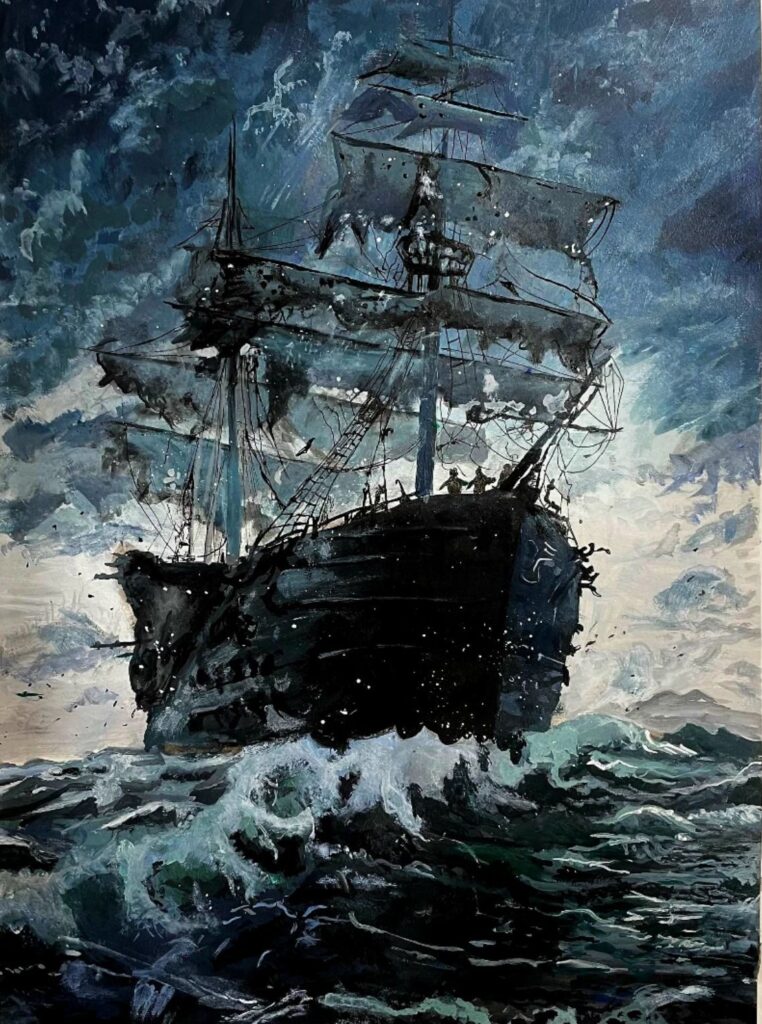
Manisha
Skyfall
A ship in torn sails, coming straight out of the storm
The hull is the darkest thing here, darker than the night around it.
White flecks land on the black wood like salt or stars.
Sails hang in rags. Still the ship leans forward.
Tiny figures stand at the rail and do not look away.
Behind the masts a pale light breaks through the blue.
Green water climbs the bow and falls back white.
Manisha, from Ranchi, studies at Deen Dayal Upadhyaya College, Delhi University. Skyfall is a 2025 painting in acrylic, 38 × 27 cm. A tall ship with torn sails rides a rough sea under a dark blue sky. Manisha enjoys acrylic because it allows layers and texture. The waves are built from thick strokes of green, grey and white. White paint is flicked across the dark hull like sea spray. Manisha says a picture can look perfect in the mind and turn out differently. Every attempt teaches something new.
Acrylic paint · 38 × 27 cm · 2025
Theme A ship in a storm
RC-744

Manisha
The silent cut
His face stays hidden. His sword stays in its sheath
A hat as wide as a roof. Under it, no face.
The robe falls in black folds, lit with the blue of late evening.
His hand rests on the sword. The blade stays inside.
Grey breath rises behind him like smoke from a cold fire.
Black leaves break off the air.
The grass at his feet is ink, sharp and still wet.
Nothing has moved yet.
Manisha paints a lone swordsman in The Silent Cut. A wide hat hides his face. His long robe is black with cold blue lights. He holds a sword at his hip but does not draw it. Around him, grey washes rise like smoke. Dark flecks fly past like leaves. Acrylic lets her build layers. She says watercolour is softer and hard to predict. It has taught her to let go of full control. Manisha comes from Ranchi. Her college is Deen Dayal Upadhyaya College, Delhi University.
Acrylic with watercolour · 38 × 27 cm · 2025
Theme Stillness before the strike
RC-745
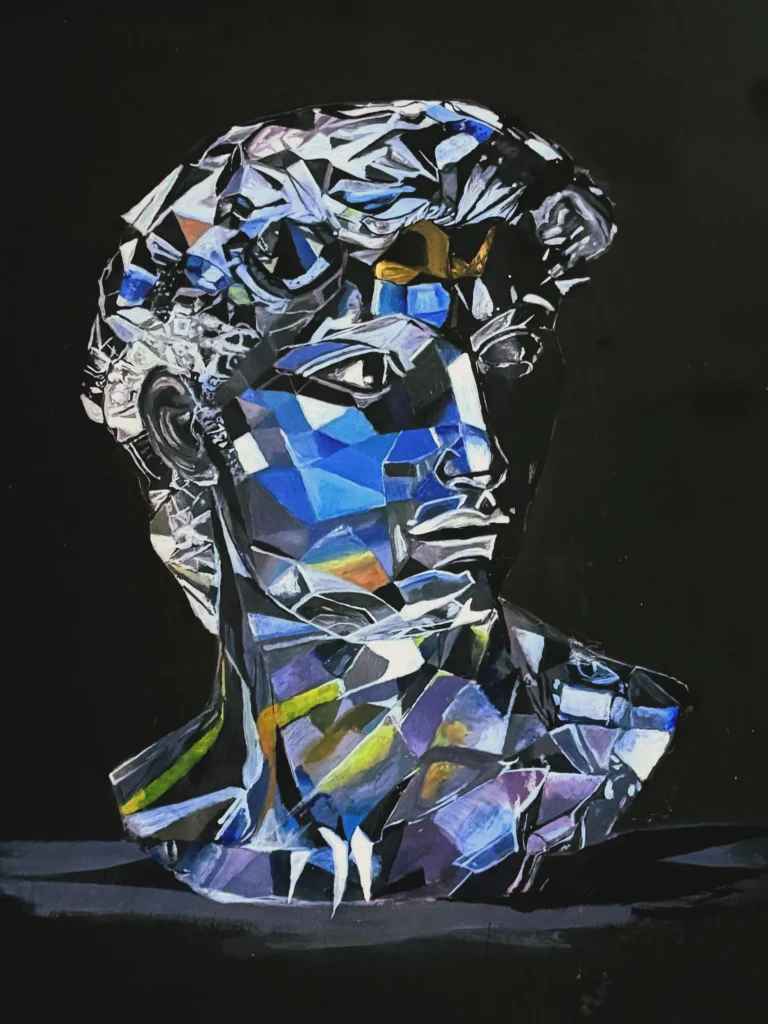
Manisha
Fragments of thought
A classical head that breaks apart into blue light
A head lifted from a museum shelf and set down in the dark.
The face comes apart in blue and violet panes like a window hit by a stone.
Gold rests in the hair where a lamp might touch it.
The neck ends in white points, thin as icicles.
Nothing here is whole.
Still the eyes look ahead, calm as marble.
In Fragments of thought, Manisha paints a classical sculpted head as if it were made of broken glass. Blue, violet and white facets catch the light against a black ground. A patch of gold sits in the curls. Manisha likes acrylic because it lets her build layers and textures. Here those layers break the face into many sharp planes. The work is from 2025 and measures 65 × 50 cm. Her college is Deen Dayal Upadhyaya College, Delhi University. Her city is Ranchi.
Acrylic · 65 × 50 cm · 2025
Theme The fractured mind
RC-741
From the open call
Kalyani Kalakriti Foundation
What were you trying to do? What did you use? What was difficult? Write it as you'd say it out loud — we're not looking for gallery language. What were you trying to do? What did you use? What was difficult? Write it as you'd say it out loud — we're not looking for gallery language. What were you trying to do? What did you use? What was difficult? Write…



Kalyani Kalakriti Foundation
p2
Step back and it turns grey. Step close and it sings
Grains of pink and green crowd together like rice spilled on a dark floor.
No grain is larger than another.
Stand back and they settle into the grey of a monsoon window.
Lean in and the grey splits open again.
A thin white line holds it all in, like thread tied around a parcel.
Inside, the colours keep moving.
p2 is a work in gouache from 2015. It measures 50 × 40 × 12 cm. The surface is covered from edge to edge with tiny points of colour. Pink, green, violet and grey sit side by side. No single colour wins. From a step away they blend into one soft grey. Up close the grey breaks apart again. A thin white line runs near the edge and frames the whole field. The work comes from Gurgaon and is linked to study at UPES.
Gouache · 50 × 40 × 12 cm · 2015
Theme Colour, distance and seeing
RC-746

Kalyani Kalakriti Foundation
p3
A grey that turns out to be every colour at once
Red, green, blue and violet crowd so close they turn to grey.
It hums like a radio caught between two stations.
A thin white line holds the noise in place.
In the top corner a few pale marks try to speak.
Stand near and the grey comes apart in your eyes.
Stand back and it closes again like still water.
This gouache dates from 2016 and comes from Gurgaon, where it is linked to UPES. It measures 50 × 40 × 12 cm. Up close the surface breaks into countless tiny specks of red, green, blue and violet. Step back and the specks settle into one even grey. A thin white line runs around the picture just inside its edge, like a frame drawn inside a frame. Small pale marks sit in the top left corner. Nothing else interrupts the field.
Gouache · 50 × 40 × 12 cm · 2016
Theme Noise and stillness
RC-747
From the open call
Khushi aggarwal
My work is primarily about identity as an umbrella term. This includes community, individuality as well as day to day consumption. The concept of identity and the struggle to achieve it as an individual through community, isolation as well as modern day consumption is made evident. Here, My self portraits convey the isolation as well as community; and my installations convey the idea of mapped consumption. I use the remains…


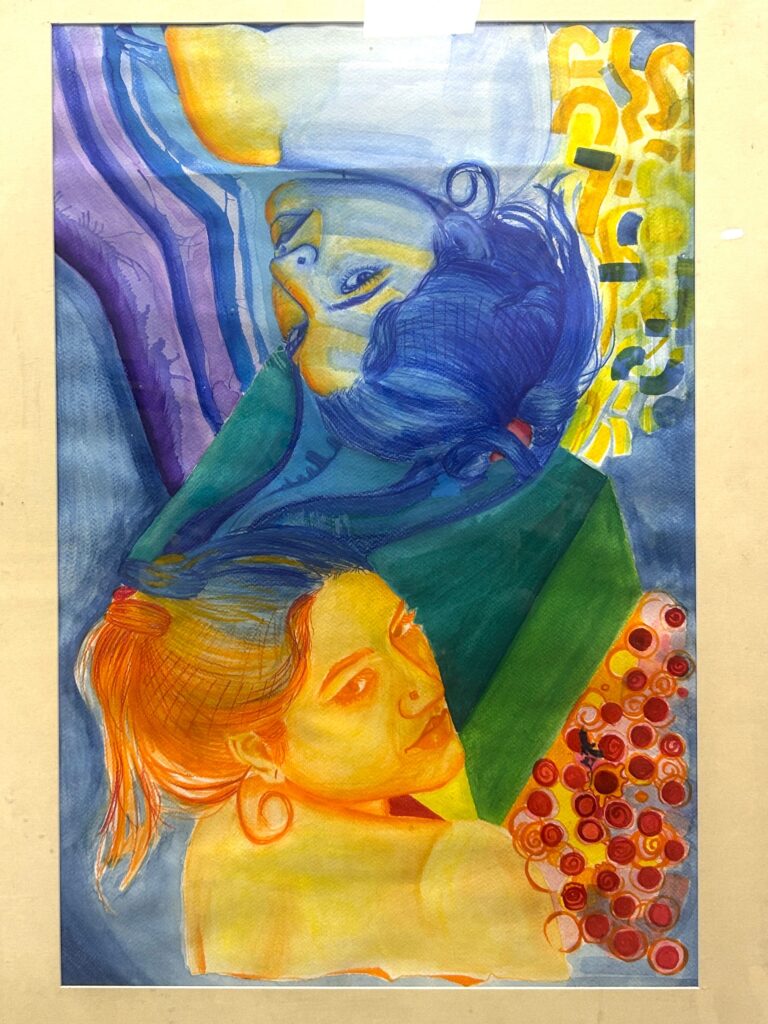
Khushi aggarwal
Tip of the iceberg
One face hangs upside down while the other turns toward you
A blue face hangs upside down, its hair a knot of ink-dark lines.
Below it, a yellow face leans in, warm as late afternoon on a wall.
A green collar folds between them like a shared coat.
Red seeds spin in one corner. Yellow marks scatter in another.
The water has dried in soft tidelines.
Two heads, one sheet of paper, no word spoken.
In this 2024 work, Khushi Aggarwal of Ghaziabad sets two faces head to head. One hangs upside down in cool blues. The other turns in warm yellow and orange. A green shape folds between them. Aggarwal lays down watercolour washes, then draws over them in colour pencil. Fine hatched lines build the hair. Her college is Amity University. In her statement she says her self-portraits "convey the isolation as well as community". She borrows from printmaking and drawing for "thoughtful and calculated distortions".
Watercolour and colour pencil on paper · 2024
Theme Isolation and community
RC-702
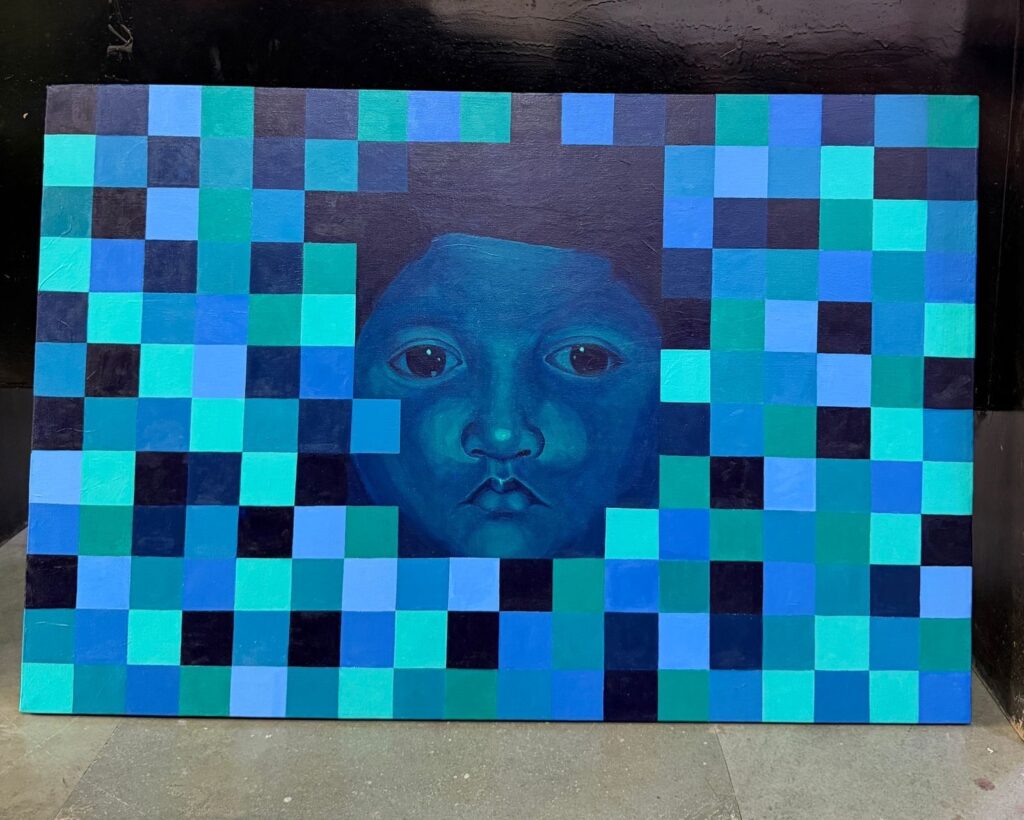
Khushi aggarwal
Metamorphosis
A blue face waits where the grid gives way
Teal, navy, turquoise, the blue of a swimming pool at night.
The squares march in rows and then stop short.
In the gap a face rises, the colour of deep water.
Two small lights sit in the dark eyes.
The mouth is closed. It has not decided to speak.
At the edges the grid keeps counting, square after square.
In Metamorphosis Khushi Aggarwal paints a face in deep blue. It floats in a dark field. Around it, small squares of teal, turquoise, navy and pale blue cover the canvas like tiles. Near the face the squares fall away in steps. The work is acrylic on canvas. Aggarwal makes work about identity: a person alone and a person among others. In painting Aggarwal borrows from printmaking, sculpture and drawing to make 'thoughtful and calculated distortions'. Aggarwal, of Amity University, is based in Ghaziabad.
Acrylic on canvas · 2026
Theme Identity and isolation
RC-703
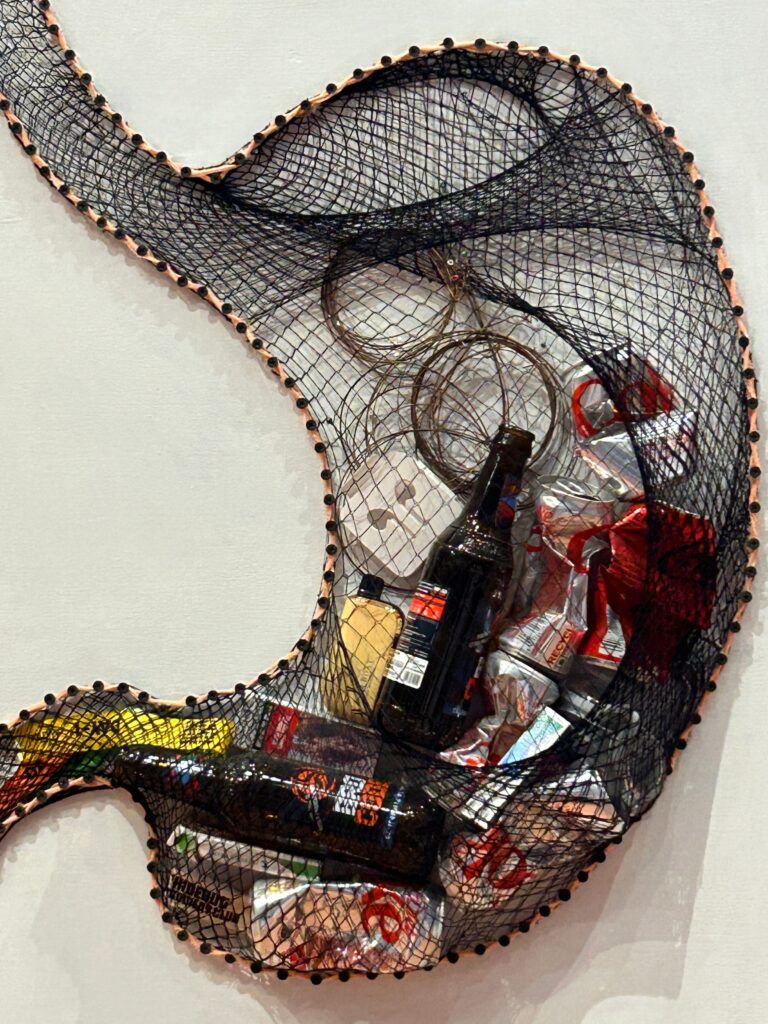
Khushi aggarwal
A balanced diet
One person's rubbish, held inside the shape of a stomach
A black net pulls tight like skin over a meal.
Red and silver cans fold in on themselves.
Two brown bottles lie down as if tired.
A white plug waits near a loop of copper wire.
Dark studs march in a line around a pink edge.
The wall behind stays pale and quiet.
This is what was swallowed and kept.
Khushi Aggarwal works in Ghaziabad. Her college is Amity University. In A Balanced Diet she stretches a black net into the shape of a stomach on a wooden board. Inside sit crushed cans, glass bottles, a plug and coils of wire. Aggarwal collects the remains of things she uses in daily life. Here she maps her own pattern of consumption. The hardest part, she says, is making each object fit the idea. The work must read as art and not as a pile of garbage.
Mixed media installation on wooden board · 2026
Theme Identity through consumption
RC-704
From the open call
Prachi Vishwakarma
I was trying to create paintings that feel personal and expressive, instead of just making something that looks pretty. A lot of my ideas come from emotions, things I observe around me, Indian culture, spirituality, nature, and folk art. Some paintings are more direct, while others are abstract because I wanted people to look at them and connect with them in their own way. I like the idea that two…


Prachi Vishwakarma
Eyeof the soul
Fish swim past an eye that holds the whole sea
Blue comes down from the top and is left to run.
An eye opens in the middle of it, wet and wide.
Fish with copper tails cross the iris like slow thoughts.
White roses float at the corners, half washed away.
At the bottom the colour gives up in thin lines.
Bare canvas waits there, white as morning paper.
Prachi Vishwakarma paints Eye of the Soul in acrylic on canvas. She studies at Raja Mansingh Tomar Music and Arts University in Bhopal. One large eye sits at the centre of a deep blue field. Dark fish with copper fins swim around it. Pale roses gather near the edges. Thin paint runs down and stops above bare white canvas. Vishwakarma often works with eyes, water and flowers. She keeps changing colours and forms until a painting feels right. The hard part, she says, is knowing when to stop.
Acrylic on canvas · 2 × 3 cm · 2025
Theme Seeing and feeling
RC-684

Prachi Vishwakarma
Abstract face
One eye stays open while the rest of the face unfolds
A lotus opens where a cheek should be.
One eye holds still, ringed in purple, with a white dot of light.
The nose is a red wall with a yellow seam.
Dark lips close on something not yet said.
Below, olive and orange curl like smoke from a lamp.
Half the face is quiet chalk. Half is a festival that will not settle.
Abstract face is a 2025 acrylic painting by Prachi Vishwakarma from Raja Mansingh Tomar Music and Arts University in Bhopal. Half of the face is a pale mask with one wide eye. The other half breaks into petals and curling shapes. Vishwakarma draws on emotion, nature, spirituality and folk art. Eyes and flowers help her express ideas that are hard to put into words. She keeps changing colours and shapes until a painting feels right. She wants each viewer to find a different meaning.
Acrylic on canvas · 2 × 3 cm · 2025
Theme Emotion and inner vision
RC-685

Prachi Vishwakarma
Veil of bloom
Roses take her eyes but leave her red mouth
A face goes under roses, red and coral and pink.
Only the mouth stays, painted the red of a closed door.
A brown butterfly sits where the eyes should be.
Blue petals gather at the throat like cool water.
White rivers move through the dark behind her.
Under one warm lamp, she keeps her looking to herself.
Prachi Vishwakarma's college is Raja Mansingh Tomar Music and Arts University in Bhopal. In Veil of bloom (2025) she paints a woman whose eyes are hidden. Roses and a pale lilac shape cover the top of her face. A small butterfly rests between them. Blue flowers rise around her shoulders. Behind her, white bands curl across a black ground. Vishwakarma works in acrylic on canvas. She changes colours and backgrounds until a painting feels right. She finds a painting can be "stronger without too much detail."
Acrylic on canvas · 1 × 2 cm · 2025
Theme Nature and the hidden self
RC-686
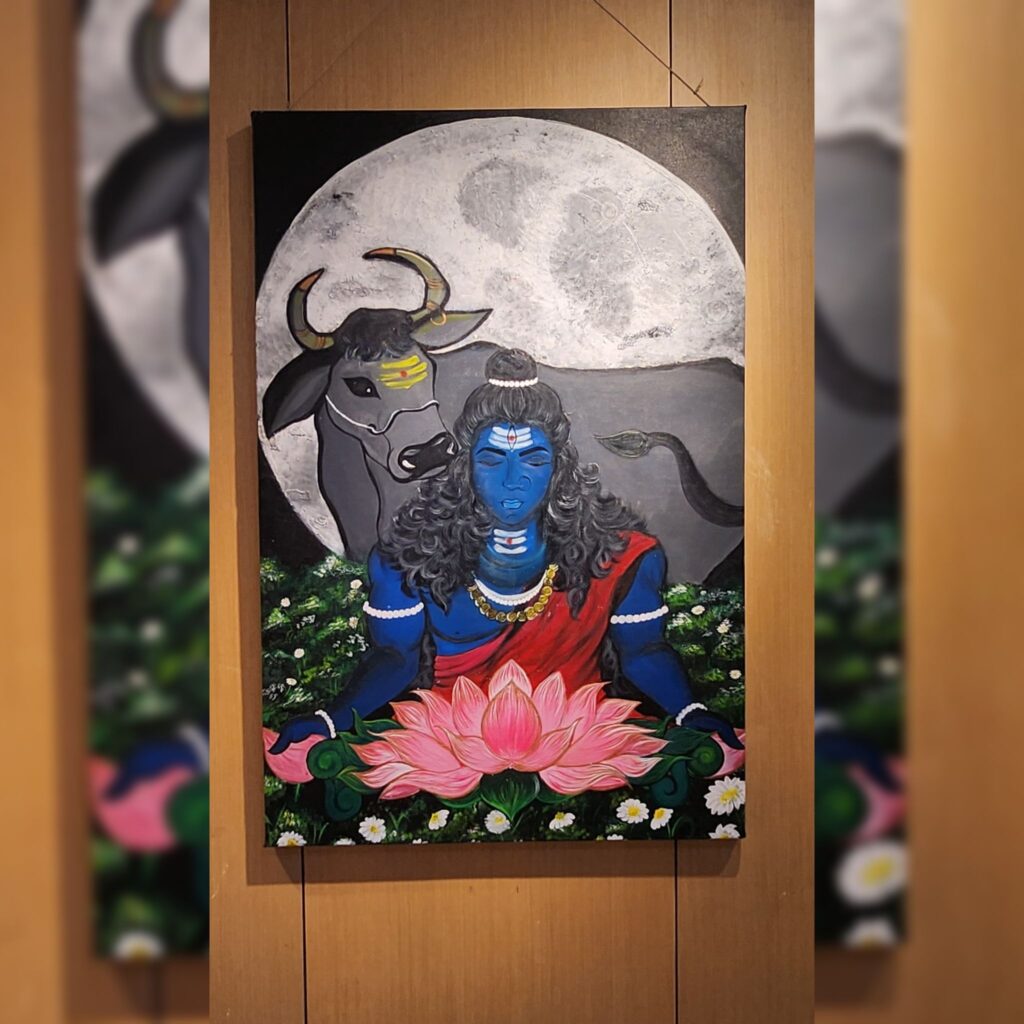
Prachi Vishwakarma
Shiva
Eyes closed under a full moon, he holds the whole night still
A moon wide as a well hangs behind his head.
The bull leans close, grey as wet stone, a yellow mark between its eyes.
His skin is the blue of deep water at night.
His eyes stay shut. His hands rest on a lotus as if it were warm.
White daisies keep watch in the dark grass.
Everything here is quiet enough to hear breathing.
Prachi Vishwakarma studies at Raja Mansingh Tomar Music and Arts University in Bhopal. In Shiva she paints the god with his eyes closed. His skin is deep blue. His hands rest on a pink lotus. Behind him stands Nandi the bull under a full moon. Vishwakarma draws on Indian culture, spirituality, nature and folk art. She keeps changing colours and backgrounds until a painting feels right. She finds it hard to know when to stop.
Acrylic on canvas · 2 × 3 cm · 2025
Theme Stillness and the divine
RC-687

Prachi Vishwakarma
Ocean guardian
A turtle carries a sunset on its back through blue flowers
A shell the colour of a mango cut open.
White lines hold each warm piece in place, like a window of stained glass.
The flippers are cool blue nets, pulling slowly through green water.
Small flowers drift past with dark centres, like eyes that do not blink.
The turtle does not hurry.
It carries the last of the day down into the deep.
Prachi Vishwakarma paints a sea turtle swimming through deep green water. Its shell glows yellow, orange and violet, like evening light. Pale blue lines mark every plate on its flippers. Blue flowers float around it like a garden under the sea. Vishwakarma studies at Raja Mansingh Tomar Music and Arts University in Bhopal. She often paints flowers, water and animals. She keeps changing colours, forms and backgrounds until a painting feels right. Then she tries to stop before adding too much.
Acrylic · 3 × 4 cm · 2025
Theme Guardian of the sea
RC-688

Prachi Vishwakarma
Inner sakti
One face keeps watch while the other weeps
An orange sky rough as plaster, a pale sun behind her crown.
Above, a small face keeps its eyes open and its red bindi still.
Below, the same woman shuts pink lids. Green on one cheek, orange on the other.
Two drops fall and catch the light like silver leaves.
Blue and orange fold across her chest like stiff paper.
Black walls stand on both sides. She stays between them, awake and resting at once.
Inner Sakti is a 2024 acrylic painting by Prachi Vishwakarma. She studies at Raja Mansingh Tomar Music and Arts University. Here one woman has two faces. The calm face on top looks straight out. The green and orange face below has closed eyes and falling drops. Vishwakarma draws on Indian culture, spirituality and folk art. She often paints eyes and feminine forms. She says she keeps changing colours, forms and backgrounds until a painting feels right.
Acrylic · 3 × 4 cm · 2024
Theme Feminine inner power
RC-689
From the open call
Punit Kadwane
My artistic practice is rooted in the exploration of spirituality, mythology, and the subtle relationship between the inner and outer worlds. Through painting, I seek to translate intangible emotions, philosophical reflections, and cultural memories into visual narratives that resonate with contemporary audiences while remaining connected to the richness of Indian tradition. I use multiple mediums like acrylics, oils, ink and mixed media on canvas. Drawing inspiration from Hindu mythology, sacred…


Punit Kadwane
Madmast Nandi
A sacred bull rolls over, bells ringing, lost in his own joy
Blue dust on a grey hide, like ash after rain.
The bull tips over, hooves to the sky.
Rows of small bells hang still, yet you can almost hear them.
His eye is half shut, heavy and pleased.
Behind him pale clouds rise in soft rounds.
The cloth on his back carries leaves that do not fall.
Punit Kadwane, of Shipra Fine Art College in Ujjain, paints Nandi, the bull of Shiva. Nandi is often shown kneeling and still. Here he rolls on his back with his legs in the air. His head turns back and his eyes half close. Kadwane draws on Hindu myth and folk art. He treats myth as a living language. He builds the blue and grey body in speckled layers of acrylic. Strings of small bells and a pale cloth with leaves follow the curve of the round canvas.
Acrylic on canvas · 122 × 122 cm · 2026
Theme The sacred bull at play
RC-728

Punit Kadwane
Moon Within
Silver spreads like moonlight over a quiet blue face
Eyes closed, the blue face listens to something inside.
Hair falls in ropes of old gold, coil over coil.
A stripe of turmeric light rests on the brow.
From the right, silver comes in small flakes, like frost on a window at night.
It touches the cheek and the mouth and does not wake them.
Half the face is sky. Half is moon.
Punit Kadwane paints Moon Within in acrylic and silver on a canvas 76 × 60 cm. A blue face rests with its eyes closed. Gold and dark lines coil through the long hair like rope. A small face sits high in the hair. A band of yellow crosses the forehead. On the right side small flakes of silver spread over the face and the grey ground. Kadwane draws on Hindu mythology and builds texture in layers. Kadwane is from Shipra Fine Art College in Ujjain.
Acrylic and silver on canvas · 76 × 60 cm · 2026
Theme Inner stillness and light
RC-732
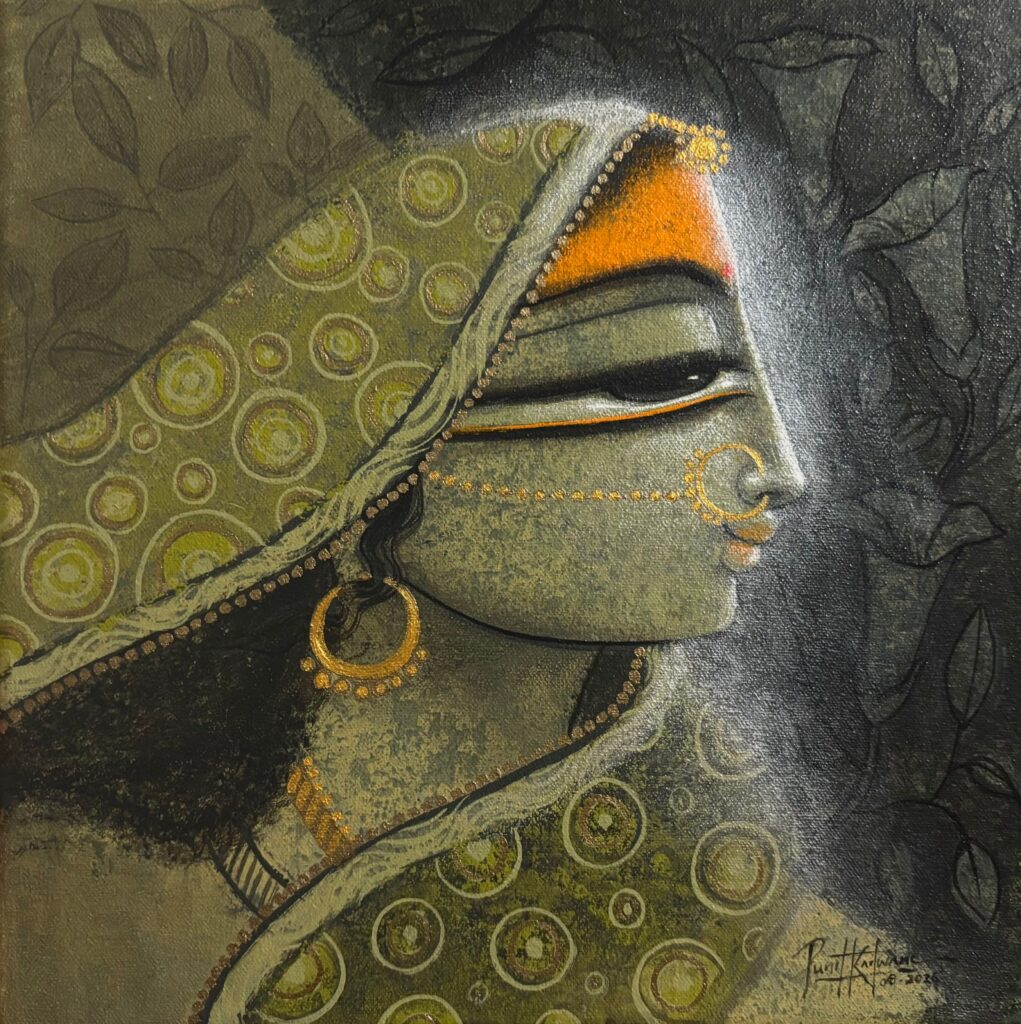
Punit Kadwane
Maa Parvati
Her eyes are lowered. Her forehead glows saffron
A grey face turns towards a soft white light.
Saffron rests on her brow, warm as a lamp.
Gold dots run from nose ring to ear in one thin bright thread.
Her veil is olive, covered with small round moons.
Behind her, dark leaves are only outlines.
She looks down and keeps something to herself.
Punit Kadwane works in Ujjain. He is from Shipra Fine Art College. In Maa Parvati he paints the goddess in profile in acrylic on a small square canvas. Kadwane draws on Hindu mythology and sacred symbols. He does not treat myth as history. He sees it as a living language. Texture matters to him. Here he builds the face in rough layers of grey. He lays fine dots of gold over the veil and the jewellery.
Acrylic on canvas · 30 × 30 cm · 2026
Theme The goddess in stillness
RC-733
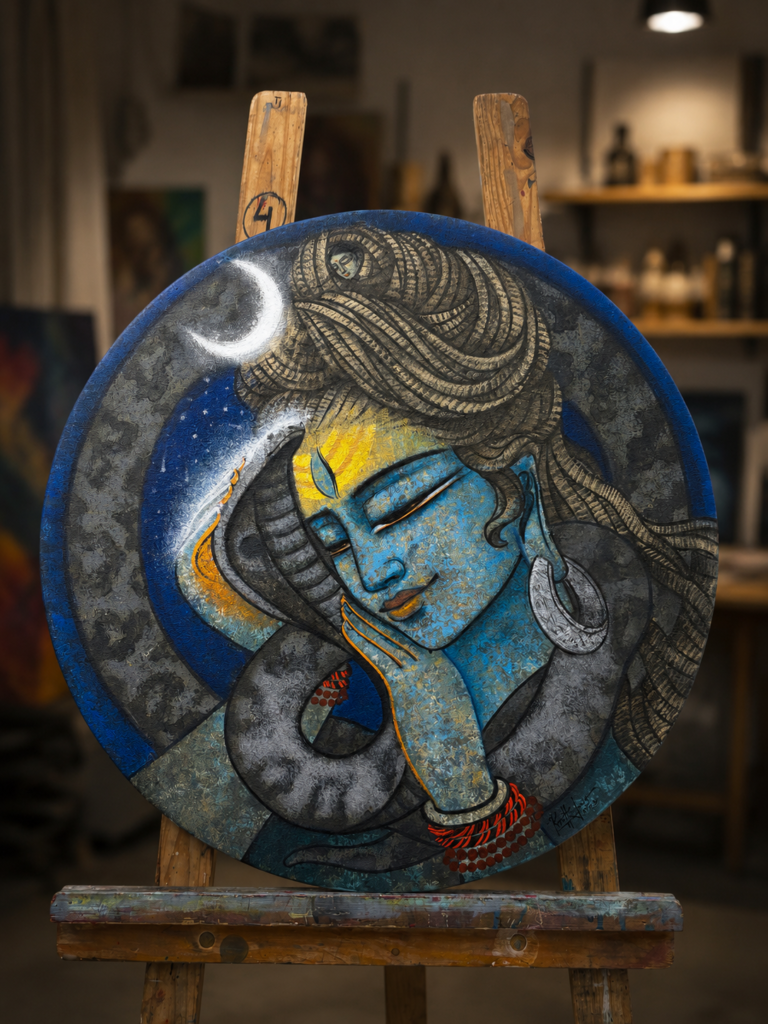
Punit Kadwane
Prem
Eyes closed, a snake for a scarf, the moon in the hair
Blue skin, the blue of deep water just before night.
A thin line of white light rests on each closed eye.
The moon is a small white cut in the hair.
A snake the colour of wet ash leans in close and stays.
Red beads hang still at the wrist.
Around it all the grey is rough as a temple step after rain.
Nothing here is asleep. It is only listening.
Punit Kadwane, of Shipra Fine Art College in Ujjain, paints Prem in acrylic on a round canvas of 60 × 60 cm. The work is from 2026. A blue figure rests its chin on one hand with eyes closed. A crescent moon sits in the coiled hair. A grey snake curls around the shoulders. Kadwane uses Hindu mythology as a living language. He builds the surface in layers so the grey ground feels rough like weathered stone.
Acrylic on canvas · 60 × 60 cm · 2026
Theme Love and stillness
RC-734
From the open call
Mayank Rastogi
I was trying to understand how light can change the way we see simple objects and forms. In this work, I used pots and geometric shapes as subjects because I was interested in their structure, curves, edges, and the spaces created around them. Instead of photographing them as ordinary objects, I wanted to focus on their shapes and see how they could become almost abstract through photography. I used studio…

Mayank Rastogi
Monochrome serenity
A white wall and a stone corner divide the sky
A white wall rises like a sheet of paper held up to the sky.
Along its top runs one thin dark line.
The grey frame is rough with small grains of stone.
In its corner a deep shadow keeps the cold.
Above, the clouds drift slowly and the stone stays still.
Everything here is quiet and every edge is sharp.
Mayank Rastogi makes this photograph in 2023. He is from the College of Arts and Crafts at Lucknow University. Here a white wall meets a frame of grey stone under a cloudy sky. Rastogi wants to understand how light changes the way we see simple forms. He looks at structure and edges. He looks at the empty space around a shape. Seen this closely the forms become almost abstract. For Rastogi a photograph does not need a complicated subject.
Photography · 2023
Theme Light, edge and form
RC-705

Mayank Rastogi
Monochrome serenity 2
A white wall holds its ground against a sky full of weather
The wall is the colour of chalk and old milk.
A hairline crack runs across it like a road on a map.
Above, the sky turns to smoke and wet slate.
One edge cuts the cloud clean in two.
A small dark window waits at the far corner.
The building stands still. The weather moves.
Mayank Rastogi is a photographer in Lucknow. He comes from the College of Arts and Crafts at Lucknow University. In Monochrome serenity 2, made in 2023, he points his camera up at a white building. A long curved wall meets a sharp corner. Dark sky and pale cloud fill the space behind it. A small window sits at the far right. Rastogi wants to see how light changes simple forms. Here a plain wall becomes pure shape.
Photography · 2023
Theme Light, shadow and form
RC-706
From the open call
ARGHA PRATIM SADHU
The central concern of my artistic practice is abstraction. I have chosen the path of abstraction not simply as a visual style, but as a means of exploring my thoughts, emotions, memories and inner experiences without confining myself within predetermined forms. For me, reality is not limited to what is visible. Objects, landscapes, people and nature may act as starting points, but my intention is not to reproduce them literally.…


ARGHA PRATIM SADHU
My Perspective
A creature breaks through twelve panes of carved wood
Black bars hold the picture like a window frame.
Above, lines curl inward and fold, a maze with no door.
Below, an eye opens in the hatched dark.
Teeth catch at the edge of one square and slip into the next.
The pale wood keeps its grain, fine scratches like rain on old glass.
Each pane shows a piece. None shows the whole.
Argha Pratim Sadhu comes from Habra and is part of the College of Visual Art in Kolkata. This woodblock print dates from 2023 and measures 68.58 × 50.8 cm. Sadhu divides the image into twelve panels with thick black bars, like a window. In the upper panels, lines turn inward like a maze. Below, a creature with one eye and sharp teeth spreads across the frames. The grain of the wood shows in the pale ground. Sadhu works towards abstraction and lets forms appear and change as the work grows.
Woodblock print · 68.58 × 50.8 cm · 2023
Theme Seeing in fragments
RC-714

ARGHA PRATIM SADHU
untitled
Six masks wait in their windows for faces to arrive
Six windows cut into cream card.
In each one a face looks back, black ink pressed hard into white.
Feathers. A beak. A crown of three sharp points.
Behind them the same word repeats in grey, soft as breath on cold glass.
The paper is rough and full of small flecks.
No face here is a person.
Each one waits for someone to wear it.
In this 2024 relief print by Argha Pratim Sadhu, six small panels sit in a cream mount in two rows of three. Each panel holds one mask, cut in strong black lines on white. One has feathers. One is a bird with a beak. One wears a crown of sharp points. Behind every mask a word in Bengali script repeats in soft grey. Sadhu is from Habra. His college is the College of Visual Art in Kolkata. He writes, "For me, reality is not limited to what is visible."
Relief print on paper · 35.56 × 43.18 cm · 2024
Theme Masks and hidden faces
RC-715

ARGHA PRATIM SADHU
nature
Where the leaves blocked the sun, the paper stayed white
Leaves lie open like hands on a cold blue floor.
Their saw-tooth edges cut the dark into stars.
Where the sun could not reach, the paper keeps its white.
Rust and moss seep in at the corners, slow as tea.
One leaf fades to a ghost behind another.
The whole sheet feels like a pond seen from above.
Argha Pratim Sadhu comes from Habra. His college is the College of Visual Art in Kolkata. This print is a wet cyanotype from 2023. In a cyanotype, light turns the paper blue. Anything that blocks the light leaves a pale shape. Here, saw-edged leaves crowd the sheet in white and soft blue. Rust and olive stains run between them. Sadhu says nature is a starting point for him, not something to copy. He lets colour and chance shape the rest.
Wet cyanotype print · 37.592 × 22.86 cm · 2023
Theme Leaves, light and chance
RC-716

ARGHA PRATIM SADHU
utsav
A festival, seen from behind the open jaws
Black ink pressed into grey paper, like smoke on a wall.
A striped head opens its jaws wider than the page allows.
Something small waits behind the teeth, half a face, half a crowd.
On the left the lines run thick as wet grass.
Two dark bars stand at the top like doors left open.
The festival is loud here. It has teeth.
Argha Pratim Sadhu makes this lithograph in 2020. Sadhu studies at the College of Visual Art, Kolkata and is based in Habra. The print is 25.4 cm wide and 15.7 cm high. Black ink sits on pale grey-brown paper. A striped animal head fills the right side. Its mouth is wide open and full of teeth. Hatching and dark bands cover the left. Below the image Sadhu writes the medium and the Bengali title in pencil. The title utsav means festival.
Lithograph on paper · 25.4 × 15.748 cm · 2020
Theme Festival and fear
RC-717
From the open call
Komal Singh
I have uploaded one video which is my recent insta reel, in the video I have shown short scene from kung fu panda 1 into paper animation, and then I have also painted one po painting with acrylic colous and with editing the paper drawings comes to life. There was no hardest part, it's just that it takes a lot of time and my patience. Next, the other one (…


Komal Singh
Akaza
A boy caught in the eye of a demon
Blue the colour of a cold night pressing on a window.
Black stripes fall across the face like bars.
Pink lashes tear open at the edges.
In the wet dark of the eye a small boy shouts in gold.
Sparks of white light cross him and do not burn.
The paper keeps its white border, a quiet room around a storm.
Komal Singh paints Akaza in 2025 with simple acrylic colour on smooth 300gsm paper. The title is the name of a demon in the Japanese anime Demon Slayer. Singh fills the sheet with one close eye. Dark stripes run across a blue face. Pink lashes open like torn cloth. Inside the eye a small boy looks back in gold light. Singh studies at Deen Dayal Upadhyaya College at Delhi University. She lives in Faridabad. She also turns film scenes into paper animation for short online videos.
Acrylic on 300gsm smooth paper · 2025
Theme Fear in reflection
RC-736

Komal Singh
Beauty and Death
A camera lens that looks straight back at you
Red sinks into the cheek like ink into cloth.
The hand holds the camera close, as if it might slip.
In the glass a second eye waits and does not move.
Blue hair breaks into fast dry strokes.
The jacket is grey water slowly drying.
Beauty and death share one face here.
We stand on the other side of the lens.
Beauty and Death is a 2024 acrylic painting by Komal Singh. Singh studies at Deen Dayal Upadhyaya College, Delhi University and lives in Faridabad. In the painting a young person with dark blue hair lifts a camera to one eye. Inside the lens a second eye looks out at us. Red and violet paint spreads over the face and the hand like stains. Quick dry strokes make the hair and the grey jacket. The pale ground shows at the edges.
Acrylic · 2024
Theme Seeing and being seen
RC-737
Komal Singh
Pixel Maze
A tiny figure in red looks up at two fires made of squares
Every flame here is a stack of small squares.
Orange climbs over red. Thin pink lines become a wing.
The sky is teal and grey, laid down like tiles.
A purple spiral turns slowly inside the lower fire.
Under the dark trunk someone small in red stands still.
They do not run. They only look up.
Komal Singh paints Pixel Maze in acrylic. The work is 42 × 29 cm and dates from 2025. Every shape is built from small squares of flat colour, like a picture on an old screen. Two creatures of orange, red and yellow fill a teal sky. One looks down from the top. The other curls around a purple spiral. In the lower left corner a small figure in red stands under a dark tree and looks up. Singh studies at Deen Dayal Upadhyaya College, Delhi University and lives in Faridabad.
Acrylic · 42 × 29 cm · 2025
Theme Smallness before great fire
RC-738

Komal Singh
The Last Samurai
Blue fire behind him, cold water at his feet
Blue fire climbs the cloth like breath on a cold morning.
Under the straw hat, no eyes. Only a mouth that has decided.
The blade is lit orange at its edge, the last warm thing here.
His robe comes apart into ash and ink.
Water jumps white around his feet.
Below, his shadow waits in the grey, holding still for him.
The Last Samurai is an acrylic painting from 2024 by Komal Singh. A lone swordsman stands in shallow water. A straw hat hides his eyes. Pale blue flame rises around him like smoke and his dark robes break into flecks of orange and black. Water splashes up at his feet. His shadow falls into the still surface below. Singh lives in Faridabad. Her college is Deen Dayal Upadhyaya College, Delhi University. She also makes paper animations from her own drawings.
Acrylic · 121 cm · 2024
Theme Stillness before the strike
RC-739
Komal Singh
One Last Hope
A goddess wears her face and pulls her out of the dark
A doorway opens in a dark grey wall.
Behind it the sky turns gold, pink and orange.
A girl with a third eye smiles through her loose curls.
A thin white ring of light rests behind her head.
Her hand comes forward, warm and sure.
Below, a dark shape rises out of blue smoke to take it.
Komal Singh paints a goddess of hope and light. The goddess has the face of a girl who is lost in darkness. Through a door, she reaches out and pulls the girl free. Singh sees herself in the girl. The painting holds a feeling she carried for some years. She paints it in acrylic on canvas cloth in only one day. She uses her own hand and posture as a reference. Getting the anatomy right is the hardest part.
Acrylic on canvas cloth · 2026
Theme Hope rising from darkness
RC-740
How buying works
A person, not a cart.
Tell us which work you love. Our team calls you from +91 98880 48804 within one working day with the price and everything else you need: size, framing, packing and delivery.
You pay Kalyani Kalakriti Foundation. We pay the artist. Packing and delivery are charged at cost, on top of the price.
Kalyani Kalakriti Foundation is a non-profit. What it earns from the catalogue goes into a fund that helps student artists with grants, gallery rent and their places at art fairs, exhibitions and residencies.