The Raconteur · Kalyani Kalakriti Foundation
The Raconteur Catalogue
Original works by the artists we have published. 136 works by 20 artists.
Before you turn the page
Every artist in this book has been in The Raconteur. You may have read about the clay that cracks, the cow on the street, the room with no one in it. Here are the works themselves.
New artists join every Monday with their issue. A work stays for a year or until it finds a home.
Prices are set by the artists and shared on request. Tap Ask for the price under any work, or message us on WhatsApp. Our team calls you within a working day, checks everything with the artist and handles the payment, packing and delivery.
In this book
The artists
Featured in Issue 5
Hind Salim
The Studio · Painting and expanded media. She makes skin as a landscape that peels, cracks, decays and grows again, in clay, latex, jute and dried algae.

Hind Salim
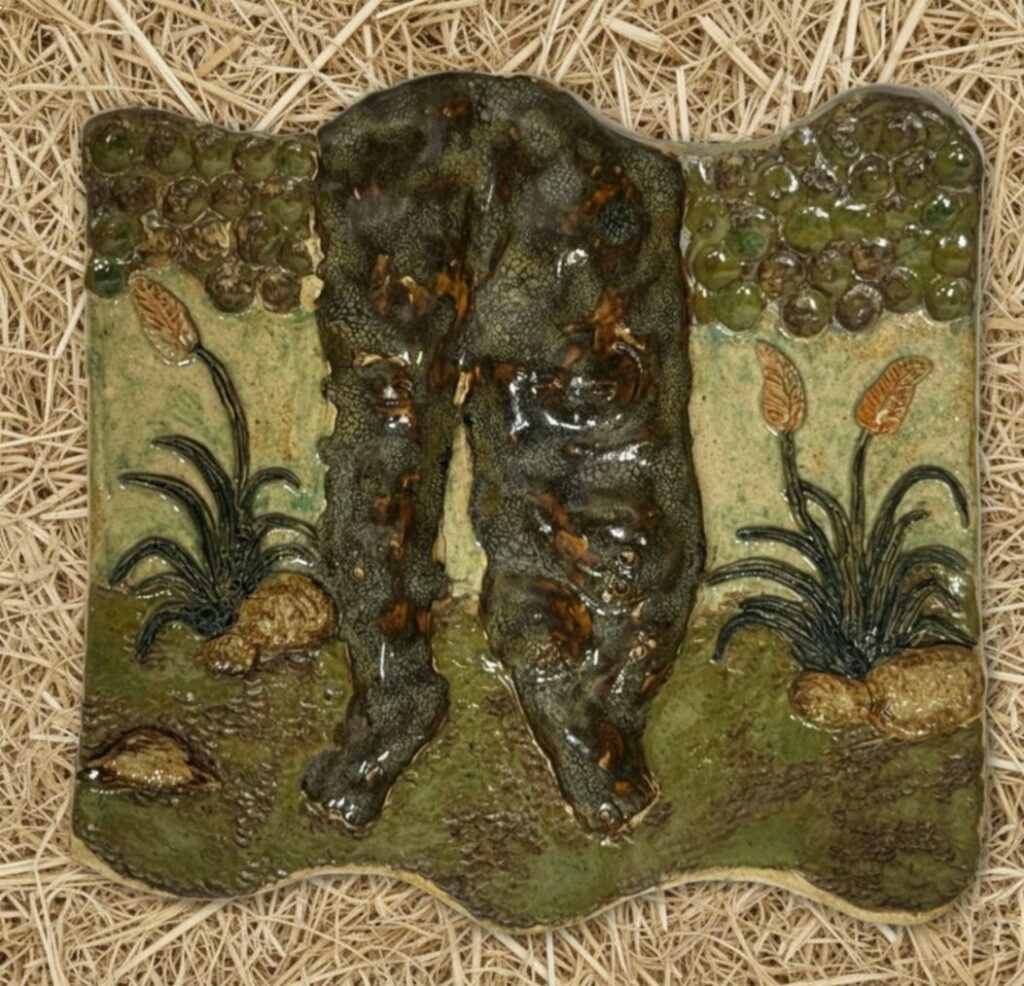
Pachydermic Ground
Two heavy legs take root in green clay ground
Two legs stand where the grass begins.
Their glaze runs dark green then brown then wet and shining like river stone.
Fine cracks cover them like a dry riverbed.
On either side tall leaves lift orange tips to the light.
Above, round shapes crowd close like pebbles under water.
The feet do not hurry. This ground is theirs.
Hind Salim makes this ceramic relief from her meetings with people who live with elephantiasis. Two heavy legs stand at the centre. Their skin is dark, glossy and cracked like bark or wet stone. Around them grow grasses and tall leaves on a green ground. Salim shapes the clay and finishes it with glaze and stain. She sees the body as land worn by time. For her the cracks and marks are not flaws to hide. They are records of what the material has gone through.
Glaze and stain on ceramic · 17 × 20 cm · 2026
Theme Body as landscape
RC-4201

Hind Salim
Morphological Continuum
An ear grows out of clay that looks like bark
Honey-coloured clay folds into the curve of an ear.
Behind it, rings of ochre spread like a fungus on a fallen log.
The dark slab shines where glaze has pooled in its ridges.
Two small holes on one side, one on the other, like pores.
The ear rests against the bark as if listening to it.
What does a body hear as it turns into ground?
Hind Salim makes an ear in clay and sets it on a slab that looks like tree bark. A layered form, like a shell or a fungus, grows behind it. Salim is studying for a master's in painting and expanded media at the University of Hyderabad. Her work grows from her own experience of Topical Steroid Withdrawal. She sees skin as something that carries experiences and histories. Firing is never fully in her control and she likes that. "Sometimes, the material makes a decision of its own."
Glaze and stain on ceramic · 5 × 22 × 12 cm · 2026
Theme Body and organic form
RC-4202
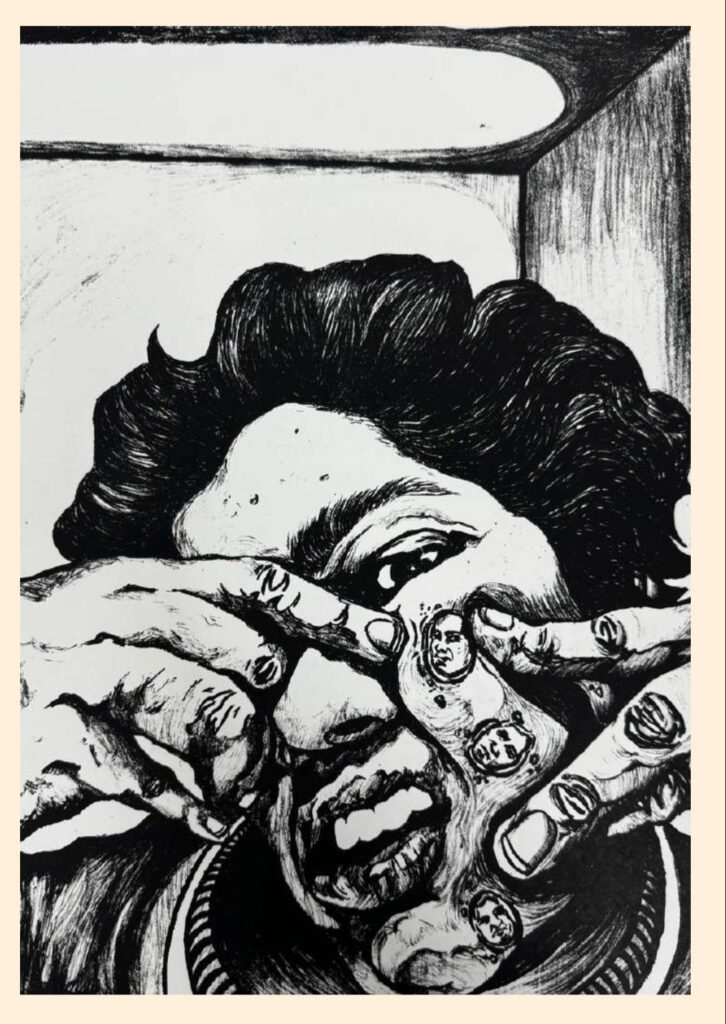
Hind Salim
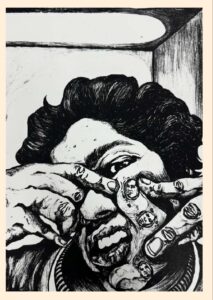
Skin holds the noise
Small faces crowd the fingers that press against a straining face
Black ink grips white paper the way fingers grip a face.
One eye stays open between the knuckles.
Teeth press out. The lip pulls down.
On each finger a small face waits, like a coin pressed into skin.
Behind, a quiet room: a pale panel of light, a wooden wall.
The skin is loud. The room says nothing.
In this lithograph, a face pushes through spread fingers. One eye stares out. The teeth are bared. Tiny faces are drawn on the fingers. Hind Salim is from Kerala. She is studying for a master's in painting and expanded media at the S.N. School, University of Hyderabad. Her work begins with her own experience of Topical Steroid Withdrawal. In print Salim treats the body as a surface that can be marked again and again. Skin, she says, is "a biological, social and political territory."
Lithograph · 42 × 29.7 cm · 2026
Theme Skin as living archive
RC-4203
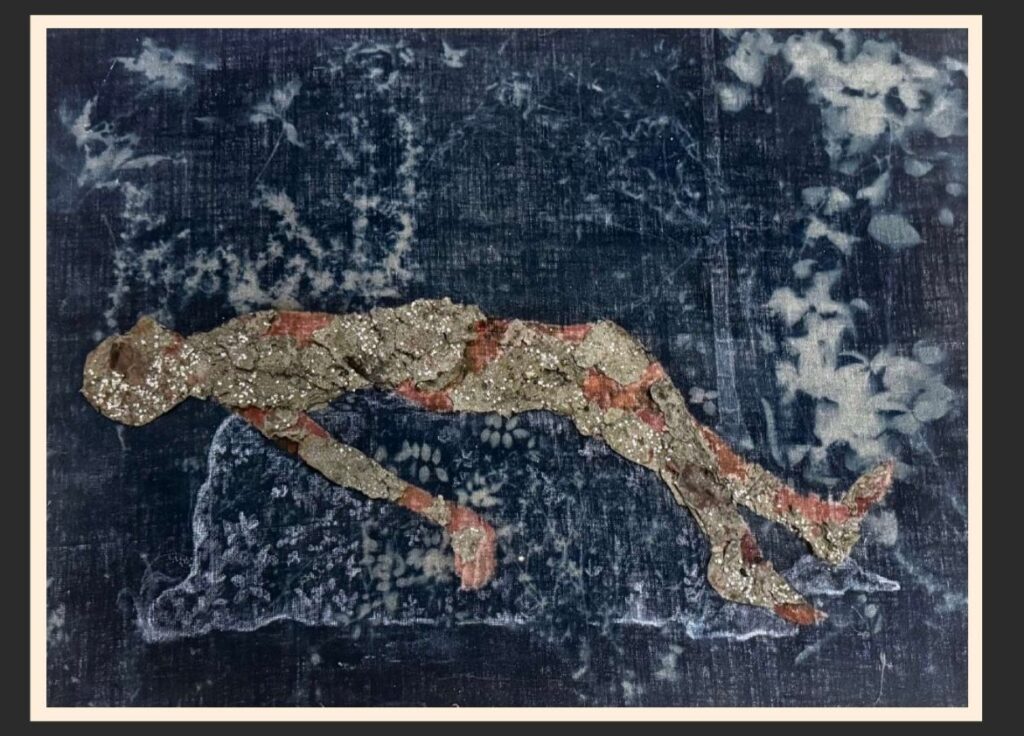
Hind Salim
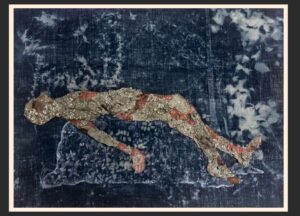
Decaying Bodies
A body made of algae, slowly coming apart on blue jute
Night blue soaks into the weave of the jute.
Leaves have left their ghosts here, pale as breath on glass.
A body lies across a stone of light with its feet lifted.
Its skin is dried algae, grey and gold, split like a riverbed in May.
Rust shows through the cracks where the green has gone.
It glitters the way salt does as it slowly gives itself back.
Hind Salim makes Decaying Bodies on jute. Cyanotype stains the cloth a deep blue. Pale shapes of leaves and plants float across it. On top lies a human figure made of dried algae. It stretches out over a pale slab with its head to the left. Salim sees skin as a living archive of illness, memory and healing. Dried algae can peel, crack and decay. Here that change is part of the meaning.
Cyanotype and dried algae on jute · 97.5 × 121 × 5 cm · 2026
Theme Skin, decay and change
RC-10612
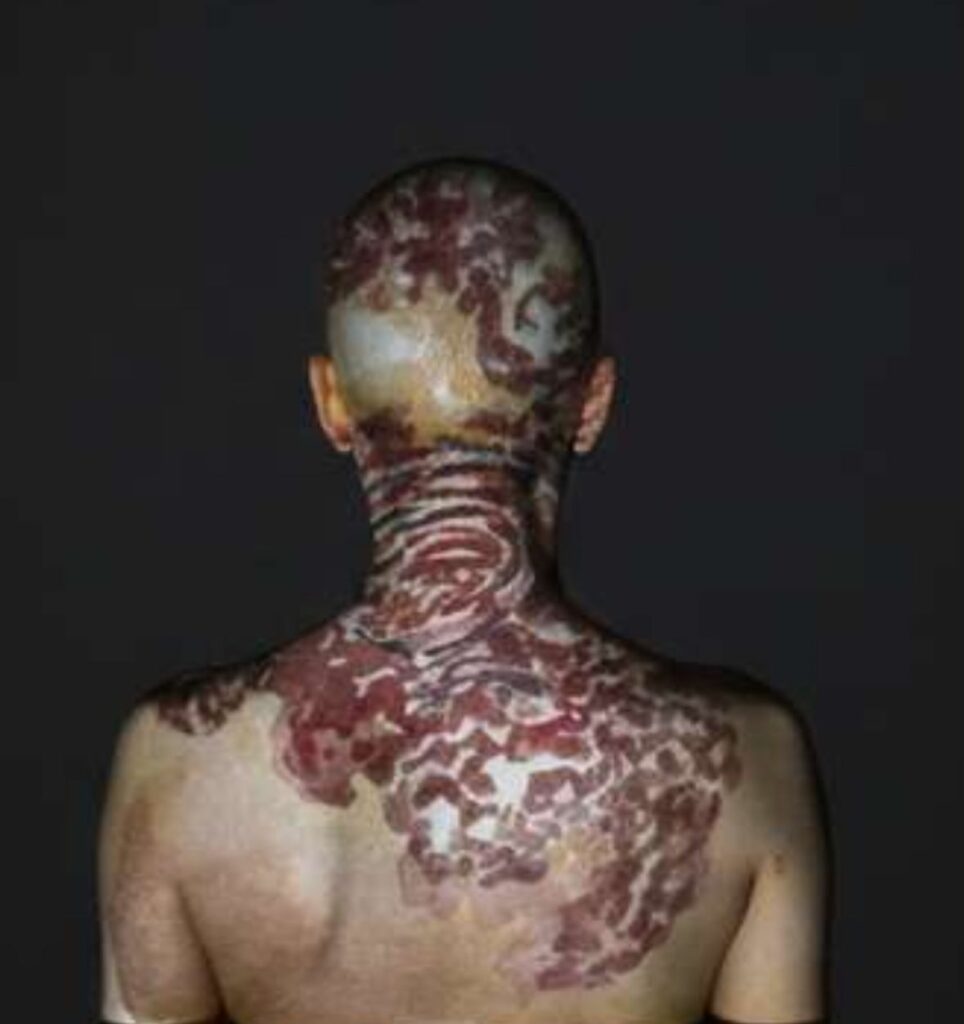
Hind Salim
Morbidity series
Light lays a second skin over the body
Dark wine red pools across the shoulders like spilt tea gone cold.
On the neck the lines tighten into rings, a thumbprint pressed by light.
The shaved head holds a pale island where the light grows thin.
Nothing here is cut or painted. It is only light, resting.
The room behind is black and still.
I look again. The marks look back like a map of a place someone has lived.
Hind Salim projects enlarged skin textures onto a body. In this work from the Morbidity series, the light falls on the back of a shaved head, the neck and the shoulders. Dark red patches spread across pale skin. On the neck, the marks curl into tight rings like a fingerprint. Salim studies at the Sarojini Naidu School of Arts and Communication at the University of Hyderabad. Salim also works in clay, print, latex and wax. Salim asks viewers to look again and to see marked skin without pity.
Installation with projection mapped on the body · 2025.26
Theme Skin as living archive
RC-10613
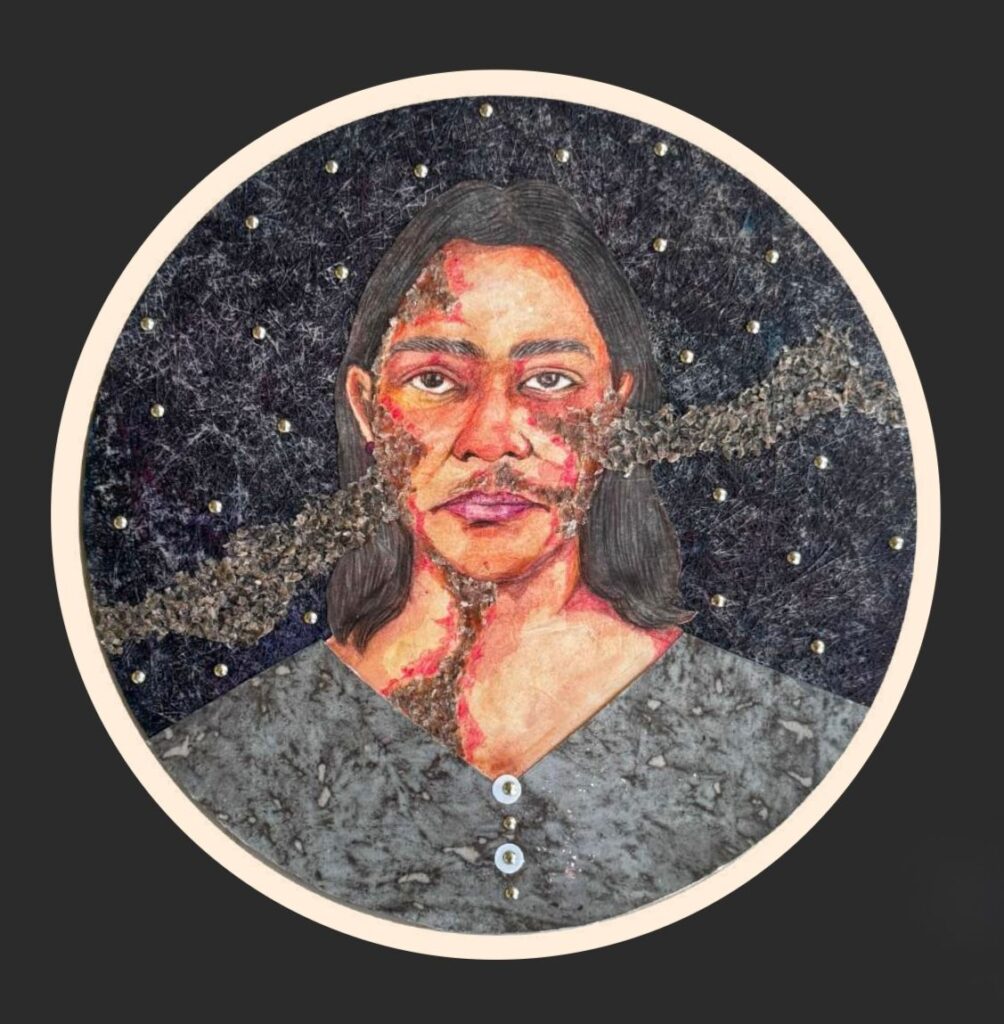
Hind Salim
Topography of self-shed
A face read like a map of what the skin remembers
A face holds still against a sky of fine grey threads.
Dry flakes of skin climb the cheek like a hill seen from a train.
Red seeps at the edges, warm as a fresh mark.
Small gold points sit in the dark where stars should be.
Two pale buttons close the collar.
The eyes ask nothing. They wait for you to look again.
Hind Salim builds this round portrait from 2025 on rice paper and fibre. A face looks straight out of a dark, starry ground. Pressed skin peels run over the cheeks and down the neck like a ridge of land. The face is drawn in watercolour pencils, with flushes of red and orange. Hibiscus pulp and small sequins complete the surface. Salim sees skin as a living archive of illness, memory and healing. Here its marks are not flaws to hide. They are a record.
Skin peels, watercolour pencils, hibiscus pulp and sequins on rice paper and fibre · 25 × 25 × 5 cm · 2025
Theme Skin as living archive
RC-10611
Hind Salim
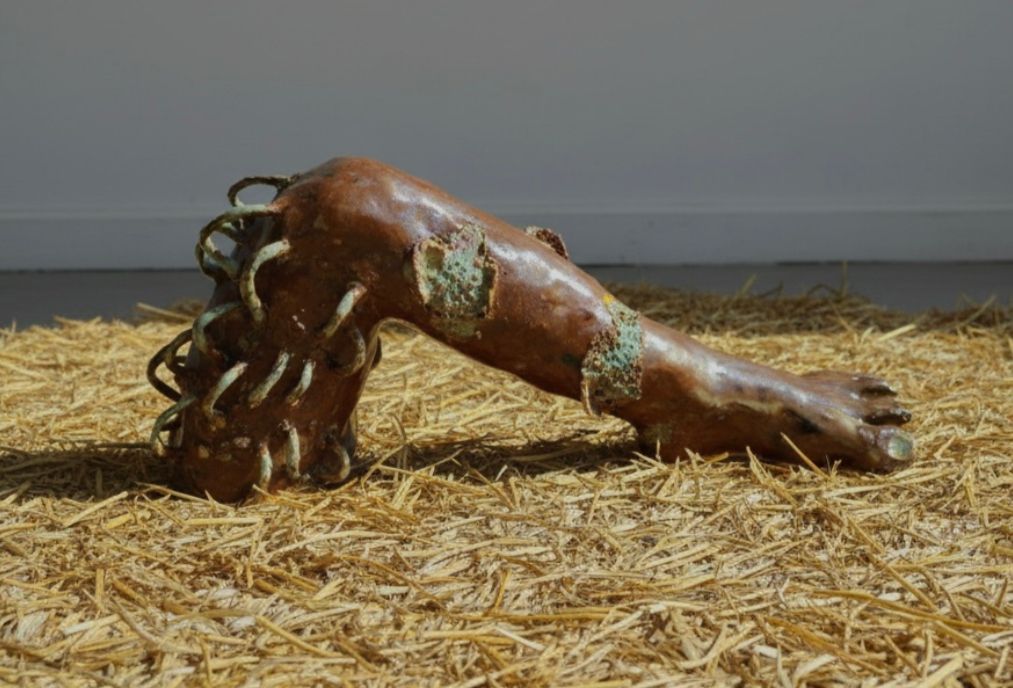
Corroded limb
A leg that has weathered like a hillside
A leg lies down in the straw as if it walked too far.
The glaze shines like wet earth after rain.
Green crust blooms at the knee and the shin, the colour of an old coin.
At the hip, pale hooks curl out like roots looking for water.
Sun falls across the toes.
Nothing here is hiding.
Hind Salim shapes a bent leg in clay, from thigh to toes. It is 26 cm long. A glossy brown glaze covers the skin. Patches of green stain sit on it like rust on metal. Pale curled hooks grow from the top of the thigh. Salim sees skin as a record of illness, memory and healing. Here the body turns into worn land. The marks stay in view. Salim comes from the Sarojini Naidu School of Arts and Communication at the University of Hyderabad.
Glaze and stain on ceramic · 10 × 26 × 6 cm · 2026
Theme Skin as eroded land
RC-10609
Hind Salim
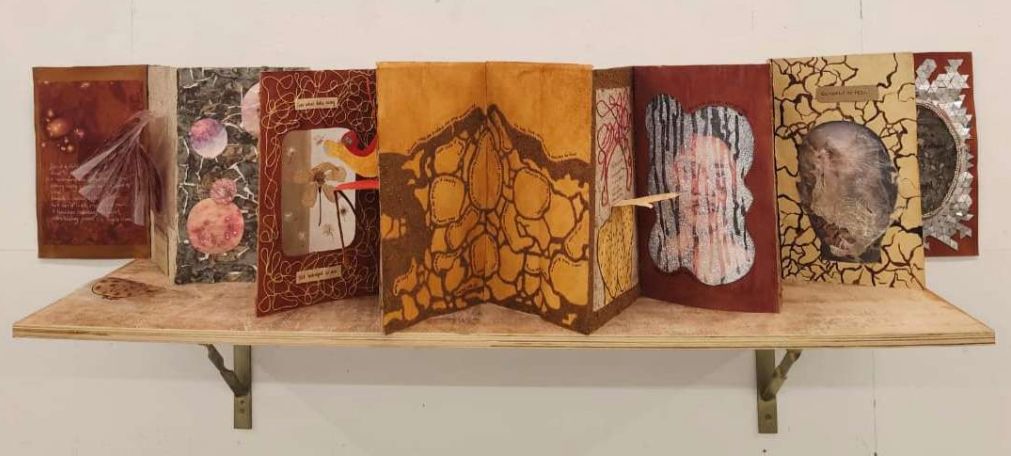
Topographies of skin
A book of skin that opens like cracked earth
Rust, ochre and a little gold, the colours of earth after a long dry month.
Cracks run across the pages like the lines on the back of a hand.
A face looks out through a cut window.
Pink moons float on grey stone.
Silver foil catches the light at the far end.
The book stands open on its plank of wood and waits to be read.
Topographies of skin is a book that opens like a fan. Its paper pages fold in a zigzag and stand open on a shelf. The work is 30 cm high and 294 cm wide. Hind Salim, of the Sarojini Naidu School of Arts and Communication at the University of Hyderabad, makes work about skin. Salim sees skin as a record of illness, memory and healing. Here cracked lines in rust and gold look like dry earth. Small windows cut into the pages show faces and round forms.
Mixed media on paper, accordion book fold · 30 × 294 cm · 2026
Theme Skin as living archive
RC-10610
Featured in Issue 5
Tridisha Dutta
Hello, my name is Tridisha Dutta, and I am from Nalbari, Assam. From my childhood, I have been interested in making crafts and creative works. This interest inspired me a lot. Through art, I can see world as different way, felt that I can express my inner thoughts, feelings, and experiences that are difficult to express in words. That's way I choose this path as my career. As a painting…


Tridisha Dutta
Bonding
Two fish look at each other across a red river
Two fish lift their heads out of a red night.
Each eye sits inside a thin red ring.
Between them a brown river bends but does not break.
Red shapes curl along its banks like small waves.
Dry leaves rest on their sides like old coins.
They do not touch. They only look.
In Bonding, two fish turn towards each other across a dark red ground. A wide brown shape runs between them like a stream. Tridisha Dutta comes from Nalbari in Assam. She studies painting at Assam University in Silchar. Animal figures are an important part of her work. Here she uses natural colours with mixed materials. Short red pieces curve in rows like waves. Small dry forms rest on the fish bodies. Thin white and yellow lines mark each scale and fin. Dutta makes the work in 2025.
Mixed media · 55.9 × 76.2 cm · 2025
Theme Closeness between two lives
RC-10614
Featured in Issue 5
Manu M Das
First Year Out · Sculpture and performance. 16,779 dots in seven hours, a thousand kullhads and one line across a hill: work you can measure in time and labour.
Manu M Das
Landscape in layers
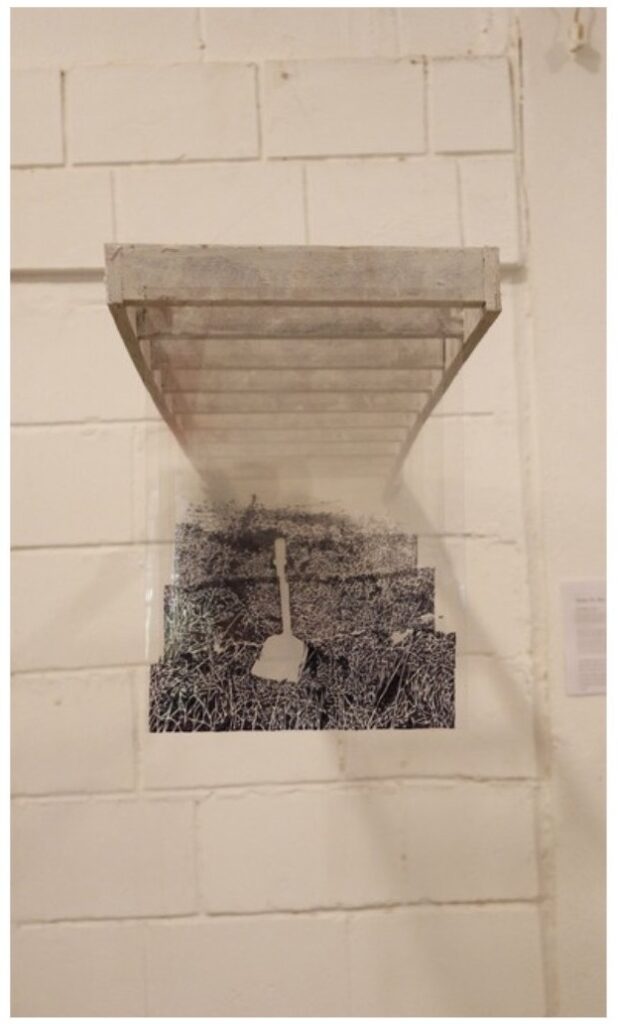
A spade stands in grass made only of light and layers
A grey frame leans out of the wall like a shelf with nothing on it.
Clear sheets hang in a row and hold the low yellow light.
On the last one the grass is black and sharp as cracked glass.
A spade stands in the middle with no hand on it.
Its shadow slides down the white bricks.
Look straight and the ground is whole. Step aside and it is gone.
In Landscape in layers a weathered wooden frame juts out from a white brick wall. Thin wooden slats hold transparent A4 sheets one behind the other. The sheets carry a black and white image of rough grass. A spade stands upright in the middle of it. Seen from the front the layers meet as one picture. Seen from the side the ground thins to air. Manu M Das comes from Palakkad and studies at Jamia Millia Islamia in New Delhi. Das treats the work as a record of time and labour spent on a place.
Installation of transparent 300 gsm A4 sheets and wood · 21 × 29.7 cm · 2026
Theme Labour, time and place
RC-10595
Manu M Das
Laterite Story
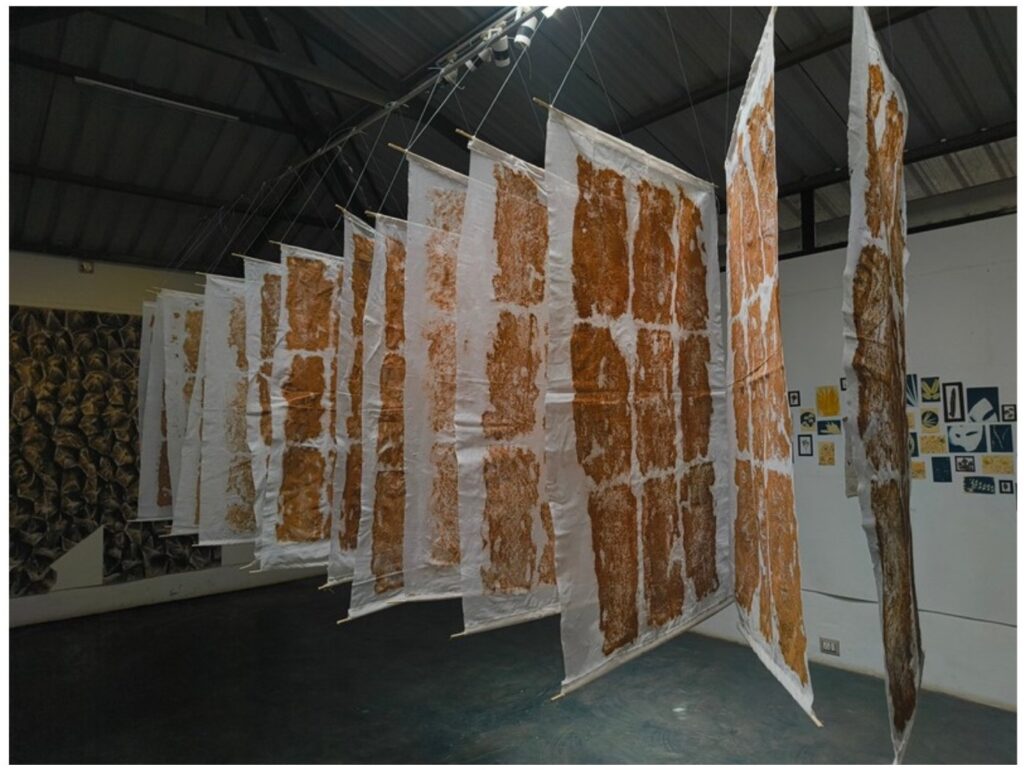
The ground, lifted up and hung out like washing
Rust on white cloth, pressed up from the ground.
Each sheet hangs from a thin rod like washing left to dry in a closed room.
The light from the roof finds the edges where the earth would not take.
Blocks of colour crack like a dry field or old floor tiles.
Walk the row and the sheets turn slightly in the still air.
A hillside folded into cloth, waiting to be read.
Laterite Story comes from the Sara Pro-Seed Artist Residency in Karnataka in 2026. Manu M Das prints the texture of natural earth onto white cloth. The marks come out rust and orange, in broken blocks like patches of ground. In this showing the cloths hang from wooden rods on thin wires. They stand in a long row across a dark hall. Das works with repeated actions and labour. He sees the work as a record of time spent and of human friction against the physical world.
Natural dirt texture print on cloth · 76.2 × 45.7 cm · 2026
Theme Earth, labour and time
RC-10596

Manu M Das
Kullhad Columns
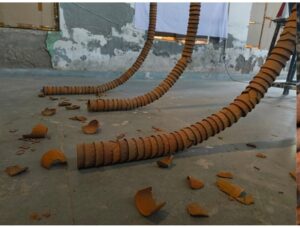
A thousand tea cups, saved from the bin, climb toward the ceiling
Cups fit inside cups, rim on rim, like the bones of a long neck.
Three lines fall from somewhere above and lie down on grey concrete.
The clay is the colour of dry chilli and old roof tiles.
Behind them a wall sheds its paint in green and white islands.
On the floor, broken halves rock like small boats.
Each one once held hot tea and someone's lips for a minute.
When Manu M Das first comes to Delhi from Kerala, he has never drunk tea from a terracotta cup. He is surprised that people throw these beautiful objects away. He keeps one. A year later he collects 1,000 discarded kulhads from tea shops near Jamia. He washes them in his studio and threads them on aluminium wire. The columns rise 335.3 cm and bend down to the floor. For Das the work keeps the time of the maker and the drinker.
Installation: 1,000 discarded kulhads and aluminium wire · 335.3 cm · 2026
Theme Time held in clay
RC-10597
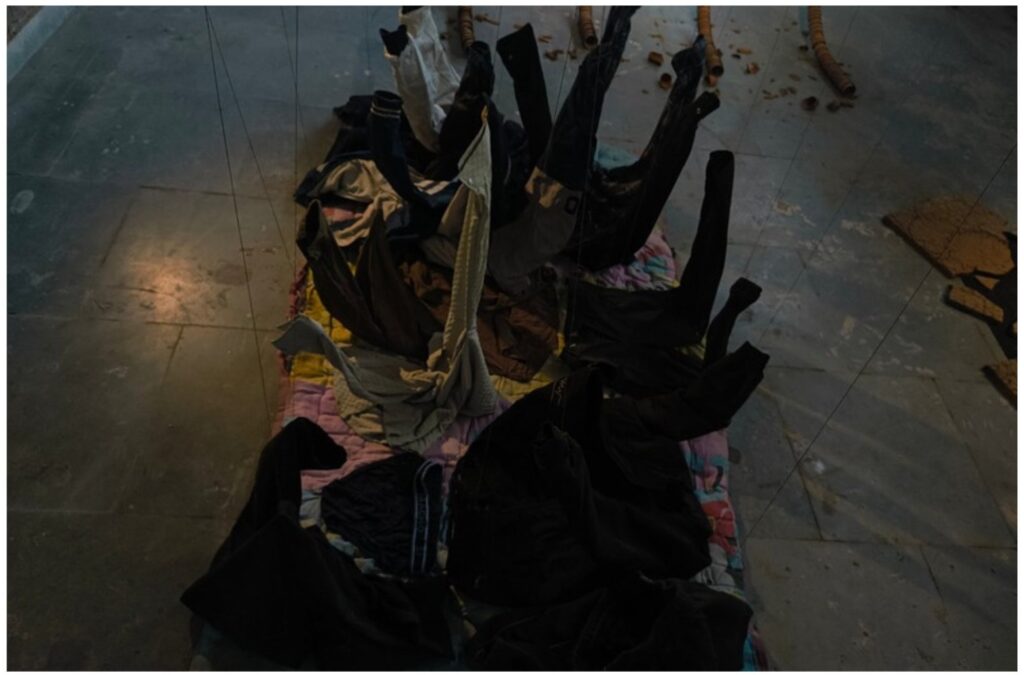
Manu M Das
Brush of Weeds
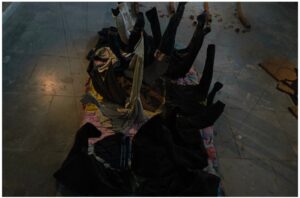
Empty trousers rise from a bed, held up by thread
A floral quilt, pink and yellow, on cold grey stone.
Trousers stand with their legs raised like arms in a dark room.
The threads are almost too thin to see.
Only they keep the cloth from falling back to sleep.
Someone once wore every fold.
The light comes in low and stays near the floor.
In Brush of Weeds, Manu M Das lays discarded clothes on a bed and lifts them with threads. Dark trousers and shirts stand upright on a pink and yellow quilt. Their legs and sleeves are pulled up into the air. Das collects materials that carry memory and assembles them by hand. For him the work is a record of the time and labour spent on it. It also records human friction against the physical world. The installation measures 213.4 × 91.4 × 61 cm.
Discarded clothes, bed and threads · 213.4 × 91.4 × 61 cm · 2026
Theme Time, labour and memory
RC-10598
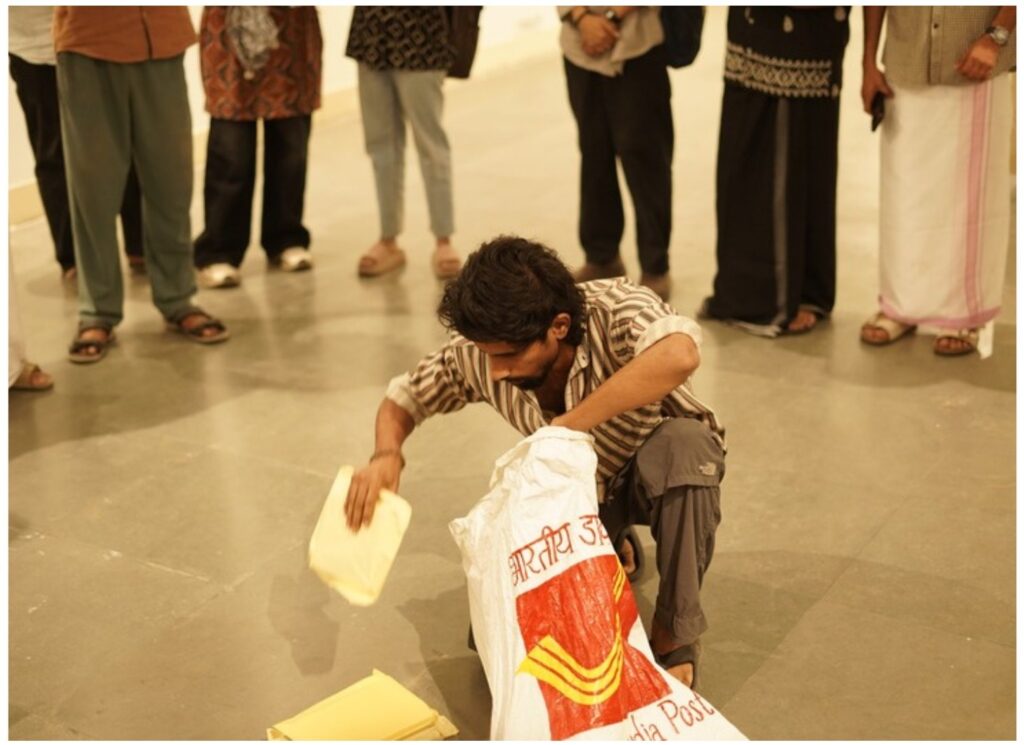
Manu M Das
Thazhe ninnum (From Below)
One by one, the yellow envelopes leave the sack
A white sack with the red and yellow of the post office on its side.
His hand goes in to the wrist and comes out holding yellow paper.
One envelope, then another, then another, warm in the gallery light.
Around him, a ring of sandals and a white cloth with a pink border.
The grey floor shines like still water.
What was sent somewhere is arriving here, slowly, from below.
In Thazhe ninnum (From Below), Manu M Das kneels on the grey stone floor of a gallery. Beside him is a white India Post sack. He reaches in and takes out yellow envelopes one at a time. He lays them on the floor. People stand in a ring around him and watch. Das makes work from repeated physical actions and the time they take. This live performance from 2026 is kept as a video. For him it is a plain record of time and labour spent.
Live performance and video documentary · 2026
Theme Labour and human friction
RC-10599
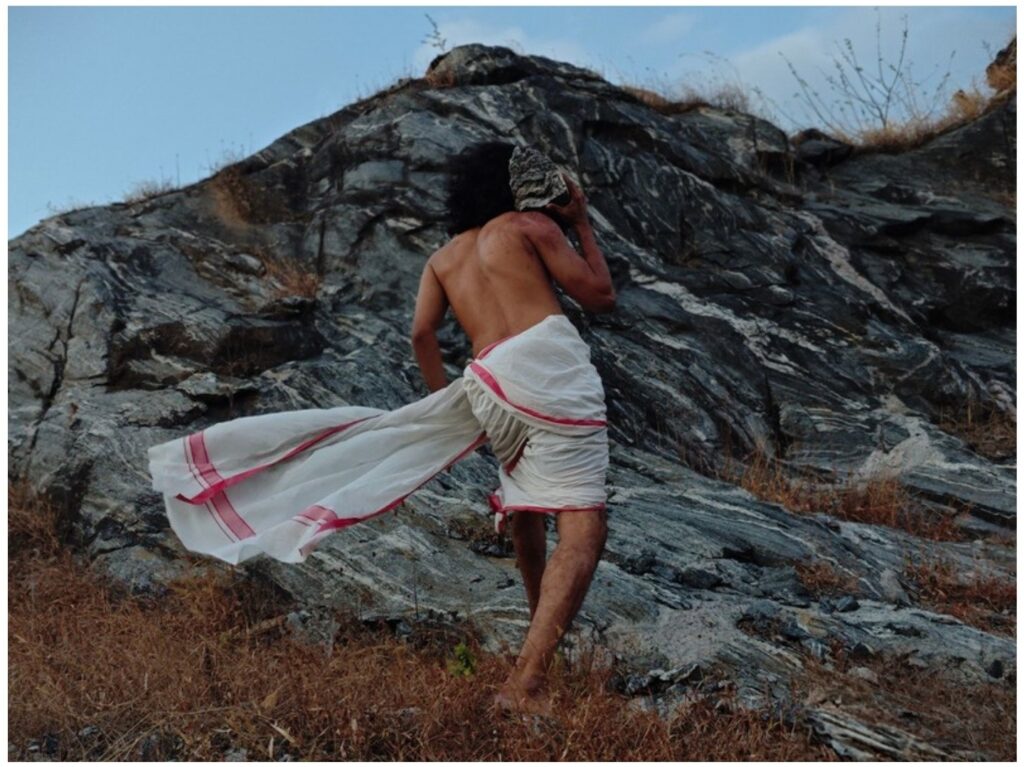
Manu M Das
My witness is Dead
The wind takes the cloth. The rock does not move
Grey rock, cut through with white veins like old water.
Bare feet in dry brown grass.
The cloth runs sideways, red stripes pulled flat by the wind.
One hand holds a weight against the head.
The back is turned to us.
Only the hill sees him climb.
My witness is Dead is a photo performance by Manu M Das, an artist from Palakkad who studied at Jamia Millia Islamia in New Delhi. A man with bare shoulders climbs a hill of grey rock. The wind lifts his white cloth with its red borders. One hand holds something grey against his head. Das makes work from physical actions that change a place for a time. He sees each work as a record of time and labour. The image is printed on cotton rag.
Photo performance, cotton rag prints · 2026
Theme Body against land
RC-10600
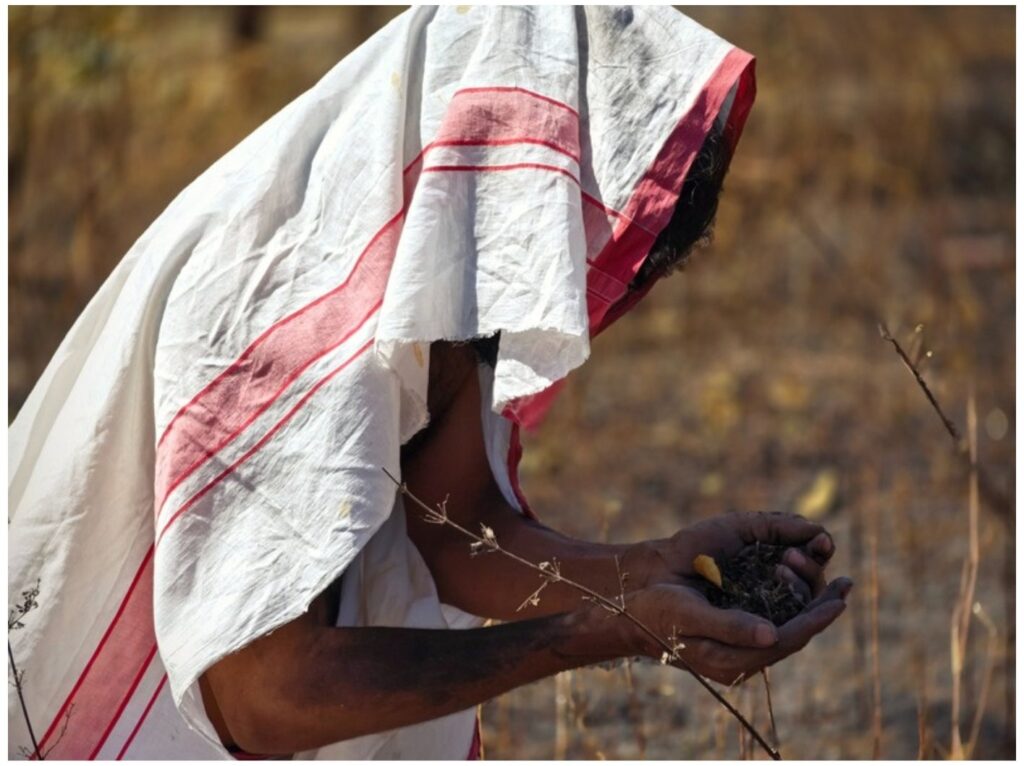
Manu M Das
My witness is Dead , Part II
A hidden face and two hands full of dry earth
White cotton falls over the head and hides the face.
Two red stripes run down it, the only bright thing in the field.
The grass behind has turned the colour of old tea.
A thin dry stem crosses the arm and does not break.
The hands are cupped as if water might come.
They hold only earth, dark and loose.
No eyes. Only the weight of waiting.
My witness is Dead, Part II is a photo performance by Manu M Das, printed on cotton rag. Das makes slow, physical actions that change a place for a short time. He records them in performance, video, sculpture and photographs. Here a figure bends in dry grass under a white cloth with red stripes. The face is hidden. Two soil-stained hands hold a small heap of earth. For Das, the photograph is a record of time and labour. It also records the friction between a body and the physical world.
Photo performance, cotton rag prints · 2026
Theme Body, land and time
RC-10601

Manu M Das
Residue of access
A covered figure stands caught in a room of black threads
A white sheet hangs over a head and shoulders, its blue hem stained grey.
Black thread runs from corner to corner and pins the air in place.
The light doubles every line as shadow on the old wall.
A dark board waits behind the figure with nothing written on it.
A green mat leans below, its weave gone muddy.
To move here, a body must bend to the string.
Residue of access is an installation by Manu M Das. It joins performance with video documentation and asks the viewer to take part. In the image a figure stands under a white cloth. Black threads cross the room from wall to wall. Das makes work from actions that change a space for a while. He works through repeated actions and the passing of time. Here he says the work is a factual record of time and labour. It also records human friction against the physical world.
Performance, video documentation and interactive installation · 2025
Theme Time, labour and friction
RC-10602
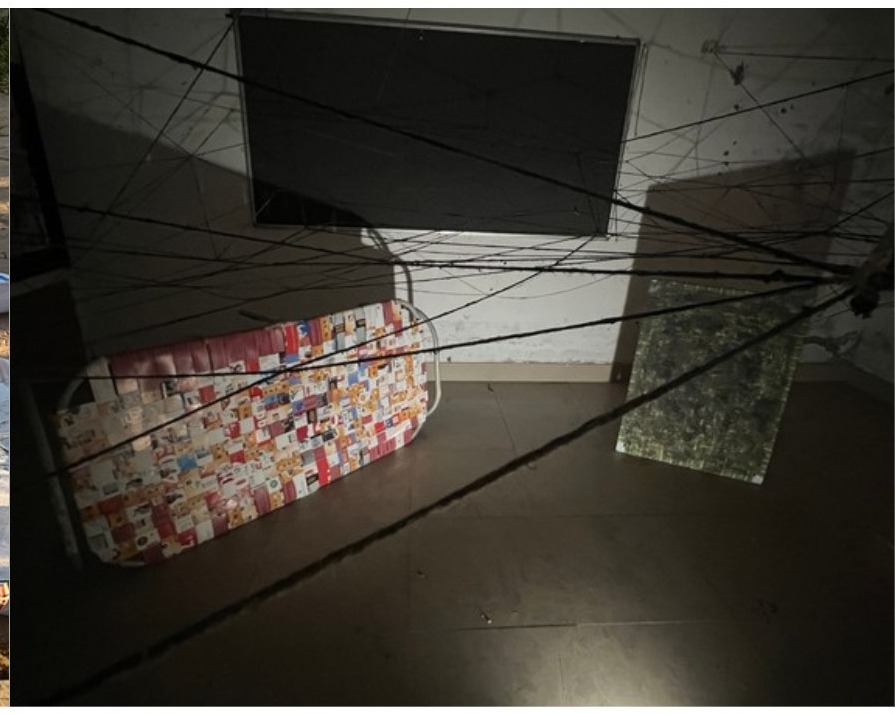
Manu M Das
Gehri saans , Dreams on credit
A bed woven from the paper of a thousand small promises
Red and white squares of paper hold the shape of a bed.
Each one once asked a stranger to want something.
Ropes cross the dark room like lines drawn by a slow hand.
Their shadows fall a second time on the wall.
A green panel waits in the corner, dull as old oil.
One lamp finds the cot and leaves the rest of the room to the dark.
In Gehri saans, Dreams on credit, Manu M Das weaves strips of printed advertisement pamphlets across the frame of a charpai. Red, white and yellow squares fill the bed. Jute ropes cross the dark room from wall to wall and cast a second web of shadow. A dark wooden frame hangs above. A pale green panel leans against the wall. Das works with discarded materials that carry material memory. He builds his work through repeated actions, labour and time.
Installation: charpai, advertisement pamphlets, wooden frame, niwar, jute ropes, grease and industrial residue · 2025
Theme Labour and longing
RC-10603

Manu M Das
Resisting System
Black iron draws through a shelf the department threw away
White paint flakes from the shelves like old chalk.
Black iron wanders across the frame, a line that will not sit still.
Orange thread knots it to the wood at every place it touches.
One door stands open, as if someone left in a hurry.
Below, ink plants and a fish lie on paper on the floor.
The shelf holds nothing now except the effort of holding.
Manu M Das makes Resisting System with discarded furniture from the department, iron and thread. An old white shelf unit stands with one door open. Black iron lines run across its frame like a drawing in the air. Short pieces of orange thread tie the iron to the wood. Das works through observation, collection and assemblage. He chooses materials that carry memory. For him the finished work is a record of the time and labour spent. It also records human friction against the physical world.
Discarded furniture, iron and thread · 45.7 × 213.4 × 243.8 cm · 2025
Theme Labour and material memory
RC-10604
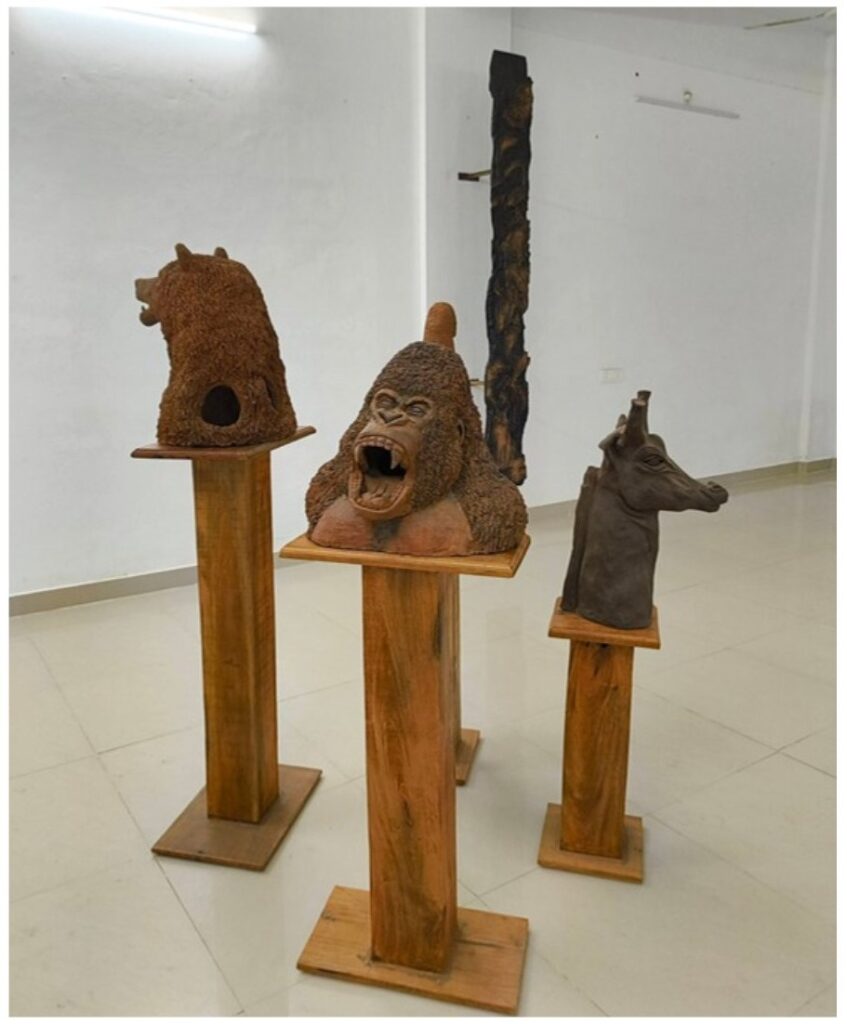
Manu M Das
Witness
Three clay heads face the room. One of them is still roaring
Red clay pressed into fur, a thousand small knots.
The gorilla holds its breath open, teeth pale in a dark mouth.
The bear turns away and shows a round hole in its side.
The giraffe is grey, as if it came from older earth.
Three wooden posts lift them to the height of a face.
Behind them a burnt column stands in the white room, keeping watch.
Witness is an installation from 2024 by Manu M Das, an artist from Palakkad trained at Jamia Millia Islamia in New Delhi. Three animal heads in terracotta stand on wooden plinths. A bear turns to one side. A gorilla roars with its mouth wide open. A giraffe in darker clay looks away. Their surfaces are rough and dense like fur. Das works through repeated actions, labour and the passage of time. For him the work is a record of the hours spent making it.
Terracotta and wood · 2024
Theme Time and labour in clay
RC-10605

Manu M Das
Cutting Ice blocks
A small white bear holds on to a hill of ice
Clear glass holds a hill of broken ice.
The edges are sharp now. They will not stay sharp.
A small white bear leans on the top block, soft at the paws.
Grey wall behind. Brown wood below. Cold light on every face.
Soon water will gather at the base, slow as a clock.
Already the room is warmer than the work.
Manu M Das makes work from actions that change a place for a short time. In Cutting Ice blocks (2024) a glass tank holds a pile of broken ice. A white bear rests at the top. The materials are ice, ice cream and glass. The ice and ice cream will melt. Das records the work on video, so the film keeps what the tank cannot. "The work simply exists as a factual record of the time and labour spent", he says. His college is Jamia Millia Islamia in New Delhi.
Ice, ice cream and glass, with video documentation · 2024
Theme Time, labour and melting
RC-10606

Manu M Das
Survey plot -49
Broken plaster, filed in glass like evidence from the ground
Grey shells of plaster, each in its own small room of glass.
The ridges circle like water rings on a pond gone still.
Green light lives in the thick edges of the panes.
One pane is cracked, a thin line across the dust.
Once they took the shape of something else.
Now they rest in rows, kept like stones from a field someone measured.
In Survey plot -49, Manu M Das sets discarded plaster casts into a grid of glass boxes. The work measures 213.4 × 213.4 × 25 cm. Each box holds one rough piece. The pieces are pale grey with thin ridges in layers. Das works by collecting and assembling materials that hold memory. The method relies on repeated actions and labour over time. The finished grid stands as a plain record of that time and labour. It also records human friction against the physical world.
Discarded plaster casts and glass · 213.4 × 213.4 × 25 cm · 2026
Theme Time, labour and record
RC-10591
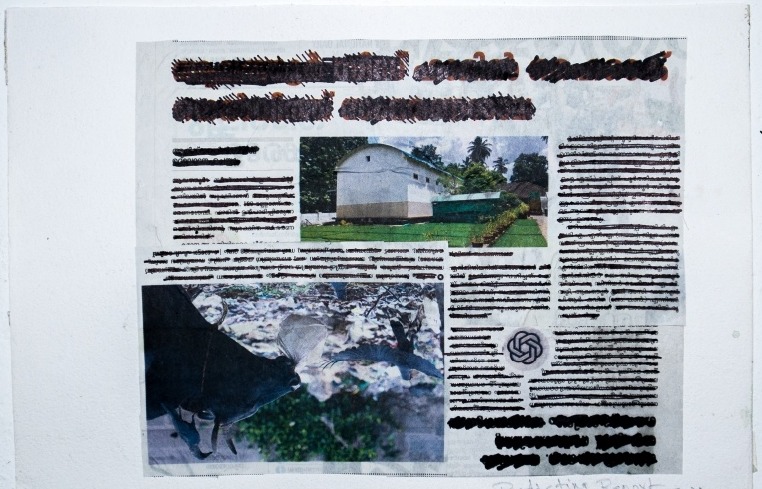
Manu M Das
Redacting Report
Every word blacked out by hand. Only the pictures remain
The news is still here, but it will not speak.
Black marker runs down each column like rows in a ploughed field.
Over the headlines the ink turns brown, the colour of old rust.
A white house waits under palm trees on a green lawn.
Below it a dark animal lowers its head to the dry leaves.
Only the pictures are allowed to stay.
Manu M Das works with discarded materials and repeated actions. In Redacting Report he takes a newspaper page and covers its words line by line with permanent marker. The headlines disappear under heavy brown and black strokes. Only two photographs stay open: a white building among palm trees and a dark animal with its head low over dry leaves. Das sees his work as a record of the time and labour spent on it. Here that labour sits in every line drawn by hand.
Mixed media: newspaper collage and permanent marker · 21 × 29.7 cm · 2026
Theme Erased news and labour
RC-10607
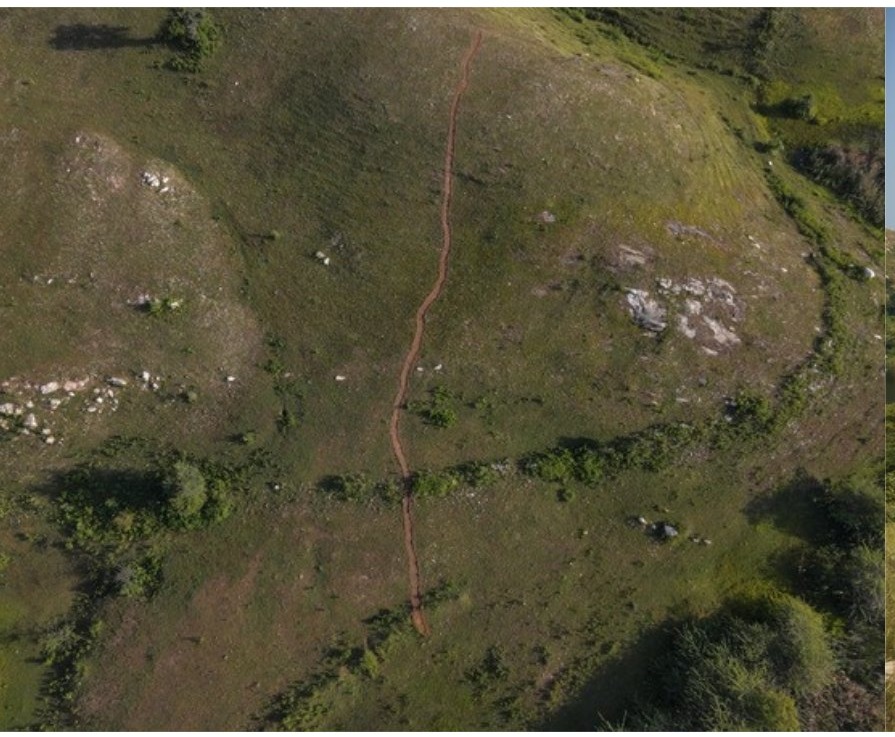
Manu M Das
Marking a Line
A hill holds one red line, worn by hours of labour
Late sun lays a long shadow behind every bush.
The grass is green, turning gold at the edges.
White stones lie scattered like dropped bread.
Through the middle runs one red seam, thin as a wrist.
It bends a little where the ground pushed back.
The hill keeps the line the way skin keeps a scratch.
Marking a Line is a durational performance by Manu M Das, recorded on video. Seen from above, a green hillside carries one thin line of bare red earth. It runs from the top of the slope to the bottom, past pale stones and dark bushes. Das works through repeated actions and labour that change a place for a while. The line is the trace of that work. It records time spent and human friction against the ground.
Durational performance, video documentation · 2026
Theme Labour, time and trace
RC-10592
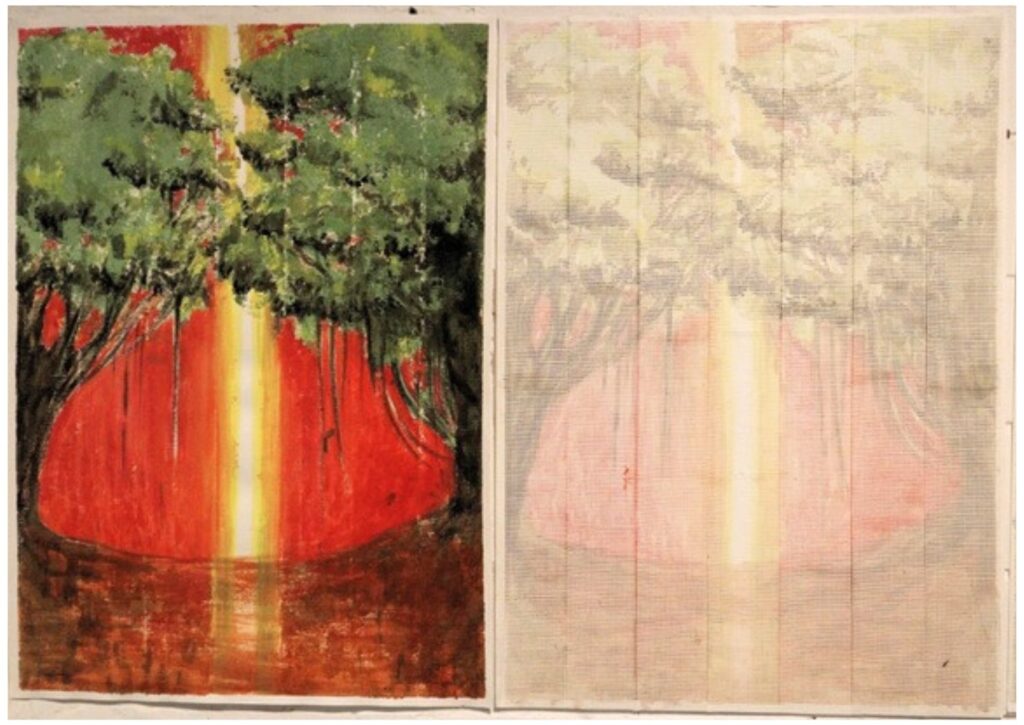
Manu M Das
Memories of the landscape
One tree painted twice: once burning red, once almost gone
Red pools under the tree like heat held in the ground.
Roots hang down in thin dark threads.
A white seam of light splits the shade in two.
Next to it the same tree fades to pink and grey.
Fine lines run across it like rain on a window.
One side is the day. The other is what stays after.
Manu M Das paints a large tree with hanging roots. A red glow fills the space under its branches. A line of white light falls through the middle. Beside it the same scene returns, faint and pink, on a surface cut by thin lines. Das works with actions that "temporarily alter an environment or a space." Das calls the work "a factual record of the time and labour spent." Here two panels hold one place in two states. Das comes from Palakkad.
Mixed media: acrylic on cartridge paper and gypsum tape · 58.4 × 71.1 cm · 2026
Theme Memory and place
RC-10593

Manu M Das
Changing landscape
Turmeric, iodine and paper settle into a slow cracked ground
Orange crust split like a riverbed in May.
A pale yellow patch where something softer stays.
Rust brown spots spread out to the edges.
The glass holds the slab and shows it twice.
Light slides along one green edge of the case.
It looks dry and slow and still at work.
Manu M Das makes Changing landscape from tissue paper mâché, turmeric, baking soda and iodine. A flat slab of this mix lies inside a glass case. Its surface is orange and rust brown with one pale yellow patch. It cracks and lifts like dry earth seen from high above. Das works with materials that change over time and calls each work a record of time and labour. Das is based in Palakkad and linked to Jamia Millia Islamia in New Delhi. The work measures 30.5 × 30.5 × 45.7 cm.
Tissue papier-mâché, turmeric, baking soda, iodine and glass · 30.5 × 30.5 × 45.7 cm · 2026
Theme Time, labour and change
RC-10594
Featured in Issue 5
Shijo Jacob
The Long View. One of the four who chose Edition Two. He paints the land and people of Kerala and the hills that are cut and carried away on lorries.
Shijo Jacob
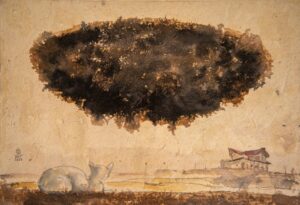
Fragmented Memories
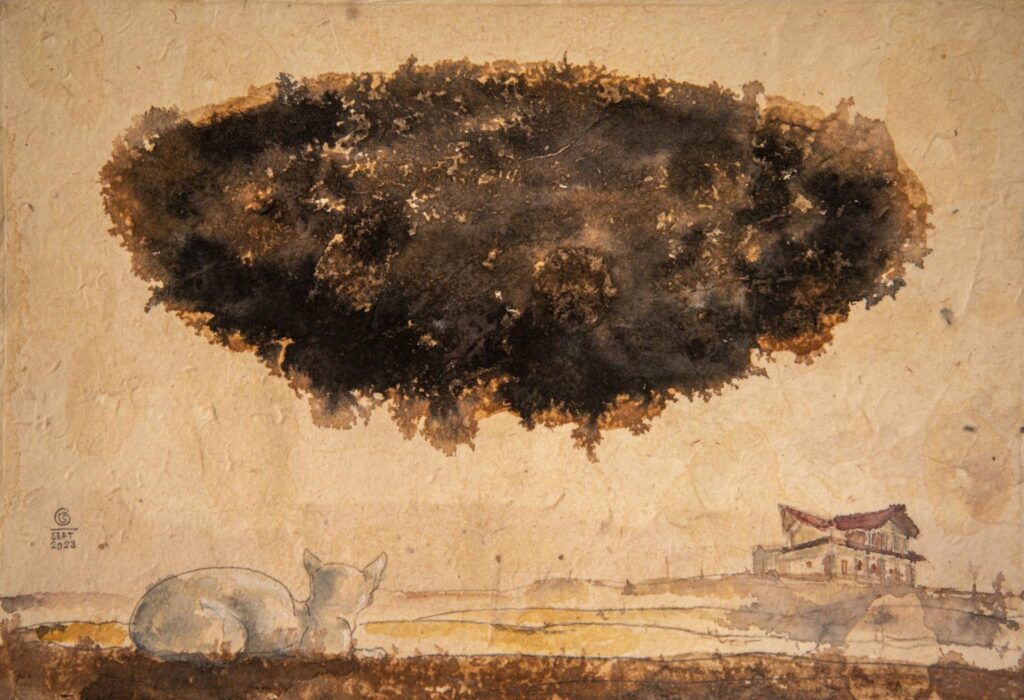
A dark cloud of tea hangs over a cat looking home
A cloud the colour of strong tea sits low in the sky.
Its edges spread and dry like a stain on a cloth.
Below it a pale cat lies still with its back to us.
It watches a house with a red roof far across the yellow field.
The paper is soft and rough like old skin.
Nothing moves. Something is about to be forgotten.
This work belongs to Fragmented Memories, a series Shijo Jacob made in 2023. The series is about memories that fade over time. It is also about the small bonds between people and between people and animals. Jacob paints with watercolour, gouache and tea stain on thin rice paper. He then pastes the rice paper onto acid-free paper. He chose watercolour because it is fragile and hard to control. Memories are like that too. Jacob is based in Thrissur and paints the land and people of Kerala.
Watercolour, gouache and tea stain on rice paper pasted on acid-free paper · 28 x 38 cm · 2023
Theme Memories that slowly fade
RC-7669
Shijo Jacob
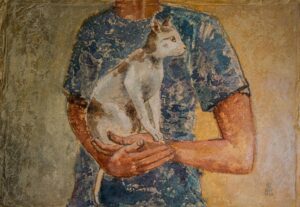
Fragmented Memories
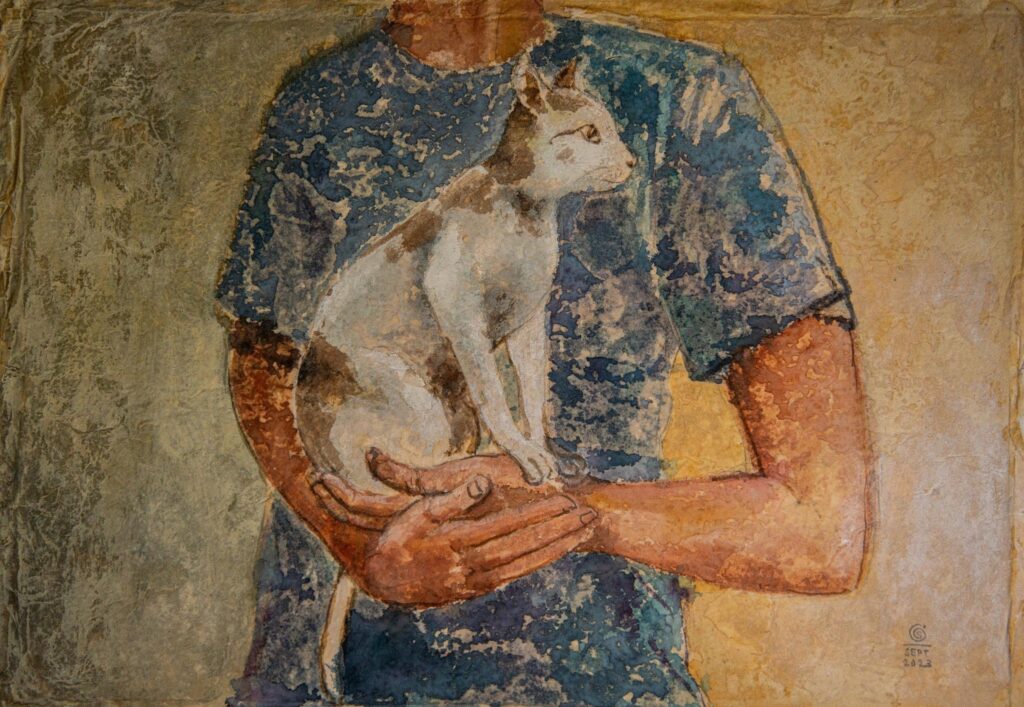
A cat held close against a shirt that is falling apart
Two hands make a cup and the cat sits in it.
She looks away to the right at something we cannot see.
The blue shirt is breaking up like old plaster.
The ground is the colour of tea and of a wall in late sun.
The paper keeps its wrinkles.
Whoever holds her has no face now. Only the arms remain, warm and steady.
Shijo Jacob is an artist from Thrissur. This work from 2023 belongs to his series Fragmented Memories. The series is about feelings and memories that fade over time. Here a person in a blue shirt holds a white cat with brown patches. The face is outside the picture. Jacob uses watercolour, gouache and tea stain on rice paper. The rice paper is pasted on acid-free paper. Its creases break the colour into small patches, like a memory coming apart.
Watercolour, gouache and tea stain on rice paper pasted on acid-free paper · 28 x 38 cm · 2023
Theme Memory and closeness
RC-7670
Shijo Jacob
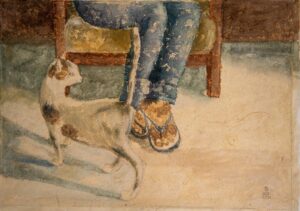
Fragmented Memories
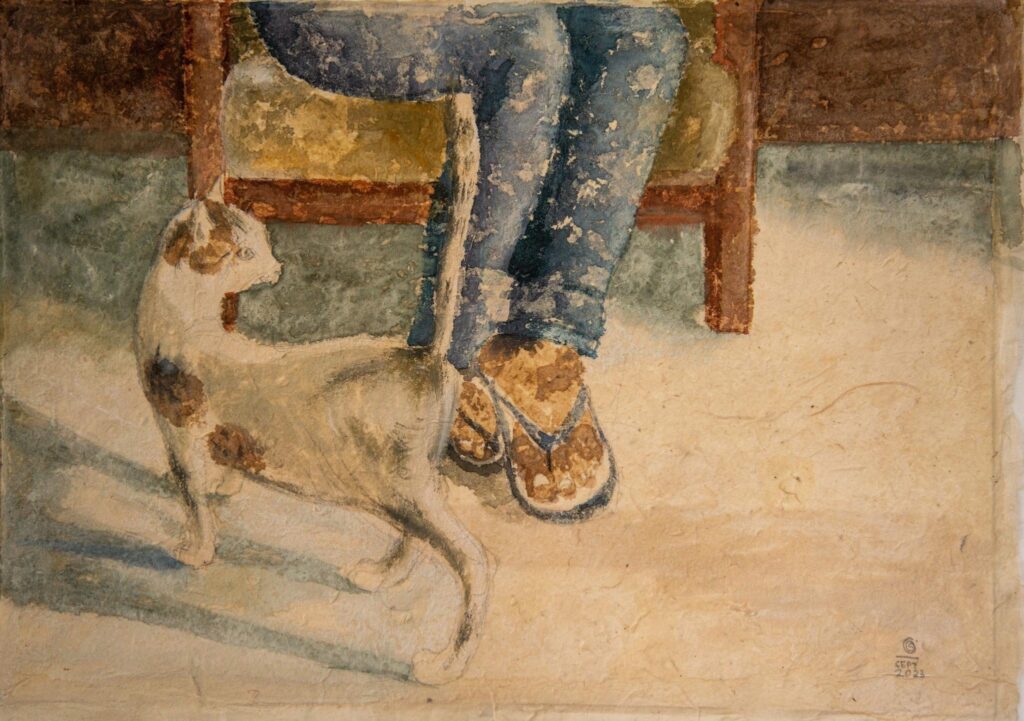
A cat, a pair of slippers and a long blue shadow
Tea has stained the feet the colour of wet earth.
The jeans are rubbed thin, blue going back to paper.
A cat with brown islands on its back turns its head.
Its shadow runs away from it, long and cool across the floor.
The chair waits. The cushion holds an old yellow.
Nothing here is finished being remembered.
A cat stops beside a pair of feet in rubber slippers. Shijo Jacob paints this quiet moment in watercolour, gouache and tea stain. He works on thin rice paper pasted onto acid-free paper. The rice paper takes the colour in patches, so the jeans and the floor look worn and broken. The work belongs to his 2023 series Fragmented Memories. It is about memories that fade with time. It is also about small bonds between people and other living beings. Jacob is based in Thrissur.
Watercolour, gouache and tea stain on rice paper pasted on acid-free paper · 28 x 38 cm · 2023
Theme Memory and quiet companionship
RC-7671
Featured in Issue 5
Asmita Das
The Studio · Watercolour. She paints the Ganges at Baghbazar as its banks fill with buildings and boats, one wash after another on damp paper.


Asmita Das
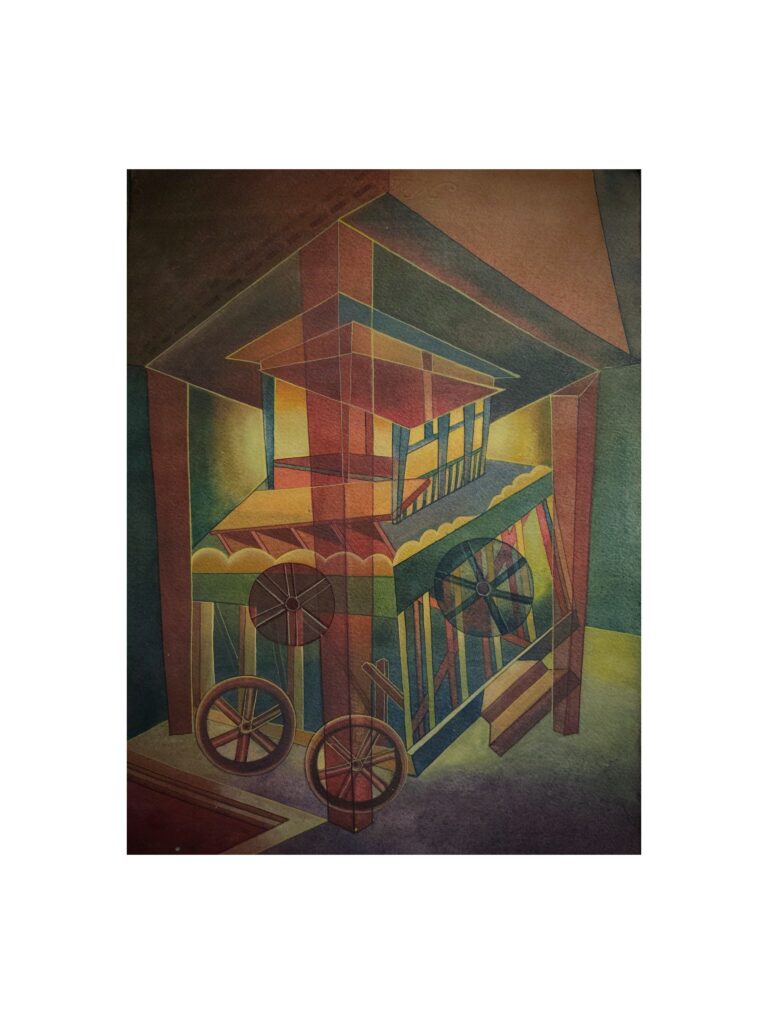
The Halted Chariot of Time
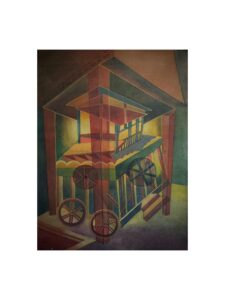
Four wheels and a lit room with nowhere left to go
Four wheels stand still on a purple floor.
Yellow light burns inside the cart like a lamp left on.
Roofs fold over roofs in thin planes of green and rust.
A small stair waits at the side for someone to climb.
Fine gold lines hold every edge in place.
The room keeps the chariot the way a hand keeps a breath.
Asmita Das paints The Halted Chariot of Time in the wash technique. She uses watercolour on 300gsm Canson paper. Das studies at The Indian College of Arts and Draftsmanship in Kolkata. She chooses wash painting most of the time because she finds the slow process peaceful. It helps her calm her mind in a life where she has always had little space. Here she takes a complicated structure and makes it simpler with light, colour and composition.
Watercolour in the wash technique on paper · 59.4 × 42 × 0.04 cm · 2025
Theme Time held still
RC-693
Asmita Das
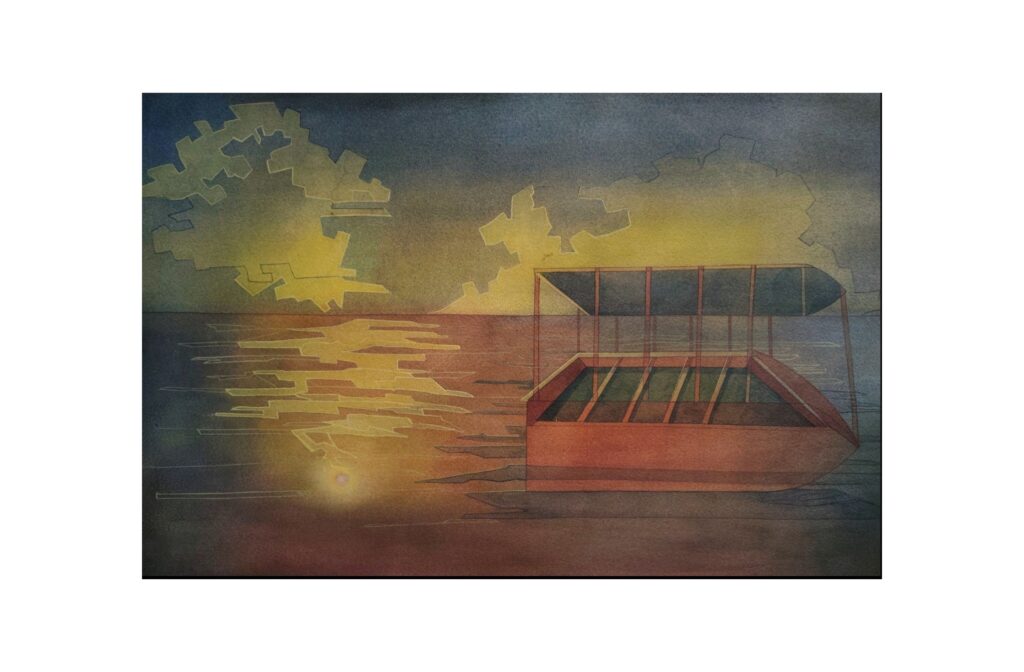
The Encroachment of the Ganges
A red boat waits where the sun sinks into the river
The sky moves from ink blue to mustard.
Clouds come apart like torn paper with sharp corners.
The sun has slipped under the water and still glows there.
Its light lies on the river in broken gold steps.
A red boat stands empty under its dark roof.
Nobody is aboard. The water keeps the last warm colour.
Asmita Das studies at The Indian College of Arts and Draftsmanship in Kolkata. In The Encroachment of the Ganges (2025) she works in the wash technique, a process she finds "very peaceful and calming." Soft washes of watercolour turn the sky from deep blue to yellow. The clouds and the sun's path on the water break into sharp angular shapes. A red boat with a canopy rests on the right. Das likes "simplifying the complicated with light, color and composition."
Watercolour in the wash technique on paper · 59.4 × 42 × 0.04 cm · 2025
Theme The river at dusk
RC-694

Asmita Das
Decapitated Civilization
A city of stone stands headless under a green moon
A green moon hangs low and holds its breath.
Red stone stands in pillars, cut off at the top.
Thin white lines trace each edge like old chalk.
Between two towers a doorway glows the colour of young leaves.
The sky is deep blue water poured over everything.
Nothing moves. The city waits for no one.
Asmita Das studies at The Indian College of Arts and Draftsmanship in Kolkata. In Decapitated Civilization Das paints a broken city of rock under a green moon. The work uses the wash technique with watercolour on 300gsm Canson paper. Colour spreads softly across the sheet. Das finds this slow process calm. It helps to quiet the mind. Here the hard shapes of buildings and stone become simple forms made of light, colour and composition.
Watercolour in the wash technique on paper · 59.4 × 42 × 0.04 cm · 2026
Theme Ruin and stillness
RC-695

Asmita Das
The Last Spotlight
The show is over. The seats still wait under the stars
Blue night. Thin clouds like chalk pulled across slate.
A room with no roof sits on the green ground.
Two green lamps still burn over a dark wall.
The rows of seats glow yellow like warm bread.
Pale lines hold the walls together. They are almost glass.
One star watches. The audience has gone home.
The Last Spotlight is a 2025 painting by Asmita Das. She studies at The Indian College of Arts and Draftsmanship in Kolkata. Das works in the wash technique. The picture grows from thin layers of watercolour. For her wash paintings she uses 300gsm Canson paper. She finds the process calm. It helps her quiet her mind against the chaos and lack of space she has known since childhood. Here she takes a building full of sharp angles and makes it simple with light and colour.
Watercolour on paper, wash technique · 29.7 × 21 × 0.04 cm · 2025
Theme Emptiness after the show
RC-696
Asmita Das
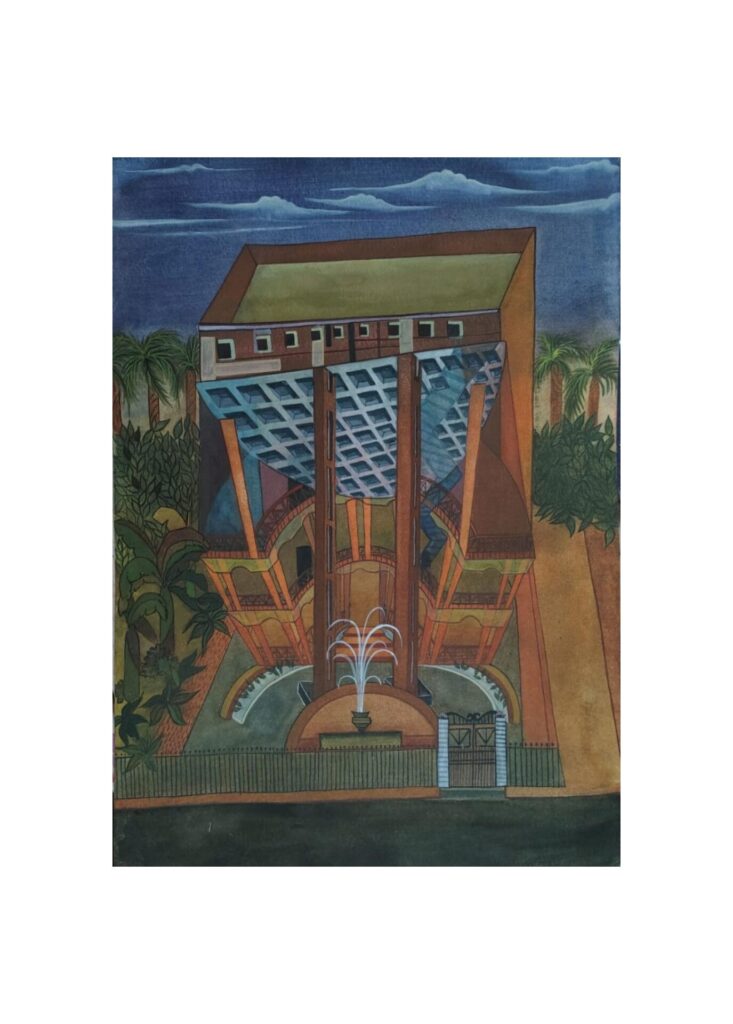
The College
A building opens its ceiling to the evening sky
Brick red climbs into a dusk of soft blue.
A ceiling of pale squares hangs open like a lid.
Water rises from a stone bowl and falls in white threads.
Palm leaves press close on both sides of the gate.
The iron fence keeps the dark road out.
Everything is still except the fountain.
Asmita Das studies at The Indian College of Arts and Draftsmanship in Kolkata. In The College she paints a building with many parts: brick columns, a grid of blue ceiling, curved balconies, a fountain and a gate. She paints in the wash technique most of the time. She says the process is "very peaceful and calming." Das takes complicated buildings and makes them simple with light, colour and composition. Here, palm trees and dark leaves close in on both sides.
Watercolour in the wash technique on paper · 42 × 29.7 × 0.04 cm · 2025
Theme Architecture made simple
RC-697

Asmita Das
The Frenzy of the Flames
A wandering line looks for fire inside spilled colour
Orange climbs the creased paper like heat up a wall.
Pink and green meet and do not stay apart.
A thin dark line wanders in loops as if it has lost its way home.
Small yellow crescents flicker at the edges.
The paper wrinkles where the water rested.
In the middle a green leaf holds still while everything burns.
Asmita Das studies at The Indian College of Arts and Draftsmanship in Kolkata. She made this small painting in 2025 with watercolour on Nepali handmade paper. The sheet is only 14.8 × 10.5 cm. Its soft creases catch the colour in pools. Orange, pink and green run into each other. A thin dark line loops across the surface and finds shapes like flames and leaves. Das picks her materials to match a feeling. "I want materials themselves to become part of the feeling of the work."
Watercolour on Nepali handmade paper · 14.8 × 10.5 × 0.01 cm · 2025
Theme Chaos and calm
RC-698

Asmita Das
Rays of Hope
Yellow light pushes in where the dark refuses to leave
Yellow comes in like a crowd of brushes, all leaning one way.
Under it red and black hold the dark of a closed room.
Blue strokes run fast, thin as split bamboo.
In the centre a pink shard sits, broken from something larger.
The edges stay dim.
The light gathers on the right and keeps pressing in.
Asmita Das studies at The Indian College of Arts and Draftsmanship in Kolkata. Most of the time she paints in a wash style. She finds that process calm and peaceful. Rays of Hope works another way. It is gouache on wasli board. Short yellow strokes press in from the right. Blue marks cut through red and black. Das names it with Despair and The Frenzy of the Flames as works where materials carry her mood. "I want materials themselves to become part of the feeling of the work."
Gouache on wasli board · 59.4 × 42 × 0.04 cm · 2025
Theme Hope within chaos
RC-699

Asmita Das
Despair
Blue water, rust lines and salt that will not stay still
Blue spreads through wet paper like a bruise under skin.
Rust lines run across it, thin as wire, bent as roots.
Salt leaves a frost of small white stars.
A dark eye opens in the middle and does not close.
Somewhere a pale line tries to hold the shape together.
The water keeps moving after the hand has stopped.
Asmita Das is an artist from Kolkata. Her college is The Indian College of Arts and Draftsmanship. Most of the time she paints in the wash style. She finds it calm. Despair, from 2024, is different. Here she works with ink, gum and salt. She wants the materials to carry the feeling. Blue washes spread across the paper. Rust-brown lines twist over them like roots or wire. Pale grainy patches break the surface. For Das, the spreading colour first feels like losing a battle. Later it becomes a source of strength.
Mixed media: ink, gum and salt · 42 × 29.7 × 0.03 cm · 2024
Theme Despair and inner strength
RC-700
Asmita Das
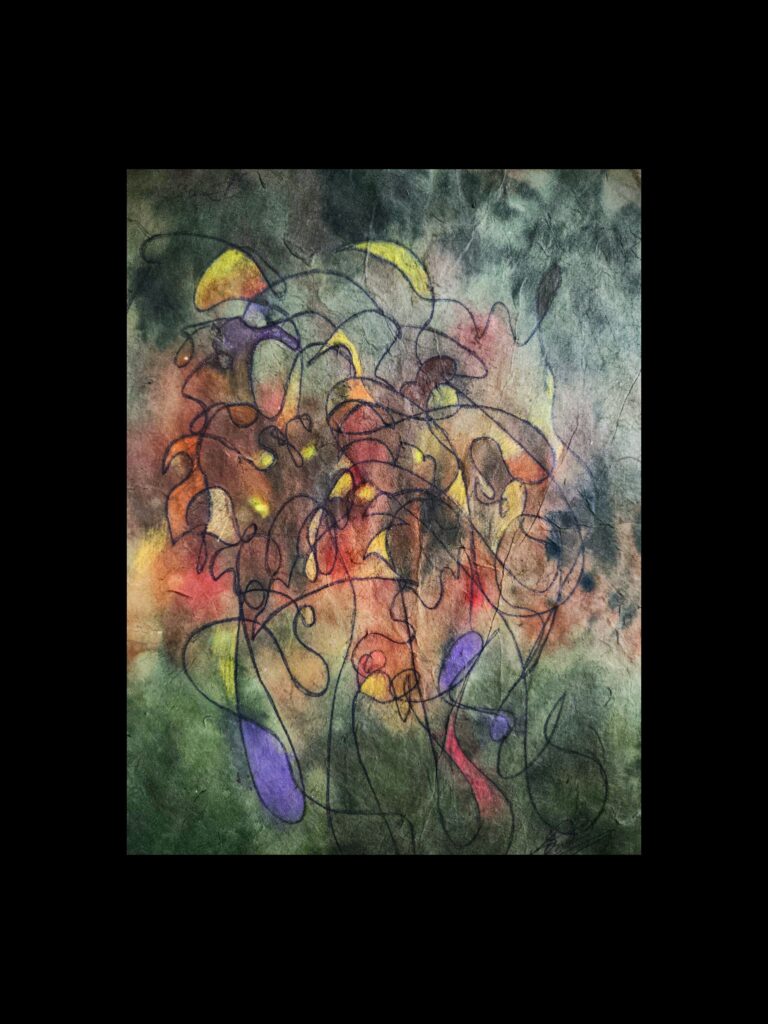
The Frenzy of the Flames.
One dark line runs through the fire and will not stop
Green smoke gathers at the edges of the paper.
In the centre orange and red push up like heat from a stove.
A dark line runs and runs. It loops back and will not stop.
Small yellow tongues lean out from the knot.
Two violet drops sit cool near the bottom.
The paper is soft and creased like cloth left out in the rain.
Asmita Das paints this small work in watercolour on Nepali handmade paper. Her college is The Indian College of Arts and Draftsmanship in Kolkata. Das often uses the wash technique because it calms her. This painting belongs to another group. In these works she uses materials to show how she feels in that moment. She says, "I want materials themselves to become part of the feeling of the work." Here colour spreads into the soft paper. Dark lines loop over reds and yellows.
Watercolour on Nepali handmade paper · 14.5 × 10.5 × 0.01 cm · 2025
Theme Feeling held in fire
RC-701
Featured in Issue 4
Sayali Eknath Khanvilkar
First Year Out · Painting and printmaking. We call our rivers mothers and goddesses, then fill them with waste. Her paintings ask what we will be remembered by.


Sayali Eknath Khanvilkar
Faith or act
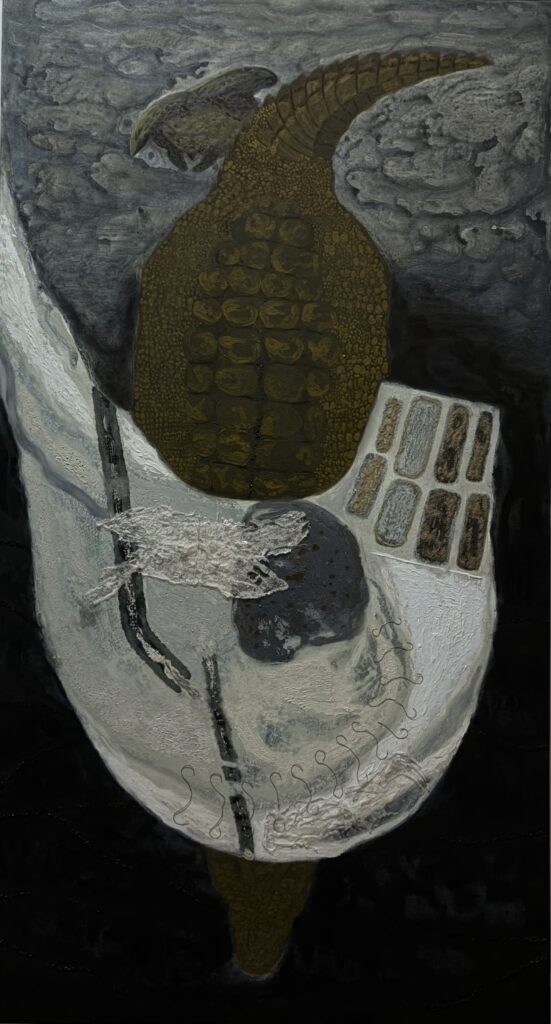
We call the river mother, then hook everything out of it
A scaled body the colour of river mud lies across a white bend.
Grey cloud thickens above it like smoke over water.
A small bird keeps watch at the top edge.
Pale flakes drift where a fish might swim.
Thin wire hooks curl along the bottom, waiting.
Everything is still. Nothing here is clean.
Sayali Khanvilkar has seen rivers that people now call drains. People praise the Ganga and the Yamuna as mothers and goddesses. Then sewage, garbage and the waste left after rituals go into them. Faith or Act asks why what we do does not match what we say. Thin wires curl like the hooks of a fishing net. They take from the river and give nothing back. For this work Khanvilkar makes fish from bioplastic. The fish react to moisture and the experiment fails. "Failure is also a mentor," she says.
Mixed media · 168 × 91 cm · 2026
Theme Faith and polluted rivers
RC-8531
Sayali Eknath Khanvilkar
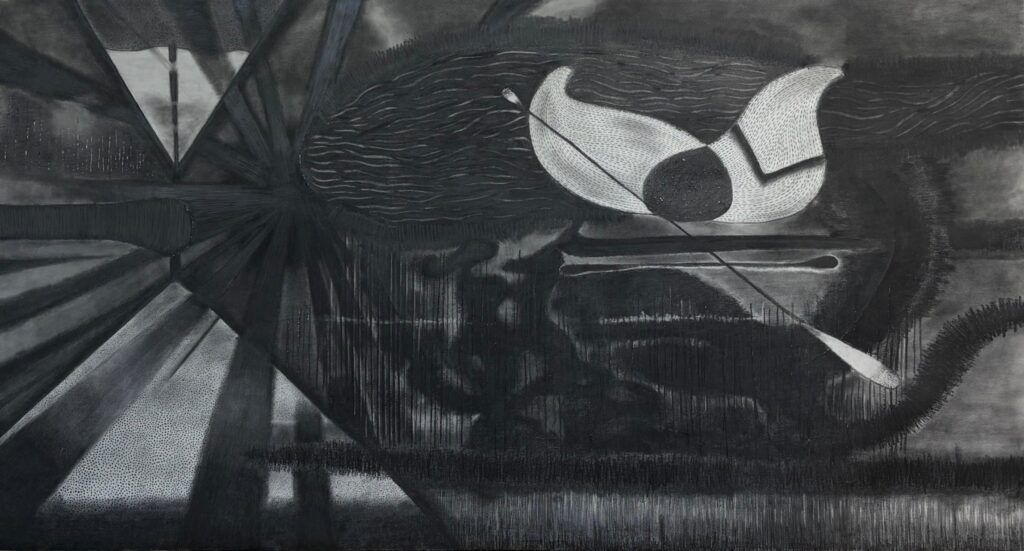
Nostalgia
A dark wheel turns slowly back toward the good days
Grey on grey, like a low sky that will not lift.
A wheel of dark spokes turns without a sound.
Two pale horns, stitched with tiny dots, rest on a coat of wavy fur.
A thin oar slides through them toward still water.
Rain falls in fine black threads.
At the bottom, grass stands in the charcoal dust and waits for a morning that has already passed.
Sayali Khanvilkar has always lived in Mumbai. Life in this fast city has made her fonder of nature. Nostalgia is a drawing in charcoal and pencil, 121 × 228 cm. On the left, dark lines spread out like the spokes of a wheel. In the centre, two pale curved shapes rest on a mass of fine wavy marks. A thin rod cuts across them. Khanvilkar builds the surface from dots, short strokes and soft smoky tones. Her work can take her to "some good days in a nostalgic dreamy world."
Charcoal and pencil · 121 × 228 cm · 2026
Theme Memory and nature
RC-8532
Sayali Eknath Khanvilkar
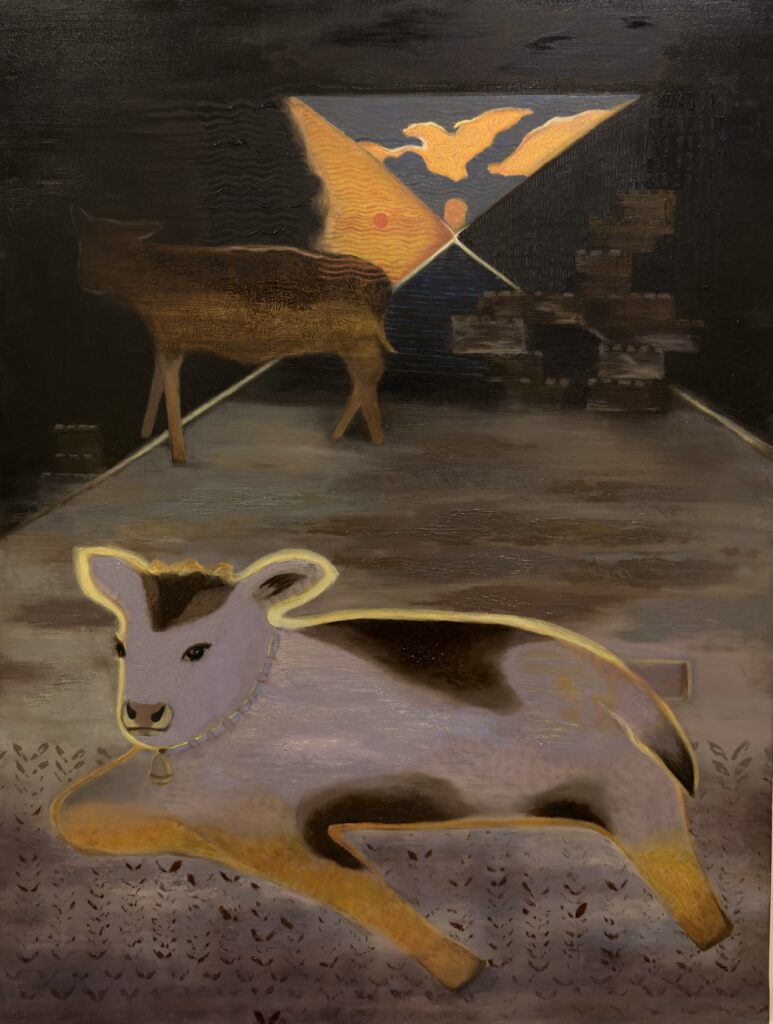
Innocence
A calf rests in a ring of light, still wearing its bell
A calf lies down on a grey floor, a small bell at its throat.
A line of warm yellow holds its body, like the last sun on a wall.
Behind it another animal stands on thin legs, brown as old wood.
A window of orange light opens in the dark.
Blocks stack up in the corner, quiet and heavy.
Small leaves grow along the floor where there is no field.
Sayali Khanvilkar has always lived in Mumbai. She is in her first year out of Sir J J School of Art. The city's distance from nature makes her care for it more. In Innocence a calf with a small bell lies at the front of the picture. Its pale body glows with a yellow edge. Behind it a brown animal stands in a dark space. Khanvilkar believes every living being feels with the same depth. She works with symbols and with forms and space.
Oil · 121 cm · 2026
Theme Unity of living beings
RC-8533
Sayali Eknath Khanvilkar
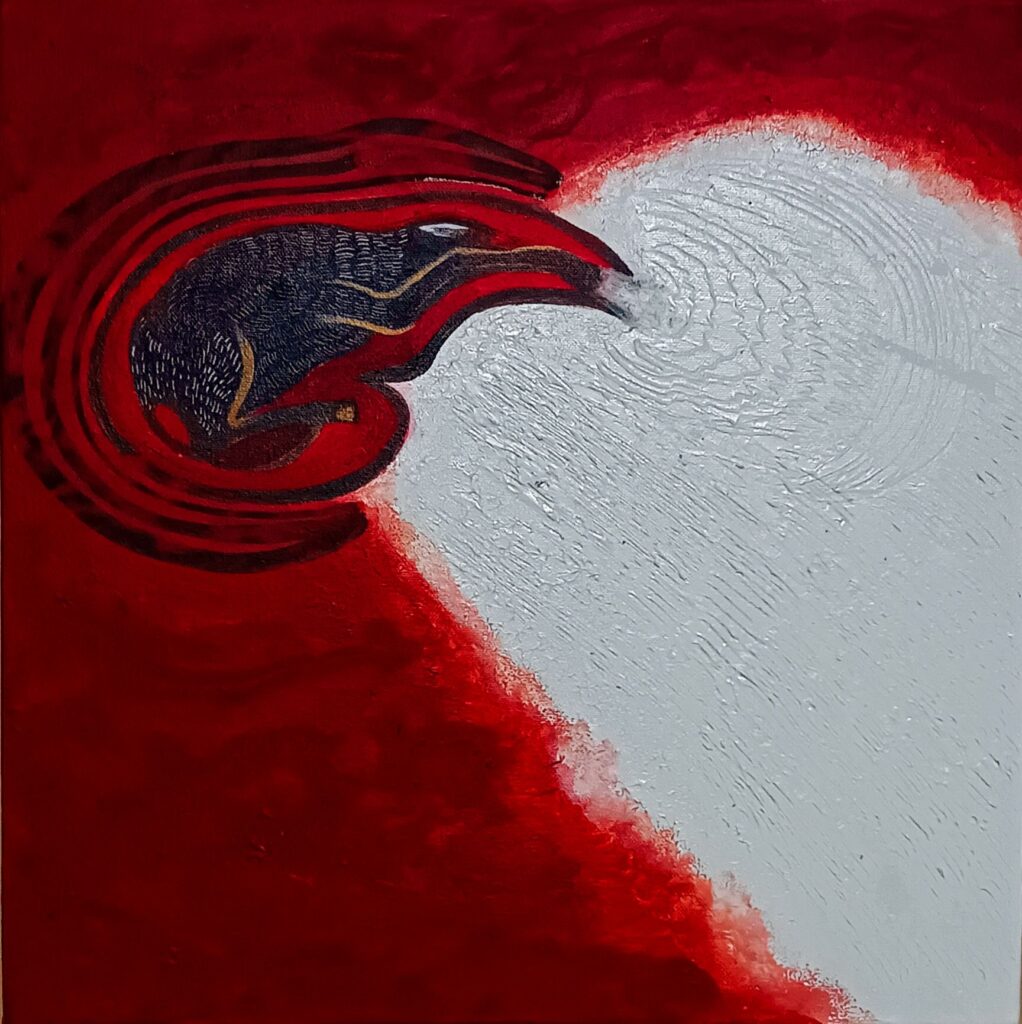
Inner world
A dark beak breathes into a field of white
Red, deep as the inside of a closed eye.
A dark head curls in its own rings, covered in small white stitches.
A gold line runs through it like a vein.
At the tip of the beak, a breath of grey.
Then the white begins: thick, ridged, turning in slow circles.
Something is listening there or being heard.
Inner world is a 2026 acrylic painting by Sayali Khanvilkar. A dark creature with a long beak curls inside bands of red and black. Fine pale strokes cover its body. Thin gold lines run along it. The beak meets a wide grey-white field. Here the paint is thick and rises in ridges that circle out like a fingerprint. Khanvilkar has always lived in Mumbai. She studied at Sir J.J. School of Art. Her work grows from form, space and the stillness of nature.
Acrylic · 30 × 30 cm · 2026
Theme Inner life and nature
RC-8534
Sayali Eknath Khanvilkar
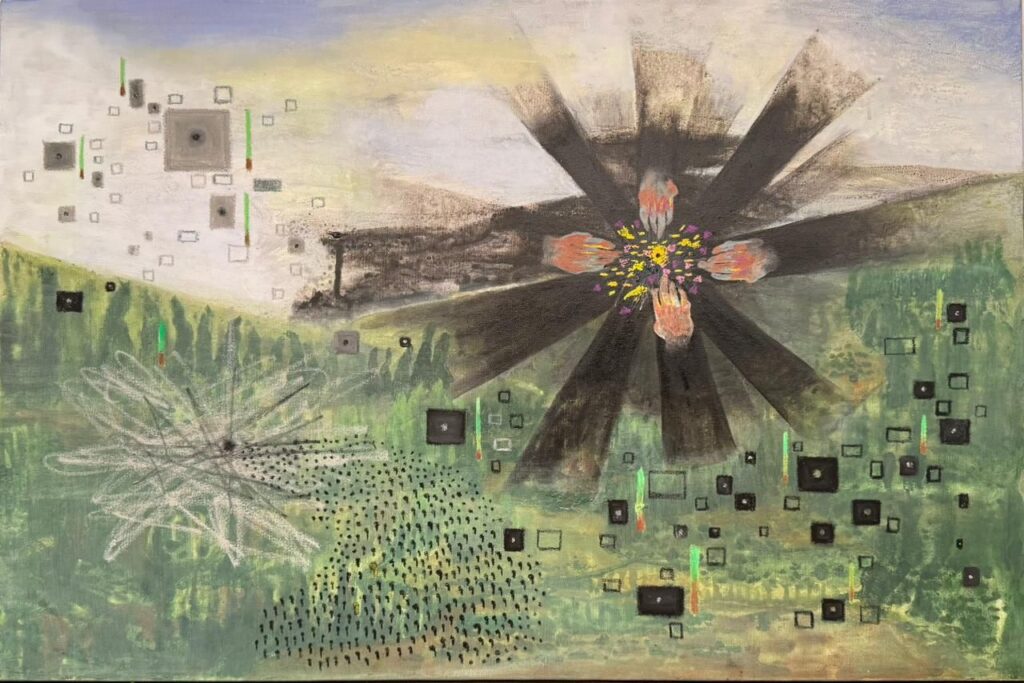
Greed 1
Four hands reach for one small flower inside the smoke
A green hill, combed with dark pines.
The sky is laid on in thin whites, one over another.
A black burst opens like smoke with nowhere to go.
At its heart four hands close around a spill of yellow and pink.
Small black squares settle on the grass, each with one bright eye.
Lower down, a crowd of dots moves toward something it cannot see.
Sayali Khanvilkar paints a green hillside under a pale sky. A dark burst spreads across the middle. Inside it, four hands reach for a small cluster of yellow and pink. Black squares drift over the land like windows or screens. The painting grows from a trip to Shimla, where she finds pollution among the mountains. Back in Mumbai she sees the same haze and a city growing "at the cost of leaving our environment behind." She builds the sky in veils of white paint, layer on layer, like the haze itself.
Acrylic · 60 × 91 cm · 2026
Theme Greed and pollution
RC-8535
Sayali Eknath Khanvilkar
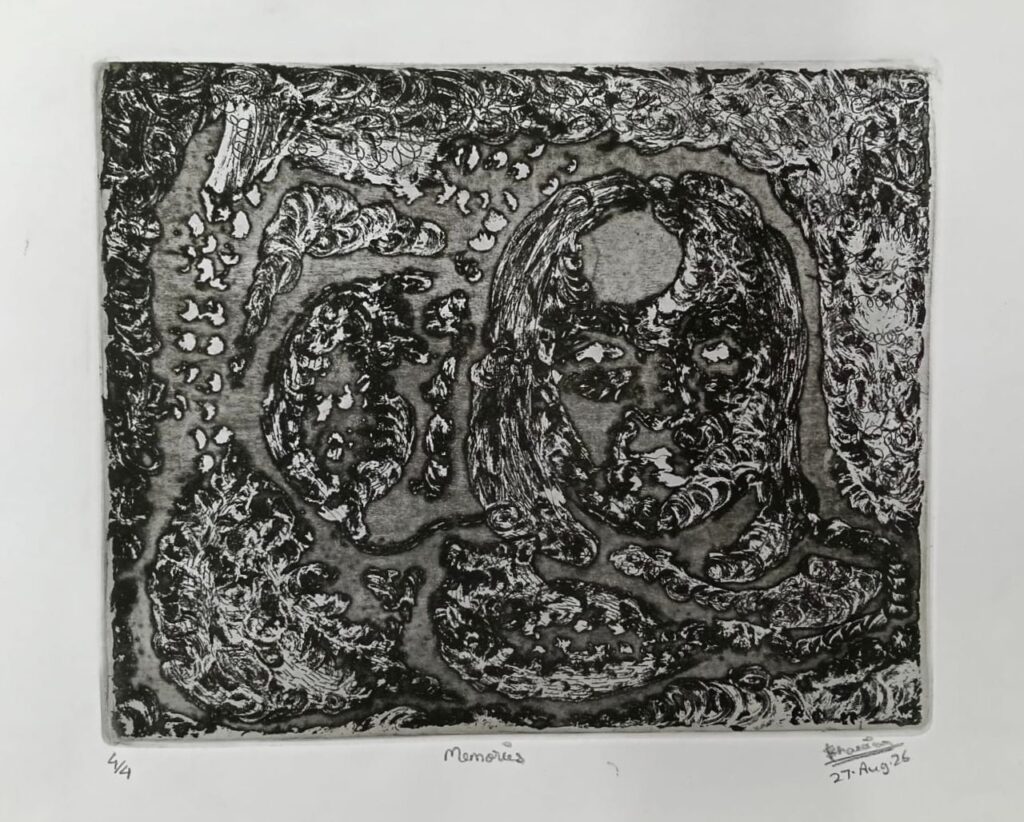
Memories
A pale moon on her brow as the past curls around her
Black ink curls like smoke over grey water.
A face waits in it, two small sparks of paper for eyes.
On her forehead sits a round pale moon the ink forgot.
Beside her something sleeps, folded up like a seed.
White petals fall from one corner of the plate.
Every line loops back the way a memory does.
Sayali Khanvilkar has always lived in Mumbai. She comes from Sir J. J. School of Art. In Memories a woman's face fills the right side of a small plate, 15 × 20 cm. A curled form rests beside her. White flecks drift down from the top corner. Dark looping lines crowd every edge. Khanvilkar says her work holds feelings such as "detachment, attachment, pain, sorrow". It takes her back to good days in "a nostalgic dreamy world". The pencil notes show this is print four of four.
Printmaking on paper · 15 × 20 cm · 2026
Theme Memory and nostalgia
RC-8536
Sayali Eknath Khanvilkar
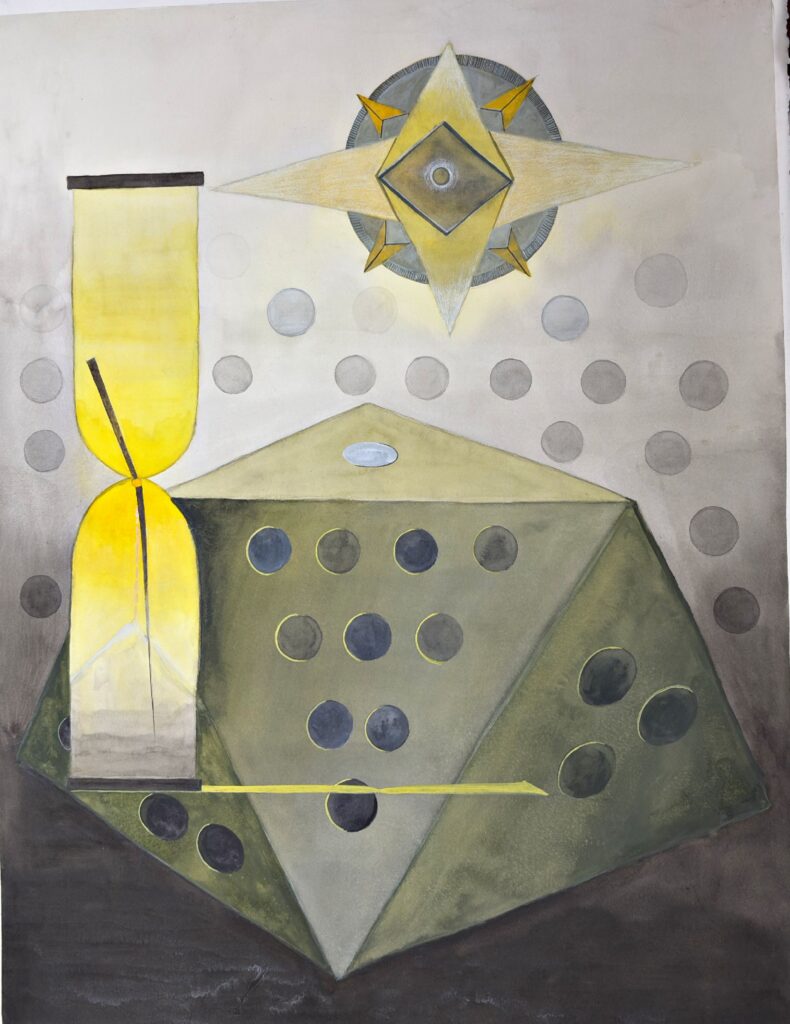
Time and it’s coexistence
Time rolls like a die and pours like sand
Yellow sand pours through a glass that will not stay still.
A green die lies on its side, its spots gone dark like wells.
Above it a star of pale gold turns on a grey wheel.
Small grey moons drift across the paper in rows.
The light is low at the bottom, as if evening has come early.
A thin line cuts through the hourglass and keeps going.
Sayali Khanvilkar paints three objects on one sheet of paper. An hourglass, a die and a compass stand together for time. To her, time is "always changing and never stable." As time moves, she says, we move with it and forget what we owe to nature. She works in watercolour. She lays thin washes of yellow, olive green and grey. Khanvilkar has always lived in Mumbai. She trained at Sir J. J. School of Art.
Watercolour on paper · 55 × 76 cm · 2025
Theme Time and nature
RC-8537
Sayali Eknath Khanvilkar
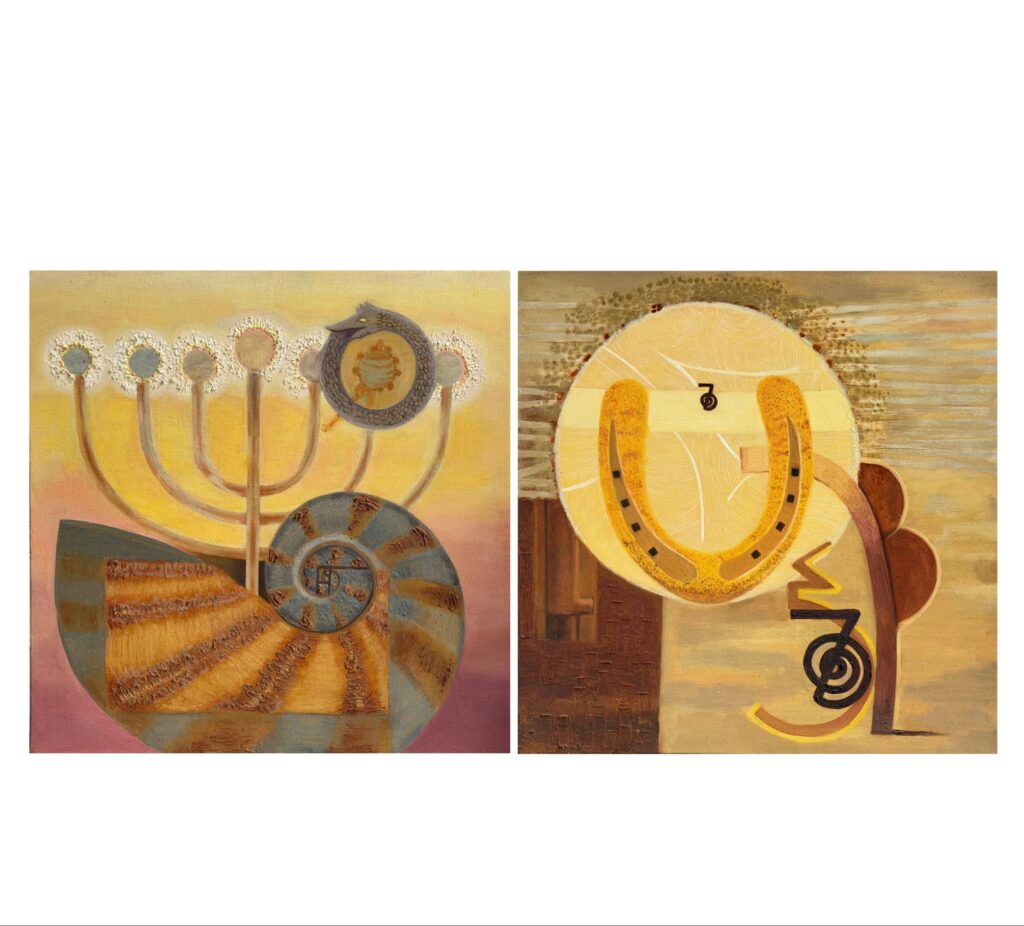
Faith and healing
A snake holds its tail while a horseshoe catches the light
Honey light fills the top of the sky and turns to rose below.
Small pale moons sit on thin stems, each ringed with salt.
A grey snake holds its own tail and keeps a small bowl warm.
The shell turns inward, slow as breath.
On the second panel a horseshoe glows like ripe grain.
A black spiral waits beside it. The paint is rough enough to touch.
Sayali Khanvilkar is a graduate of Sir J.J. School of Art and has always lived in Mumbai. Faith and healing is made in mixed media on two square panels. On the left a branching stand of lights rises from a spiral shell. On the right a golden horseshoe sits inside a pale circle. Khanvilkar works with symbols and builds raised, rough surfaces. She feels that faith today is often only an act. Nature pays the price. Here she asks what real faith could be.
Mixed media · 60 × 120 cm · 205
Theme Faith, nature and healing
RC-8538

Sayali Eknath Khanvilkar
Greed
Four hands reach in for one small light
White comes first, one thin veil and then another, until the sky forgets it was blue.
Small grey boxes drift through the haze like windows with no rooms.
A dark wheel opens over the hills.
Four hands reach in and close around one grain of yellow light.
In the grass, black squares sit where trees should be.
Green and red marks rise and fall.
The field keeps growing, quietly, underneath.
Sayali Khanvilkar has always lived in Mumbai. She finished art school this year. On a trip to Shimla, Khanvilkar finds pollution among the mountains. Back home she sees the same haze over a city that grows at a cost to nature. In Greed she builds that haze up in veils of white acrylic and pastel, layer on layer. Dark rays burst open over green hills. Four hands reach in for one small yellow light. Black squares fill the grass below.
Acrylic on canvas · 2 × 3 cm · 20262
Theme Progress against nature
RC-8539

Sayali Eknath Khanvilkar
Surreal
A fish dives out of the clouds as the land goes dark
Charcoal sky, rubbed soft as ash on a thumb.
A fish tips out of the clouds, each scale counted in pencil.
Torn paper edges shine white along every body.
A bird with a dark beak. A clawed hand. A striped animal with one open eye.
Below them the ground is black and very still.
They are all sliding into the same night.
Sayali Khanvilkar makes this drawing in charcoal and pencil, 55 × 76 cm. A large fish with heavy scales tips down out of the sky. Below it, a bird, a clawed creature and a long striped animal lie on what look like torn scraps of paper. Khanvilkar has always lived in Mumbai and studied at Sir J.J. School of Art. The city's distance from nature makes her care for it more. She believes every living being feels with equal depth. Here the animals share one strange space.
Charcoal and pencil · 55 × 76 cm · 2026
Theme Unity of living beings
RC-8540
Sayali Eknath Khanvilkar
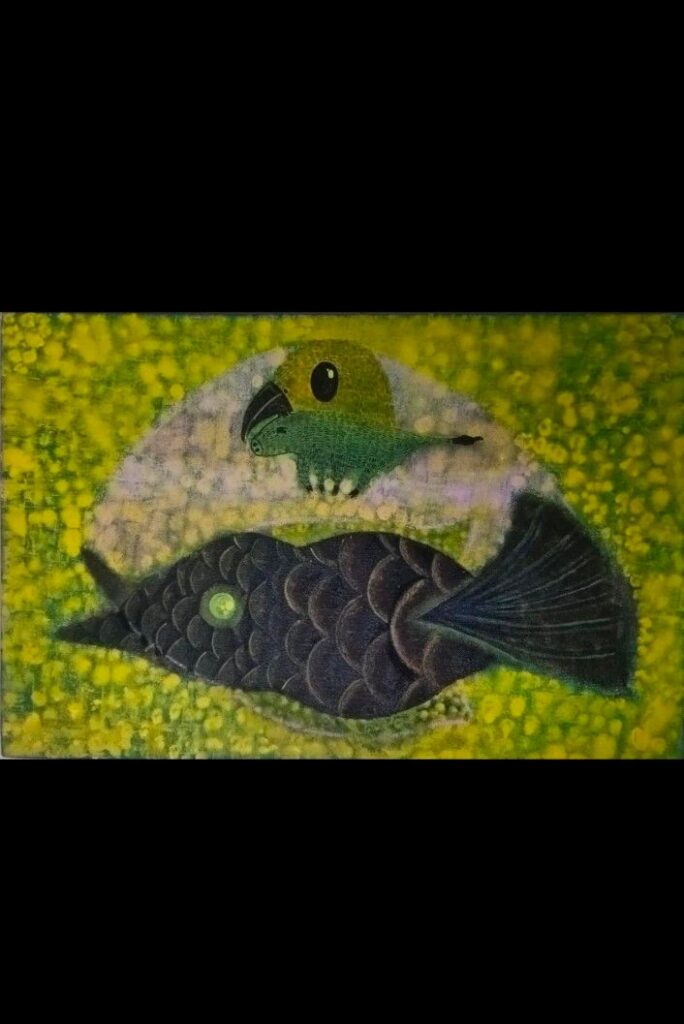
Surreal
A parrot with a fish's body floats above its dark cousin
Yellow dots crowd the green like pollen after rain.
The big fish is the colour of a bruise, each scale lit at its edge.
Its one eye glows pale green, a small coin of light.
Above, a parrot wears a fish's body and keeps the tail.
A lilac moon holds them close.
No one here is eating anyone.
Sayali Khanvilkar has always lived in Mumbai. She is a recent graduate of Sir J J School of Art. In Surreal a dark fish lies across a field of yellow and green dots. Above it, inside a pale lilac ring, a creature floats. It has a parrot's head and a green fish's body. Khanvilkar believes every living being feels with equal depth. Her practice is built on symbols, forms and space. Here bird and fish seem to share one body.
Acrylic · 55 × 76 cm · 2026
Theme Unity of living beings
RC-8541
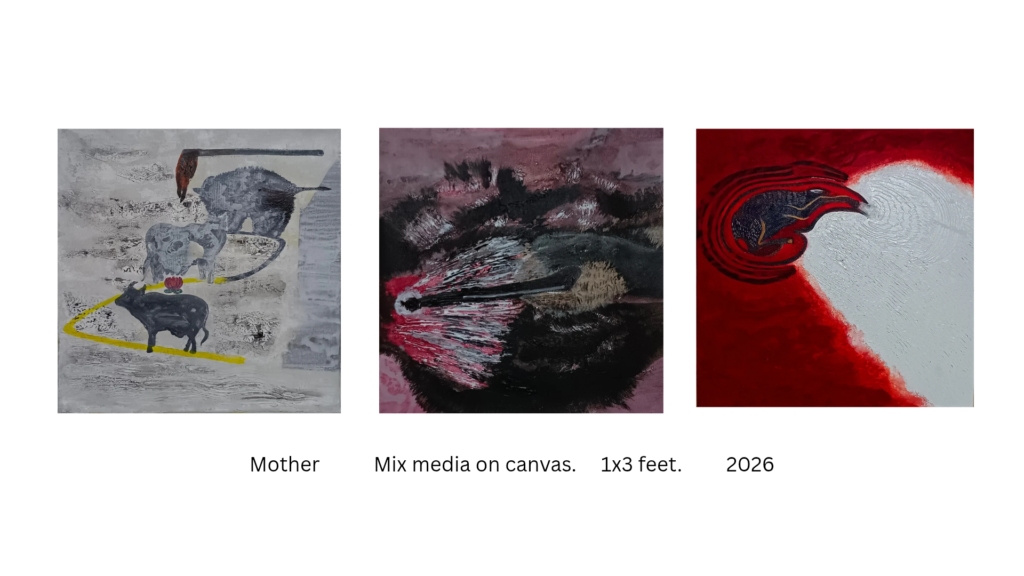
Sayali Eknath Khanvilkar
Mother
A cow, a calf and a small red mark between them
A black cow stands still on grey ground. A pale calf leans in above her.
Between them sits a small red knot.
A yellow line runs past like a road not yet walked.
In the middle, black hair crowds a pink dusk and red threads fly from one white eye.
On the right, white rises out of red in rings like a thumbprint.
A dark curled head waits at its edge.
Sayali Khanvilkar paints Mother as three square panels set side by side. Together they measure 30 × 90 cm. On the left a black cow stands below a pale calf on grey ground. A yellow line runs beside them. In the centre a dark mass spreads over dusky pink. On the right a white shape pushes into deep red. Khanvilkar has always lived in Mumbai and trained at Sir J J School of Art. She builds her surfaces in mixed media. Her practice rests on symbolism and on forms drawn from nature.
Mixed media on canvas · 30 × 90 cm · 2026
Theme Unity of living beings
RC-8542
Featured in Issue 4
Satadru Sovan Banduri
The Long View. He paints, makes installations of light and performs with his own body as the material. And he tells young artists never to stop sending their work into the dark.
Satadru Sovan Banduri
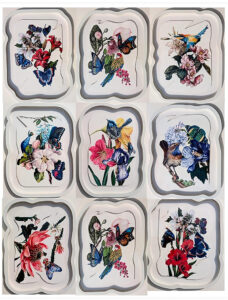
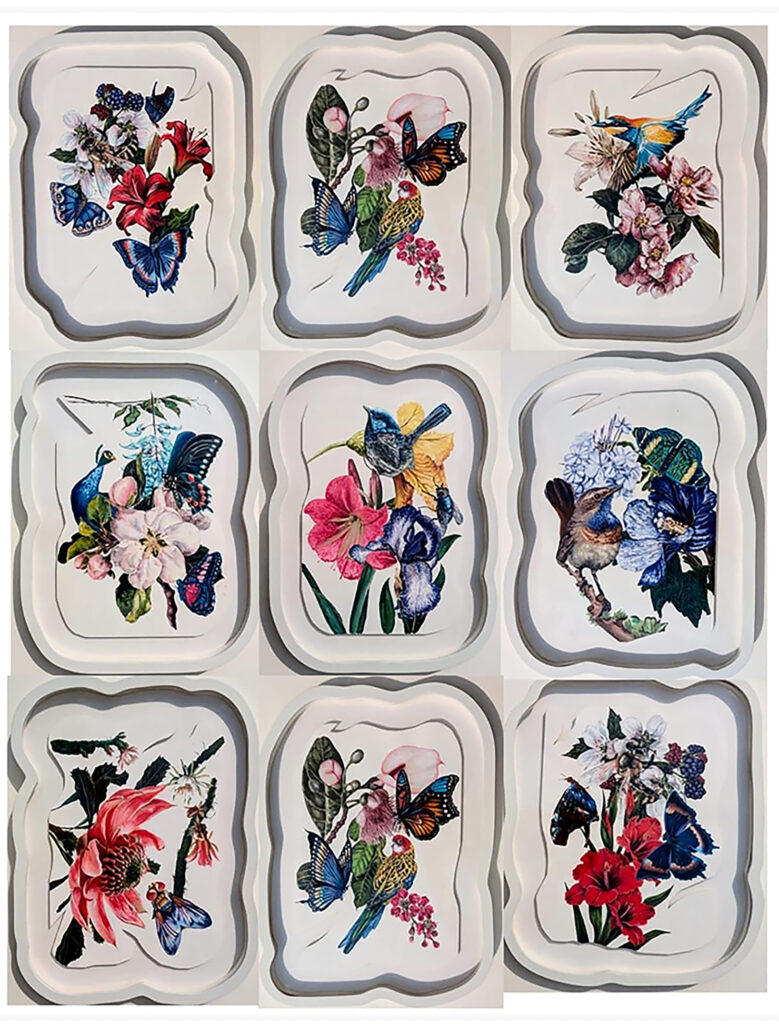
1.Where Wings Dare not Wander
Every bird here sits inside a frame that is starting to crack
A lily opens red against the white.
A small bird holds still beside an iris the colour of a bruise.
Butterflies fold blue wings over leaves that never touch soil.
Around each bunch the white swells in slow ridges like poured plaster.
A thin crack runs in from the edge.
The flowers do not know it is there.
Satadru Sovan Banduri paints the fragile life of the planet. Here nine white panels sit in a grid. Each one holds a cluster of flowers, birds and butterflies in acrylic with gouache. The colours are bright and exact, like plates in an old nature book. But the white around them rises in soft wavy ridges. Thin cuts run in from the edges. Banduri does not treat the damage to nature as a matter of figures. He calls it "planet-wide grief."
Acrylic with gouache
Theme Grief for fragile nature
RC-8525
Satadru Sovan Banduri
Acrylic with Gouache on Canvas
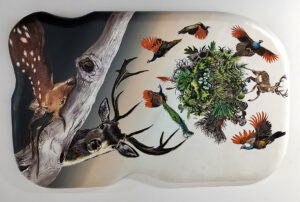
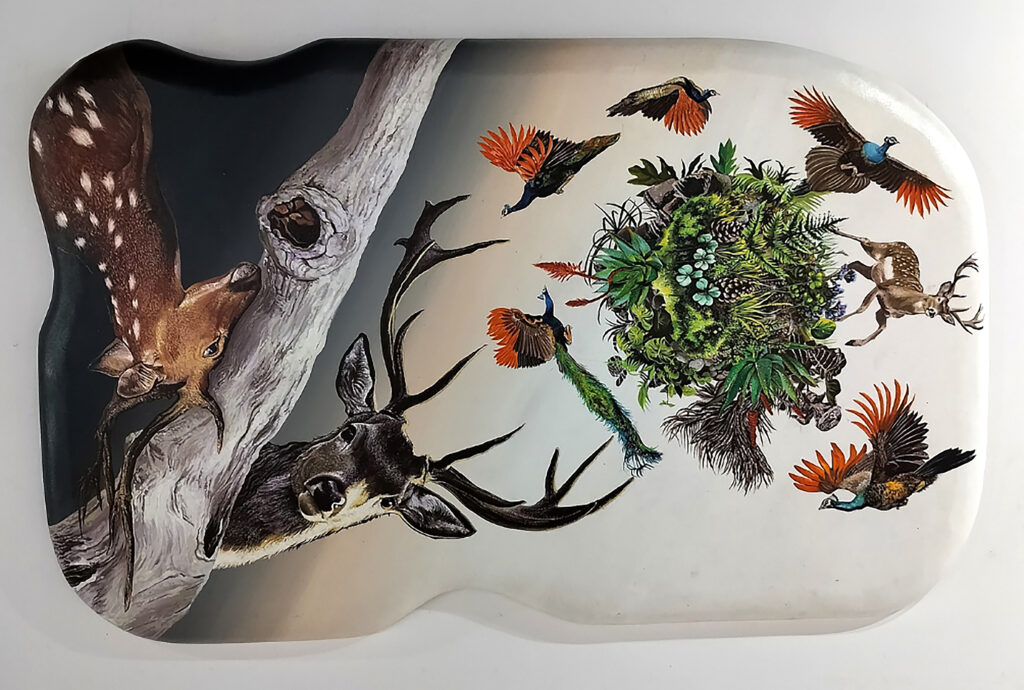
Peacocks circle a world small enough to hold in two hands
Grey dusk on the left. A branch white as bone.
A spotted deer stretches her neck to taste the bark.
The stag looks out at us, antlers wide as a dry river.
On the pale side, peacocks flash orange like struck matches.
They ring a green ball of fern and moss and cones.
A tiny deer runs from it into all that white.
Satadru Sovan Banduri paints in acrylic with gouache on canvas. Here the canvas itself has soft uneven edges, like a pool or a leaf. On the left a spotted deer and an antlered stag press out of dark grey ground beside a pale bare branch. On the right peacocks with orange wings circle a small round world of ferns, moss and cones. A tiny stag leaps from it. Banduri builds surreal landscapes where animals and birds meet what he calls "planet-wide grief."
Acrylic with gouache on canvas
Theme Animals and a grieving planet
RC-8526
Satadru Sovan Banduri
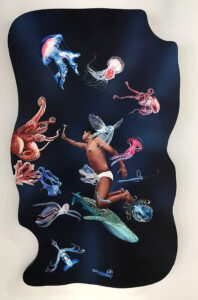
Song of the Sea
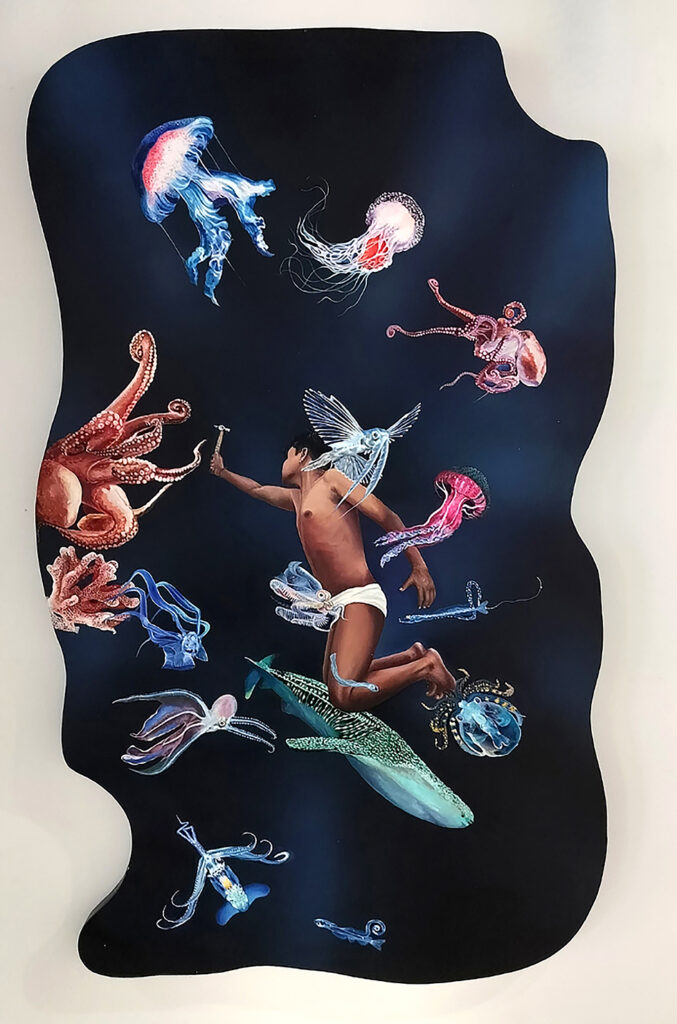
He reaches into the deep. The sea reaches back
The water here has edges that bend like cloth.
A boy kneels on nothing and lifts a small tool to an octopus.
Jellyfish glow pink at the centre, thin as paper lamps.
A fish with glass wings sits in his hair.
Under his knee a whale shark turns, spotted like a road at night.
He does not sink. He is asking something.
Satadru Sovan Banduri paints in acrylic with gouache on canvas. Here the canvas has wavy edges, like a pool of night water. A boy in white kneels in the deep blue. He holds a small tool out towards an octopus. Jellyfish, squid, coral and a whale shark drift around him. A winged fish rests on his head. In Banduri's paintings, creatures of the sea share the canvas with the human body. He does not see the damage to nature as a matter of figures.
Acrylic with gouache on canvas
Theme Human presence and survival
RC-8527
Featured in Issue 4
Aakansha Gupta
The Studio · Ceramics and glass. She turns what a flood ruined into fired clay and glass, so that it cannot be washed away again.


Aakansha Gupta
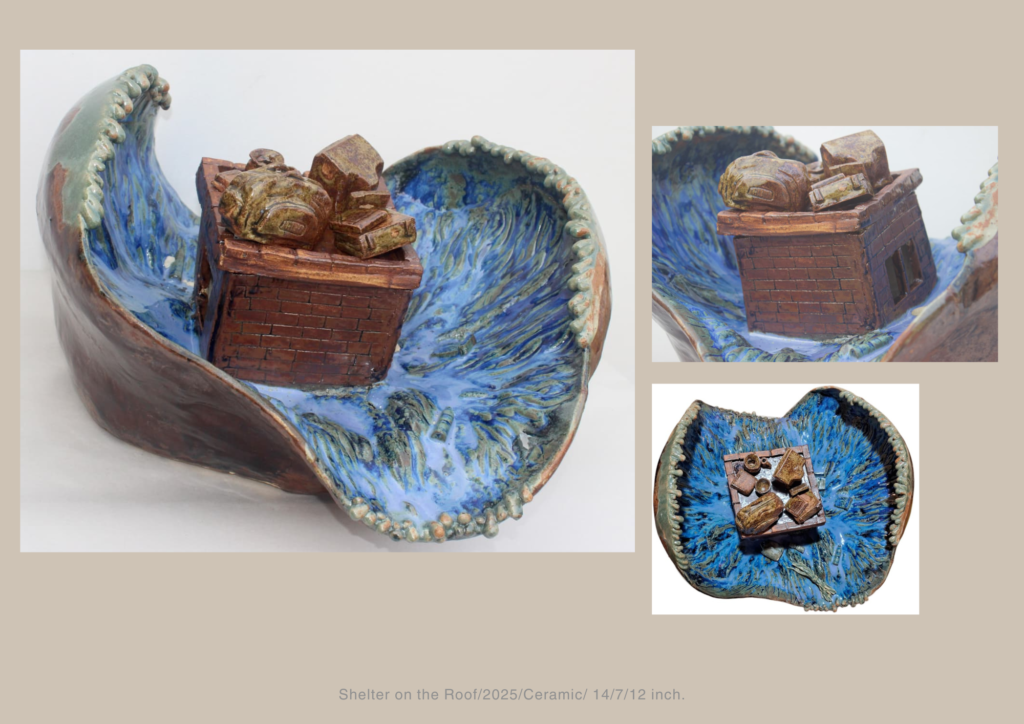
Shelter on the roof
A whole household carried up to the roof as the water rose
A brick house stands to its windows in blue.
On the roof, bundles sit close, tied and heavy, the colour of wet earth.
The water is glass-bright and streaked, as if it is still moving.
Its green rim curls over like foam about to break.
The wave lifts high on one side and holds.
Nothing falls. Everything waits up here, where it is still dry.
Aakansha Gupta was a child when a flood came into her family's home in Kishanganj, Bihar. The family carried bags, mattresses and food up to the roof. Here a small brick house holds that load. Gupta builds it by hand in stoneware and fires it at a high heat. The house is matte and earth coloured. A glossy blue wave curls around it. In the kiln the glazes on the house run in ways she did not plan. They leave marks like those a flood leaves on a wall.
Glazed ceramic · 30.48 × 17.78 × 35.56 cm · 2025
Theme Refuge from a flood
RC-8529
Aakansha Gupta
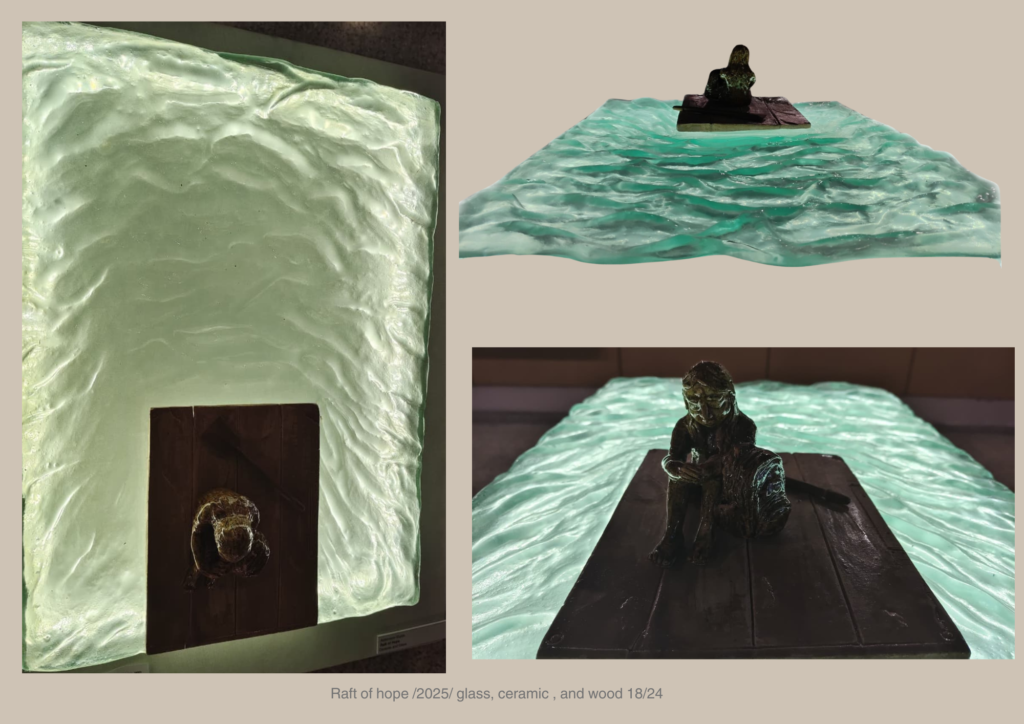
Raft of hope
Help came late. A door frame carried them through the water
Green light climbs through the glass from underneath.
The water has stopped moving but it still looks cold.
A child sits on a door that has become a floor.
One knee up. Hands holding on to almost nothing.
No shore at any edge.
Only the paddle, lying where a person might have been.
Raft of hope begins with a flood in Kishanganj, Bihar, when Aakansha Gupta is a child. Help does not come in time. Neighbours use a wooden door frame as a raft and carry her family to safety. Here a ceramic child sits on a wooden raft. Under it lies a sheet of rippled glass, lit from below. Gupta first makes a second figure, the neighbour, but the piece feels too crowded. She takes him out and puts in a wooden paddle. She keeps the glass clear, not muddy.
Ceramic, glass, commercial light and wood · 17 × 45.72 × 60.96 cm · 2025
Theme Surviving a childhood flood
RC-8530

Aakansha Gupta
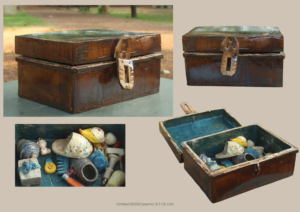
Box of curiosity
A child's flooded trunk, its toys fired so they cannot drown
A trunk the colour of strong tea, still shining as if just pulled from the water.
The latch hangs loose and pale at the front.
Inside, the lining is the blue of a deep pond.
A yellow duck. A blue comb. A parcel tied with ribbon.
Each one heavy now, each one fired hard.
Nothing in this box will float away again.
Aakansha Gupta lived through a flood in Kishanganj, Bihar, as a child. Box of curiosity returns to that time. It is a small trunk made in glazed ceramic and wire. The brown surface shines as if it is still wet. Open the lid and the inside is teal blue. It holds a yellow duck, a blue comb, a parcel tied with ribbon and other small things. Water ruins such objects quickly. Gupta fires them hard in clay so they last. Her glazes hold the colour of mud and silt.
Glazed ceramic and wire · 35.56 × 27.94 × 20.32 cm · 2026
Theme Flood, childhood and memory
RC-458

Aakansha Gupta
Basera
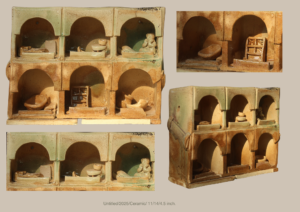
Six small rooms, each holding what the water left behind
Green settles on the roof like still water.
Below it the walls turn the brown of a riverbank after rain.
A mattress folds in on itself. A chair stands empty.
In one room a small child holds its face in both hands.
The light reaches only halfway into each arch.
Everything here has gone hard, as if the flood stopped and stayed.
Aakansha Gupta builds a small house with six arched rooms in two rows. Each room holds one object: a folded mattress, a stack of bowls, a chair, a round basin and a small seated child. As a child in Kishanganj, Bihar, Gupta lived through a flood. Here she makes soft, easily ruined things in high-fired clay so that they become permanent. The glaze runs from pale green at the top to brown and ochre below. For Gupta, these colours carry the weight of mud and silt.
Glazed ceramic · 11.43 × 27.94 × 27.94 cm · 2026
Theme Flood and childhood home
RC-459
Aakansha Gupta
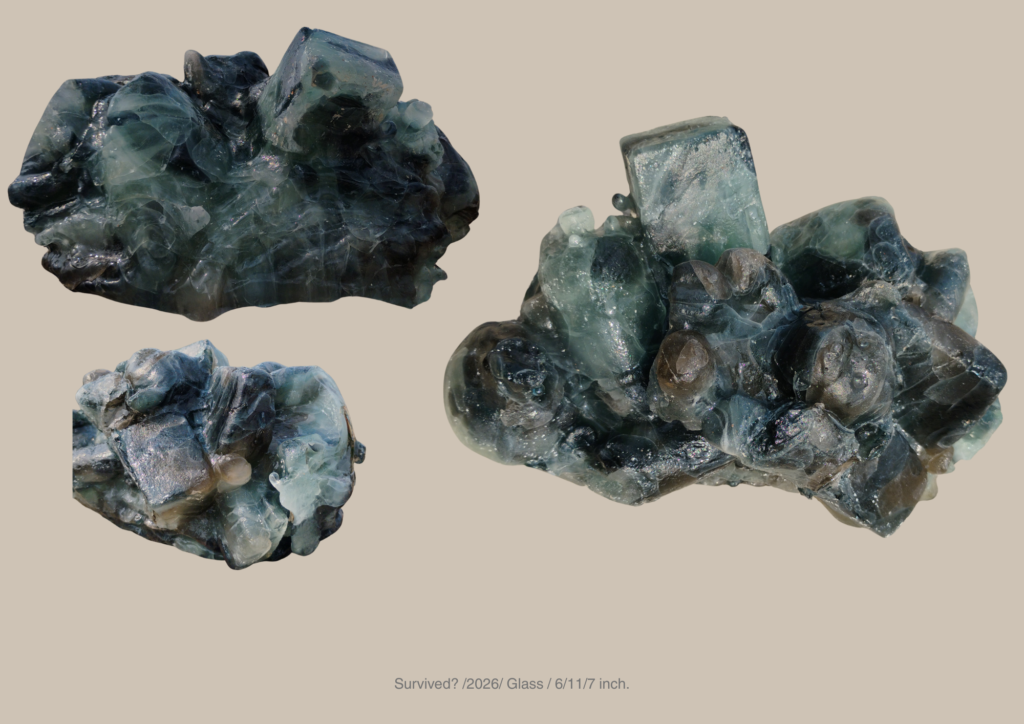
Survived??
A flood held still in green and smoky glass
A pond stopped in the middle of a thought.
Smoky brown stones sit inside green water that will not move.
One square block climbs to the top and stays there, like a box kept dry.
Small beads of glass cling to its side.
Light goes in and comes back grey.
Everything the water touched is still here, only heavier.
Aakansha Gupta comes from Kishanganj in Bihar. As a child, Gupta lived through a flood there. The sculptures in this series ask how one disaster can break the comfort of daily life for good. In this series, high-fired clay usually holds things still. Glass brings the other side: fragile, broken and see-through like water. Survived?? is made only of glass. Blue-green, grey and smoky brown lumps press together. One pale square block stands on top.
Glass · 17.78 × 27.94 × 15.24 cm · 2026
Theme Flood and childhood memory
RC-460
Aakansha Gupta
Guang
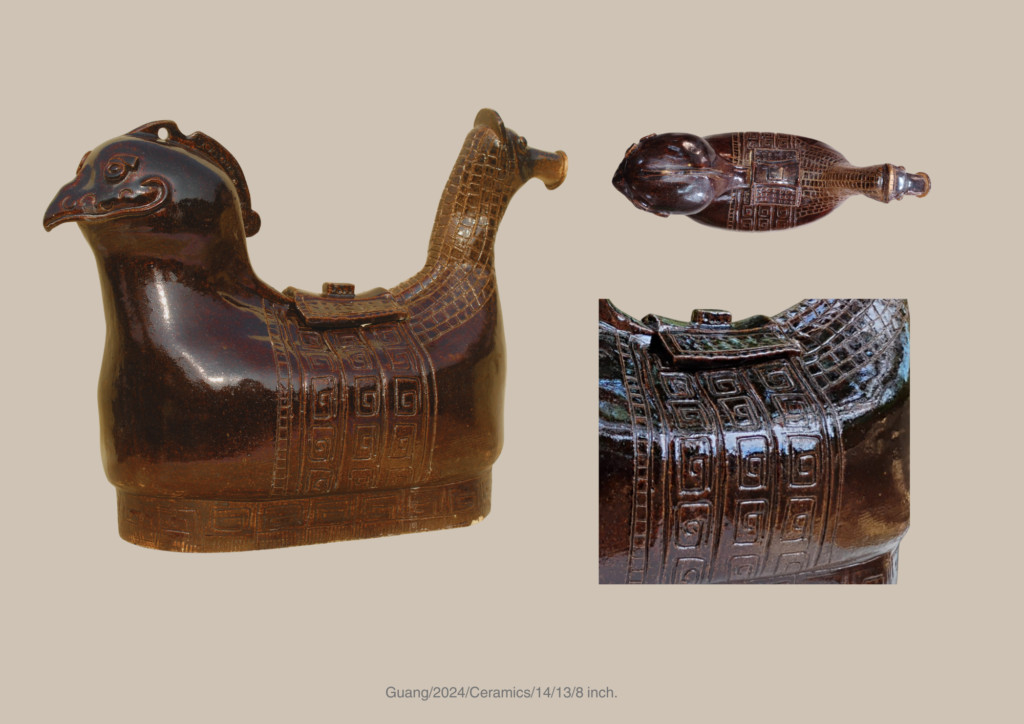
A bird with a second neck rising from its back
Brown glaze pools like river water left standing in a room.
A bird lifts its hooked beak and does not fly.
Behind it a second neck climbs, scaled in tiny squares.
Spirals turn and turn, sharp at every corner.
Light slides off the shoulder and turns gold at the edges.
Something soft has been made to stay.
Aakansha Gupta makes Guang in ceramic under a deep brown glaze. A bird's head with a curled crest sits at one end. At the other end a long neck rises to a small open mouth. Bands of square spirals run down the sides and around the base. A grid of small squares covers the neck like scales. A lid sits on its back. Gupta, of Visva Bharati University, grounds her work in a childhood flood in Kishanganj. She uses glaze to hold the weight of mud and silt.
Glazed ceramic · 20.32 × 33.02 × 35.56 cm · 2024
Theme Memory held in clay
RC-461

Aakansha Gupta
Untitled
A lamp bends low over a girl lost in her book
Sea green light settles over the desk.
A black lamp leans in like a heron at the water.
The girl's hair falls in one dark rope down her back.
Her book is green as a rice field after rain.
Blue chips gather at the table's edge and shine.
She does not look up. She keeps reading.
Aakansha Gupta studies at Visva Bharati University. She comes from Kishanganj in Bihar. As a child she lived through a flood there. Her sculptures look at how such a disaster changes life at home. In this work a girl with a long ponytail bends over an open green book. A dark desk lamp curves above her. A pen rests on the table. Gupta sets firm clay beside glass. The clay holds still. The glass breaks the light the way water does.
Glazed ceramic · 35.56 × 25.4 × 17.78 cm · 2026
Theme Home, childhood and memory
RC-457
Featured in Issue 4
Kotha Revanth
The Studio · Painting. He grew up with the masks of the Naikpod community, which are Gods. Now he paints them, on paper, on canvas and on palm-leaf mats.


Kotha Revanth
Abandoned
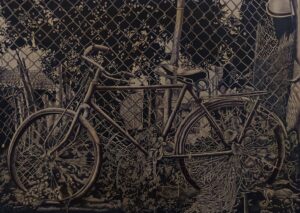
Leaves are already climbing through the back wheel
Coffee settles into the ground like late afternoon.
Black ink knots the fence one diamond at a time.
The saddle still holds the shape of someone.
A coiled lock hangs there, guarding nothing.
Leaves push through the spokes and do not ask.
The front tyre has gone soft on the dirt.
In Abandoned (2025), Kotha Revanth begins with a coffee wash for the background. Then he draws the bicycle and every other detail in black pen. An old bicycle leans on a wire fence. Its seat is worn and a coiled lock hangs below it. Leaves grow up through the back wheel. Behind the fence dark trees and a tiled roof sit in shadow. Kotha uses pen for fine lines. Here many small marks build the wire, the spokes and each leaf. The work measures 40.64 × 55.88 cm.
Coffee wash and black pen · 40.64 × 55.88 cm · 2025
Theme Things left behind
RC-518

Kotha Revanth
Pothuraju
A childhood festival mask, painted to stare straight back at you
A red face fills the square like a held breath.
The eyes are two white moons with black wells at their centre.
A moustache curls up at both ends, a smile saved for the crowd.
Small grey leaves climb the cap in rows.
At the throat a yellow band, beaded white, holds the head still.
Around it the cream ground waits for the festival to begin.
Kotha Revanth paints Pothuraju as one large mask on a pale square ground. Kotha comes from the Naikpod community in Mulugu district. The artist remembers making masks as a child for festivals such as Laxmi Devara and Pothuraju. Here the face is a deep red. Thick black brows and a curled moustache frame wide white eyes. Fine lines mark the lashes and the leaf pattern on the cap. Kotha builds acrylic in layers. The aim is to reinterpret the old form, not copy it.
Acrylic · 46 × 46 cm · 2026
Theme Naikpod memory and ritual
RC-519
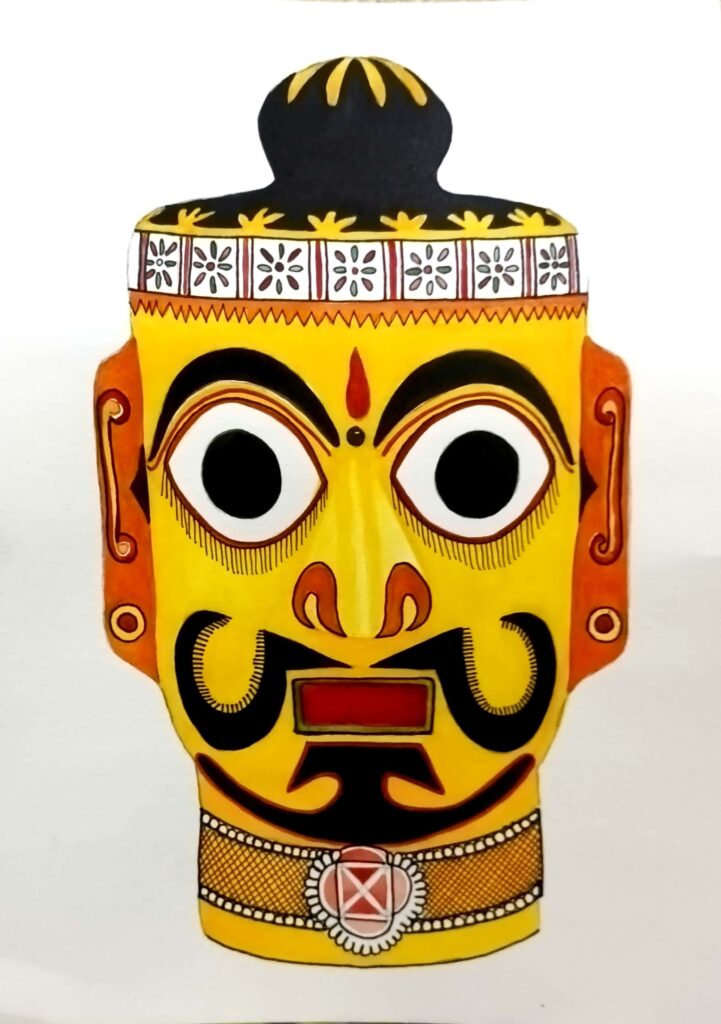
Kotha Revanth
Singaboyadu
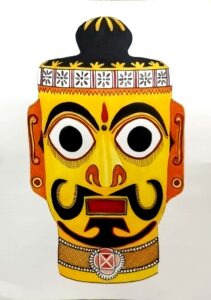
Round eyes and a black moustache, remembered from childhood festivals
Turmeric yellow fills the whole face.
Two white eyes hold their black centres and do not look away.
The moustache curls up like a river bend drawn in ink.
A red mouth stays closed, a small square door.
Tiny flowers march around the headband.
Orange ears listen for drums we cannot hear.
Kotha Revanth belongs to the Naikpod tribal community. He comes from Mulugu district. His village is full of rivers, trees, birds and animals. As a child he makes masks for festivals such as Laxmi Devara and Pothuraju. In Singaboyadu he paints a mask in watercolour on a small sheet. A yellow face stares out with round eyes, a red mouth and a curling black moustache. He does not copy the old forms. He gives them a new shape in his own visual language.
Watercolour on paper · 29.7 × 21 cm · 2026
Theme Ritual masks and memory
RC-520
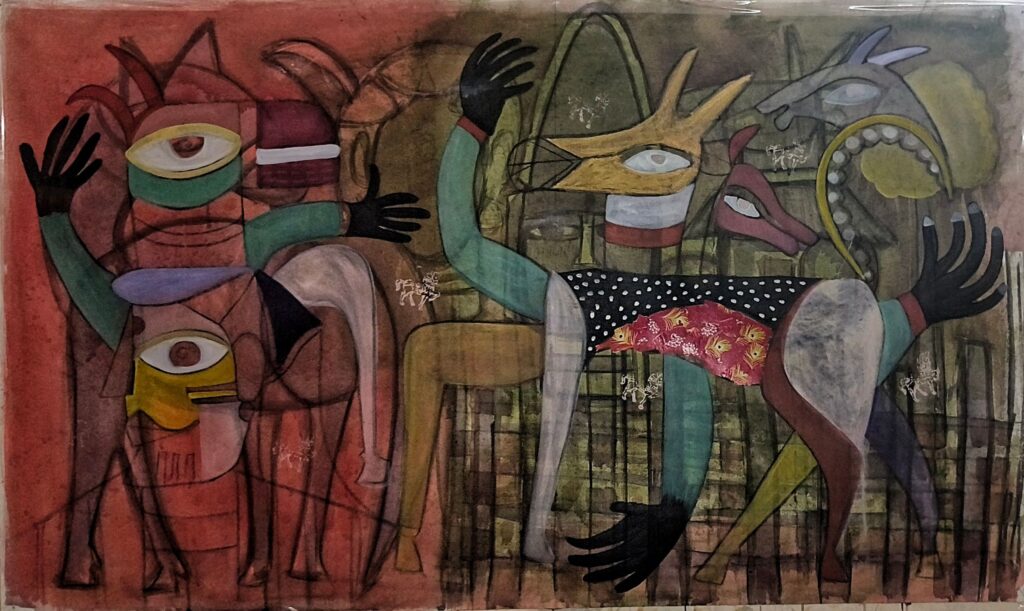
Kotha Revanth
Untitled
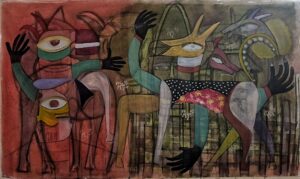
Childhood festival masks return with wide eyes and black hands
Rust red on one side, river green on the other.
A single eye opens in a mask and does not blink.
Black hands lift as if a drum has started.
A horned head leans in, teeth set like a string of beads.
Red paper with peacock feathers rides on a moving body.
Charcoal lines run under everything, like roots under a field.
Kotha Revanth grew up in a village in Mulugu district among rivers, trees and animals. The artist belongs to the Naikpod tribal community. In childhood, Kotha made masks for festivals such as Laxmi Devara and Pothuraju. Those memories shape this work. Masked figures with one wide eye stand beside horned animal heads. Kotha builds the surface with layers of acrylic wash. Charcoal adds rough lines. Pasted decorative paper adds texture and depth. The aim is not to copy old forms but to give them a new, personal language.
Acrylic washes, charcoal and pasted decorative paper · 152.4 × 91.44 cm · 2026
Theme Festival masks and memory
RC-521
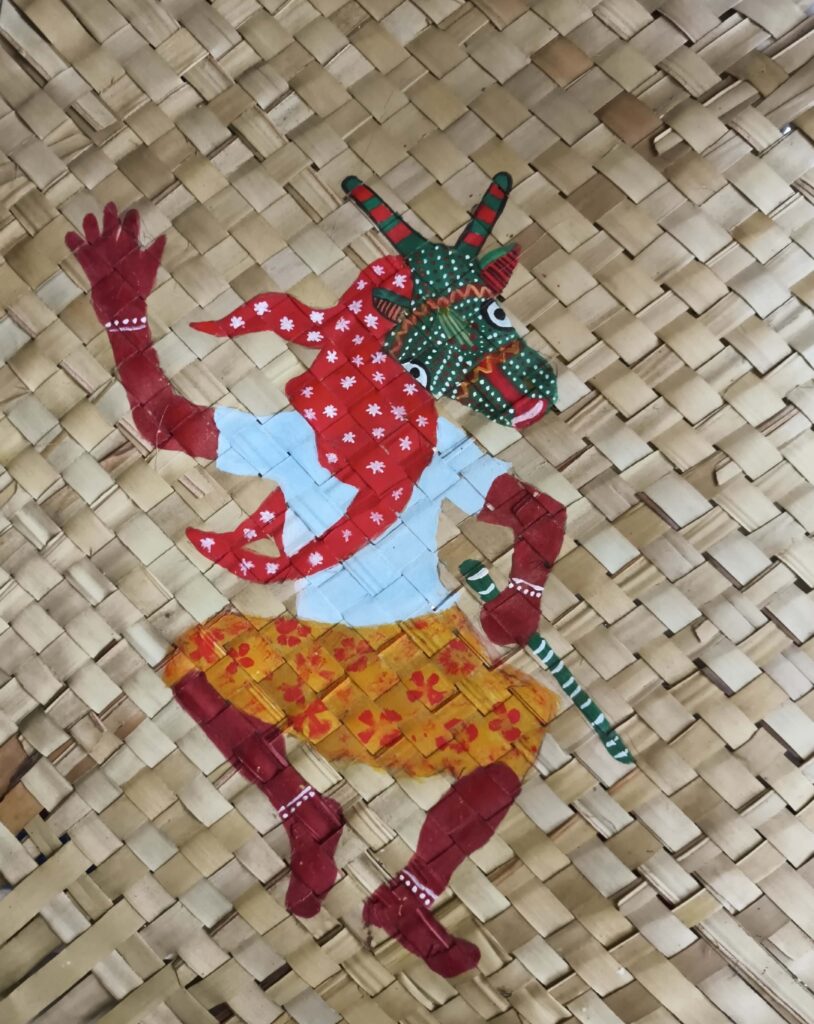
Kotha Revanth
Gurrapothu
A festival dancer painted onto the weave of a leaf mat
A green face with horns striped red and green.
White dots sit on it like grains of rice.
Red cloth with small white stars swings from the shoulder.
One hand is up. One foot leaves the ground.
Under the paint the leaf keeps its weave.
The dancer is made of small squares of mat
and still he will not stand still.
Kotha Revanth grows up in the Naikpod tribal community in Mulugu district. As a child he makes masks for festivals such as Laxmi Devara and Pothuraju. In Gurrapothu a dancing figure wears a green horned mask. Kotha paints in acrylic straight onto a palm-leaf mat handmade in a tribal region. He does not hide the weave. Each square of leaf breaks the colour into small blocks. The body seems to move across the mat.
Acrylic on handmade palm-leaf mat · 40.64 × 30.48 cm · 2025
Theme Ritual masks and memory
RC-522
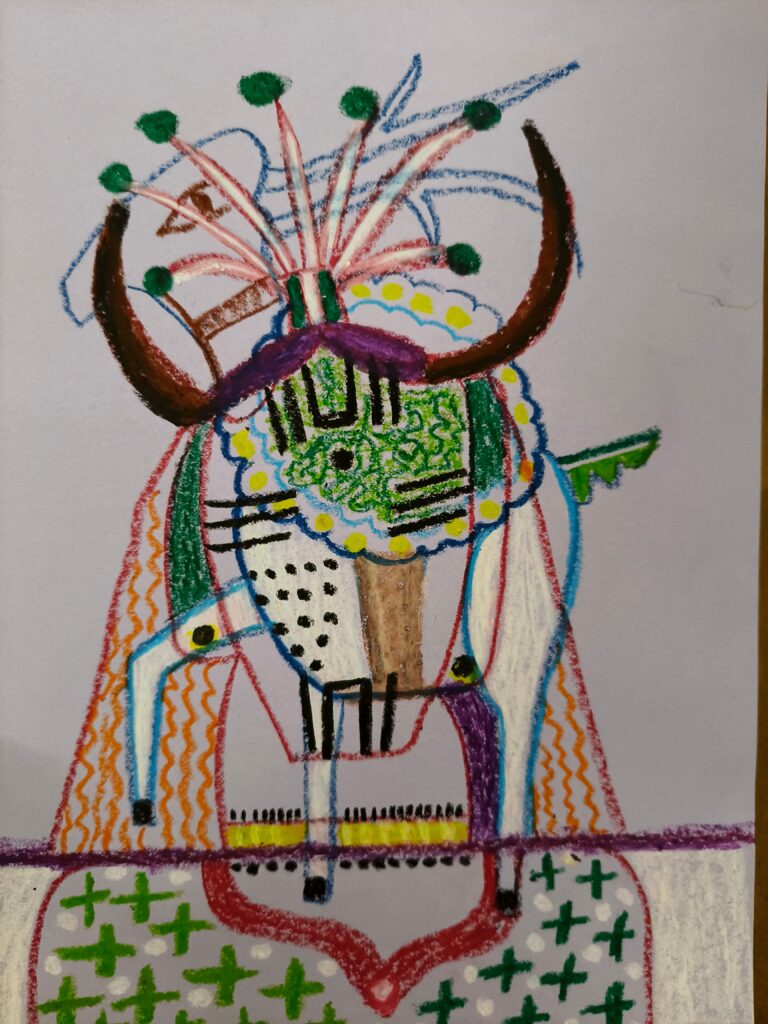
Kotha Revanth
Tribal women
Horns, feathers and a green face built from memory
Two brown horns curve up like the arms of a dancer.
Pink stems burst from the head, each one tipped with a green seed.
The face is a knot of green scribble inside a ring of yellow dots.
Orange lines ripple down the sides like water after rain.
Below, green crosses scatter across white ground.
The pastel sits thick and waxy on pale lilac paper, still warm from the hand.
Kotha Revanth comes from the Naikpod tribal community and from a village in Mulugu district full of rivers, trees, birds and animals. Childhood memories of making masks for festivals such as Laxmi Devara and Pothuraju shape this drawing. A horned mask face rises above a white body marked with black dots. Kotha does not copy old forms. The artist rebuilds them in oil pastel with rows of dots, crosses and wavy lines on a sheet of 29.7 × 21 cm.
Oil pastels on coloured paper · 29.7 × 21 cm · 2026
Theme Ritual masks and memory
RC-523

Kotha Revanth
Naikpod Masks
Three painted faces and a horse, all staring straight at you
Turmeric yellow, indigo blue, two reds hot as embers.
Eight round eyes, white as rice, do not look away.
Moustaches curl like river bends drawn in black ink.
A tall crown climbs in green and red triangles.
The horse lifts its ears between the men.
Festival faces held still on a white ground, waiting for someone to wear them.
Kotha Revanth belongs to the Naikpod tribal community and comes from Mulugu district. As a child he made masks for festivals such as Laxmi Devara and Pothuraju. In Naikpod Masks he paints four faces in a row. Three are human. One is a horse. Kotha builds the colour in layers of acrylic and adds fine patterns with pen. He does not want to copy old forms. He wants to show a culture that is still alive and changing. He studies at Suravaram Pratapa Reddy Telugu University.
Mixed media: acrylic, watercolours and pen · 58.42 × 20.32 cm · 2026
Theme Living tribal tradition
RC-524
Featured in Issue 3
Janani
First Year Out · Drawing. She draws everyday care in pen: hands that hold, a paper fan and sparrows that are not yet sure of a new hand.
Janani
The present in past
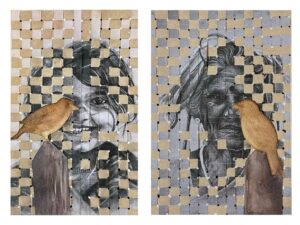
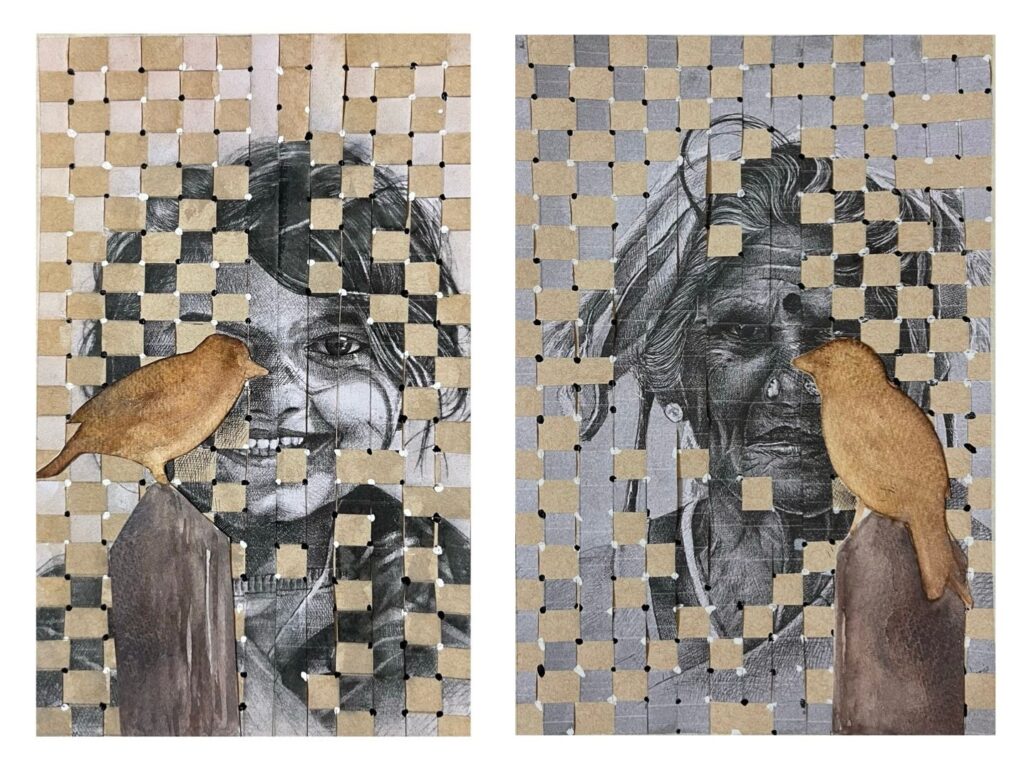
A child and an elder, woven into the same paper
Brown paper over grey ink, under and over, like a mat on a floor.
A girl laughs through the squares. Her eye is whole.
Across the gap an old face waits in silver light. Lines run down her cheek like rain on a wall.
Two small birds stand on worn posts and look in.
Between the panels there is only white.
Each face is half kept, half lost, held by the weave.
Janani grew up in the Nilgiris and studied painting at Karnataka Chitrakala Parishath in Bengaluru. The present in past is two panels. On the left a young girl smiles. On the right an older woman looks out. Strips of brown paper are woven through both portraits, so each face appears in small squares. Two cut-out birds sit on posts and turn towards each other. Janani lets parts of the image break apart and join again. For her this is how memory works. It changes each time we remember.
Ink drawing, digital print, acrylic and woven paper · 40.6 × 122 cm · 2026
Theme Memory and what remains
RC-8187
Janani
Feeding birds
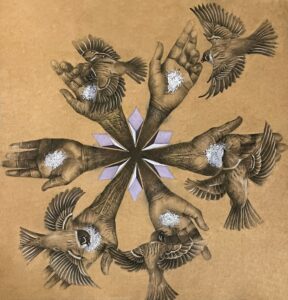
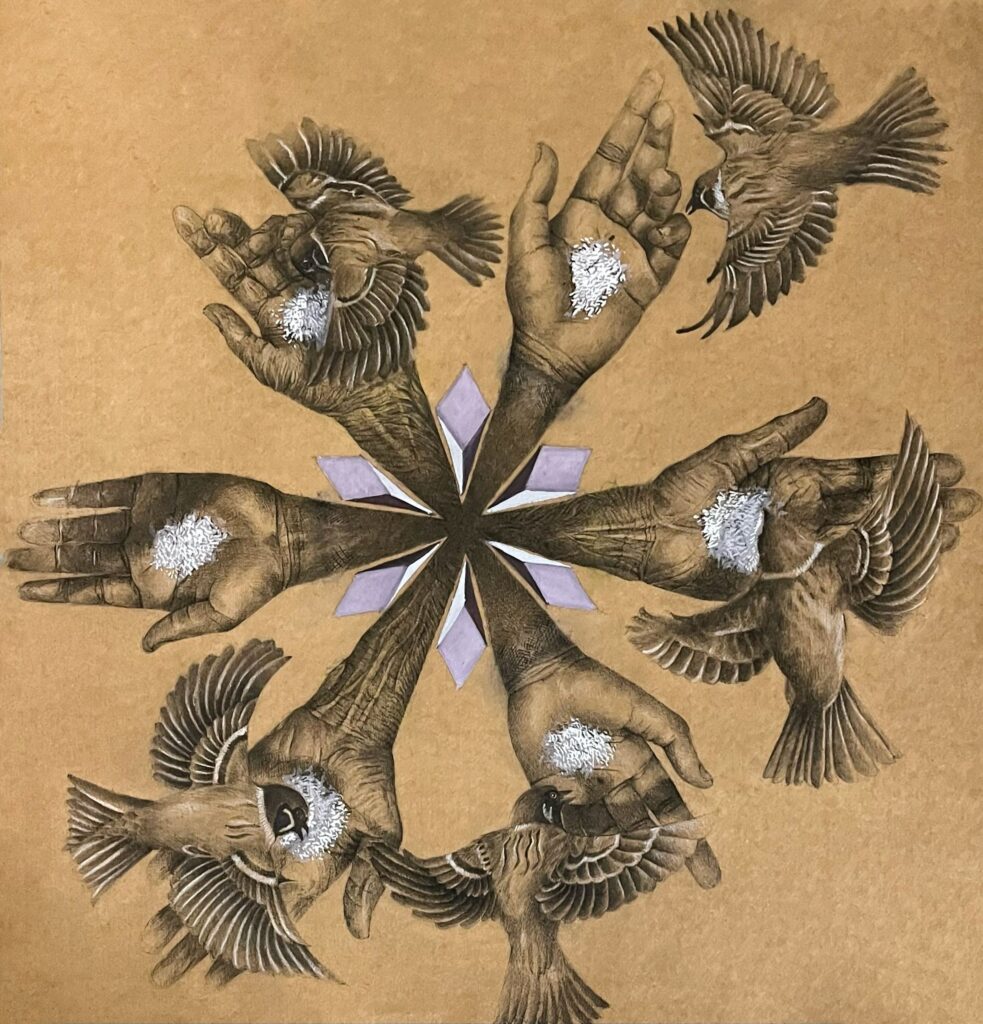
The sparrows trust the old hand. The new one must wait
Six palms open on paper the colour of a mud doorstep.
Each one keeps a small white hill of rice.
Wings cut through the circle, brown feathers drawn line by line.
At the centre, lilac points turn like a star of folded paper.
One bird eats. One bird waits.
The ink moves slowly, the way trust moves.
Feeding Birds begins with Janani's memory of kolams. These rice flour patterns at the door of a home are also food for birds and insects. Here hands open in a ring like a kolam. Each palm holds a small heap of rice. The sparrows know the elder's hand. They are not yet sure of the younger one. It is reaching out for the first time. Janani builds the image slowly in pen, line after line. For her, trust grows the same way, through repeated gestures of care.
Ink on paper · 55 × 57 cm · 2026
Theme Inherited care and trust
RC-8188
Janani
What holds us together
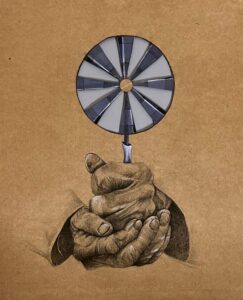
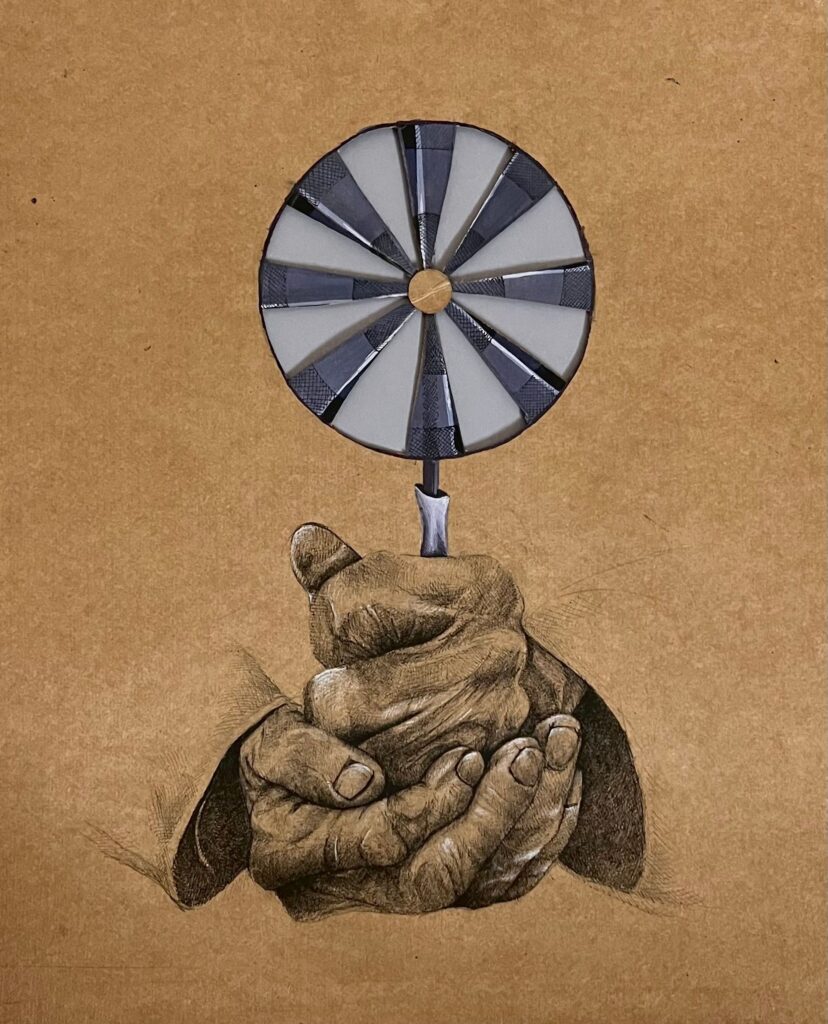
Old hands, a paper fan and a grip that never tightens
Brown paper, the colour of a parcel tied with string.
Two hands fold over each other, every crease drawn in black ink.
White catches the knuckles like late light on a window ledge.
Above them a small wheel of grey and silver waits for wind.
The grip is close but the fan is free to turn.
What it holds is lighter than the hands.
Janani grew up in the Nilgiris and studied painting at Karnataka Chitrakala Parishath in Bengaluru. She draws almost always in pen. In this work two old hands close around the stick of a paper fan. For her the fan stands for a child's innocence. The hands hold it but do not control it. The drawing is the first moment in a bond she returns to across her works: childhood as a place of safety. She builds every fold of skin with repeated lines slowly.
Ink on paper · 35.5 × 31.8 cm · 2025
Theme Childhood and care
RC-8189
Janani
What holds within us (II)
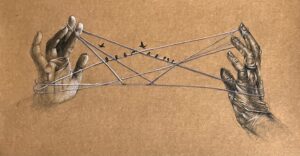
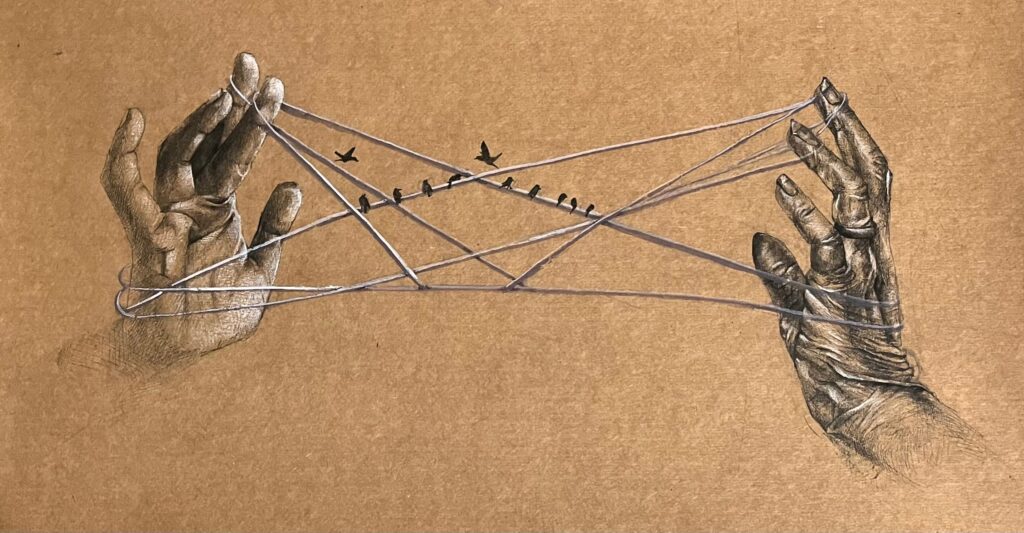
The elder's hand still holds the string the birds rest on
Brown paper, the colour of a parcel kept too long.
White thread runs from a smooth palm to a creased one.
A ring sits on a thin finger below the knuckle.
Small birds wait on the line as if it were a wire outside a window.
Two lift off.
Pull too hard and the shape falls apart.
Hold it still and it stays.
Two hands play a string game. One hand is young and smooth. The other is old and lined. This is the second moment in a bond that Janani draws across her works. The elder is no longer there. The younger one carries the care forward. Small birds rest on the string. Hidden in the drawing is a shape like a home with birds flying around it. Janani builds each image slowly in pen, line by line. She is a 2025 graduate of Karnataka Chitrakala Parishath.
Ink drawing on paper · 35.6 × 54.6 cm · 2025
Theme Care carried forward
RC-8190
Featured in Issue 3
Tanmay Santra
The Long View. Watercolours, small terracottas and pen drawings that combine looking with listening.

Tanmay Santra
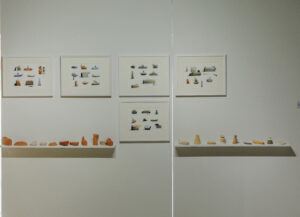
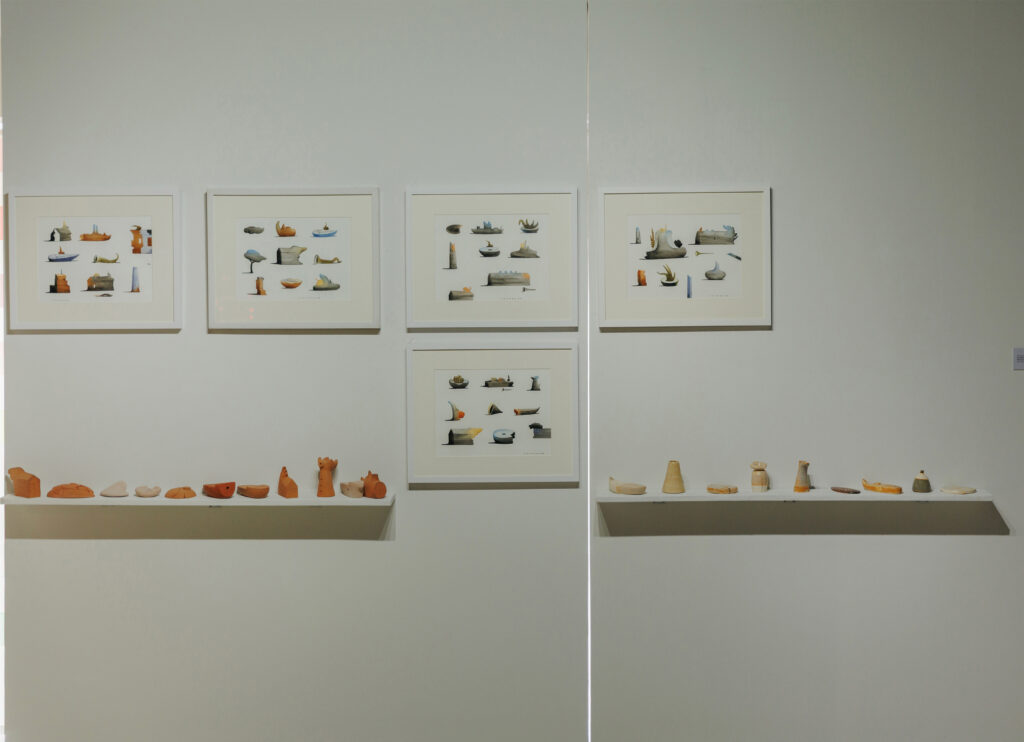
Display view (Nothing Arrives Unchanged)
Small clay notes sit under a line of painted objects
Orange clay sits low on a white shelf.
Above, painted boat shapes and towers float on paper with no ground.
A grey stone wears a small yellow crown.
On the right shelf the colours fade to cream and bone.
Each frame is a quiet room of things.
The white wall keeps the space between them.
This view shows Tanmay Santra's work in Nothing Arrives Unchanged at Kalakriti Art Gallery, Hyderabad. Satyajit Dave curates the show. Five watercolours hang on the wall. Below them, small terracottas and ceramics sit on two white shelves, like notes under a line of music. Santra works in series and returns to an idea again and again. The objects come from the way he talks with the places around him. Here looking and listening meet.
Watercolour on paper, terracotta and ceramics · variable · 2024 - 202
Theme Looking with listening
RC-7364
Tanmay Santra
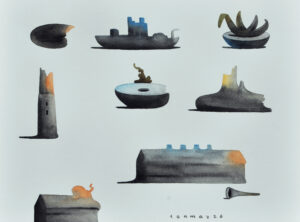
Soundscape-VII
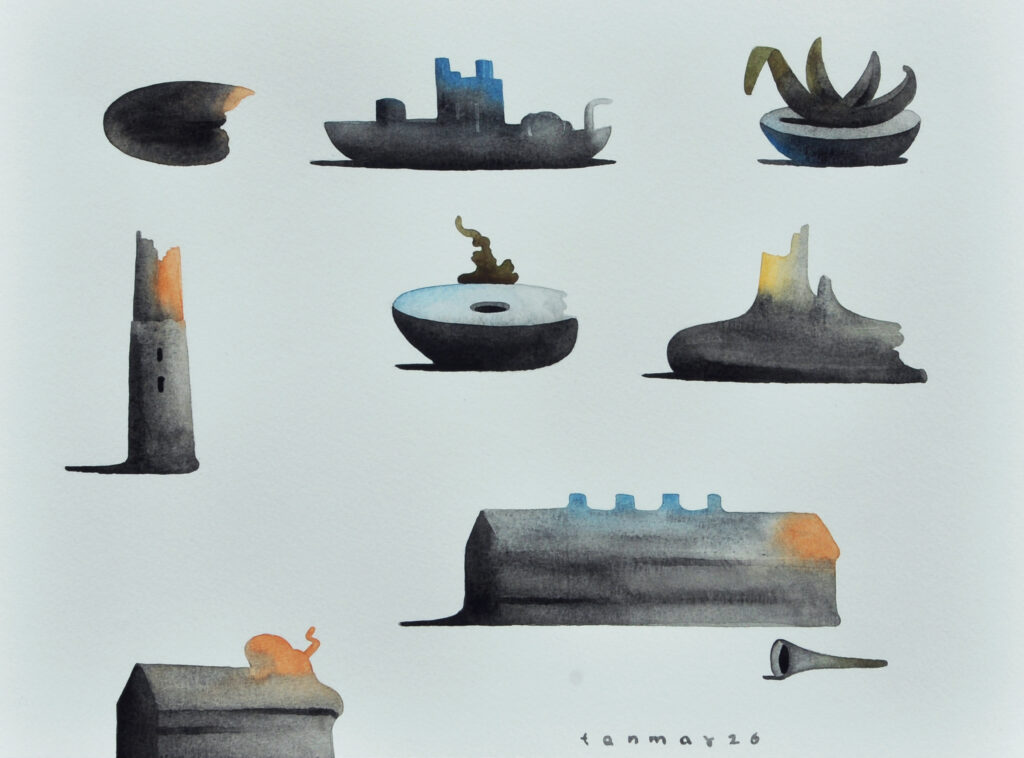
Nine quiet objects, each one resting on its own small shadow
A grey boat waits with a blue room on its deck.
A tower is broken at the top and the break glows orange, like a coal still warm.
A bowl holds dark leaves that curl toward nothing.
Brown smoke rises from a round dish with a hole in it.
Every shape stands on a thin line of shadow.
The paper between them is quiet, the colour of rain before it falls.
You wait for a sound to come.
In Soundscape-VII Tanmay Santra paints nine small objects on pale grey paper. A boat, a broken tower, a long shed with four chimneys and a little horn all sit apart, each with its own short shadow. Santra says his work combines looking with listening. The objects come from the way he talks with the places around him. The number in the title shows that he works in series. He comes back to the same idea again and again. The work is watercolour on paper, 27 × 37 cm.
Watercolour on paper · 10.5 X 14.5 inches · 2026
Theme Listening to places
RC-7365
Tanmay Santra
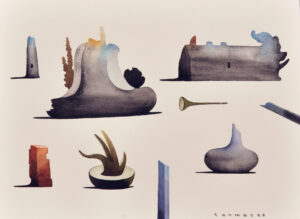
Soundscape-IX
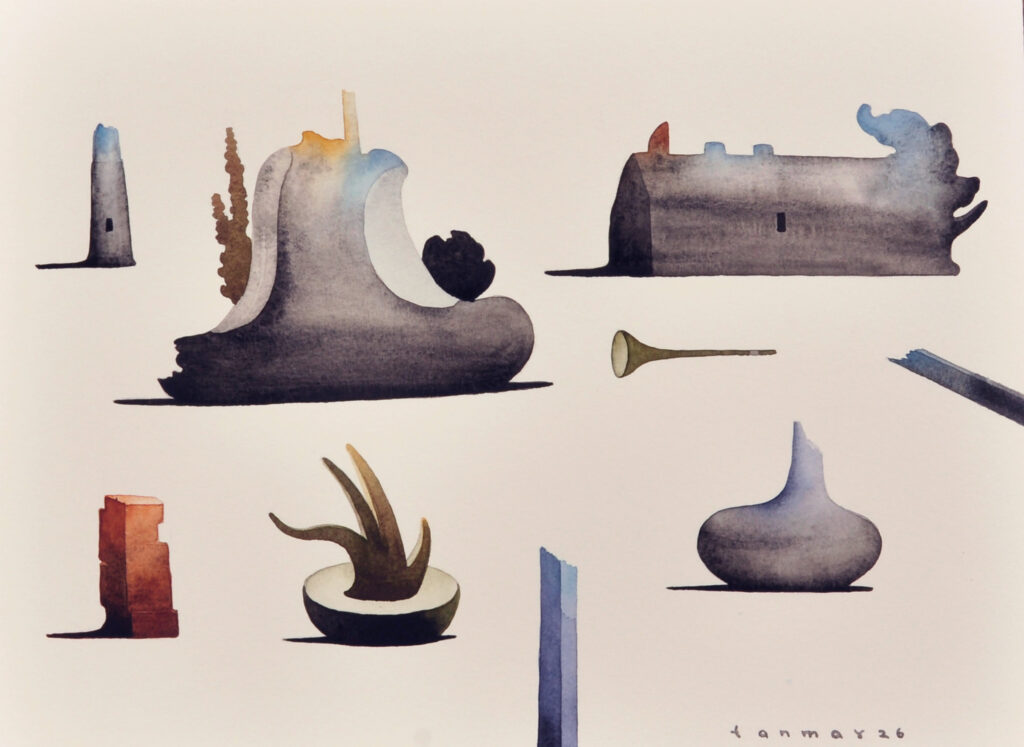
A horn, a brick, a tower: each waiting to be heard
A grey tower lifts a cap of blue sky.
A brick stands alone, rust red, its edges chipped.
A horn lies on its side and waits for a breath.
Shoots curl up from a bowl like fingers after rain.
Each thing keeps its own small shadow.
Between them the cream paper holds its quiet,
the way a room holds the last note.
Soundscape-IX is one of a series of watercolours that Tanmay Santra makes about looking and listening. Santra talks to the places around him and the work is what they say back. Here small objects float on pale paper: a tower, a red brick, a horn, a bowl of shoots, a round pot. Each one rests on its own thin shadow. The number in the title shows that he returns to the idea again and again. The painting measures 27 × 37 cm.
Watercolour on paper · 10.5 X 14.5 inches · 2026
Theme Listening to places
RC-7366
Tanmay Santra
Floating Melody-4
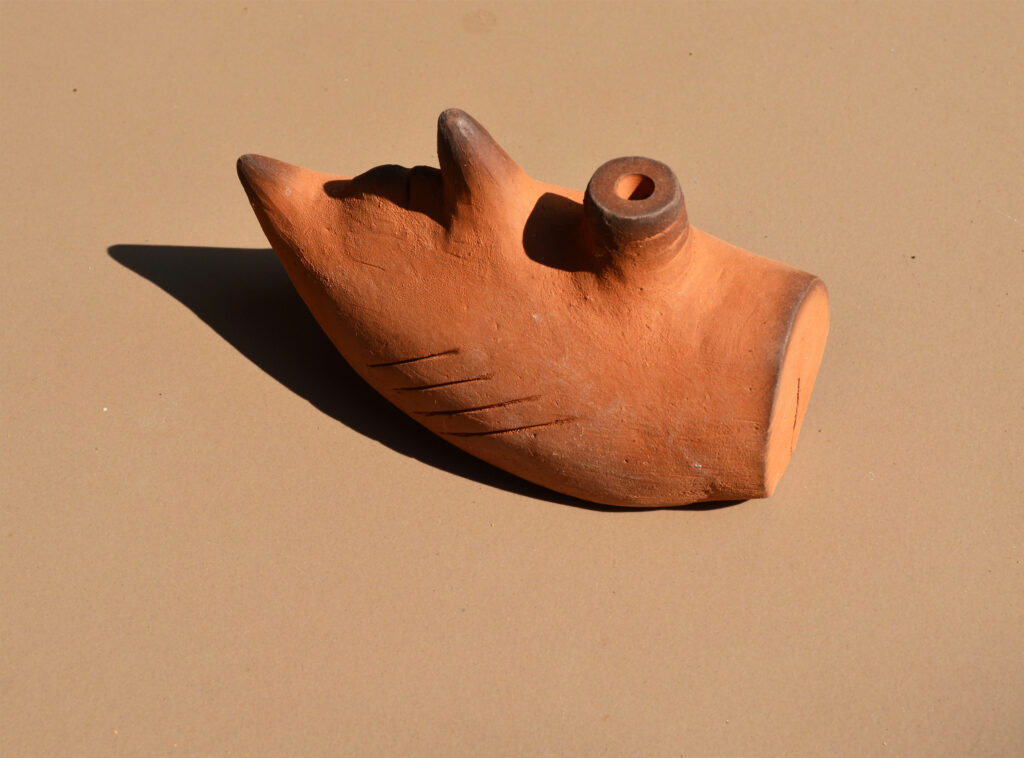
A small clay shape that seems to be listening
Orange clay rests on its side in hard sun.
Two points lift from its back like fins above still water.
A small round mouth waits for a breath or a note.
Four thin cuts run along its belly.
The tips and the rim turn dark, as if burnt.
Its long shadow swims across the sand-coloured ground.
Floating Melody-4 is a small terracotta from 2024. It measures 9 × 14 × 6 cm. The fired clay is a warm orange and it lies on its side. Two points rise from its back. A round opening with a dark rim sits near the flat end. Four thin lines are cut into its side. Tanmay Santra works in series. The number in the title shows that he returns to this idea again and again. He says his work combines looking with listening.
Terracotta · 2024
Theme Looking and listening
RC-7367
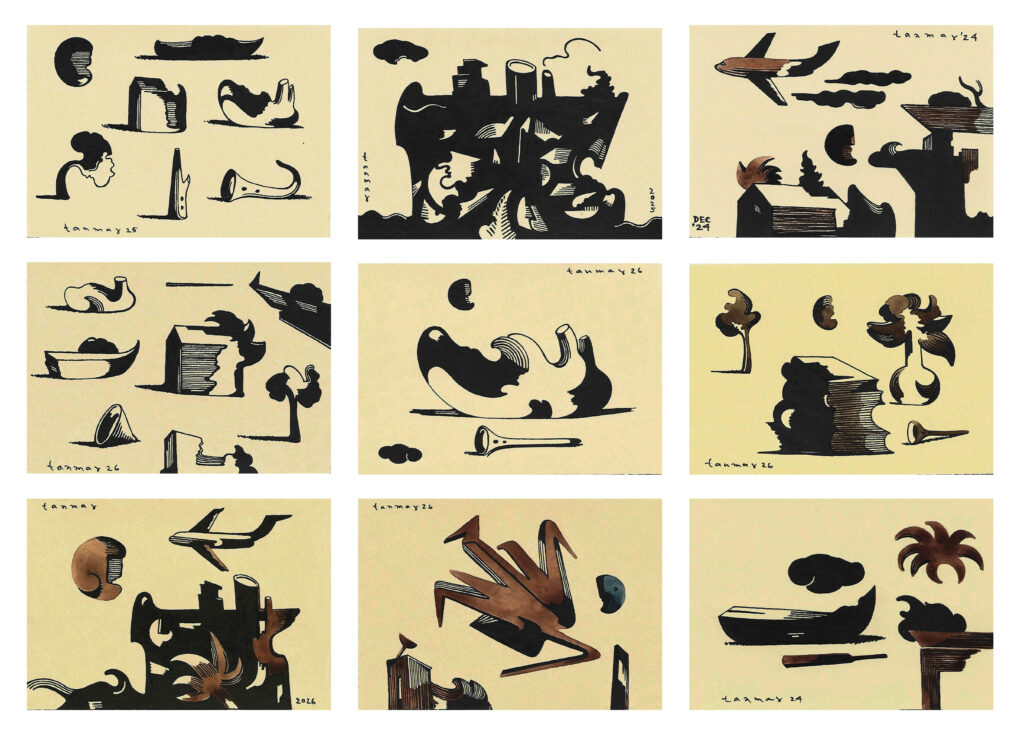
Tanmay Santra
Pen drawings on postcards
A boat, a horn, a cloud: small things that keep coming back
Black ink sits on cream card like a shadow at noon.
A boat carries one dark cloud. A horn lies on its side and waits for breath.
Houses lean, their walls combed into fine lines.
Brown wash seeps into a moon, a tree, a wing.
One small blue stone hangs above a broken bird.
Nine cards hold the same few things, moved a little each time.
Tanmay Santra makes these nine drawings at his table. They date from 2024 to 2026. Each postcard is about 10 × 15 cm. He draws first on the folding pages of a new book, then on the cards. "An accordion book is in progress," he says. Black ink gives boats, clouds, houses and horns. Thin brown watercolour warms a few of them. Santra works in series. The same shapes return from card to card.
Watercolour and pen drawing on postcard · 4 X 6 inches (approx)
Theme Everyday objects as dream
RC-7368
Featured in Issue 3
Uttam Prajapat
The Studio · Printmaking. He prints pictures of his village in the Aravalli hills on fired clay and lets the cracks stay.

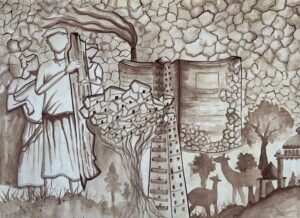
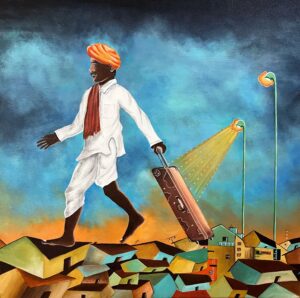

Uttam Prajapat
बिलखती काय (Bhilakti Kaya)
Children printed in black on fired clay, fading at the edges
A boy half hidden behind a tree trunk.
A small child held close against an older chest.
Black ink sits on red clay like soot after a fire.
The ground around them breaks into dark patches.
One child walks away across the open earth.
The clay edges curl, soft as torn bread.
Uttam Prajapat's work begins in Vatera village in the Sirohi district of Rajasthan. Mining in the Aravalli hills is changing the land there and pushing people to leave. Prajapat works with soil from these hills and with fired surfaces. Here he screen prints photographs in black onto four flat pieces of terracotta. Each piece has soft, uneven edges. The images show children on open, rocky ground. Some prints are clear. Others break into patches like the land itself.
Serigraphy on terracotta · 20 × 20 × 0.5 cm · 2026
Theme Land, mining and displacement
RC-500
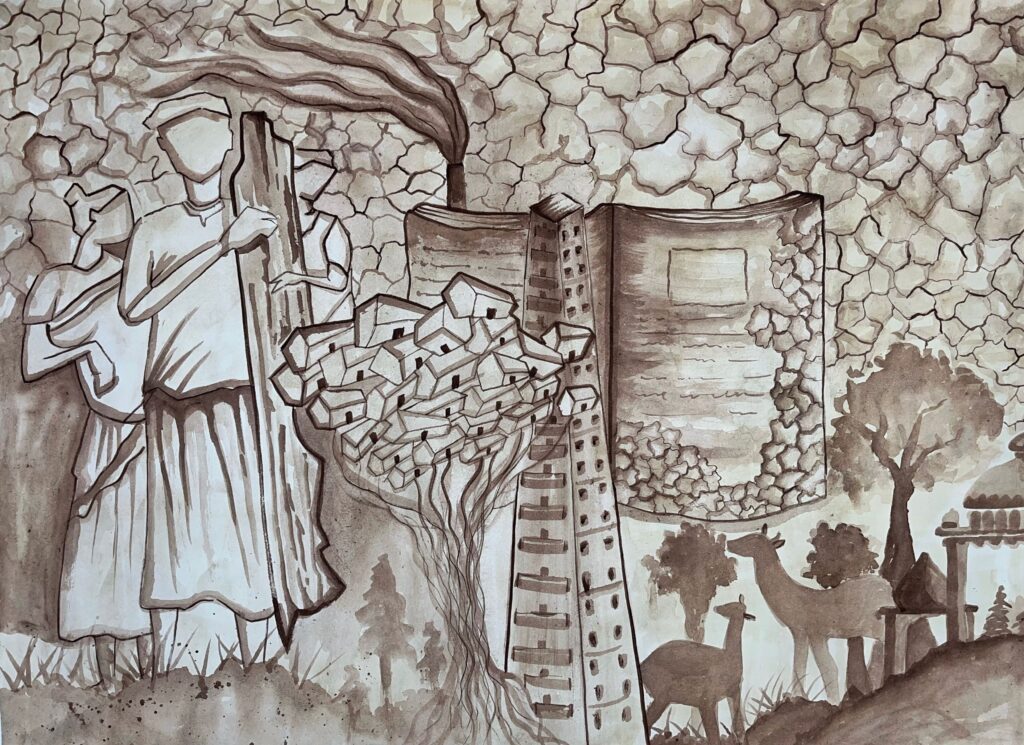
Uttam Prajapat
Arid Landscape
When the ground cracks, even the sky turns to dry earth
The whole page is the brown of mud after the water has gone.
The sky has split into plates, like a field with no rain.
A woman holds a post of wood and does not look at the smoke.
Houses pile on a tree whose roots hang loose in the air.
Two deer stand at the edge, small, near a little shrine.
The book is open. Its last page is turning into ground.
Uttam Prajapat's work comes from his ties to Vatera village in the Sirohi district of Rajasthan. Mining in the Aravalli region is changing the land and the lives there. Prajapat does not draw the mines. He uses signs instead. Cracked ground fills the sky and a chimney sends up smoke. Houses crowd on a tree with bare roots. A tall block rises like a ladder. A book lies open as the cracks eat its page. Prajapat's college is Sir JJ School of Art, Architecture and Design in Mumbai.
Mixed media · 23.4 × 33.1 cm · 2025
Theme Mining and lost land
RC-501

Uttam Prajapat
Urban Lader
A barefoot man crosses the rooftops with one suitcase
Orange turban, red scarf, white cloth against a sky of storm blue.
Bare feet step on the tops of houses, green and ochre and rust.
The suitcase leans back, heavy with somewhere else.
A street lamp bends to look at it and pours down yellow light.
Below him, small dark windows keep their quiet.
He does not look down.
Uttam Prajapat paints a man in an orange turban and white clothes. He walks barefoot across the roofs of small coloured houses. He pulls a suitcase behind him. A street lamp bends down and lights it. The work grows from Vatera village in the Sirohi district of Rajasthan. There, mining in the Aravalli hills pushes people from their land. In this acrylic painting from 2024 Prajapat shows migration as a forced move. His college is Sir JJ School of Art, Architecture and Design in Mumbai.
Acrylic · 24 × 24 cm · 2024
Theme Forced migration from land
RC-502
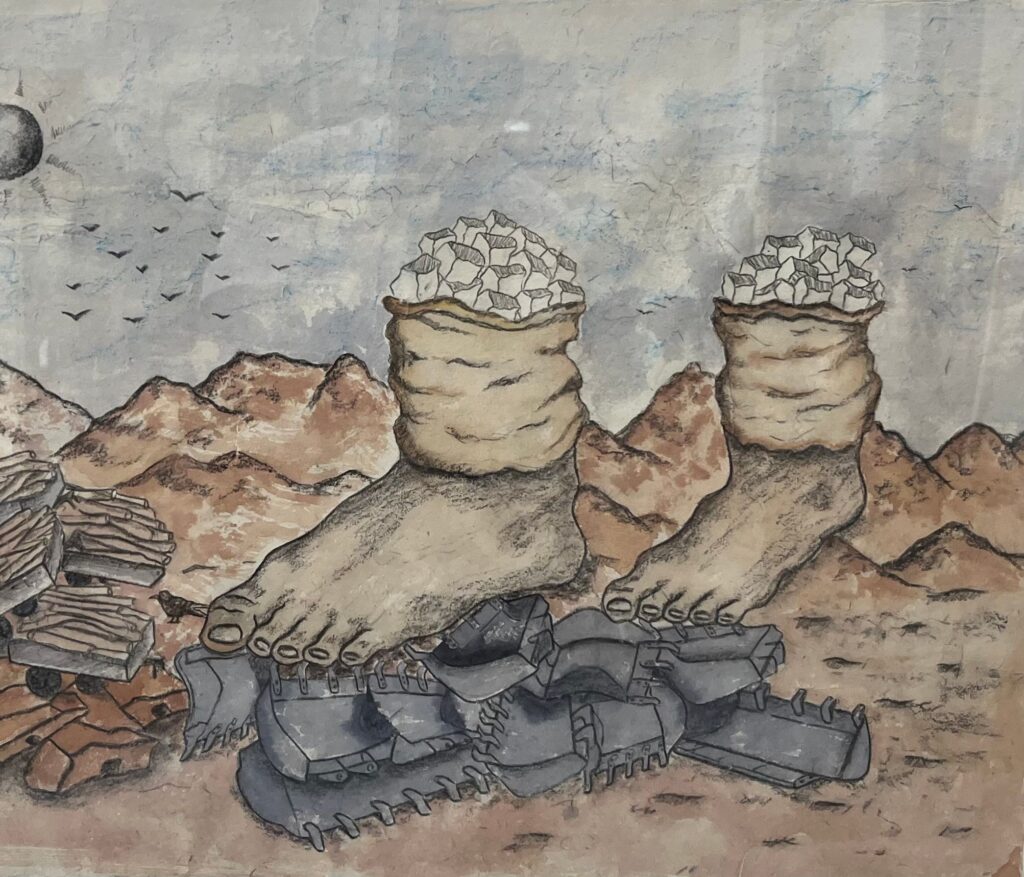
Uttam Prajapat
Scars of Extraction
Where the legs should be, there are only sacks of stone
Two bare feet, cracked and grey with dust, press down on iron teeth.
Where the legs should be, cloth sacks hold white stone.
The hills behind are the colour of old brick.
A dark sun hangs low. Birds leave in a thin line.
Near one toe a small bird waits, unsure where to stand.
At the edge, cut slabs ride away on wheels.
Uttam Prajapat's practice comes from his lived connection to Vatera village in the Sirohi district of Rajasthan. Mining in the Aravalli hills is changing the land and the lives of the people there. In this mixed media work two giant bare feet stand on a heap of digger buckets. Sacks of white stone sit where the legs should be. Prajapat does not show mining as it looks. He uses symbols instead. He studies at Sir JJ School of Art, Architecture and Design in Mumbai.
Mixed media · 22.28 × 31.2 cm · 2026
Theme Mining and lost land
RC-503

Uttam Prajapat
बिलखती काय, Series 2 (The Broken)
Children under branches, printed on clay that is already cracking
Rust-orange clay, the colour of a hillside after rain.
Children look out from under a roof of thin branches.
A crack runs through a small shoulder and keeps going.
On the smaller piece a sheet of cloth hangs from sticks.
The black ink sits in the clay like smoke.
Everything here was fired to last. Everything here is splitting.
Uttam Prajapat comes from Vatera village in the Sirohi district of Rajasthan. Mining in the Aravalli hills is changing the land and the lives of people there. In this work Prajapat prints images onto fired terracotta using serigraphy. One piece shows children sitting under a roof of branches. The other shows a shelter of sticks and cloth. Cracks run across both surfaces. He often works with soil from the Aravalli hills. He does not show the mines. He shows what is breaking.
Serigraphy on terracotta · 15 × 20 × 0.5 cm · 2026
Theme Land, mining and displacement
RC-499
Featured in Issue 3
Purabi Roy
The Studio · Printmaking. She carves the middle class into wood: the hawker, the commuter, the small shopkeeper. And she watches them smile.



Purabi Roy
By the Food, Of the Food, For the Food
Three bodies bend under the weight of what feeds them
Turquoise spills down from the top of the paper.
An old face opens its mouth above a wide pot ringed with letters.
In the middle panel, red curls rise like flowers or like fire.
A bare foot presses into blue.
On the right, a body squats and grips a stick under a long green weight.
The ink sits deep in the grain of the wood, black and patient.
Purabi Roy sets three wood intaglio prints side by side. She comes from a family of weavers in West Bengal. Automatic machines took most of that work and her family turned to other jobs. Roy sees the same change in small grocery shops, pedal rickshaws and cloth stores. Her subject is the middle class, who keep living and keep celebrating. In these prints, figures crouch and strain under heavy shapes of red and turquoise. The title echoes a famous line about democracy.
Wood intaglio on paper · 30 × 40 cm · 2026
Theme Work, food and survival
RC-504
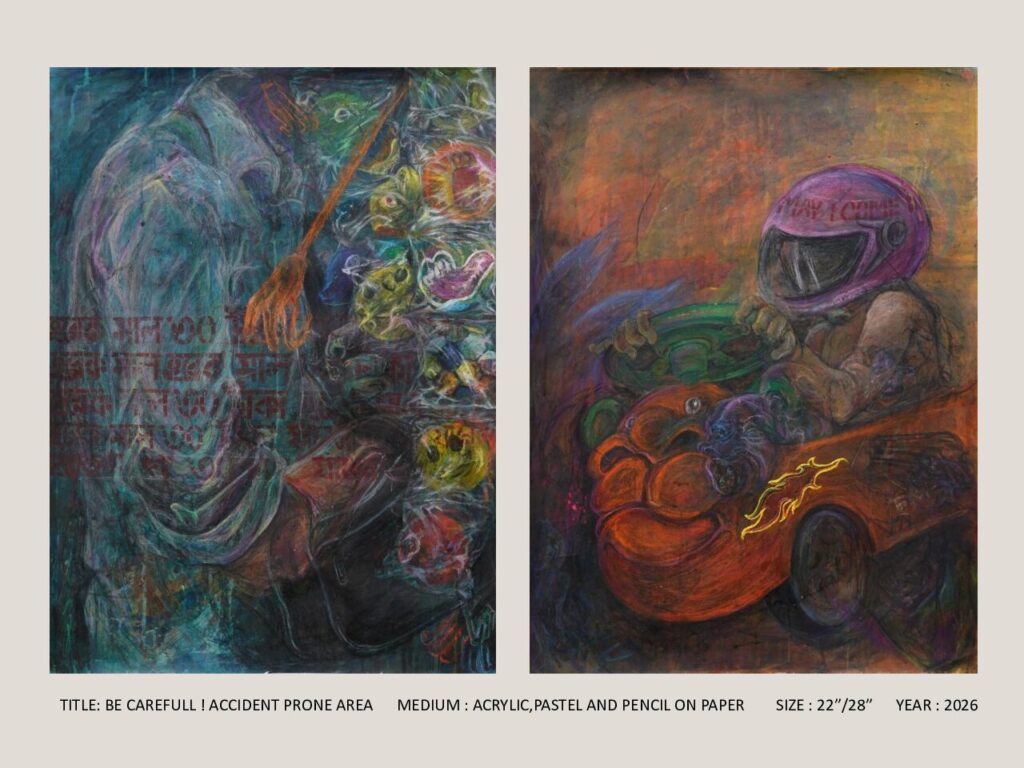
Purabi Roy
Be Careful! Accident Prone Area
A pink helmet, a toy car and nowhere safe to drive
Teal water or night holds a pale figure that will not settle.
An orange hand reaches down through a crowd of grinning moons.
Red letters sink into the blue like old shop signs after rain.
Next door the air turns to rust.
Someone in a pink helmet grips a green wheel and leans in.
The little car wears a yellow flame it has not earned yet.
Purabi Roy's family were weavers in West Bengal until computerised machines took the work. Roy completed her BFA at Rabindra Bharati University in 2024. In one panel a figure in a pink helmet steers an orange car. In the other, grinning faces and red lettering crowd a teal ground. She works in pastel and pencil over acrylic. Her subject is a middle class whose small traders 'don’t even have the voice to talk about their problems.'
Mixed media on paper · 71 × 55 cm · 2026
Theme Small lives, fast change
RC-505
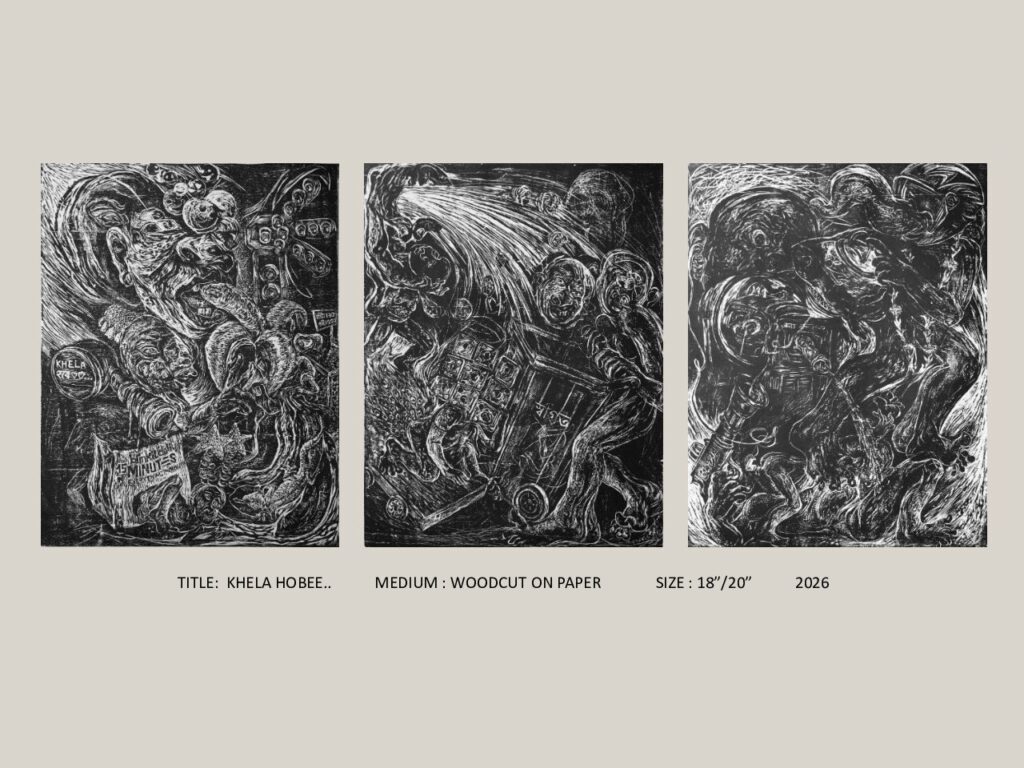
Purabi Roy
Khela Hobee
15 minutes to your door, cut into wood by hand
Black ground, white cuts, like scratches on a shop shutter at night.
Faces press together until there is no room left to stand.
A cart tips forward on small wheels and someone keeps pushing.
A sign promises fifteen minutes.
Light falls in a hard white rush from one corner.
Every line is a gouge in wood that cannot be taken back.
Purabi Roy comes from a weaving family in West Bengal. Automatic machines took over the looms and her family had to find other work. This woodcut in three panels looks at that kind of change. Faces crowd every print. A sign in the first panel reads "15 MINUTES". In the middle panel a figure pushes a heavy cart. Roy usually works in pencil pastels and charcoal. Here she cuts each white line into wood and prints it in black ink on paper.
Woodcut on paper · 50 × 45 cm · 2026
Theme Work lost to machines
RC-506
Featured in Issue 2
Sourav Mohanty
The Studio · Sculpture. He bends the boats and temples of Odisha into copper and aluminium wire.


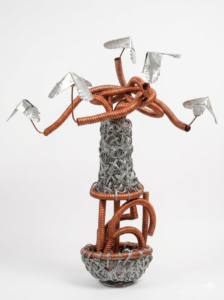

Sourav Mohanty
Odra 3
A festival boat, folded in copper, carrying a heart of wire
A grey hull, coiled like rope pulled tight.
One round stone of wire rests in its curve.
Copper wraps the rim, stitched along its seam, warm as a lamp in the morning.
At each end the metal folds into a point and leans towards the water.
No sail. No oar.
Only the weight of something kept, riding a small festival tide.
Odra is an old name for Odisha. It is also the name of Sourav Mohanty's sculpture series. Odra III is a boat inspired by Boita Bandana. On Kartik Purnima families in Odisha float small boats to remember the sailors who once crossed the sea to Bali, Java and Sumatra. Here the hull is copper sheet, folded to a sharp point at each end. Inside sits a round core of woven aluminium wire. For Mohanty the wire holds strength and memory. The copper gives structure and warmth.
Copper plate and aluminium wire · 90 × 60 cm · 2026
Theme Festival boats of Odisha
RC-8180
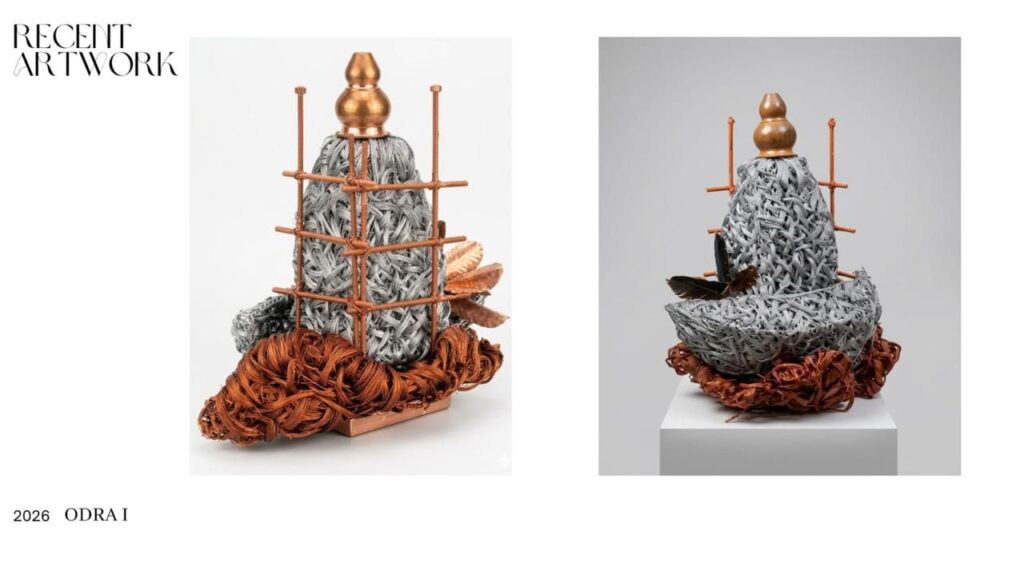
Sourav Mohanty
Odra 1
A temple of woven wire sets out to sea
Grey wire crosses over and under itself until it becomes a wall.
Copper rods hold it the way scaffolding holds a temple still being built.
At the top a copper gourd catches the studio light.
Below, the copper coils loosen like a tide pulling at the shore.
Two thin leaves lean out as if testing the wind.
The whole small shrine waits to be set afloat.
Odra I is the first work in Sourav Mohanty's series Odra. Odra is an old name for Odisha. Here a small copper boat carries the Konark Sun Temple out to sea. The temple is woven from aluminium wire and held in a frame of copper rods. Below it lies a sea of coiled copper wire. Copper leaves rise at its side. Mohanty is in the first year of an MFA in sculpture at Jamia Millia Islamia, New Delhi. He says this sculpture tells the story of Odisha.
Copper and aluminium wire · 46 × 30 cm · 2026
Theme Odisha's temples and sea
RC-8178
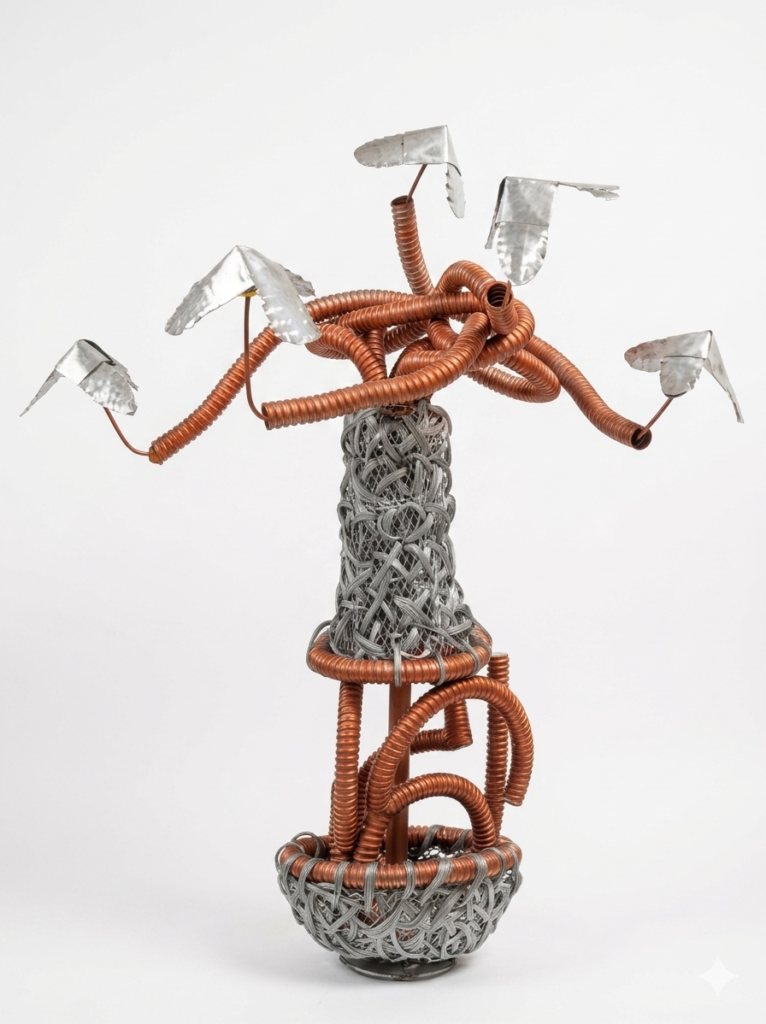
Sourav Mohanty
Odra 2
A copper palm tree waits for the wind to move it
Copper coils like a hose that learned to grow.
A grey trunk woven tight as a fishing basket.
At the top the tubes knot and then reach out.
Five silver leaves fold at their tips, their edges bitten small.
They wait on thin stalks for the air to stir.
The whole tree stands in its own woven bowl.
Odra 2 is a tree that is two trees. Its woven aluminium trunk is a coconut palm. Its wide leaves belong to a banana plant and are cut from metal, with Odia letters cut into them. A breath of wind or a fan sets the leaves turning. Sourav Mohanty, a first-year MFA sculpture student at Jamia Millia Islamia in New Delhi, calls it a tribute to the rhythm of life in Odisha. The movement, he says, is the flow of time and tradition.
Copper and aluminium wire · 91 × 60 cm · 2026
Theme Odisha's rhythm of life
RC-8179
Featured in Issue 2
Pranjal Saini
The Long View. An animation film designer from Delhi and one of the four who chose Edition One. He draws the people around him, then makes them move.
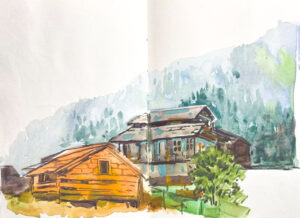

Pranjal Saini
Sketchbook 1
The mountain stops where the paint runs out
An orange hut holds the last of the afternoon.
The grey house behind it wears blue in its windows.
Pines come down the hill in wet drips of green.
The mist is only paper left alone.
A small tree leans towards the low fence.
Then the colour stops and the page breathes.
Pranjal Saini keeps two sketchbooks this year. One is full of strangers on the Delhi metro. This one holds his own days, painted in gouache. Across two pages, an orange wooden hut stands in front of a taller grey house. Behind them, a slope of dark pines fades into mist. Much of the paper stays white. Saini designs animated films and teaches Applied Art at the College of Art in Delhi. He points out that Impressionist painters could leave the studio once paint came in tubes.
Gouache on paper
Theme His own days
RC-8176

Pranjal Saini
Sketchbook 2
One man on the floor of a carriage full of standing legs
Yellow straps hang in a row and only one is held.
Above him the crowd is a rust-red wall of shins and sandals.
Below, the floor is white as a sheet of paper.
He folds himself small, his grey skin streaked with rust and blue.
His fingers move through bright yellow pieces, one by one.
Nobody in the carriage looks down.
Pranjal Saini draws the people around him. This year he keeps two sketchbooks. One holds his own days. The other is full of strangers on the Delhi metro. Here a thin man sits on the white floor of a carriage with his legs folded. One hand holds a yellow strap above him. The other reaches for small yellow shapes scattered at his feet. Behind him stands a wall of legs and sandals. Saini's subjects are workers, crowds and the cost of a day's labour.
Acrylic on canvas
Theme Strangers on the metro
RC-8177
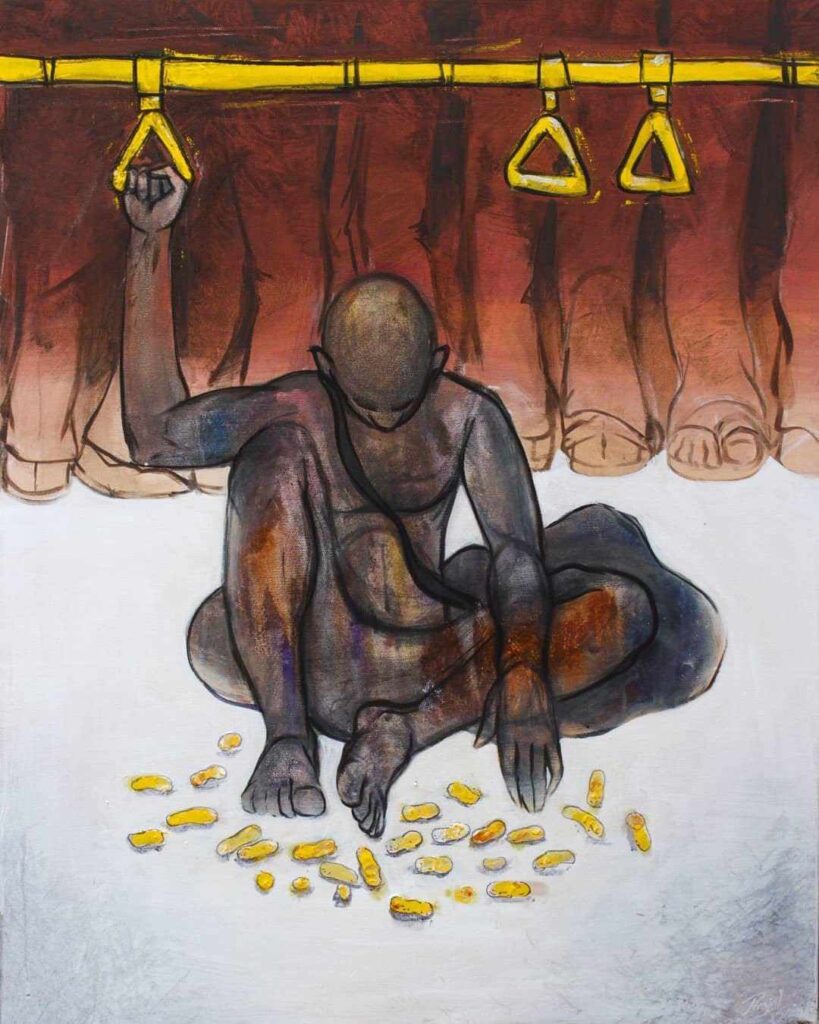
Pranjal Saini
A Daily Commute
One hand holds the rail. The other gathers what fell
Rust-red legs stand like a forest that never moves.
Above them, a yellow rail and three yellow loops.
One loop is taken by a grey fist.
The man below sits low on white, folded small.
His fingers spread over little yellow pieces, bright as the rail.
The same colour holds him up and lies at his feet.
Pranjal Saini is an animation film designer from Delhi. He draws the people around him. Then he makes them move. His subjects are workers, crowds and the cost of a day's labour. In A Daily Commute he paints in acrylic on canvas. A man sits on the floor of a crowded carriage. One hand grips a yellow strap. The other reaches for small yellow shapes on the floor. Behind him stands a wall of legs and feet. Saini teaches Applied Art at the College of Art in Delhi.
Acrylic on canvas · 61 × 76 cm · 2023
Theme Labour and daily crowds
RC-5653
Featured in Issue 2
Shakibul Islam
First Year Out · Painting. His painting fell and tore. His friends helped him mend it. He kept the scar.
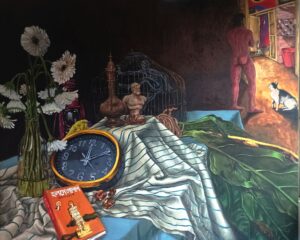
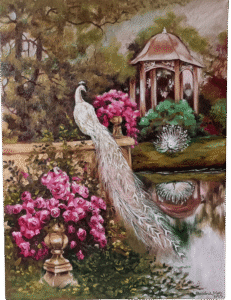
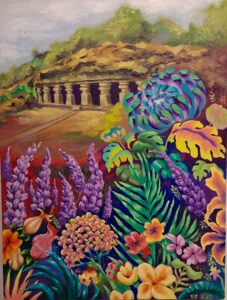
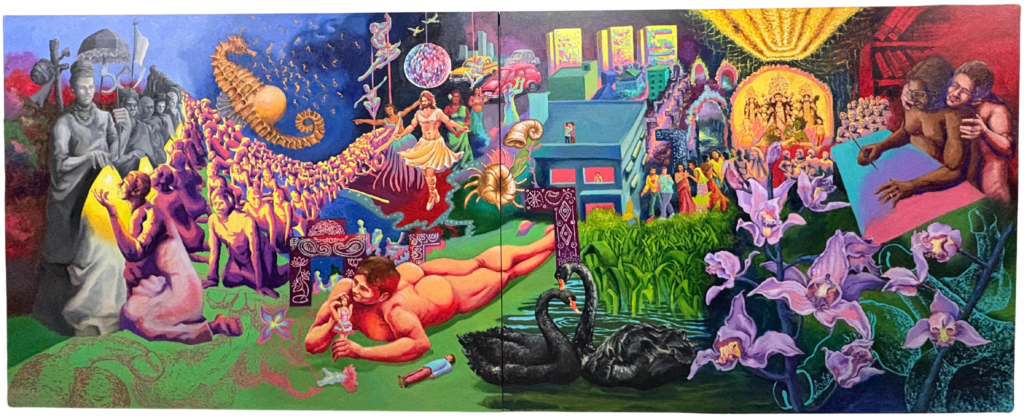
Shakibul Islam
Queer as folk
Black swans, seahorse fathers and a crowd with nothing to hide
Grey people stand at the left edge, still as old photographs.
Then the colour starts: a river of orange bodies, a disco ball, a dancer in a white skirt.
A man lies on the green grass with small dolls in his hands.
Two black swans bend their necks toward each other.
Purple orchids open wider than faces.
Gold light pours over a goddess and her crowd.
No one here is asking to be forgiven.
Shakibul Islam paints Queer as Folk in nine days. He works eighteen to twenty hours a day in a corridor of the architecture building at his college in Mumbai. The diptych is a celebration. Nobody hides here. People dance, bathe and embrace among black swans, seahorses and lilies. Black swans often pair with partners of the same sex. Seahorse fathers carry the young. Islam paints them as family, not as decoration. Like a temple mural, the canvas has no single centre.
Oil on canvas (diptych) · 213.36 × 487.68 cm · 2026
Theme Queer life and nature
RC-644
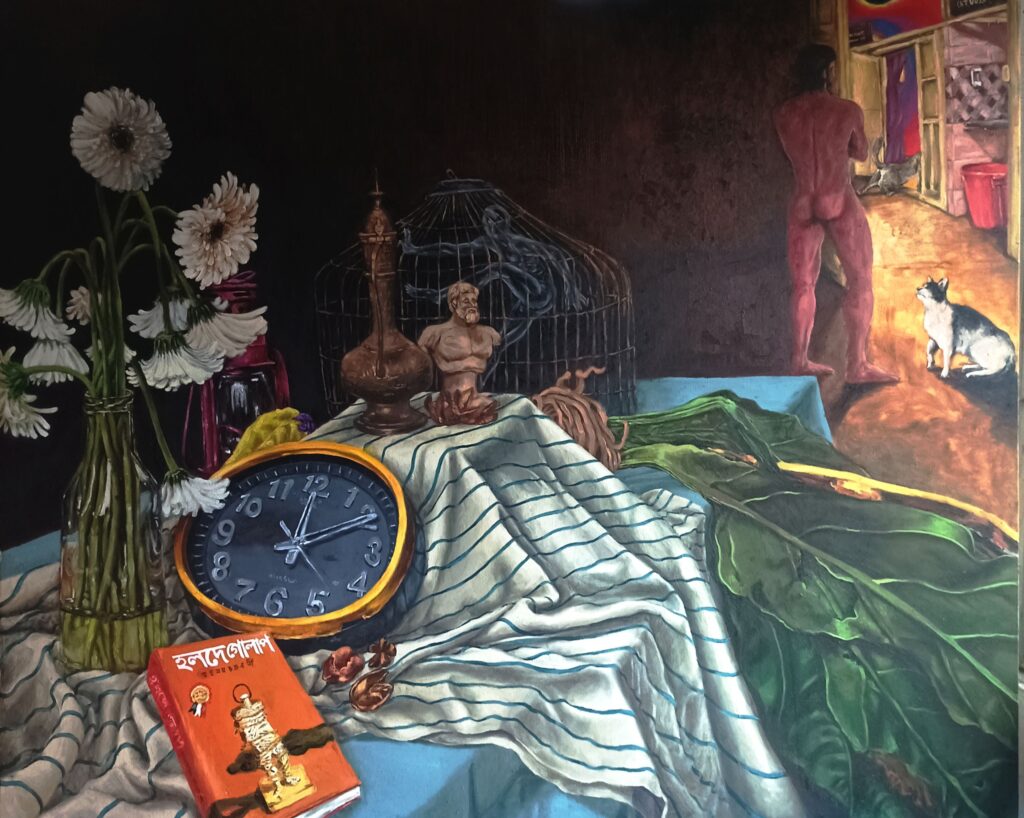
Shakibul Islam
Waiting
A clock on the table, a bare body at the door
White petals bend toward the cloth, tired of standing.
The gold clock leans on the stripes and counts the hours.
Smoke curls inside the cage where a bird should be.
Across the dark room a door spills orange light.
A bare back faces it. The cat looks up and waits too.
On the table a green leaf lies still, holding its breath.
Waiting is a large oil painting from 2023 by Shakibul Islam. A table holds white flowers, a gold clock, a birdcage and an orange book with a Bengali title. Behind it, in a warm doorway, a nude figure stands with its back to us. A cat looks up at the figure. Islam grew up in Kolkata. There he saw queer bodies celebrated in ritual and mocked in daily life. In his paintings the nude is not a spectacle. It shows the body as a place of desire and choice.
Oil on canvas · 121.92 × 152.4 cm · 2023
Theme Waiting to be seen
RC-652
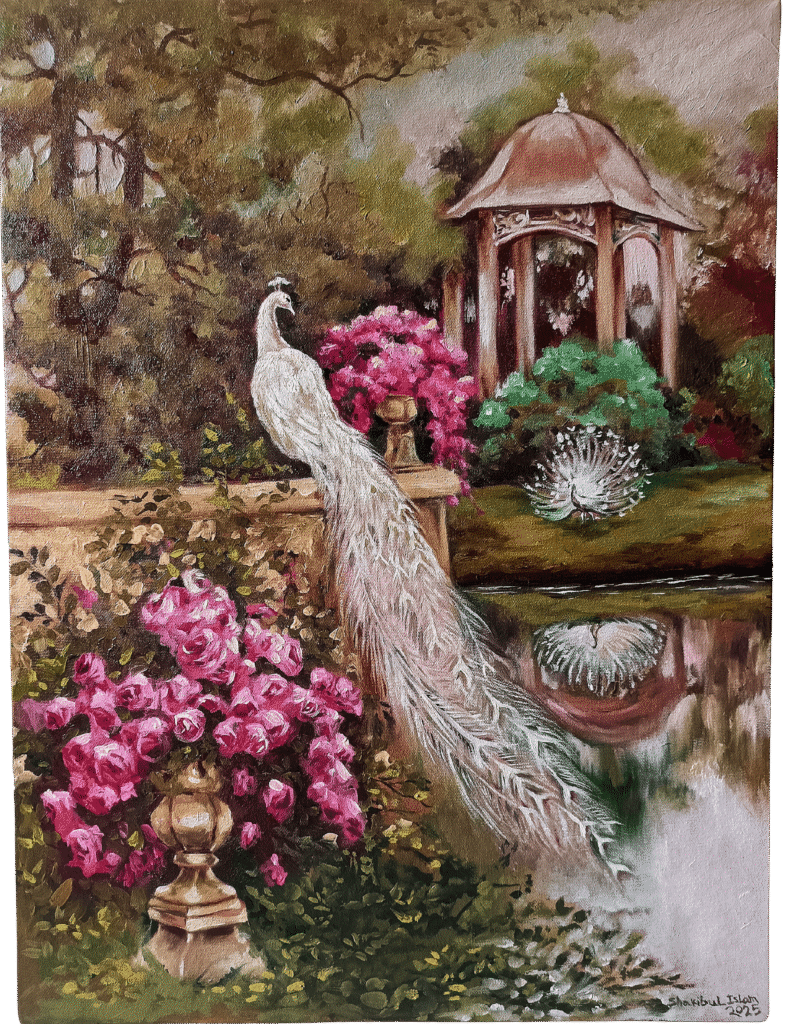
Shakibul Islam
Peacock in the garden
One white tail, falling like water toward its own pond
White feathers pour over warm stone like milk from a tipped jug.
Pink roses crowd the urns, heavy as wet cloth.
Across the lawn another bird opens a white fan.
The pond takes the fan and turns it upside down.
Under the trees the light is green and slow.
No one hurries in this garden. Even the tail takes its time.
Shakibul Islam paints Peacock in the garden in oil on canvas. A white peacock stands on a low stone wall. Its long tail falls in soft white strokes almost to the water. Behind it, a second white peacock opens its fan on the grass. The pond holds its reflection. Pink roses spill from stone urns. A pavilion with a rose-coloured dome stands among the trees. Islam is a painter from Kolkata. He works mostly in oil, acrylic and gouache. He trained at Sir J.J. School of Art in Mumbai.
Oil on canvas · 45.72 × 30.48 cm · 2025
Theme Stillness in a garden
RC-653
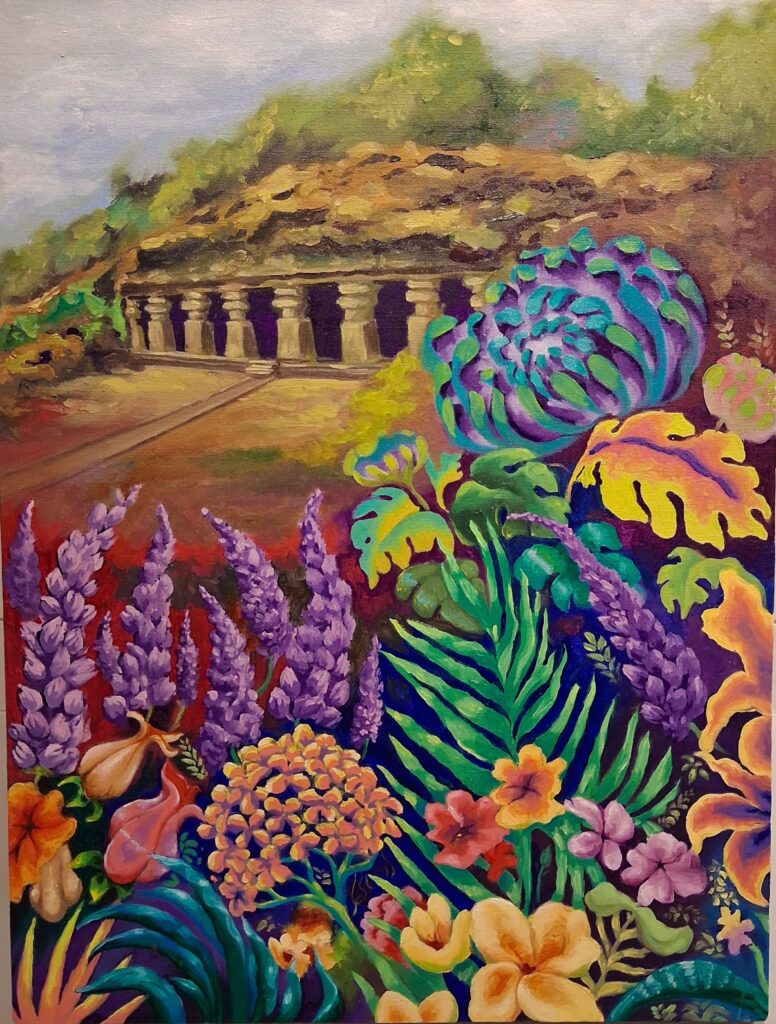
Shakibul Islam
Elephanta cave
Old stone pillars watch a garden that refuses to stay small
Cream pillars hold up a hill that is mostly moss.
The path to the dark doorways is dry and quiet.
Then the purple climbs, spike after spike, like bells stacked on a stick.
A flower the size of a cabbage turns teal at every petal tip.
Leaves split open like hands.
Under all of it, red, still warm from somewhere.
Elephanta cave is a small oil painting on canvas by Shakibul Islam, made in 2025. Islam works in Mumbai. The cave sits high on a green hill. Its pale pillars stand in a row over a dusty path. Below them the flowers take over. Purple spikes, wide leaves and cream blossoms fill more than half of the canvas. Patches of red glow between the stems. Islam uses the brightest colours he can, on purpose. He wants the eye to stay with them and find their beauty.
Oil on canvas · 45.72 × 30.42 cm · 2025
Theme Old stone, new bloom
RC-654
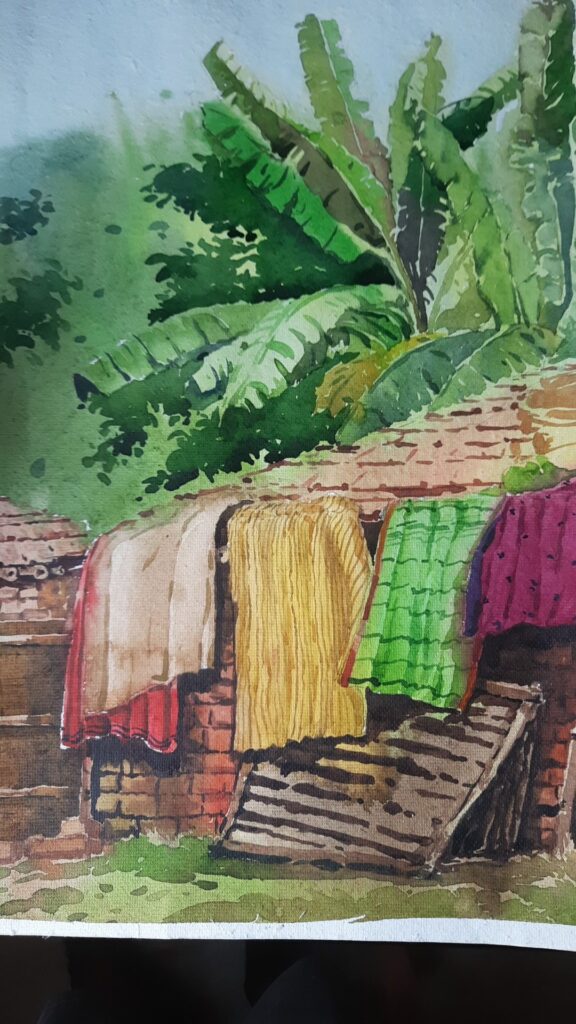
Shakibul Islam
Drying clothes
The day's washing, hung out under big banana leaves
Morning has already passed through these cloths.
Yellow hangs heavy like a field of straw, still holding water.
The green check catches the sun the banana leaves let through.
Red brick, warm as a stove, takes the weight without complaint.
A wooden plank leans at the door, striped with shadow.
Above, the leaves split and fan, wider than any roof.
By evening someone will fold all this and carry it in.
Drying clothes dates from 2021. Shakibul Islam paints it in watercolour on handmade paper, 38.1 × 27.94 cm. A low brick hut sits under a sloping tiled roof. Cloths hang over its edge to dry: cream with a red border, a yellow one, a green check and a deep pink with dark spots. Banana leaves and sky are soft and wet. The hut is drawn with firm dark lines. Today Islam works mostly in oil, acrylic and gouache. This small watercolour shows a quieter side of his hand.
Watercolour on handmade paper · 38.1 × 27.94 cm · 2021
Theme Everyday life at home
RC-655
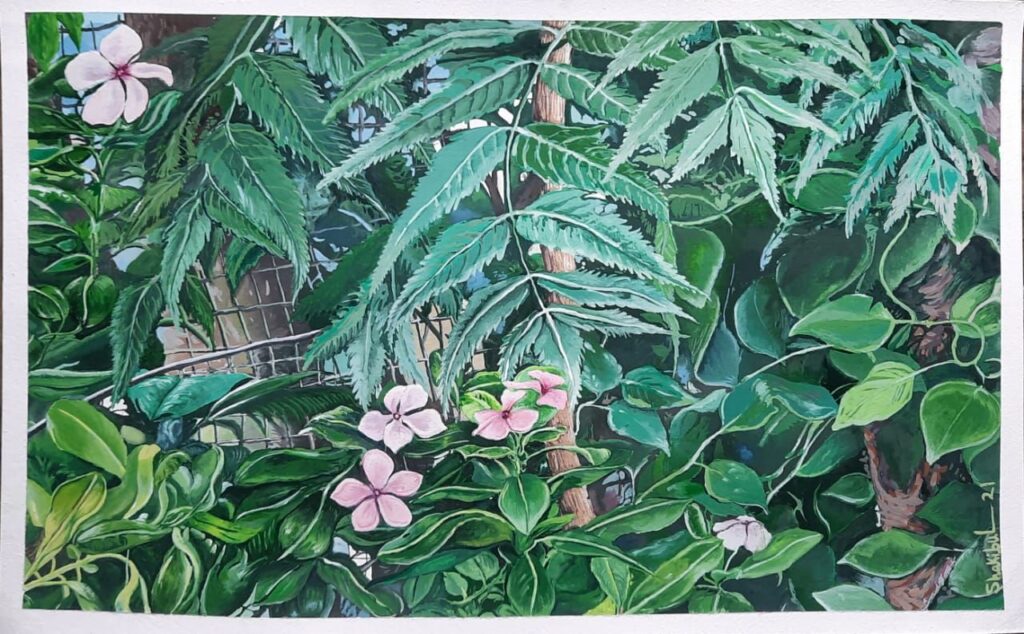
Shakibul Islam
Foliage
A wire fence, nearly swallowed by leaves that refuse to match
Green on green on green. Still no two leaves agree.
A fern opens its fingers over a wire fence.
Heart-shaped leaves climb the trunk without asking.
Pink flowers turn their faces up through the dark middle.
The sky comes in only in small pale pieces.
What was built to keep things out is slowly being held.
Shakibul Islam makes this watercolour in 2021. Fern fronds, climbing plants and pink five-petalled flowers fill the whole sheet. Behind them a wire fence and tree trunks show through. Small pieces of pale sky appear between the leaves. Islam gives each leaf its own edge, vein and shine. There is no single centre. His name and the year sit in the lower right corner. Today he works mostly in oil, acrylic and gouache. Nature stays close to his work. He says nature has never discriminated in what it creates.
Watercolour on paper · 27.94 × 38.1 cm · 2021
Theme Wild green growth
RC-656
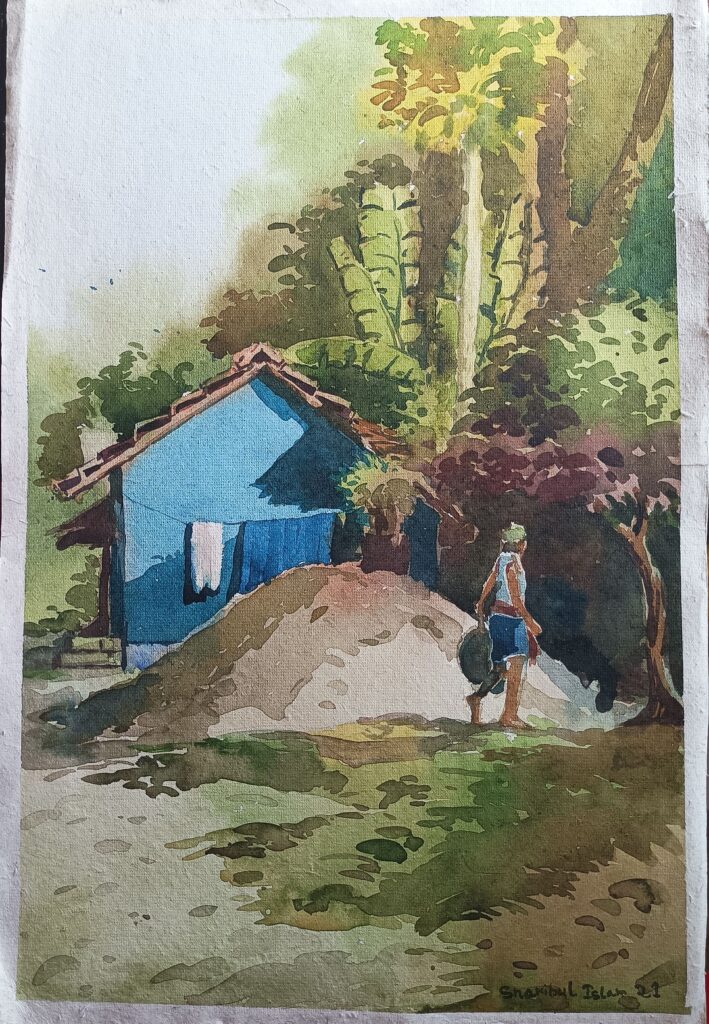
Shakibul Islam
Blue
A blue wall, a mound of earth, a man walking past
The wall is the blue of washing water left in a bucket.
A white cloth and a blue cloth hang still in the heat.
The earth is piled high, soft as flour.
Banana leaves open like hands above the roof.
A man walks barefoot through green shade with a dark vessel at his side.
The sky is only paper, left alone.
Blue is a watercolour on paper from 2021. It measures 38.1 × 27.94 cm. Shakibul Islam paints a small hut with a tiled roof under tall trees and banana leaves. Its wall is a cool, clear blue. Cloth hangs along the side to dry. A mound of earth rises in front. A barefoot man walks past it with a dark round vessel. The white paper is left open in the sky. Islam works mostly in oil, acrylic and gouache. Here his colour is soft and still.
Watercolour on paper · 38.1 × 27.94 cm · 2021
Theme A home among trees
RC-657
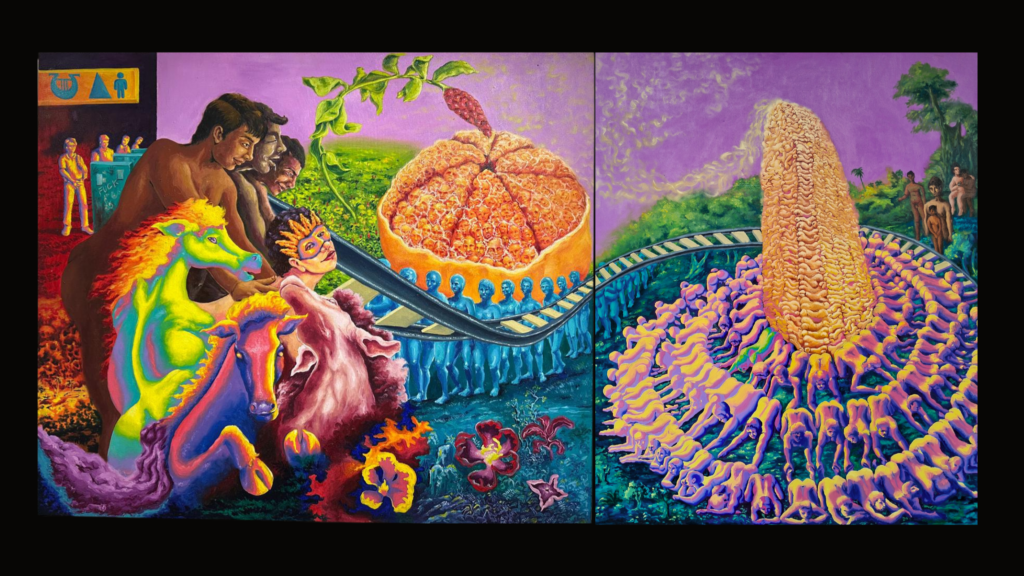
Shakibul Islam
Fishtingzone
The corn fell and tore. His friends mended it from behind
A violet sky. A railway bends through green grass.
Blue men stand in a line along the track, waiting.
A tangerine opens. Every segment holds small bodies.
A horse burns yellow. A bull glows pink.
On the right, pink figures lie in rings around a tall gold corn.
The colours are so bright the eye wants to leave.
Stay. Look again.
Fishtingzone is a painting in two panels about survival. Because of homophobia, queer people in many cities find their own meeting places. These are public washrooms, thickets and the bushes beside railway lines. Shakibul Islam paints those places here. A tangerine and an ear of corn stand in for the body. The corn panel once fell in the studio and tore through the middle. His batchmates give their own materials. They join the tear from behind with strips of canvas and gesso. Islam paints that part again and keeps the repair in view.
Oil on canvas (diptych) · 142.24 × 365.76 cm · 2026
Theme Queer survival and care
RC-643
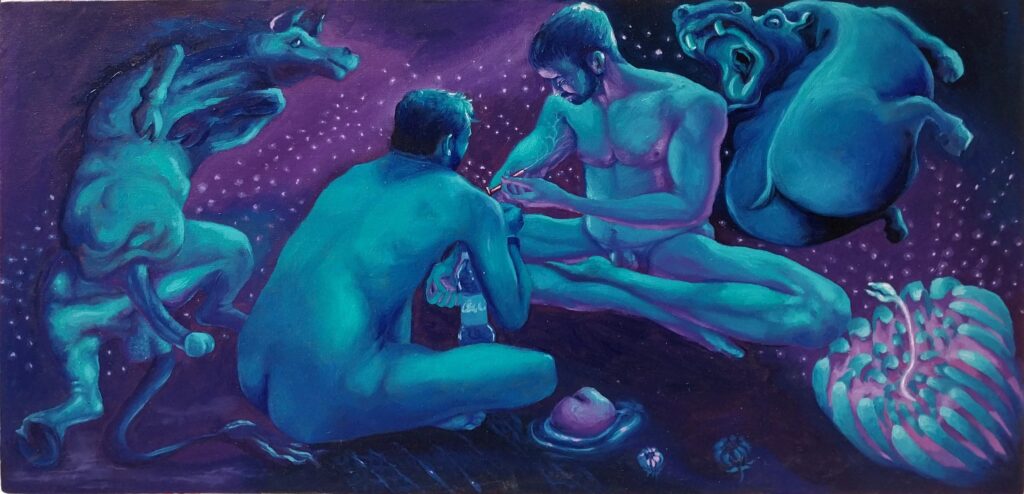
Shakibul Islam
Roommates 2
A quiet night at home, with a hippo floating overhead
Turquoise skin against a purple night full of white specks.
Two bodies, bent knees, a plastic bottle held loosely.
A hand reaches out with something small and orange between the fingers.
Above them a hippo turns over, mouth open, in no hurry.
A pale horse twists in the dark like smoke.
Nobody here is looking away.
Roommates 2 is a small oil painting by Shakibul Islam. Two nude men sit close on a dark floor. One reaches towards the other's hand. Around them float animals: a twisting horse-like creature, a hippo and a striped shell. Islam is researching queerness beyond the human, in nature and other living beings. He uses bright colour on purpose. Many people find it hard to look at fluorescent colour for long. He has seen people look away from queer lives in the same way.
Oil on canvas · 39.37 × 76.2 cm · 2026
Theme Queer domestic intimacy
RC-645
Shakibul Islam
Comfort
Two faces so close the colour cannot keep them apart
Two cheeks meet and the paint turns pink where they touch.
One face rests with its eyes shut. The other keeps watch.
Green shadows run along a nose, a lip, a jaw.
Around them, branches of orange and turquoise grow like coral in warm water.
Small and yellow, two figures dance below their chins.
Far off, a purple crowd stands under arches, too far away to reach them.
Two faces press cheek to cheek at the centre of Comfort. One face has closed eyes. The other has its eyes open. Around them, shapes like coral and branches grow in red, yellow, turquoise and purple. Shakibul Islam uses colour that is hard to look at for long. Some people look away from queer lives in the same way, he says. He often starts on a red ground with pink, lime and blue in acrylic. Then he paints over it in oil, so the colour glows.
Oil on canvas · 91.44 × 142.24 cm · 2025
Theme Queer intimacy and comfort
RC-646

Shakibul Islam
Mayapur
A man rises from a rainbow flower, arms open to the dark
Red runs under everything, like a floor that is still warm.
A man sits in a flower of rainbow petals and lifts both arms.
Above him a ring of pink and green lights turns like a festival gate.
Three women lean on a lattice rail and look back over their shoulders.
Lime bodies glow, tied together by long orange threads.
In the far window a white dome waits under deep blue.
Shakibul Islam paints Mayapur in acrylic on a square canvas. Nude figures fill a ground of red, green and black. A bearded man raises his arms from a flower of rainbow petals. Glowing yellow figures are joined by long orange cords. Islam uses the brightest colours he can on purpose. Many people cannot look at fluorescent colour for long, he says. He has seen people look away from queer people in the same way. He wants viewers to stay with the discomfort and find the beauty in it.
Acrylic on canvas · 142.24 × 142.24 cm · 2025
Theme Queer bodies and visibility
RC-647

Shakibul Islam
Maddox square
Behind the green railing, bodies rest without hiding
Red soaks the ground like a carpet that never dries.
Green drips fall behind the bodies like rain on a window.
A man turns his back to us with a red flower open on his shoulder.
Two yellow lovers fold into each other and do not look up.
A small green dog lifts its face to the music.
The railing curls but it does not close.
Maddox Square is a large square painting in acrylic on canvas from 2023. Shakibul Islam grew up in Kolkata and did his post-graduation at Sir J.J. School of Art in Mumbai. Here nude figures sit, stand and embrace on a deep red ground. A lime green railing curls in from the left. Islam uses the brightest colours he can on purpose. Many people look away from fluorescent colour. He has seen people look away from queer people in the same way. He wants you to stay and look.
Acrylic on canvas · 121.92 × 121.92 cm · 2023
Theme Queer bodies without hiding
RC-648
Shakibul Islam
Eden Gardens 1
Three bodies hold each other while a dark figure watches
The floor is red and warm under bare knees.
Gold lines turn and turn behind them, a thumbprint the size of a wall.
One body kneels. One bends over him like a roof.
Hands rest on heads with no hurry.
Blue shapes grow at the edges like coral.
Far back, a dark man stands and does not look away.
The colour stings. Stay.
Eden Gardens 1 is oil on canvas, 121.92 × 91.44 cm. Shakibul Islam painted it in 2025. He studied at Sir J. J. School of Art, Architecture and Design, Mumbai. A nude man kneels on a red floor. Another figure bends over his back. A third face leans in close. A dark figure stands alone and watches. Islam uses the brightest colours he can. People look away from bright colour, he says. He has seen them look away from queer people in the same way.
Oil on canvas · 121.92 × 91.44 cm · 2025
Theme Queer love under watch
RC-649
Shakibul Islam
Eden Gardens 2
Fire at their feet. Faces in the leaves. They hold on anyway
Yellow lines crawl over the green like whispers that grew faces.
The ground is a cold blue sea and it is on fire.
Two bodies lean into one another, skin warm as baked clay.
A hand lifts a small brown fruit and does not let it go.
Below, white clouds sit like quiet sheep.
The colour is loud. Stay with it.
Eden Gardens 2 is an oil painting on canvas made in 2025 by Shakibul Islam. Two nude figures hold each other in a garden. One lifts a round fruit. Flames rise from the blue ground. Faces drawn in yellow lines watch from the green behind. Islam often paints the body nude so it carries no social markers. He uses the brightest colours on purpose. Many people look away from bright colour. He has seen people look away from queer lives in the same way.
Oil on canvas · 121.92 × 91.44 cm · 2025
Theme Desire under watching eyes
RC-650
Featured in Issue 2
Tanishq Pratap Singh
The Studio · Painting. He paints the cows on his street in Rudrapur with silk, pearls and lily petals. And he asks a lot of questions.
Tanishq Pratap Singh
Male Gaze
A braid swings where a tail should be
Rust water spreads across the paper like a stain that will not dry.
She turns her back to us. Gold hangs from her braid.
A cloth the colour of turmeric slips from her shoulder.
Red hair lifts and curls as if in a hot wind.
Her legs twist. Her shadow runs long and violet to the edge.
We keep looking. She keeps walking.
In Rudrapur, Tanishq Pratap Singh notices that women and cows walk down the same streets with the same grace. In Male Gaze he joins the two. A long braid runs down the cow's back like a tail. Singh says the work is not only about gender. The gaze belongs to all of us. It is how a society decides a body should look. He paints in watercolour on Wasli, a handmade paper first made in Jaipur. The paper gives him a sense of labour and endurance.
Watercolour on Wasli paper · 76 × 60 × 0.5 cm · 2026
Theme How bodies are watched
RC-707
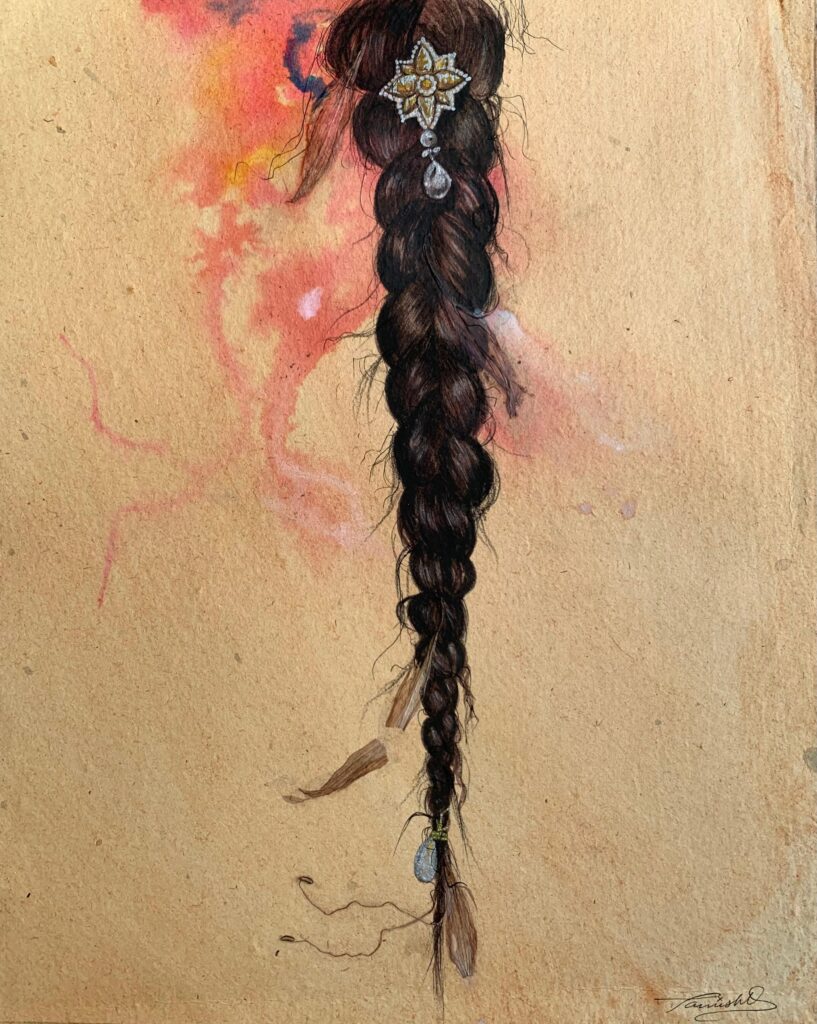
Tanishq Pratap Singh
Untitled
A braid that swings like a tail
A braid falls the whole length of the page, dark as wet bark.
A gold star pins it at the top. A silver drop hangs below.
Near the crown a stain of coral and rose spreads like tea through cloth.
Loose hairs curl away from the plait. Pale wisps break off and drift.
At the tip another small stone catches the light.
Everything shines. Something is still held tight.
Tanishq Pratap Singh lives and works in Rudrapur in Uttarakhand. On his street he sees women and cows walk with the same grace. A braid swings like a tail. Here one long braid hangs down the length of the work. Loose hairs and pale wisps slip out of it. A gold jewel sits at the top. Singh works from photographs on his phone and sketches in his own hand. He is asking how shining things like crystals can cover the hard facts of daily life.
Mixed media: inks and charcoal on canvas · 66 × 96 × 2 cm · 2026
Theme Grace and endurance
RC-708
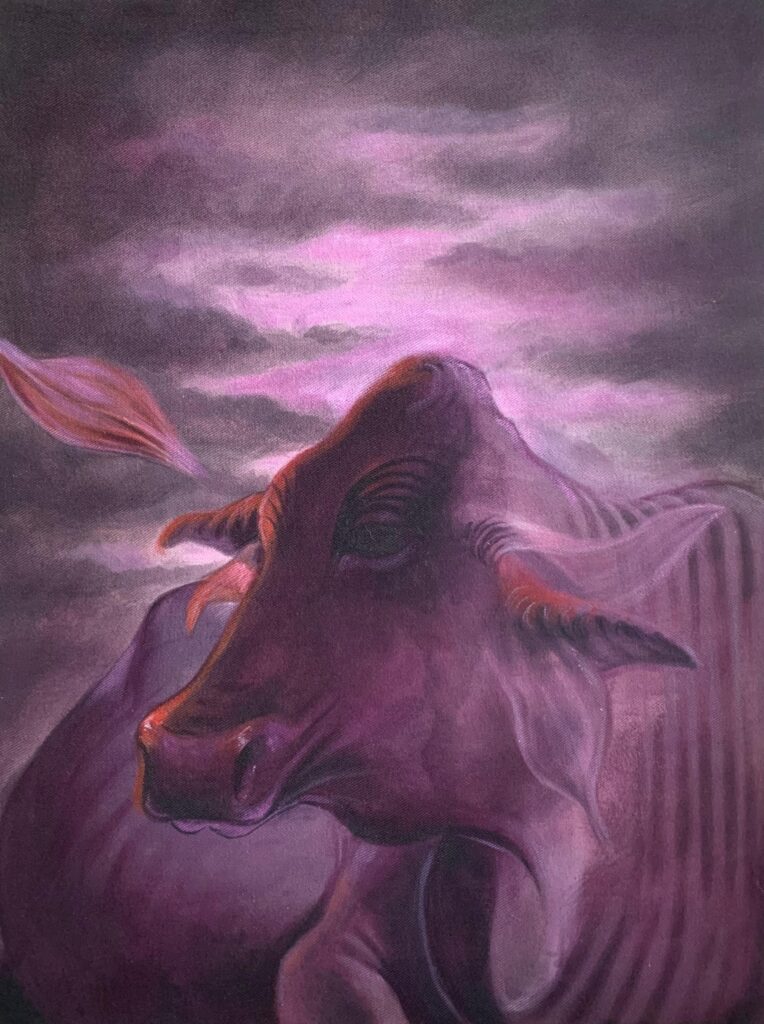
Tanishq Pratap Singh
No faith
Under a violet sky she closes her eyes and waits
Magenta clouds press down on the slope of her back.
A thin red light runs along her nose and one short horn.
Her eyes are half closed, heavy, not asleep.
An ear hangs low like a petal near the end of its week.
At the edge of the sky a pink leaf lifts away.
Under the paint, the cloth of working trousers keeps its weave.
A street cow fills this painting by Tanishq Pratap Singh. He lives and works in Rudrapur in Uttarakhand, where cows stand between the traffic and the shops. He photographs them on his phone and draws them in his own hand. Then he chooses a surface to suit the feeling of the work. Here he paints in acrylic on denim. Singh sees something of himself in these animals. They stand in the open and endure a world they did not make.
Acrylic on denim · 60 × 45 × 2 cm · 2026
Theme Endurance on the street
RC-709
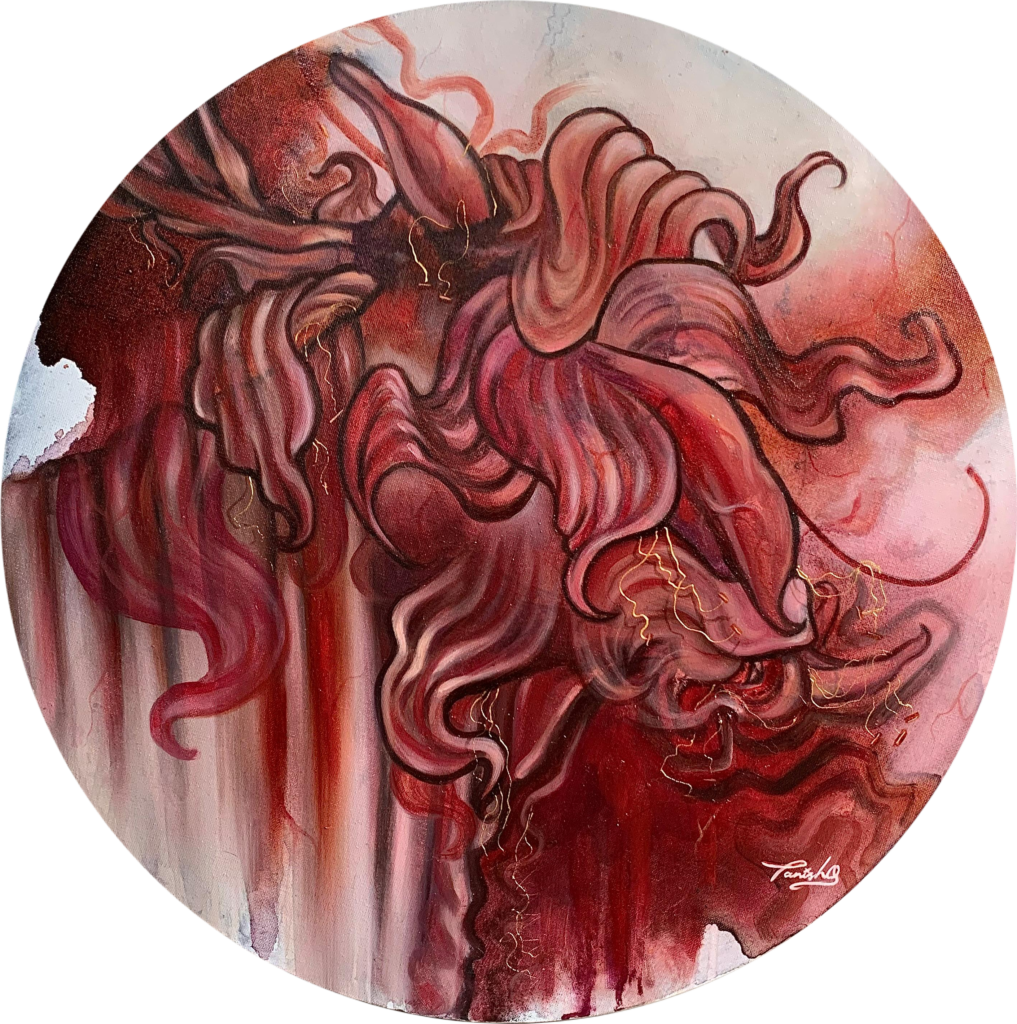
Tanishq Pratap Singh
Persistence
The paint runs down. The red folds hold on
A circle of red, held up like a plate to the light.
Folds of rose and rust curl over one another, petal over petal.
Thin gold threads cross them like cracks in old glaze.
On the left the colour gives way and runs down in long stripes.
Pale canvas shows at the edges, cool as morning.
Nothing here stops moving. Nothing here lets go.
Persistence is painted in oil and inks on a round canvas, 60 centimetres across. Tanishq Pratap Singh lives and works in Rudrapur in Uttarakhand. He paints daily life that shows vulnerability, endurance and the need to keep adapting. His works grow from sketches, photographs and things he notices as he watches. Singh then chooses the materials to suit the feeling of each work. Here, folded red forms curl like petals. Thin gold lines run through them. Paint drips down the left side.
Oil and inks on circular canvas · 60 × 60 × 1 cm · 2026
Theme Endurance and vulnerability
RC-710

Tanishq Pratap Singh
Houseplant
Loved, admired and kept indoors, like a plant in a pot
Gold seeps down the silk like old rain on a wall.
Two lilies bend where her ears should be, soft and already folding.
Glass chandeliers hang from them, catching a light that is not there.
Her mouth meets the pot as if she drinks from it or grows from it.
A necklace sits on the pot's round belly, heavy with stones.
Under everything, thin roots look for somewhere to go.
Tanishq Pratap Singh lives in Rudrapur, Uttarakhand, where cows stand between the traffic and the shops. Drawing lilies in his small garden, he sees that a cow's ear is about the size of a lily petal. In Houseplant the petals become ears. The head rises from a pot like a plant kept indoors, safe and cared for. Small chandeliers hang beside her. Singh paints on Chanderi, a fine silk with golden threads that he bought long before only because it shone.
Acrylic on Chanderi fabric stretched over canvas · 101 × 76 × 2 cm · 2026
Theme Protection and confinement
RC-711
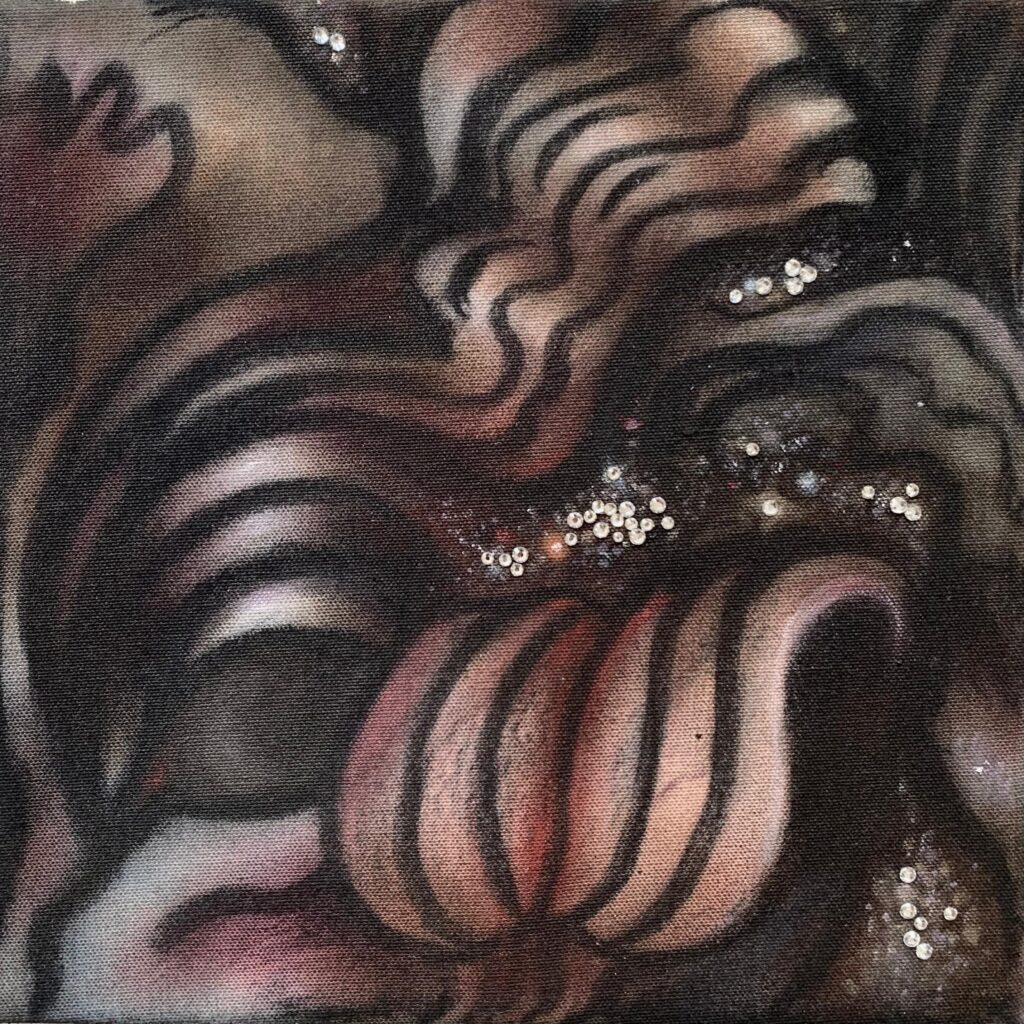
Tanishq Pratap Singh
Untiled
Crystals shine brightest on the things we stop looking at
Pink folds over brown, like skin pressed against skin.
Black lines run through it, the way a rope marks a hide.
In the dark between, small crystals gather like frost on a night road.
One hollow stays shut, an eye that will not open.
The light finds the stones first.
Only later do you see what they rest on.
Tanishq Pratap Singh lives and works in Rudrapur, Uttarakhand. He paints the street cows he sees there, animals that endure without making trouble. Singh builds each work from photographs, sketches and collected observations. Then he chooses materials for what the work needs. On this small canvas, soft folds of pink, brown and black press close together. Swarovski crystals sit on the dark paint in small clusters. Singh wants to see how a shiny, seductive material can cover up or overpower hard daily life. His work asks, "are we all okay?"
Charcoal, inks, oil and Swarovski crystals on canvas · 30 × 30 × 2 cm · 2026
Theme Beauty hiding endurance
RC-712
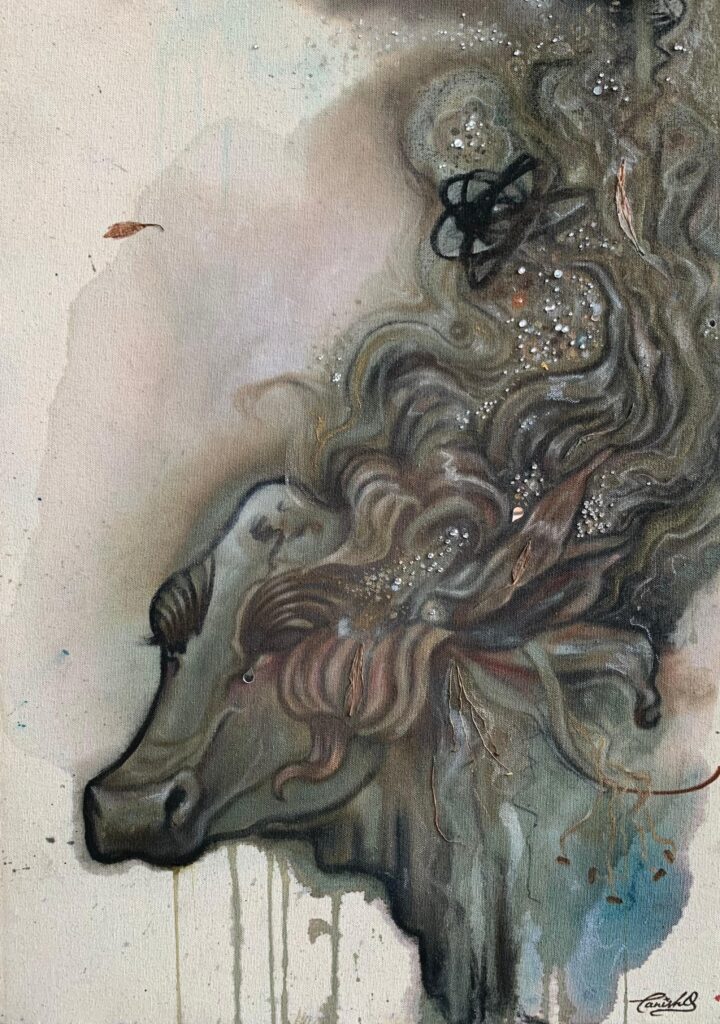
Tanishq Pratap Singh
Imbroglio
Crystals in her hair cannot lift her lowered head
A grey head bends toward the bottom of the canvas.
The lashes are long and the eye stays closed.
Hair rises like smoke and holds small points of light.
A black knot of charcoal sits in the curls.
Paint runs down from the neck in thin lines.
A little blue gathers below like cold water.
One dry petal drifts away on the pale cloth.
In Imbroglio a street cow from Rudrapur lowers her head. Tanishq Pratap Singh photographs the cows on his street with his phone. Then he sketches them by hand. Here he works in charcoal, inks and oil on canvas. He adds dried lily petals from his garden and Swarovski crystals. He is testing how shiny crystals can hide or overpower the hard facts of daily life. The cow still asks his quiet question. Are we all okay?
Charcoal, inks, oil, Swarovski crystals and dried lily petals on canvas · 71 × 50 × 2 cm · 2026
Theme Endurance and concealment
RC-713
Featured in Issue 1
Sushil Yadav
The Studio · Sculpture. He builds people out of terracotta, coil by coil, to ask what stays with us when a home is gone.


Sushil Yadav
Rooted Humanity
Bodies that grow into roots and hold each other up
Orange clay, pinched and pressed until it looks like bark.
The bodies lean in so close that no one can fall.
Heads open at the top like hollow stems or small mouths.
Their legs bend down into one low floor of clay.
Under them, dark stone. Above them, only pale grey air.
They do not let go.
Sushil Yadav comes from a village in Kushinagar district in Uttar Pradesh. There, houses made of clay slowly fall and go back into the soil. In Rooted Humanity, a group of figures stands close together. Their legs bend down and join in a low base, like roots holding the ground. Yadav builds each piece coil by coil with his hands. He says this work reminds him of how earthen houses are built, "one layer at a time."
Terracotta · 45 × 30 × 30 cm · 2025
Theme Roots of belonging
RC-8181
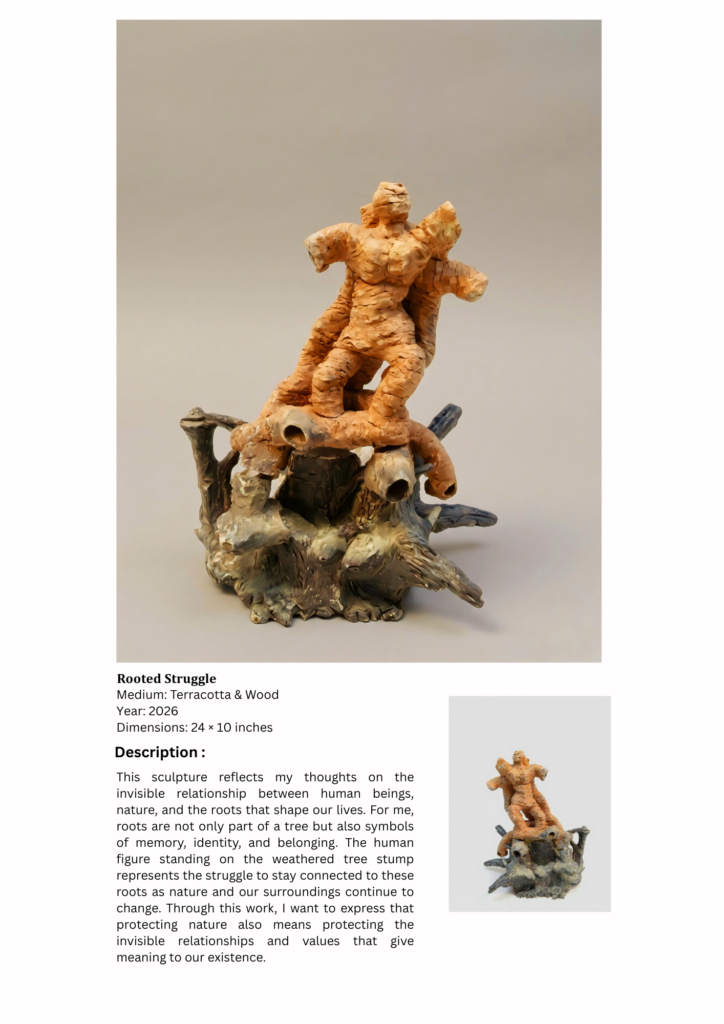
Sushil Yadav
Rooted Struggle
Two bodies of orange clay hold on while the ground changes
Orange clay, ridged as if a thumb has passed over it again and again.
Two bodies lean into each other with their arms open to the air.
Under their feet, hollow branches open like small dark mouths.
The stump below has turned grey, the colour of old rain.
Roots spread out across the floor and grip it.
Nothing here is still. Everything is holding on.
In Rooted Struggle two orange figures stand close together on a weathered tree stump. Sushil Yadav builds his figures by hand, coil by coil. He presses and joins each coil the way the earthen houses of his village in Uttar Pradesh rise, one layer at a time. Here roots stand for memory, identity and belonging. The figures hold on to them while nature and the world around them keep changing. The work is terracotta and wood and stands 60 cm tall.
Terracotta and wood · 60 × 25 cm · 2025
Theme Memory, nature and belonging
RC-8182
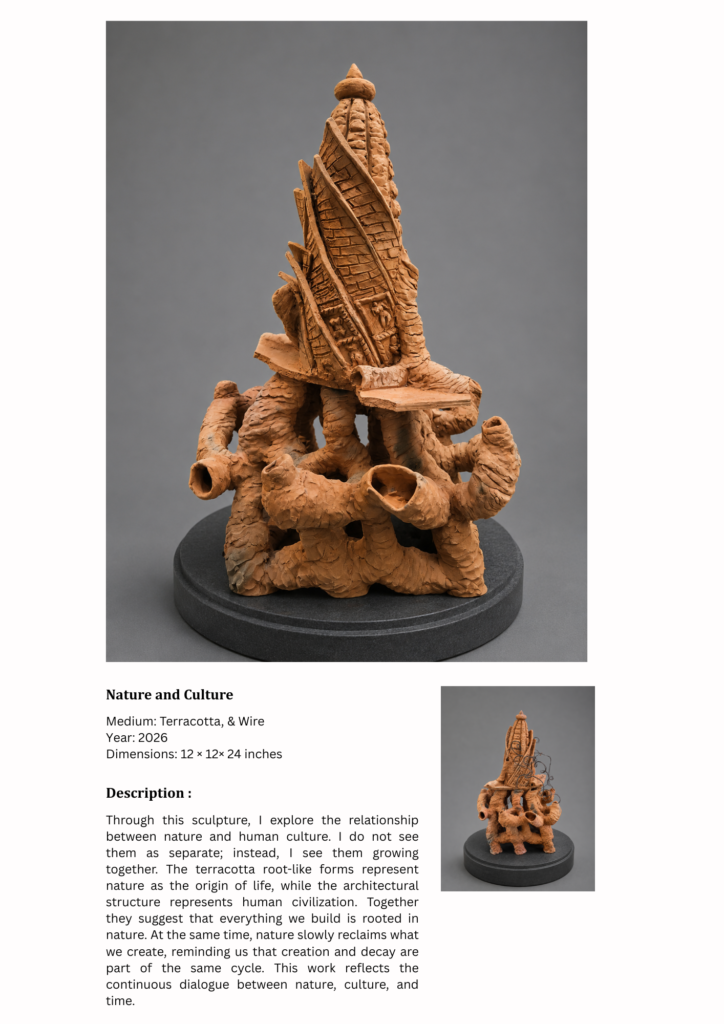
Sushil Yadav
Nature and Culture
A tower of brick grows straight out of the roots
Orange clay, the colour of a field after rain.
Roots thick as wrists cross over each other and open their mouths to the air.
Every surface carries the press of a thumb.
Above them a slab sits like a doorstep.
Then the brick climbs, turning as it goes, toward one small knot at the top.
Grey light falls evenly.
Nothing here has decided yet whether it is growing or falling.
Sushil Yadav grew up in a village in Uttar Pradesh. There he watched houses of clay rise, wear away and go back into the earth. In Nature and Culture the same clay does both jobs. Thick roots twist across the base. Their hollow ends open like mouths. On top of them sits a tower with a brick pattern that spirals up to a small point. Yadav builds each sculpture coil by coil with his hands. Here the roots stand for nature and the tower for what people build.
Terracotta and wire · 60 × 30 × 30 cm · 2026
Theme Nature, building and decay
RC-8183

Sushil Yadav
Root of belonging
What stays when the walls of a home return to soil
Orange clay, pressed again and again until it looks like bark or scales.
A round bowl sits on dark stone, two small mouths open in its side.
Out of it the arms climb, bend back, lean on one another.
One end is open, as if something could still pass through.
The light is soft and the clay holds it warm.
Nothing here stands alone.
Sushil Yadav comes from a village in Uttar Pradesh where houses are built from clay. He remembers watching them wear down and return to the soil. In this early work the root becomes his way to speak about belonging. Hollow forms rise from a round clay base. They bend and lean on each other. Yadav builds his sculptures coil by coil with his hands. He works in terracotta because it comes straight from the earth. The roots here stand for the ties we cannot see.
Terracotta · 45 × 25 × 25 cm · 2024
Theme Roots and belonging
RC-8184

Sushil Yadav
Shared Roots
Out of a tangle of clay roots, a small face looks up
Orange clay, ridged like bark under a thumb.
Roots climb out of a dark box and open their mouths like pipes.
Grey wire drifts around them, a line someone drew in the air and left.
At the top a pale face lifts its chin.
It is small. It is not in charge.
The light is soft and even, the colour of a wet morning.
Sushil Yadav builds Shared Roots coil by coil with his hands. He joins, presses and shapes each coil. This is how earthen houses are built in the village in Uttar Pradesh where he grew up: one layer at a time. The terracotta roots are not plant roots. They stand for the hidden ties that hold life up. A small monkey face rises at the top. It tells us that people are part of nature. A frame of plywood and wire stands for the world people make.
Terracotta, plywood and wire · 60 × 30 × 30 cm · 2026
Theme Hidden ties of life
RC-8185

Sushil Yadav
Shared Existence
A face looks out from a tangle of clay roots
Orange clay climbs out of a grey block like smoke learning to stand still.
Every branch ends in an open mouth, waiting for rain or a bird.
The skin of it is pinched and pressed, thumb after thumb.
High in the tangle, a pale face rests and looks down at us.
It does not try to climb out.
The roots hold it the way a field holds a fallen house.
Sushil Yadav comes from a village in Kushinagar district in Uttar Pradesh. There, mud houses rise from the earth and slowly go back into it. He builds his sculptures in the same way, coil by coil, with his hands. In Shared Existence, thick terracotta roots twist upward and end in hollow open mouths. Near the top, a monkey face looks out. For Yadav, humans, animals and nature are parts of one living system. The roots stand for the ties we cannot see.
Terracotta · 60 × 30 × 35 cm · 2026
Theme Shared roots of life
RC-8186
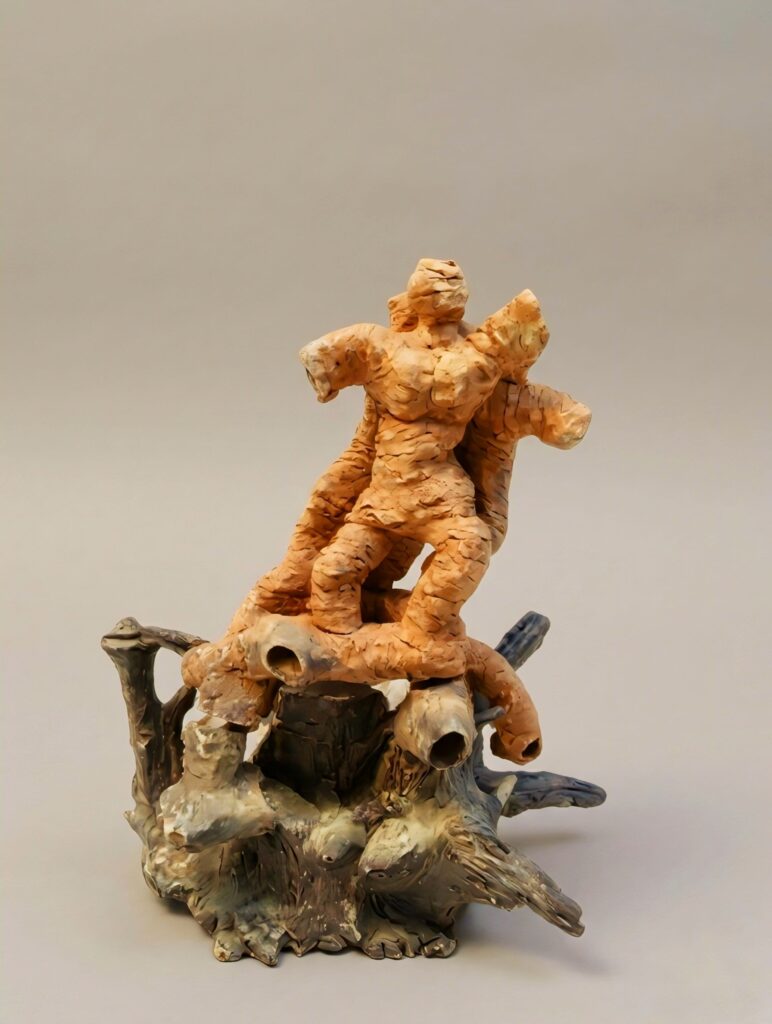
Sushil Yadav
Composition 2
A body that has not let go of the tree
Orange clay, pressed and pitted like bark that has not hardened yet.
One body or two, leaning into one shape, arms thrown out to the side.
Under their feet the branches end in round open holes.
The stump below is grey and green, turning blue at its tips.
Warm skin on old wood, held up by what it holds.
A soft grey room and no wind at all.
Sushil Yadav builds his people out of terracotta, coil by coil. Here a figure sits on an old tree stump. Roots wrap around its body. For Yadav these roots are not plants. They stand for the ties we cannot see. The work asks how much we need nature. It also asks how hard it is to stay close to it while everything around us changes. Yadav is in the final year of an MVA in Sculpture in Lucknow. The work is on the cover of Issue One.
Terracotta and wood · 24 × 10 in · 2026
Theme Holding on to nature
RC-3287
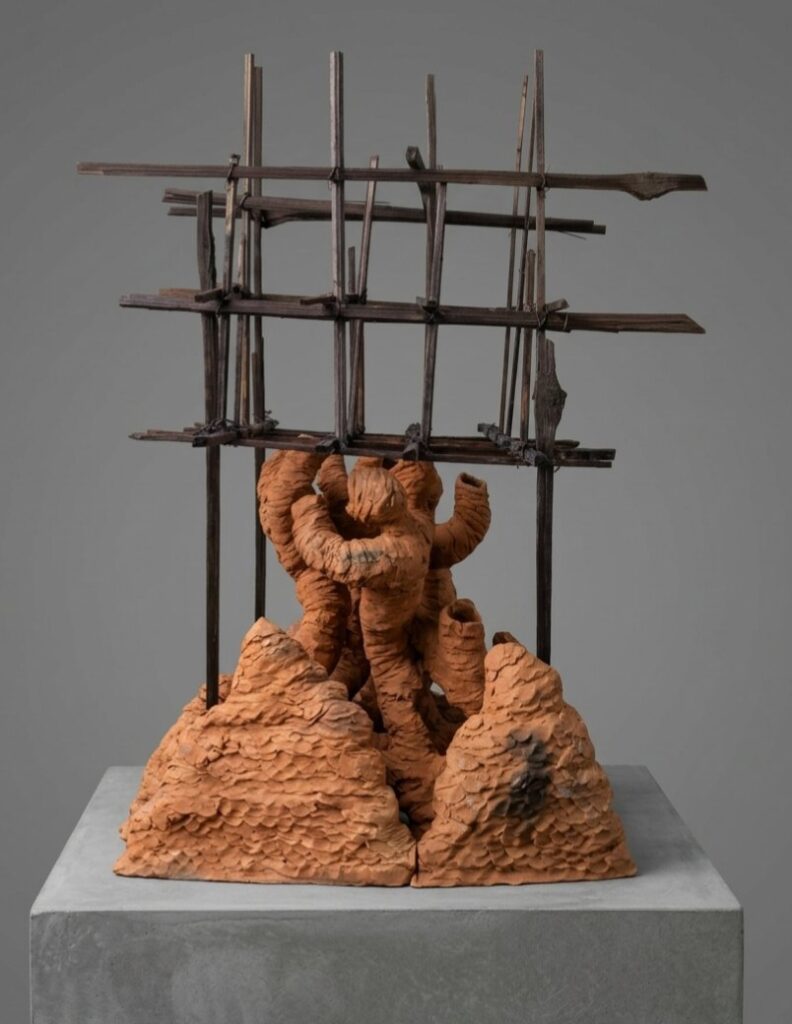
Sushil Yadav
Roots, Memories, Ruins, Reconstruction
A roof left unfinished on purpose, over people made of earth
Orange clay heaped like two small hills, scaled with the marks of fingers.
Out of the gap between them bodies climb and hold on.
One arm ends in an open mouth, a hollow pipe of earth.
A soot shadow sits on the right hill where the fire touched it.
Above, dark sticks crossed and tied: a roof that waits for its next pair of hands.
Grey light. Nothing finished. Everyone still holding.
In the village in Kushinagar district where Sushil Yadav grew up, mud houses soften in the rain and return to the soil. In this work Yadav builds human forms in terracotta, coil by coil. They rise out of broken ground and lean on each other. Above them stands a frame of bamboo sticks tied together. It is not finished. “The structure is incomplete on purpose,” he says, “because I see rebuilding as something that goes on.” He makes it in 2026, in the final year of his MVA.
Terracotta and bamboo sticks · 14 × 12 × 28 in · 2026
Theme Home, memory and rebuilding
RC-3288
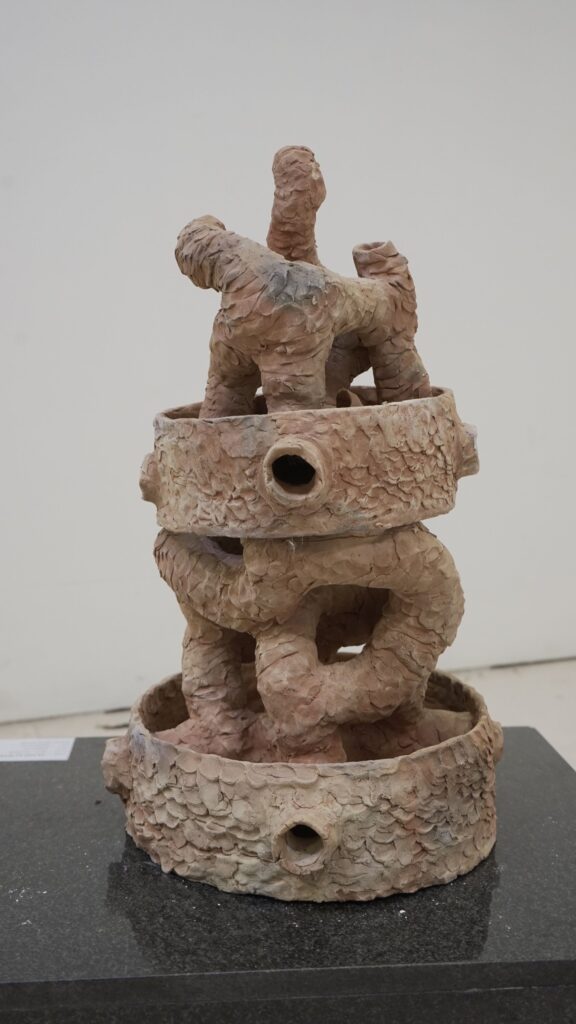
Sushil Yadav
Entwined Roots
What holds us together can also hold us in
Pink-brown clay, pressed all over with small marks like fish scales.
Two rings sit one above the other, each with a round dark hole that looks back at you.
Thick coils loop through them, an arm, a root, a knot you cannot follow.
At the top the coils climb free and reach in three directions.
Grey smoke from the fire still rests on the clay.
Below, black stone. Behind, a white wall. The earth stands up on its own.
Sushil Yadav grew up in a village in Kushinagar district. There he watched mud houses break down in the rain and go back into the soil. He asks what stays when a home is gone. Yadav builds his figures out of terracotta, coil by coil. In Entwined Roots, bodies and roots wind through each other inside two rings of clay. You cannot tell where one person ends. The roots stand for the ties we cannot see. He is studying for an MVA in Sculpture in Lucknow.
Terracotta · 32 × 18 in · 2025
Theme Ties that hold us
RC-3289
Featured in Issue 1
Aniket Dharmendra Varma
The Studio · Painting. He paints the broken idols that wash up after visarjan and asks a hard question: do we believe or do we only follow?


Aniket Dharmendra Varma
Current project
A gold key, a red square and something walking in the dark
A bird made of white dots crosses the black.
Below it an animal stands up, outlined in chalk-white light.
A tall mauve shape holds a small red door that does not open.
A square of blue water sits low in its body.
On the white side a gold key waits, ringed with teeth.
Grey cloud moves over everything, the way a week moves.
Current project is a large painting in oil and paper. It measures 182.88 × 365.76 × 2.5 cm, twice as wide as it is tall. Aniket Dharmendra Varma makes it in 2026 while he studies for his MFA in Painting at Sir J.J. School of Art in Mumbai. Varma does not draw a plan first. He builds the picture in oil, layer by layer, as a response to what he lives through. "The daily experiences became the sketch," he says.
Oil and paper · 182.88 × 365.76 × 2.5 cm · 2026
Theme Memory and belief
RC-8191

Aniket Dharmendra Varma
Drawings for Painting
A beak, a claw, a striped tail before the painting begins
A yellow sky sits low over a blue eye.
Black strokes push in like wet branches.
In thin blue pen a creature stands on long legs and waits.
Stripes cross a pale pool like a tail in shallow water.
A pink beak opens. Claws reach for nothing.
Dark blots float where the ground should be.
Aniket Dharmendra Varma is studying for his MFA in Painting at Sir J.J. School of Art in Mumbai. He works mostly in oil. Here he works on paper. These four small drawings come before a painting. Three are made in watercolour with heavy black marks. One is drawn in blue pen. A beak, a striped tail and curled claws move through them. For Varma the making matters most. “The process of my work is more important, enjoyable and fascinating than any other concept, thought or idea.”
Watercolour on paper · 9 × 11 × 2.5 cm · 2026
Theme Drawing towards a painting
RC-8192

Aniket Dharmendra Varma
Drawings for Painting
A pale rider on a black bird, far above the waves
A stone of blue night, scribbled over and over until it hums.
Black dust presses in from every side.
Next to it, the sky burns orange in one thin band.
A bare figure sits on a black bird as large as a boat.
Water breaks below in small blue teeth.
Another bird flies ahead, one dark brushstroke going home.
Aniket Dharmendra Varma is an MFA student in Painting at Sir J.J. School of Art in Mumbai. He paints in oil, layer by layer. He does not draw a plan first. These two small sheets, each 9 × 11 cm, show where a painting can start. On the left, a blue and violet wash sits inside a black border. Fast tangled lines cover it. On the right, a pale figure rides a huge black bird over blue waves. For Varma, daily life becomes the sketch.
Watercolour on paper · 9 × 11 × 2.5 cm · 2026
Theme Flight over water
RC-8193
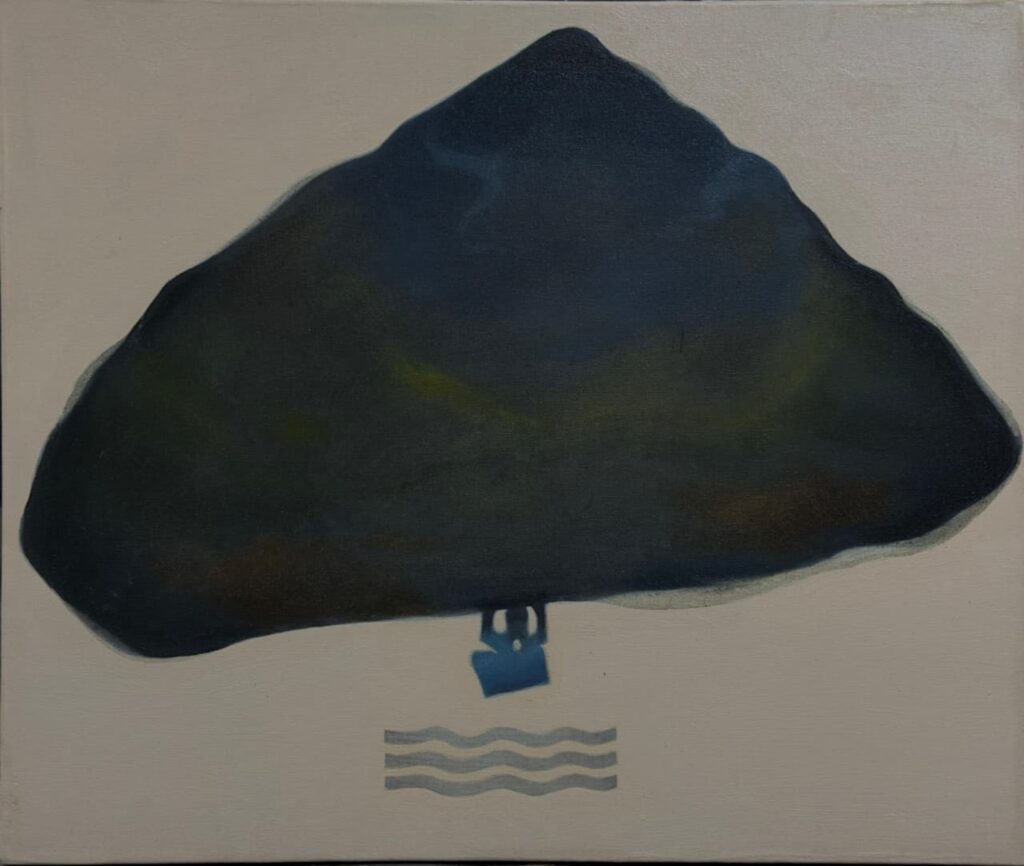
Aniket Dharmendra Varma
Witness
One small figure stands under a dark weight above the water
A dark stone hangs in a room the colour of chalk and rose.
Inside it sit old green and a little gold, like river light under silt.
Its edges blur into the pale ground.
Below it one small blue figure lifts both arms.
Is he holding the weight or only standing under it?
Three grey lines move beneath him, slow as the tide.
Someone has to stay and watch.
Witness is an oil painting from 2025 by Aniket Dharmendra Varma. Varma is studying for his MFA in Painting at Sir J.J. School of Art in Mumbai. He paints in oil layer by layer. He does not draw a plan first. A painting starts from what he has lived through that week. Here a huge dark form fills the top of a pale ground. A small blue figure stands under it. Three grey wavy lines lie below like water.
Oil paint · 60.96 × 91.44 × 2.5 cm · 2025
Theme Belief and its weight
RC-8194
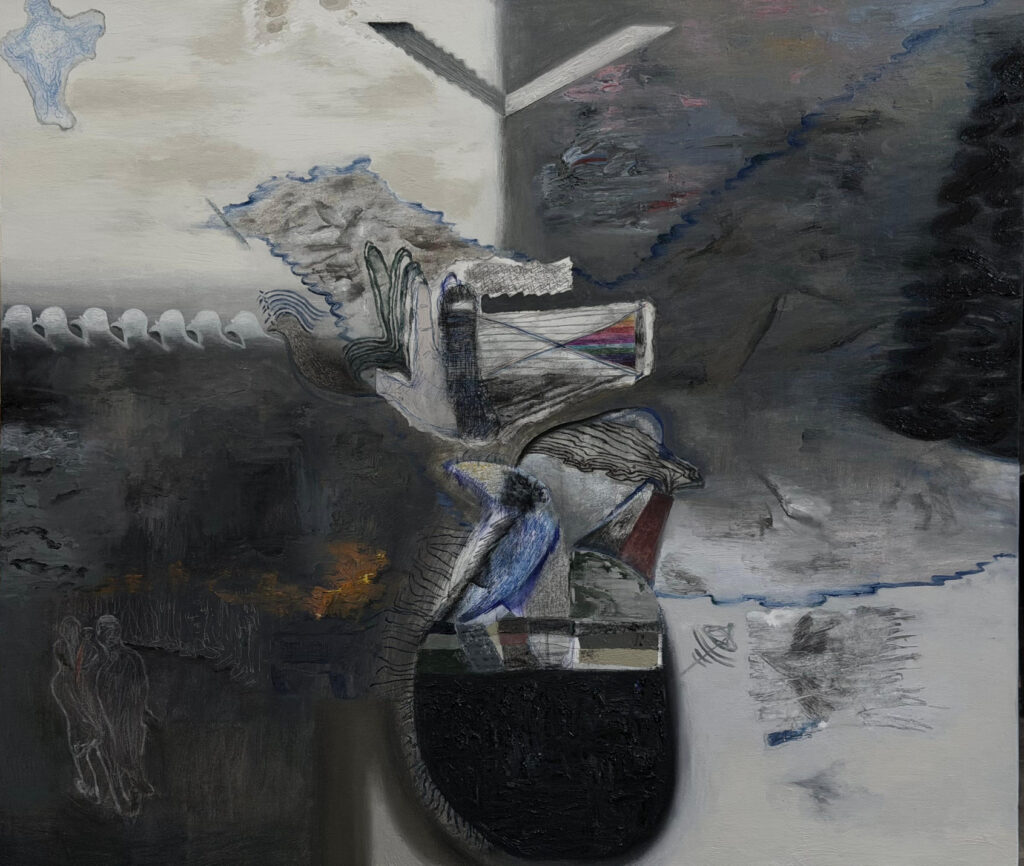
Aniket Dharmendra Varma
Peace
Two pale figures fight in a corner as a blue dove rises
Grey comes in from every side like smoke after rain.
A blue bird pushes up from a black bowl with its wings scratched in thin lines.
Above it a small box holds a strip of rainbow, folded shut.
A row of white waves curls along a wall that goes nowhere.
Down in the dark corner two thin white figures lean into each other.
From here you cannot tell if they hold or strike.
Aniket Dharmendra Varma is an MFA Painting student at Sir J.J. School of Art in Mumbai. He paints in oil, layer by layer. He does not draw a plan first. His paintings begin with what he has lived through that week. Peace shows both war and peace. Doves fly through it. Two figures attack each other. They could be anyone. “In the end, we all belong to the same race,” Varma writes. “That is enough.” The canvas is 76 × 91 cm.
Oil on canvas · 30 × 36 in · 2026
Theme War and peace together
RC-3292
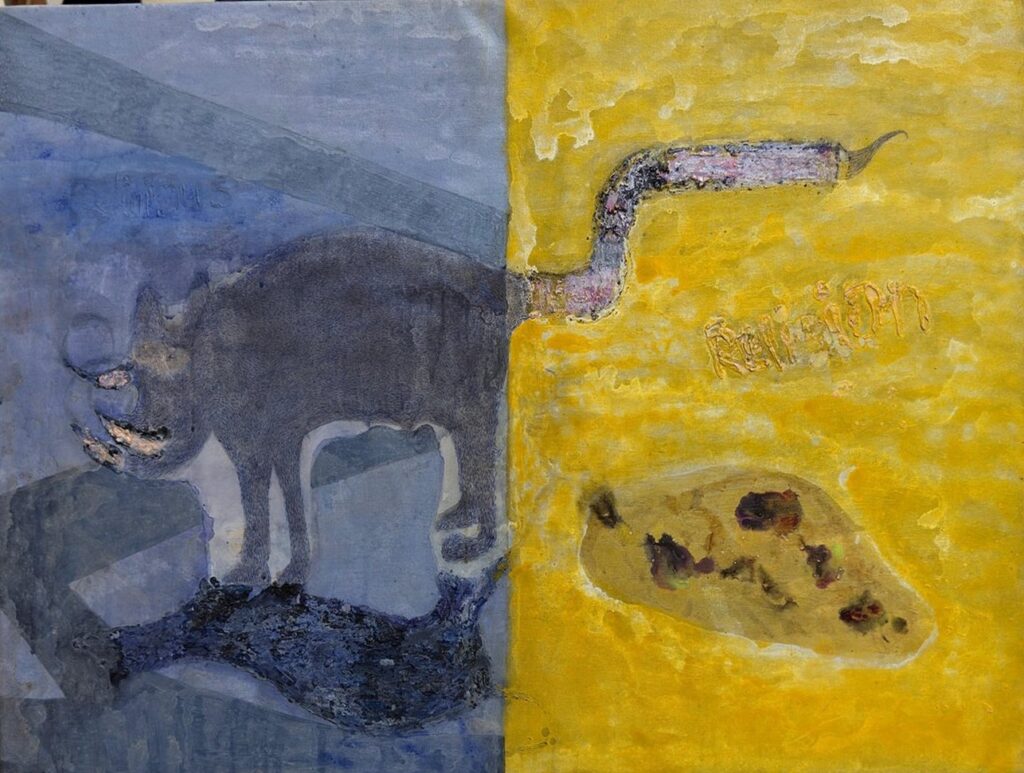
Aniket Dharmendra Varma
Our Home
A grey cat, a yellow wall and two faiths under one roof
A grey cat stands on a dark fish in a room of cold blue light.
Its long tail crosses the line and turns pink in the yellow.
On that side the paint is thick as dried turmeric.
A pale leaf shape holds red marks like old petals.
Letters are pressed into the colour, only half read.
Two colours share one wall and do not fight.
Our Home is a painting about the home of Aniket Dharmendra Varma's family. Varma comes from a Hindu family. After a very hard time, his mother comes to believe in Jesus Christ. His father does not share her belief. Yet today there is peace in their home. Varma makes the work as three canvases that form one picture. Some forms stand for his mother and his father, their work and their beliefs. He paints himself there too, asleep in the middle panel.
Acrylic on canvas, three panels · 24 × 95 in overall · 2026
Theme Faith and family peace
RC-3291
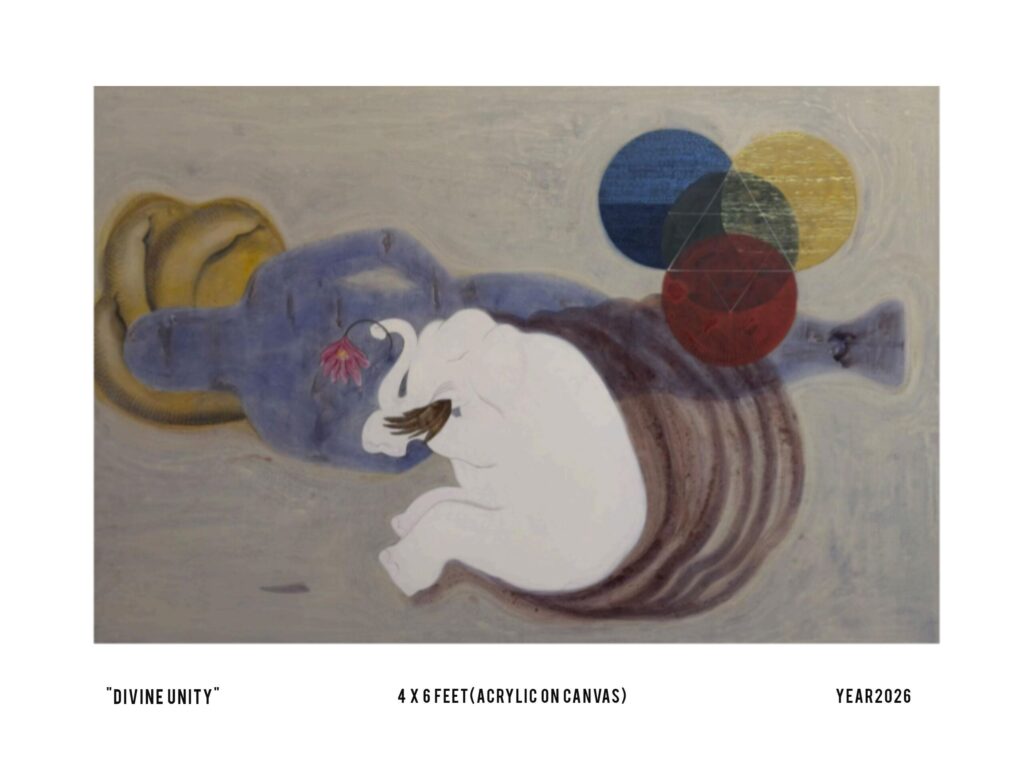
Aniket Dharmendra Varma
Divine Unity
Two faiths, one home and a white elephant fast asleep
A white elephant folds its legs and sleeps on grey ground.
A pink lotus bends from its trunk as if it is tired too.
Behind it a blue shape lies down with its head on a golden coil.
Brown lines spread under the body like a soft dark wave.
High in the corner blue, yellow and red circles touch.
Where they meet a small star of two triangles keeps quiet watch.
Aniket Dharmendra Varma grew up in a Hindu family. After a hard time at home his mother came to believe in Jesus Christ. His father does not share her faith. Yet today there is peace in their home. Divine Unity comes from his questions about faith. A white elephant sleeps with a lotus in its trunk. Three circles of blue, yellow and red overlap above it. It is acrylic on canvas, about 122 × 183 cm. Varma studies for his MFA in Painting at Sir J.J. School of Art.
Acrylic on canvas · 121.92 × 182.88 × 2.5 cm · 2026
Theme Faith and coexistence
RC-635
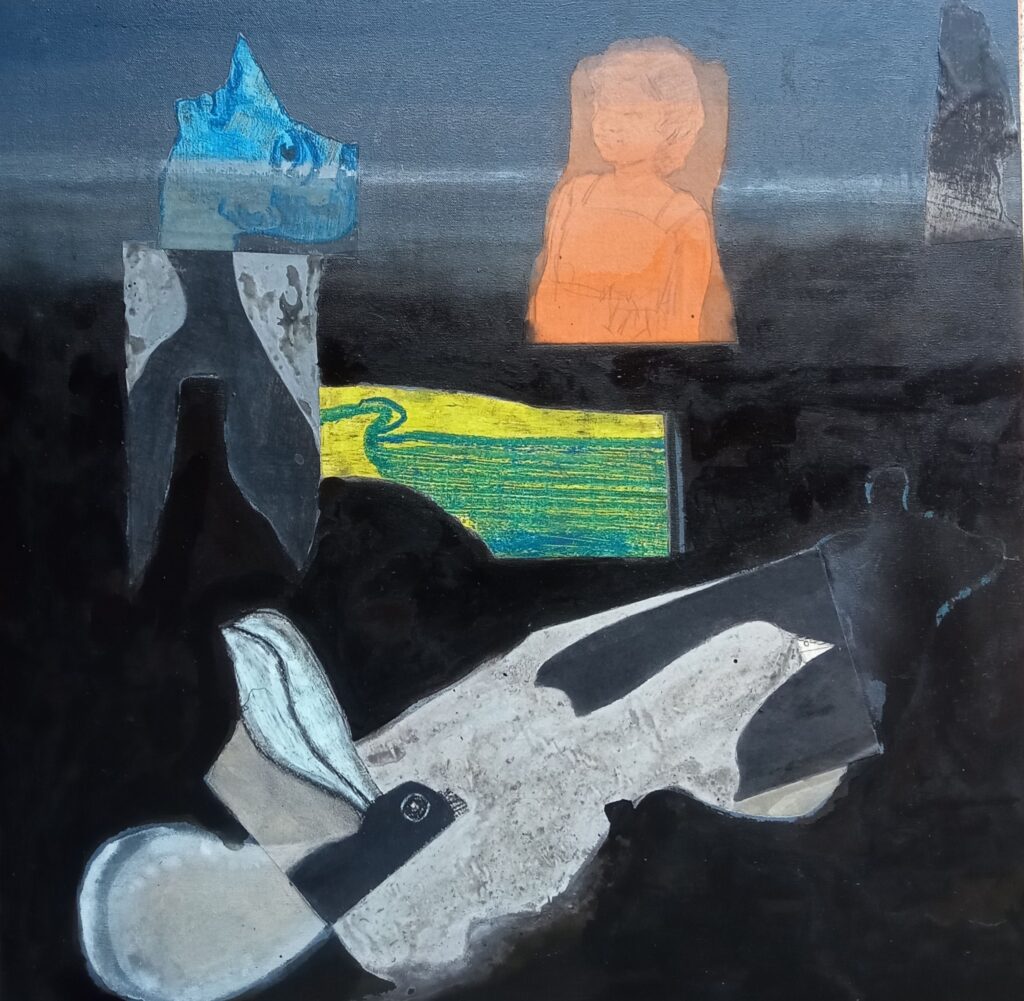
Aniket Dharmendra Varma
Gagan or sagar ke beech
A child, a bird and a blue face hang in the dark
Night comes down from the top of the canvas. A thin grey line keeps the sky from the ground.
A blue face looks out from a torn edge of light.
An orange child stands still, made of pencil lines and warm paint.
A strip of yellow water holds one green wave.
Below, a pale bird lies on its side with its eye still open.
Everything waits between the high dark and the low dark.
Aniket Dharmendra Varma paints from daily life and memory, not from a fixed theme. Varma studies for his MFA in Painting at Sir J.J. School of Art in Mumbai. His work asks questions about faith that began in his own home. The square canvas is painted in acrylic. A strip of blue sky sits above a black ground. Shapes float in the dark: a blue face, an orange child drawn in pencil, a patch of yellow and green. Below lies a large grey white bird with a dark eye.
Acrylic on canvas · 91.44 × 91.44 × 2.5 cm · 2025
Theme Memory and belief
RC-636
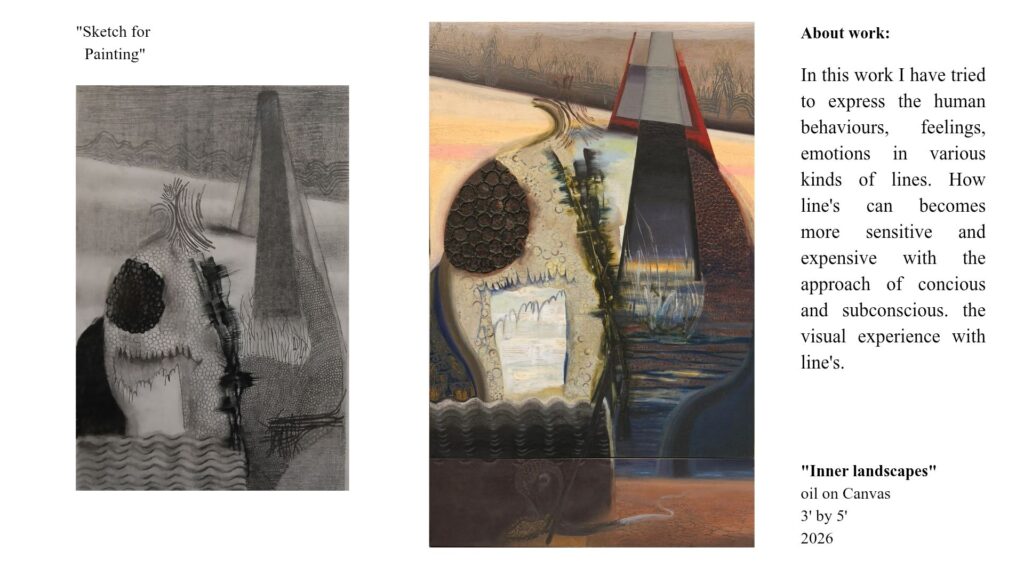
Aniket Dharmendra Varma
Inner landscapes
Every line carries a feeling, some planned and some not
A tower of grey and red leans into a pale yellow sky.
A dark oval sits on the cream form like a seed full of small cells.
Thin marks climb up the middle, fine as grass after rain.
In the blue on the right, a sunset hides behind glass.
Brown waves roll along the bottom and never break.
Every line here is someone thinking.
Aniket Dharmendra Varma is studying for his MFA in Painting at Sir J.J. School of Art in Mumbai. In Inner landscapes he uses line to show human feelings and behaviour. Some lines come from a plan. Others come from a less awake part of the mind. A grey drawing sits beside the painting in the image. It holds the same shapes: a tall tower, a dark round form, rows of waves. In oil, Varma builds these shapes in layers of colour.
Oil on canvas · 152.4 × 91.44 × 2.5 cm · 2026
Theme Feeling through line
RC-637

Aniket Dharmendra Varma
Just a Ritual
He prays with joined hands as pale water rises around him
Hands pressed flat, a man leans into the dark.
White waves climb his shirt and spill below him like a cloth over an altar.
Small yellow marks swim in that pale water.
A thin white line cuts the air, as if glass has cracked.
Deep red closes in from the corners.
At the bottom a red fan opens. The prayer is not finished.
A man stands with his hands pressed together in prayer. White wavy lines run over his shirt and down the canvas like water. Aniket Dharmendra Varma paints in oil layer by layer. He does not draw a plan first. Each painting begins with something he has lived through. He grew up in a Hindu family. Later his mother came to believe in Jesus Christ. In this work Varma asks about the rituals he has seen since childhood. Does he believe or does he only follow?
Oil on canvas · 182.88 × 91.44 × 2.5 cm · 2026
Theme Faith and ritual
RC-638
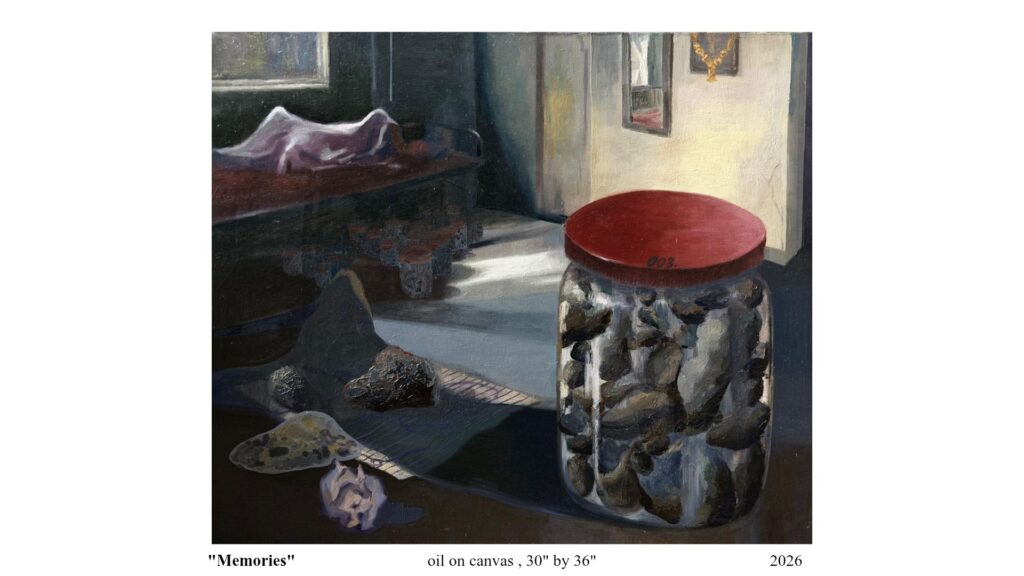
Aniket Dharmendra Varma
Memory
Some memories are kept in jars, sealed and numbered
A red lid, numbered like a drawer in a museum.
Inside, dark stones press their faces to the glass.
Across the floor lies a pale stripe of window light, cut into bars.
A mauve cloth rests over something the shape of a sleeper.
Under the bed, small jars wait in rows.
On the wall a gold garland glints on a frame.
Everything is kept. Nothing is opened.
A large glass jar stands in a dim room. It is full of dark stones. Its red lid carries a number, 003. Behind it, a cloth covers a shape on a bed. Aniket Dharmendra Varma paints in oil, layer by layer. He does not draw a plan first. "The daily experiences became the sketch," he says, "and I painted it." His work grows from memories of the past and the present. Varma trained in classical painting at Sir J.J. School of Art, where he now studies for his MFA.
Oil on canvas · 91.44 × 97.44 × 2.5 cm · 2025
Theme Memory and keeping
RC-639

Aniket Dharmendra Varma
Landscape
A pink dress, a dark coat and a hill of stones
A green hill, grey stones scattered across it like seeds.
A small figure in pink and plum walks down the path.
A man in a dark coat sits on the low wall and waits.
Yellow leaves glow at the left edge.
The paint stands up thick, each stroke left where the brush lifted.
An ordinary afternoon, kept small enough to hold in two hands.
Aniket Dharmendra Varma did his BFA in Drawing and Painting at the Sir J.J. School of Art in Mumbai. He now studies there for his MFA in Painting. His training is classical. It includes portraits, composition and outdoor studies. Landscape is a small acrylic painting, only 15 × 20 cm. A figure in pink walks on a path. A man in a dark coat sits on a low wall. Varma says nature has always moved him to try new ways of painting. Some are fully spontaneous. Some are planned.
Acrylic · 15 × 20 × 1.5 cm · 2026
Theme Figures in nature
RC-641
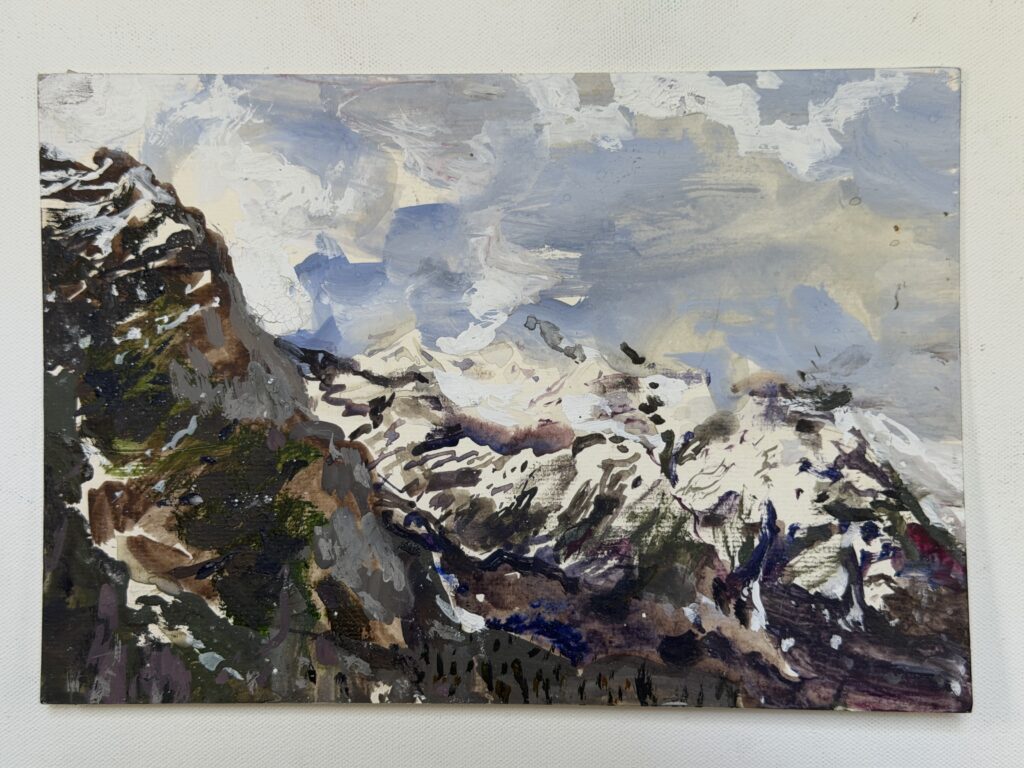
Aniket Dharmendra Varma
Mountain
A whole mountain, held in a space just 20 centimetres wide
Snow sits in the cracks of brown rock like spilled milk.
On the left a cliff wears moss green and slate.
The sky is not finished. White is dragged across blue with a dry brush.
Dark marks run down the slope like birds or stones.
At the bottom, small strokes of grass stand in the cold.
The light comes from somewhere behind the cloud.
Aniket Dharmendra Varma studies painting at Sir J.J. School of Art in Mumbai. His training there includes long days of painting outdoors. In Mountain he works small, on a surface just 15 × 20 cm. Snow and dark rock fill the lower half. A cool blue sky moves above them. Varma lays the gouache on thick in places and thin in others. The brush marks stay open and quick. For Varma, nature is a constant pull. He paints it in ways that are sometimes free and sometimes planned.
Gouache and watercolour · 15 × 20 × 1.5 cm · 2026
Theme Mountain light and weather
RC-642
Featured in Issue 1
Nitya Bhaumik Joshi
First Year Out · Drawing. She draws the rooms of her home in charcoal. No one is in them, yet every room shows that someone lives there.
Nitya Bhaumik Joshi
Objects and Spaces I
A chair, its long shadow and nobody in the room
A dark post stands at the edge of the room.
Behind it a chair holds its cushion, square and patient.
Light comes in at a slant and lies grey on the floor.
The other half is a wall, scratched and flaking white.
One pale line runs down it like a crack of afternoon.
Someone was here. The charcoal remembers the weight.
Nitya Bhaumik Joshi walks through her home with a camera. She photographs the rooms as they are. Nothing is tidied. She first paints from these photographs but stops halfway. The colour takes the silence away. So she draws in charcoal and pastel. Here two drawings meet at an uneven cut like two photographs laid side by side. A chair sits in one half. Its shadow falls across the floor. The work is part of her final series at Anant National University.
Charcoal and pastel on paper · 22 × 34 in · 2026
Theme Presence in absence
RC-3293
Nitya Bhaumik Joshi
Objects and Spaces II
An open door, a slant of light and nobody home
Grey dust rubbed into paper until it becomes a wall.
A door stands open on a dark that has no floor.
Light comes in at a slant and lies there, pale as chalk.
White flakes show through where the charcoal gave way.
No one is here.
Still the door was opened by a hand.
Nitya Bhaumik Joshi draws the rooms of her home. First she walks through the house with a camera and photographs each room as it is. Nothing is tidied. Here a doorway stands in a corner and a band of light falls across the wall. Joshi first tries to paint her photographs. Halfway through she stops. The colour takes away the silence. So she turns to charcoal. The drawing belongs to her final series at Anant National University.
Charcoal on paper · 22 × 34 in · 2026
Theme Presence in absence
RC-3294
Nitya Bhaumik Joshi
Silence
A slipper waits on the mat for the foot that left it
Light comes in past the curtain and lies down on the floor.
One slipper rests on the dark mat. Its strap still bends to a foot.
The door stands open. Its shadow leans out into the room.
Charcoal fills the corners, stroke over stroke.
Grey, then black, then the pale ground showing through.
Nobody speaks. Somebody was just here.
Nitya Bhaumik Joshi draws the home she grew up in. First she walks through it with a camera and photographs the rooms as they are. Then she sketches them and turns them into larger drawings. She starts by painting these photographs. Halfway through, she stops. The colour takes the silence away. So she chooses charcoal. In Silence she lays it on in strokes, layer over layer. No person appears here. Yet a slipper and an open door show that someone lives in this room.
Charcoal on canvas · 60 × 90 in · 2026
Theme Traces of presence
RC-675
How buying works
A person, not a cart.
Tell us which work you love. Our team calls you from +91 98880 48804 within one working day with the price and everything else you need: size, framing, packing and delivery.
You pay Kalyani Kalakriti Foundation. We pay the artist. Packing and delivery are charged at cost, on top of the price.
Kalyani Kalakriti Foundation is a non-profit. What it earns from the catalogue goes into a fund that helps student artists with grants, gallery rent and their places at art fairs, exhibitions and residencies.