
The Open Studio / Rakesh
See it on a wall
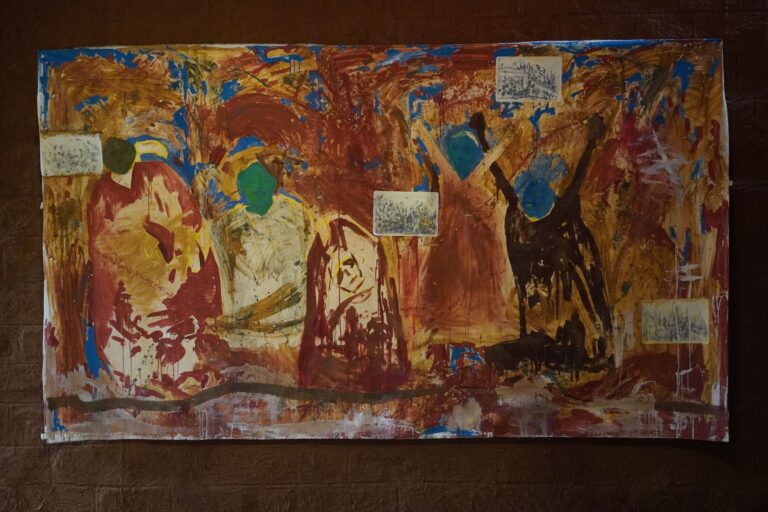
Shown at true size: 63 × 233 cm. A very large work, for a big wall, a lobby or a hall. The person is about 170 cm tall. Every work is shown whole, never cropped.
Rakesh
Grass Line
A thin line of grass holds while black strokes close in
A low fire of yellow grass runs the whole width of the field.
Black strokes come down on it like the arms of machines or crows.
The earth is brick red and rust and old mud after rain.
Above it hangs a torn white sky with one blue gap.
Something is being cleared. Something is still standing.
The grass holds its line a little longer.
The work
Rakesh grew up with mud houses and fields in a village in Madhya Pradesh. Later he lived in an informal settlement in New Delhi. There people repair and rebuild their space again and again. His work begins from this change. Grass Line is long and low. A band of yellow strokes runs across it like dry grass. Heavy black marks sweep over red and brown ground. Rakesh does not try to keep the old place. He asks how a place feels as it turns unfamiliar.
Offices, cafés and hotels can rent works through art on loan, changed every season.
- Theme
- Disappearing rural land
- Material
- Mixed media
- Size
- 63 × 233 cm
- Year
- 2026
- Edition
- -
- Framed
- No
- About the artist
- Sarojini Naidu School Of Arts and Communication, University of Hyderabad
- From
- New Delhi
- Code
- RC-389
In the artist’s words
My practice began with a personal shift in the way I experienced space. Growing up in a village in Madhya Pradesh, I understood places through everyday interactions with mud houses, fields, and the rhythms of rural life. Later, living in an informal settlement in New Delhi exposed me to a very different spatial condition, where space was constantly negotiated, altered, repaired, and rebuilt. Experiencing these contrasting environments made me realize that when places change, they do more than transform physically; they reshape the ways people inhabit, understand, and relate to the world around them. I am interested in the experiences that disappear as environments are continuously transformed through development, ecological…